Biocalmpro Review and Ads Breakdown: A Research-First Look
Somewhere between thirty and fifty million Americans experience tinnitus, the perception of sound, most commonly a ringing or buzzing, that originates not in the environment but in the auditory sy…
8,226+
Videos & Ads
+50-100
Fresh Daily
$29.90
Per Month
Full Access
12.5 TB database · 72+ niches · 24 min read
Introduction
Somewhere between thirty and fifty million Americans experience tinnitus, the perception of sound, most commonly a ringing or buzzing, that originates not in the environment but in the auditory system itself. For most, it is a background inconvenience; for roughly two million of those sufferers, according to the American Tinnitus Association, it is severe enough to interfere with daily functioning, sleep, and mental health. This is a population that has, by the time they encounter a product like Biocalmpro, almost certainly already cycled through a dispiriting sequence of audiologist appointments, white noise machines, prescription medications, and online remedies that delivered nothing. That exhaustion is not incidental to the Biocalmpro pitch, it is the pitch's entire structural foundation.
The VSL (Video Sales Letter) for Biocalmpro is brief by industry standards, running a single tight narrative arc from declared desperation to claimed miracle. What it lacks in length it compensates for in rhetorical efficiency: nearly every sentence performs a specific persuasive function, and the sequencing of those functions follows a well-established direct-response playbook. The product itself, its format, its ingredients, its clinical basis, is almost entirely absent from the script. What the viewer receives instead is a story, and stories, as decades of behavioral research confirm, move people far more reliably than data.
This analysis treats the Biocalmpro VSL as a text worthy of close reading. The goal is not to condemn or endorse the product, but to trace the anatomy of its pitch with enough precision that a prospective buyer, a competing marketer, or a curious researcher can see exactly how the message is constructed, what it implies versus what it proves, and what a reasonable consumer should understand before clicking. The investigation is organized around three central questions: What does Biocalmpro actually claim? How does the VSL's rhetoric function on a psychological level? And how should a skeptical but open-minded reader weigh the gap between promise and evidence?
What Is Biocalmpro?
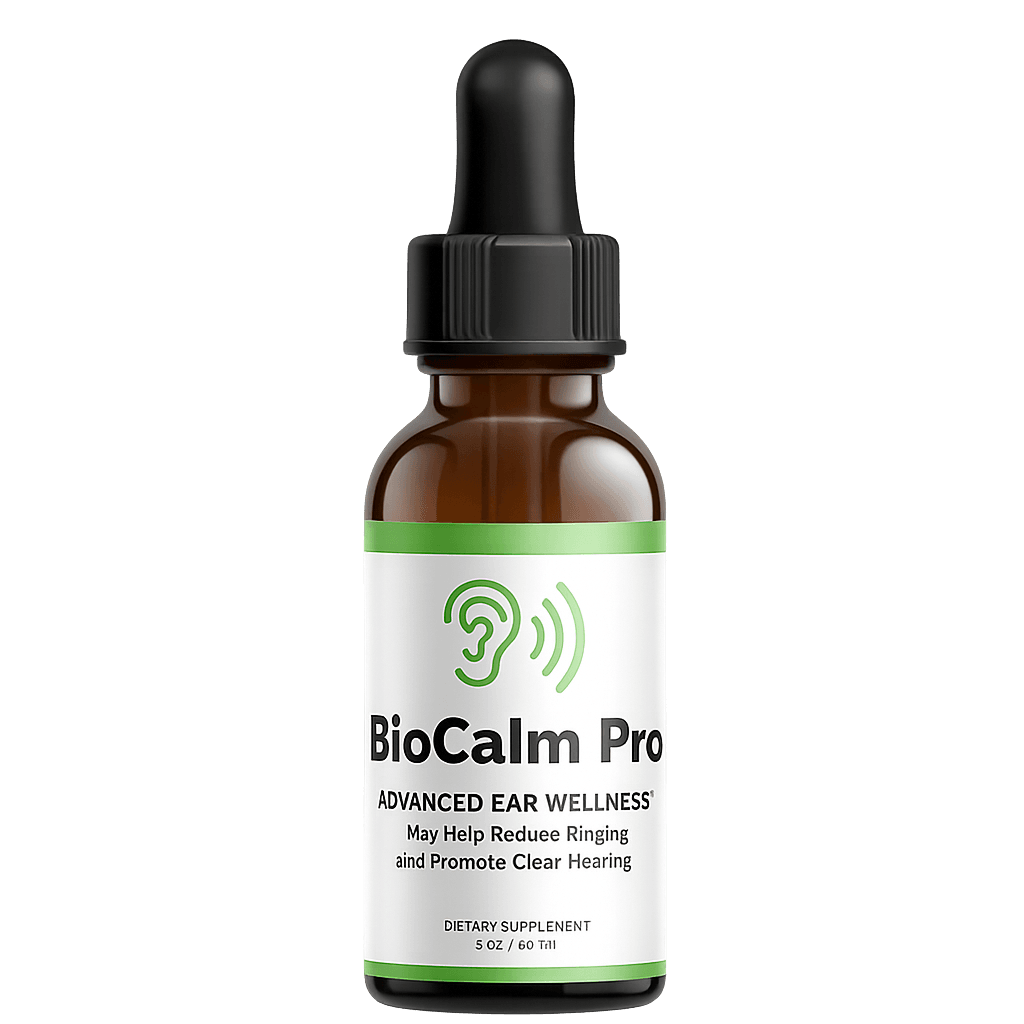
Biocalmpro is a health product positioned specifically for tinnitus sufferers, people who experience a persistent, internally generated sound (ringing, buzzing, hissing, or clicking) with no external source. The VSL does not specify the product's physical format, whether it is a capsule, a liquid drop, a digital program, or a device. Which is itself a notable design choice typical of top-of-funnel VSLs intended to drive clicks rather than close sales directly. The product name, the category (tinnitus relief), and the emotional narrative carry the full weight of the pitch; the mechanics of what the buyer actually receives are deferred to the landing page.
In market positioning terms, Biocalmpro occupies the challenger slot: it is framed explicitly against the medical mainstream, including prescription medications and professional therapies. This is a classic positioning strategy in the direct-to-consumer supplement space, where the product gains identity not through what it contains but through what it defeats. The target user, as constructed by the VSL, is someone who has already tried the conventional path and found it expensive, ineffective, and demoralizing. A person who has, in the language of the script, been failed by the system and is open to something that sounds, on its surface, unconventional.
The broader market context matters here. Tinnitus has no FDA-approved pharmaceutical cure as of this writing; the condition is managed, not resolved, through sound therapy, cognitive behavioral therapy, hearing aids, and lifestyle interventions. This regulatory and clinical gap creates a substantial commercial opening for products that promise what medicine currently cannot deliver, and the supplement category has moved aggressively to fill it.
The Problem It Targets
Tinnitus is among the most prevalent chronic sensory conditions in the industrialized world. The CDC estimates that roughly fifteen percent of the U.S. adult population experiences some form of tinnitus, and global prevalence data published in JAMA Otolaryngology-Head & Neck Surgery places the condition's burden in similar ranges across high-income countries. Unlike many chronic conditions, tinnitus carries a compounding psychological toll: the sound itself is not the only problem. Sleep disruption, anxiety, depression, and social withdrawal are documented comorbidities, each of which amplifies the sufferer's motivation to find relief by any means available. This is the human reality that a well-crafted tinnitus VSL does not fabricate; it simply selects and amplifies it.
The VSL's framing of the problem is economically sophisticated. Rather than dwelling on the neuroscience of tinnitus (a complex and still-contested area involving auditory cortex hyperactivity, cochlear damage, and central sensitization), the script focuses on the social and financial pain of the condition: the cost of medications, the futility of therapies, the exhaustion of a sufferer who has spent real money and received nothing. This is the Problem-Agitate-Solution (PAS) framework operating at its most efficient, the problem is tinnitus, the agitation is the wasted resources and prolonged suffering, and the solution is the unnamed trick the doctor discovered. By centering the financial pain alongside the sensory one, the script simultaneously addresses two loss frames (money already spent, peace not yet found) and doubles the pressure to act.
What the VSL does not engage with is the clinical heterogeneity of tinnitus, the fact that the condition has multiple etiologies (noise-induced hearing loss, age-related hearing loss, medication side effects, vascular issues, neurological conditions) and that no single intervention has demonstrated universal efficacy across those subtypes. A pitch that promises near-immediate relief to anyone suffering from tinnitus is, from an evidence standpoint, making a claim that the published literature cannot support for any currently available product. That gap between the implied universality of the pitch and the actual clinical picture is something prospective buyers should hold in mind.
The commercial opportunity the VSL exploits is real and significant. The global tinnitus treatment market was valued at over one billion dollars annually by multiple market research firms, with the supplement and nutraceutical segment growing fastest as consumers seek options outside the formal healthcare system. The Biocalmpro pitch lands in that current precisely.
Curious how the psychological architecture of this pitch compares to other VSLs in the tinnitus and hearing-health niche? Section 7 maps every tactic to its theoretical source.
How Biocalmpro Works
The VSL's explanation of how Biocalmpro works is, in technical terms, almost entirely absent. The mechanism is described as a "simple trick" learned at an otolaryngology conference, a phrase that performs two simultaneous functions: it implies legitimacy (a professional medical conference is a credible venue) while remaining completely opaque about content (the viewer learns nothing about what the trick actually involves). This is a deliberate rhetorical construction. Direct-response copywriters call it an open loop, a curiosity gap opened by withholding information that the viewer must click to close. The mechanism's secrecy is not an oversight; it is the primary conversion lever.
When the VSL claims the "constant sound in my ear started to decrease" and that relief was "almost immediate," it is invoking the aspirational endpoint without describing the pathway. In the tinnitus research literature, genuine short-term relief has been documented through specific interventions: transcranial magnetic stimulation, acoustic neuromodulation therapy, and certain pharmacological agents have shown measurable effects in controlled trials. However, these interventions are neither simple nor inexpensive, and none currently carries FDA approval as a tinnitus cure. The claim of near-immediate relief from a simple, accessible trick is, charitably, an extrapolation from best-case anecdote; less charitably, it is an overclaim that the available science cannot support.
If Biocalmpro is a dietary supplement, the most common format for products marketed this way, then the plausible mechanisms would involve ingredients that address auditory nerve health, inflammation, blood flow to the inner ear, or neurological factors associated with sound perception. Several such ingredients (discussed in the following section) have genuine research backing at the ingredient level, even if whole-product clinical trials are rare in this category. A skeptical but fair reading acknowledges that plausible ingredient-level mechanisms exist, while noting that the VSL's specific language about immediacy and certainty substantially overstates what those mechanisms are likely to deliver.
The critical evaluative question is the distance between what "a doctor learned at an otolaryngology conference" implies and what is actually inside the product. If the formulation reflects current research on auditory health supplementation, the mechanism claim is at least grounded in plausible science, even if overstated. If the formulation is a generic proprietary blend with no peer-reviewed backing, then the conference framing is pure borrowed authority, a real institution lending unearned credibility to an unsupported claim.
Key Ingredients / Components
Because the VSL transcript does not disclose specific ingredients, the following analysis is based on what the research literature identifies as the most commonly cited and studied components in tinnitus-targeted supplement formulations. The category into which Biocalmpro most likely falls given its marketing positioning. A buyer should verify the actual label against this framework before purchasing.
Zinc. A trace mineral found in high concentrations in the cochlea. Several studies, including a review published in American Journal of Otolaryngology, have noted a correlation between zinc deficiency and tinnitus severity, and supplementation has shown modest benefit in deficient populations. The VSL makes no specific claim about zinc, but it appears in the majority of tinnitus supplements on the market.
Ginkgo Biloba; An herbal extract historically associated with circulatory benefits, including blood flow to peripheral tissues such as the inner ear. Research results are mixed: a large Cochrane Review found insufficient evidence to recommend ginkgo for tinnitus, while smaller trials have reported subjective improvement. It is included in most tinnitus formulations and carries a long history of use in European integrative medicine.
Magnesium, Plays a role in auditory nerve function and has been studied specifically in noise-induced hearing loss contexts. A study published in The American Journal of Otology found that magnesium supplementation reduced noise-induced temporary threshold shifts, suggesting a protective rather than curative mechanism. Its relevance to chronic tinnitus is more indirect.
B Vitamins (B12, B6, Folate), Deficiency in B12 has been associated with auditory dysfunction in several observational studies. The mechanism proposed involves myelin sheath integrity around auditory neurons. Supplementation is low-risk and biologically plausible, though controlled trial evidence in tinnitus populations specifically is limited.
Alpha-Lipoic Acid, An antioxidant that crosses the blood-brain barrier and has been studied for neuroprotective effects. Its theoretical relevance to tinnitus involves oxidative stress reduction in auditory pathways. Evidence is preliminary and largely preclinical.
The pattern across these ingredients is consistent: individually plausible mechanisms, limited large-scale human trial evidence, and a meaningful gap between what the ingredient science suggests and what a VSL pitch implies about results. That pattern is not unique to tinnitus supplements, it characterizes much of the functional supplement market.
Hooks and Ad Angles
The opening line of the Biocalmpro VSL, "My problem with tinnitus was out of control, and what I did to solve it was ridiculous", is constructed with more precision than it appears. The word "ridiculous" does the heaviest lifting: it functions as a pattern interrupt, violating the listener's expectation of a straightforward medical pitch and creating immediate cognitive dissonance. A viewer who expected to hear "I found a great product" instead hears a self-deprecating admission that the solution sounds absurd, which, paradoxically, makes it feel more credible. This is a classic application of what Cialdini identifies as the disarming effect of apparent vulnerability: the speaker who concedes their own skepticism preemptively neutralizes the listener's.
The hook also operates as what Eugene Schwartz, in Breakthrough Advertising (1966), would classify as a stage-four market sophistication move. A stage-one pitch leads with the product claim directly ("Cure your tinnitus now"). By stage four, the audience has seen every tinnitus claim imaginable and trusts none of them. The only move that cuts through is a contrarian frame. Positioning the solution as something that looks wrong, that even the narrator doubted, but that worked anyway. The "ridiculous trick" frame signals to a burned-out audience that this is not another standard pitch, and that signal alone earns the seconds of attention the rest of the VSL needs to function.
The secondary hook. "my doctor told me to throw away all the expensive medications"; deploys borrowed authority while simultaneously attacking the establishment that authority represents. This is a tension that the script navigates without resolving, because resolving it would break the spell: the doctor is credible enough to validate the trick, but the system the doctor operates within is corrupt enough to have kept the trick hidden. That internal contradiction is not examined by the viewer mid-watch; the emotional momentum of the narrative carries them past it.
Secondary hooks observed in the VSL:
- "I thought he was crazy, but I was so desperate I decided to give it a try"
- "The constant sound in my ear started to decrease"
- "I finally managed to sleep through the night in peace"
- "The relief was almost immediate, it felt like a miracle"
- "This could even free you from expensive medications, costly therapies"
Ad headline variations for Meta/YouTube testing:
- "My doctor said throw away the meds and try this. I thought he was insane."
- "The 'ridiculous' tinnitus trick from a medical conference that actually worked"
- "Tinnitus kept me awake for years. This one thing changed everything overnight."
- "Why your expensive tinnitus treatments keep failing, and what a doctor found instead"
- "I was desperate enough to try anything. This is what finally worked."
Psychological Triggers and Persuasion Tactics
The Biocalmpro VSL is structurally lean, under two hundred words, but it compounds its persuasive moves in a way that rewards close analysis. Rather than deploying authority, social proof, and urgency in parallel (the approach of a longer, more methodical VSL), this script stacks them in sequence, each one building the emotional case that the previous move established. The narrator's desperation precedes the doctor's credibility; the doctor's credibility precedes the miracle outcome; the miracle outcome precedes the attack on the failed alternatives; the attack on alternatives precedes the call to action. Each move inherits the emotional energy of the one before it, producing a compounding effect that a longer, more interrupted script might not achieve.
What is particularly sophisticated about the script's architecture is its use of cognitive dissonance (Festinger, 1957) as a setup for conversion. The narrator explicitly states that the solution seemed crazy, and then confirms it worked. A viewer who is themselves skeptical, which any experienced tinnitus sufferer will be, is invited into a moment of identification: "I thought this was crazy too, and I was right to think so, but I was also wrong." That moment of shared rational skepticism, immediately followed by its defeat, softens the defenses precisely because it acknowledges them.
Pattern Interrupt (Cialdini, 2006; Ogilvy tradition): The opening word "ridiculous" disrupts the viewer's autopilot response to a health pitch, buying the attention needed for the narrative to take hold.
Authority Transfer (Cialdini's Authority principle, Influence, 1984): An anonymous doctor citing an otolaryngology conference provides institutional credibility without verifiable credentials, real authority signals without real accountability.
False Enemy Framing (Russell Brunson's DotCom Secrets, 2015): Expensive medications and failed therapies are cast as the collective villain, creating an in-group (sufferers who've been let down) and positioning the product as the out-group escape route.
Open Loop / Curiosity Gap (George Loewenstein, Information Gap Theory, 1994): The "simple trick" is named but never described, compelling the viewer to click to close the informational gap. One of the most reliable conversion mechanisms in digital direct response.
Loss Aversion (Kahneman & Tversky, Prospect Theory, 1979): The script dwells on money already wasted on medications and therapies that failed. Invoking the documented cognitive bias that losses feel roughly twice as painful as equivalent gains feel rewarding.
Emotional Contagion / Miracle Framing (Hatfield et al., Emotional Contagion, 1993): The phrase "it felt like a miracle" is designed to transfer the narrator's emotional relief to the viewer, triggering the hope response in an audience conditioned by chronic disappointment.
Soft Urgency (Direct-response CTA convention): "Click the button below now" adds mild temporal pressure without a hard deadline, avoiding the skepticism that aggressive countdown timers now trigger in sophisticated audiences.
Want to see how these psychological mechanisms compare across fifty or more VSLs in the health supplement space? That's exactly what Intel Services is built to document.
Scientific and Authority Signals
The authority architecture of the Biocalmpro VSL rests on a single, unnamed figure: a doctor who attended an otolaryngology conference. In formal terms, this is what analysts call borrowed authority; the product benefits from the association with a real type of institution (medical conferences are genuine venues of scientific exchange) without the viewer receiving any information that would allow them to verify the claim. No name is given, no conference is named, no year or location is specified, and no specific finding is cited. The reference functions rhetorically rather than evidentially: it tells the viewer that a professional with relevant credentials has endorsed this approach, without providing any of the information that would make that endorsement checkable.
This is a common and legally defensible construct in direct-response health marketing. Because the doctor is unnamed, no specific person is making a medical claim; because the conference is unnamed, no specific institution can distance itself from the association. The ambiguity protects the advertiser while the implication does the persuasive work. A viewer who processes the claim quickly, which is how most viewers process VSL content, will register the authority signal without pausing to note its unverifiability.
The VSL cites no studies, no clinical trials, no peer-reviewed research, and no regulatory approvals. There are no before-and-after data points, no success rates, and no independent third-party assessments. From an E-E-A-T (Experience, Expertise, Authoritativeness, Trustworthiness) standpoint, the script's authority case is thin: it is built entirely on one anonymous anecdotal endorsement within a first-person story. For a buyer researching a health product, this absence should register as meaningful. The tinnitus supplement category has published ingredient-level research available in PubMed-indexed journals; a product confident in its formulation typically finds ways to reference that research, however selectively. The Biocalmpro VSL does not.
What the script does well, from a trust-building standpoint, is emotional authenticity. The narrator's voice is self-deprecating, reluctant, and specific in its description of suffering (sleep disruption, constant sound, desperation). These are the texture of genuine experience, and they land credibly even in the absence of clinical evidence. This is the paradox of testimony-based marketing: it can feel more trustworthy than a citation-heavy pitch precisely because citations can be fabricated or cherry-picked, while emotional specificity reads as lived experience.
The Offer, Pricing, and Risk Reversal
The Biocalmpro VSL is structured as a top-of-funnel click driver rather than a full sales close. No price is stated, no specific guarantee is offered, and no bonus stack is presented within the script itself. These omissions are deliberate: the VSL's only job is to generate a click; pricing, offer structure, and risk reversal are handled on the product landing page, where conversion optimization tools (A/B testing, heatmaps, scroll-depth data) allow more precise tuning than a static video script permits.
The implicit price anchoring, however, is present and active. By repeatedly referencing "expensive medications," "costly therapies," and "treatments that never worked," the script establishes a comparison class against which any price for Biocalmpro will feel favorable. This is contrast principle anchoring (Cialdini, 2006) operating without a specific number: the buyer arrives at the sales page already primed to perceive the product as economical relative to the alternatives they have already tried. If the product lands at thirty-nine to sixty-nine dollars, the typical price range for premium supplement SKUs in this category, the emotional math has already been done before the buyer sees the number.
The risk-reversal architecture visible in the VSL is the testimonial itself. The narrator's story functions as a vicarious guarantee: "it worked for me" implies "it might work for you," which is not a formal money-back promise but a social assurance that carries similar psychological weight for viewers who are already predisposed to believe. Whether the product's actual landing page offers a satisfaction guarantee (common in this category, thirty or sixty-day returns are standard) cannot be determined from the transcript alone, but the absence of that guarantee from the VSL itself is not, by direct-response convention, unusual.
Who This Is For (and Who It Isn't)
The buyer the Biocalmpro VSL is built for is highly specific: an adult, most likely between forty-five and seventy, with chronic tinnitus of sufficient severity to have already spent real money on treatments that failed. This is not a curiosity buyer or a prevention-minded health consumer, it is someone in active distress, who has been in that distress long enough to be both exhausted by it and somewhat desensitized to standard health pitches. The "ridiculous trick" framing is specifically calibrated to reach that buyer, because a straightforward claim would slide past their defenses unchanged. The pitch works, to the extent it works, because it speaks in the register of someone who has been where they are.
Psychographically, the ideal buyer is pragmatic rather than ideological about health: not necessarily opposed to conventional medicine, but disappointed by it in this specific context. They are willing to try something unorthodox because orthodox has failed them. They likely have some digital fluency (they're watching a VSL on a device), but they are not deep researchers, a person who spends three hours reading PubMed abstracts before buying a supplement will find the Biocalmpro VSL's lack of clinical disclosure frustrating rather than intriguing. The pitch is designed for someone who processes at the emotional level first and the analytical level second, if at all.
Readers who should approach with greater caution include those with tinnitus caused by a diagnosed underlying condition (acoustic neuroma, Meniere's disease, cardiovascular issues). In these cases, supplementation is unlikely to address the root cause and medical consultation is non-negotiable. Additionally, buyers who have already tried multiple supplements in this category and found no relief should weight the VSL's "almost immediate" promise against their own experience. The script's brevity and its complete absence of ingredient disclosure make it difficult to assess whether Biocalmpro's formulation differs meaningfully from products already tried. That due diligence, the VSL does not offer. It must come from the buyer.
Comparing Biocalmpro to other tinnitus products in the market? The Final Take section synthesizes what this VSL reveals about where the category is heading and what questions every buyer should bring to any product in this space.
Frequently Asked Questions
Q: What is Biocalmpro and how does it work?
A: Biocalmpro is a health product marketed for tinnitus relief. The VSL does not disclose its specific format or ingredients, describing the mechanism only as a "simple trick" from a medical conference. Based on market positioning, it is most likely a dietary supplement formulated with ingredients associated with auditory health, such as zinc, ginkgo biloba, magnesium, or B vitamins.
Q: Is Biocalmpro a scam?
A: There is insufficient publicly available information to make that determination definitively. The VSL uses well-established direct-response persuasion tactics and makes claims that are not supported by disclosed clinical evidence. Prospective buyers should research the actual ingredient label, look for third-party reviews on independent platforms, and verify any money-back guarantee before purchasing.
Q: Does Biocalmpro really work for tinnitus?
A: The VSL presents one first-person testimonial describing significant relief. No clinical trial data, success rates, or independent research are cited. Some ingredients commonly found in tinnitus supplements have genuine research support at the ingredient level, but no supplement has demonstrated universal, near-immediate tinnitus relief in peer-reviewed trials. Results are likely to vary substantially by individual and by the underlying cause of the tinnitus.
Q: What is the 'simple trick' mentioned in the Biocalmpro video?
A: The trick is never explained within the VSL itself; this is a deliberate open-loop technique designed to drive clicks to the product page. The viewer must click through to discover what the method involves. This is a standard direct-response conversion device, not an oversight.
Q: Are there side effects from taking Biocalmpro?
A: Because the VSL does not disclose ingredients, side effects cannot be assessed from the transcript alone. Common ingredients in tinnitus supplements (zinc, ginkgo, magnesium) are generally well tolerated at standard doses but can interact with certain medications, including blood thinners and antibiotics. Anyone taking prescription medication should consult a physician before adding a supplement.
Q: Is Biocalmpro safe to use?
A: Safety cannot be evaluated without a full ingredient list and dosage information. If you are considering this product, request the supplement facts panel before purchasing and cross-reference it with any medications you currently take. If you are pregnant, nursing, or managing a chronic condition, medical consultation before use is advisable.
Q: How long does it take for Biocalmpro to work?
A: The VSL claims relief that is "almost immediate," which is an unusually aggressive timeline for a dietary supplement. Published research on tinnitus supplements typically measures outcomes over weeks to months, not hours or days. Treat the "almost immediate" claim as aspirational marketing language rather than a clinical benchmark.
Q: Where can I buy Biocalmpro and what does it cost?
A: The VSL directs buyers to click a button to access the purchase page, but no price is stated within the script. Pricing and availability should be verified directly on the official product page, where terms, guarantee details, and dosage instructions should also be present.
Final Take
The Biocalmpro VSL is a technically proficient piece of short-form direct-response copy that accomplishes its narrow objective, generating a click, with considerable efficiency. In under two hundred words, it executes a pattern interrupt, establishes borrowed authority, deploys a false enemy, opens a curiosity loop, and lands an emotional close. These are not accidental choices; they reflect a writer who understands the exhausted tinnitus buyer's psychology and has structured every sentence to move that buyer toward the button. Evaluated purely as persuasion craft, the script is good. Evaluated as a disclosure of product merit, it is nearly empty.
That tension, between rhetorical sophistication and informational scarcity, is not unique to Biocalmpro. It characterizes a substantial segment of the direct-to-consumer supplement market, particularly in conditions like tinnitus where the clinical picture is genuinely complex, consumer desperation is high, and the regulatory framework permits broad claims as long as no specific disease cure is stated. The Biocalmpro script navigates that regulatory line with precision: the word "cure" never appears, the doctor is never named, and the conference is never specified. The implied promise is enormous; the literal claim is almost nothing. That gap is where the legal exposure lives, and where the buyer's risk lives too.
For a prospective buyer, the honest summary is this: the emotional story the VSL tells is real in the sense that tinnitus is a real and miserable condition, and the frustration with failed treatments is entirely legitimate. Whether Biocalmpro's formulation represents a meaningful advance over the tinnitus supplements already on the market cannot be determined from the VSL transcript alone. The absence of ingredient disclosure, clinical backing, and verifiable authority figures should prompt, at minimum, a demand for a full ingredient label and a clear guarantee policy before money changes hands. The pitch is compelling; the evidence behind it is, on current information, thin.
The tinnitus relief supplement market will continue attracting VSLs like this one because the demand is genuine, the clinical gap is real, and the direct-response format is extraordinarily well-suited to connecting desperate buyers with products that, at worst, do nothing and, at best, provide modest relief through plausible mechanisms. The Biocalmpro pitch is a clear window into how that market operates, and reading it carefully is, in itself, a form of consumer protection.
This breakdown is part of Intel Services, our ongoing library of VSL and ad-copy analyses. If you are researching similar products in the tinnitus, hearing health, or supplement space, keep reading.
Disclaimer: This article is for research and educational purposes only. It is not medical, legal, or financial advice, and it is not affiliated with the product or its makers. Always consult a qualified professional before making health or financial decisions.
Comments(0)
No comments yet. Members, start the conversation below.
Related reads
 reviews
Jocko Greens Review: Does One Scoop Match the Evidence?
Jocko Greens is a one-scoop powder with approximately 30 calories and 9 billion colony-forming units of probiotics per serving. Jocko Fuel also confirms ashwagandha extract and makes a digestive-support claim. The harder question is whether the available research matches this specific formula. It does not match closely enough to establish a finished-product outcome.
Read reviews
NooCube Review: Does the 250 mg Bacopa Dose Match the Research?
NooCube is one of the few nootropics that prints a milligram number next to an ingredient instead of hiding it in a blend. This review takes that one number, 250 mg Bacopa monnieri, and checks it against a real trial that used 300 mg in a very different population, then shows exactly where the comparison breaks down.
Read reviews
Olly Goodbye Stress Review: Label Claims vs. Evidence
OLLY Goodbye Stress combines GABA, L-theanine, and lemon balm extract in a Berry Verbena gummy aimed at occasional stress, not sleep. Here's what the label discloses, what a real L-theanine trial found, and exactly where the evidence stops.
Read