Bronson Vitamin C Pink Salt VSL Analysis
Somewhere between a frustrated morning scroll through Instagram and a podcast clip allegedly recorded in February 2025, a very specific kind of consumer, tired, having already tried and failed, an…
8,226+
Videos & Ads
+50-100
Fresh Daily
$29.90
Per Month
Full Access
12.5 TB database · 72+ niches · 27 min read
Introduction
Somewhere between a frustrated morning scroll through Instagram and a podcast clip allegedly recorded in February 2025, a very specific kind of consumer, tired, having already tried and failed, and primed to believe the problem was never their fault, is handed a story designed precisely for them. The ad opens with a disarmingly ordinary confession: a woman who tried every viral pink salt recipe she could find and lost nothing. Not a single pound in two months. It is a hook calibrated not to surprise but to recognize, to make the viewer feel, within the first five seconds, that they are watching their own experience played back to them. That feeling of recognition is not accidental. It is the foundational move of a persuasion architecture that runs several layers deep, and understanding those layers is what this analysis sets out to do.
The VSL under examination here is running traffic to Bronson Vitamin C, a supplement brand, using a pink salt weight loss narrative as its entry point. The ad does not lead with the product name, the ingredient list, or a price. It leads with a character, a villain, and a mystery, three elements of classic direct-response storytelling that have been refined over decades of infomercial, email, and social media copy. What makes this particular execution interesting is how it layers celebrity authority, pseudo-scientific specificity, and a conspiratorial "fake versions" frame to manufacture urgency and trust simultaneously.
The pink salt weight loss trend is real in the sense that it genuinely circulates on TikTok, Instagram Reels, and YouTube Shorts, typically as a simple morning drink recipe involving Himalayan pink salt, lemon juice, and water. The trend has no single credible origin point in the clinical literature, which is precisely why it is a fertile ground for the kind of "real versus fake" narrative this VSL constructs. When a trend lacks an authoritative canonical source, the first marketer to provide one, even a manufactured one, captures the trust vacuum. That is the strategic position this ad is trying to occupy.
The central question this piece investigates is straightforward: how does this VSL use the mechanics of modern social media persuasion to move a viewer from skeptical failure to motivated action, and how do its scientific and authority claims hold up under scrutiny? The answers matter both for researchers studying conversion-optimized health advertising and for consumers who encountered this ad and are now deciding whether to click.
What Is Bronson Vitamin C?
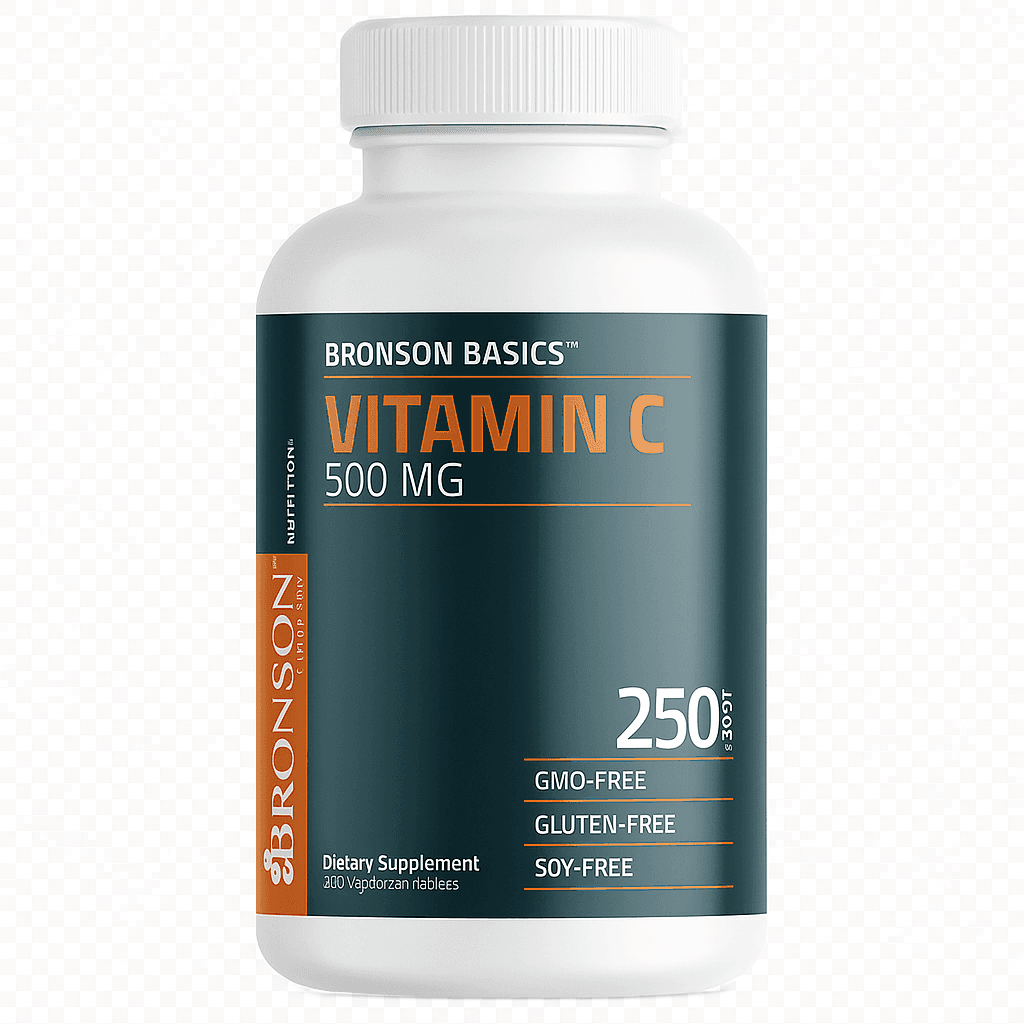
Bronson Vitamin C is a dietary supplement sold by Bronson Vitamins, a U.S.-based supplement brand with a reasonably long history in the vitamins and minerals retail category. The brand markets a range of standard nutritional supplements, vitamins, minerals, herbal extracts. Typically positioned around quality manufacturing and value pricing. Vitamin C, in its various forms (ascorbic acid, sodium ascorbate, buffered formulations), is among the most commoditized supplements on the market, which creates an immediate positioning challenge: in a category where every drug store carries a $6 alternative, differentiation must come from narrative rather than ingredient novelty.
What is structurally unusual about this VSL is that the product itself. A vitamin C supplement; is almost entirely absent from the pitch. The ad is built around a pink salt morning drink ritual, a framework that has no obvious direct connection to vitamin C supplementation. This suggests the VSL is functioning as a category entry point advertisement: its job is not to explain what Bronson Vitamin C does, but to intercept a consumer who is already searching for a pink salt weight loss solution and redirect that intent toward a purchase. The viewer who clicks "Learn More" is presumably taken to a landing page that bridges the pink salt narrative to the vitamin C product, perhaps by positioning vitamin C as the "real" active ingredient behind the recipe, or as a complement to it.
The target user, as constructed by the ad's avatar, is a woman in her 30s to 50s who has been exposed to the pink salt trend on social media, attempted it at least once, seen no results, and is still motivated enough to seek a better explanation. She is not a first-time weight loss seeker; she is a repeat seeker who has accumulated frustration and is particularly receptive to a narrative that explains her past failures without attributing them to her own behavior.
The Problem It Targets
The problem the VSL frames is ostensibly "using the wrong version of the pink salt recipe," but the deeper problem it is actually targeting is something more durable: the experience of being repeatedly failed by social media health trends. This is not a niche frustration. The global weight loss market was valued at approximately $224 billion in 2021 according to Business Research Insights, and a significant driver of that market is the cycle of trial, failure, and renewed search that defines the consumer journey for a large portion of people managing their weight. The CDC reports that approximately 17% of U.S. adults are actively trying to lose weight at any given time, and behavioral research consistently shows that most people attempt multiple methods before finding one they sustain, if they find one at all.
Social media has accelerated and intensified this cycle. Viral health trends, apple cider vinegar shots, celery juice, lemon water, now pink salt, move through TikTok and Instagram with extraordinary speed, generate massive attempted adoption, and then largely fail to produce the results they promise, for the simple reason that none of them are supported by robust clinical evidence as standalone weight loss interventions. The viewer who has tried three versions of the pink salt recipe is not unusual; they are typical of how health information travels and is consumed in 2024-2025.
The VSL frames this systemic problem as a specific, solvable one: the internet is full of "fake versions" created by people chasing engagement metrics, and the solution is access to the "real" recipe from its authoritative source. This reframe is commercially elegant. It converts a diffuse, structural frustration, "social media health trends don't work", into a targeted, actionable one: "you had the wrong recipe, and here is where to get the right one." By doing so, it preserves the viewer's motivation and investment in the pink salt concept while giving them a reason to take one more action. The pivot from systemic failure to solvable mistake is perhaps the single most important rhetorical move in the entire ad.
It is worth noting that Himalayan pink salt's actual evidence base as a weight loss agent is thin. Pink salt differs from standard table salt primarily in trace mineral content and is not associated with clinically significant metabolic effects in peer-reviewed literature. The anti-inflammatory and hormonal claims in the VSL are not supported by mainstream nutritional science at the levels described.
Curious how other VSLs in this niche structure their pitch? Keep reading, Section 7 breaks down the psychology behind every claim above.
How Bronson Vitamin C Works
The VSL's claimed mechanism rests on two pillars: first, that pink salt reduces inflammation in fat cells by up to 73%, citing a 2021 study published on Science Daily; and second, that this inflammation reduction activates "fat-burning hormones" even in the absence of dietary changes or exercise. Both claims deserve careful examination before being accepted or dismissed.
Science Daily is a science news aggregator, not a peer-reviewed journal. When a VSL cites a study "published on Science Daily," it is citing a press release or news summary. The actual research would have appeared in a primary journal such as Nutrients, Obesity, or The Journal of Clinical Endocrinology & Metabolism. No widely cited, peer-reviewed study matching the description of a 73% reduction in fat-cell inflammation attributable specifically to pink salt has been identified in the public literature as of early 2025. The specificity of the figure. 73%, not a range, not approximate; is characteristic of what researchers in persuasion call pseudo-precise authority: a number precise enough to sound like measured data, but with a source that cannot be easily verified by a lay audience.
The second claim, that the recipe activates fat-burning hormones without diet or exercise, is an appeal to a real physiological framework (the role of hormones like leptin, adiponectin, and cortisol in fat metabolism) deployed in a way that overstates what any dietary ingredient can accomplish. Hormonal influences on fat metabolism are genuine and extensively studied; the claim that a morning salt drink meaningfully shifts this hormonal environment in a way that produces visible weight loss within a week is speculative extrapolation at best. The human endocrine system does not respond to single-ingredient interventions with the speed or magnitude the VSL implies.
What the mechanism section of this VSL actually accomplishes, analytically, is the construction of a plausibility scaffold, a chain of references that each carry some legitimacy (real doctor, real concept of inflammation, real metabolic hormones) assembled in a sequence that implies scientific rigor without delivering it. A viewer without a biochemistry background has no easy way to evaluate the chain and is likely to accept it as credible because each link gestures toward something real.
Key Ingredients and Components
The VSL is notably vague about the actual ingredients in the "correct" recipe, mentioning pink salt by name and gesturing toward "a few simple ingredients" without specifying them. This vagueness is itself a persuasion mechanism, it creates an information gap that can only be closed by clicking through. Based on the typical formulation of pink salt weight loss drinks circulating in this trend cycle, and the product being advertised (Bronson Vitamin C), the likely components include the following:
Himalayan Pink Salt, A mineral-rich salt mined primarily in Pakistan, containing trace amounts of iron, potassium, calcium, and magnesium alongside sodium chloride. The VSL claims it reduces fat-cell inflammation by 73% and activates fat-burning hormones. Independent nutritional research supports pink salt as a source of trace minerals but does not support the specific metabolic claims made here. The Mayo Clinic notes no significant health advantages of pink salt over regular iodized salt at typical dietary doses.
Vitamin C (Ascorbic Acid), The actual product being sold. Vitamin C is a well-established antioxidant with roles in immune function, collagen synthesis, and the reduction of oxidative stress. There is legitimate research suggesting that adequate vitamin C status correlates with lower body mass index in some population studies, a 2006 study by Johnston et al. in the Journal of the American College of Nutrition found that individuals with adequate vitamin C oxidized 30% more fat during moderate exercise than those who were vitamin C-deficient. However, the jump from this correlation to "activates fat-burning hormones" is a significant overreach.
Lemon Juice. Mentioned as one of the failed versions the narrator tried, but likely present in the "real" recipe as well. Contains vitamin C and citric acid. Some evidence supports lemon polyphenols in attenuating weight gain in animal models (Fukuchi et al., Journal of Clinical Biochemistry and Nutrition, 2008), but human clinical trials are limited.
Apple Cider Vinegar. Also mentioned as a tested variation. ACV has a modest but real evidence base for appetite suppression and modest glycemic response reduction, reviewed in Journal of Functional Foods (Johnston & Buller, 2005), though effects on actual weight loss are small and not consistently replicated.
Hooks and Ad Angles
The opening line; "I tried several versions of the pink salt recipe I found online and didn't lose a single pound", functions as what Robert Cialdini would call a pattern interrupt: it disrupts the viewer's expectation of a product pitch and substitutes a peer confession, a move that dramatically lowers the initial persuasion guard. The viewer expecting to be sold something is instead watching someone who failed, just as they may have failed, and that mirroring effect generates the psychological safety needed to keep watching. This is not a new technique, it has roots in the testimonial-first infomercial format of the 1980s, but its deployment in a short-form social video context is well-adapted to the platform, where the first three seconds determine whether the viewer scrolls past.
What elevates this hook beyond a simple testimonial opener is its immediate specificity: two months, every version, every platform. The density of failed attempts establishes the narrator as a thorough, not gullible, seeker, someone whose failure is not due to laziness but to the systemic deception of bad information. This is a classic Eugene Schwartz market-sophistication Stage 4 or 5 move, aimed at an audience that has already seen and tried every direct pitch and is now only persuadable through a new mechanism or a new villain. The villain here, the fake recipe creators chasing likes, is a believable, contemporary, and emotionally satisfying target for the viewer's accumulated frustration.
The secondary hooks work in concentric circles around the central open loop:
- "The real pink salt trick was created by an actual doctor", authority gap
- "The exact same one he gave to Rebel Wilson, who lost over 40 pounds in just six weeks". Celebrity social proof with quantified result
- "A 2021 study revealed pink salt reduces inflammation in fat cells by up to 73%". Scientific specificity hook
- "Activates fat-burning hormones even without diet or exercise"; the "no sacrifice required" desire-based hook
- "The one mistake 9 out of 10 people make", scarcity-of-knowledge hook with implied insider access
For a media buyer testing on Meta or YouTube, the following headline variations represent the ad angles most likely to generate click-through against this audience:
- "The pink salt recipe you've been using is the fake version, here's the original"
- "Why 9 out of 10 women see zero results from the pink salt trick (and the fix that works this week)"
- "Rebel Wilson's actual recipe: 40 lbs in 6 weeks, and it's not what you've seen on TikTok"
- "Stop blaming yourself. The recipe you tried was designed to fail."
- "A doctor's study shows 73% less fat-cell inflammation, but only with the right ingredients"
Psychological Triggers and Persuasion Tactics
The persuasive architecture of this VSL is not a collection of independent tactics applied in sequence, it is a stacked, compounding structure in which each layer reinforces the next. The ad opens with identity absolution ("it wasn't me"), which lowers shame and reopens motivation; it then builds authority through celebrity-doctor association, which gives the viewer a credible figure to trust; it deploys pseudo-scientific specificity to harden that trust into conviction; and it closes with open loops and urgency to convert conviction into action. This is a textbook Problem-Agitate-Solution structure, but executed with the social media fluency of a creator-style ad rather than the declarative authority of a traditional direct-response letter.
What is particularly sophisticated is the way the VSL uses the narrator's own past failure as a credibility asset rather than a liability. In most sales contexts, failure undermines trust. Here, the narrator's two months of failed attempts actually functions as proof of thoroughness, she is not someone who tried once and gave up, she is someone who tried everything, which makes her eventual discovery of the "real" recipe feel earned and reportable rather than convenient.
Identity Absolution, Drawn from Leon Festinger's cognitive dissonance theory (1957) and popularized in direct response copy by Frank Kern's "it's not your fault" frame. The line "the truth is it wasn't me" is deployed at the exact moment the viewer's shame might cause them to dismiss the ad as another failed solution. By removing personal culpability, the VSL keeps the viewer emotionally available for the solution pitch.
False Enemy / Villain Construction. Russell Brunson's StoryBrand-adjacent framework, reinforced by Donald Miller's brand narrative model. Fake recipe creators are named as the villain with real motivations (likes, shares, money), making the antagonist believable and contemporary. A villain the viewer can recognize from their own social media experience is far more persuasive than an abstract pharmaceutical conspiracy.
Authority Transfer via Celebrity Proxy. Cialdini's Authority principle compounded with his Social Proof principle. Dr. Gundry's credibility is established first through his medical title, then amplified by naming Gwyneth Paltrow as a patient, then activated by attaching Rebel Wilson's quantified result. Each name borrows social capital from the one before it.
Pseudo-Precise Social Proof; Cialdini's Social Proof combined with what behavioral economists call the concreteness effect (Reyna & Brainerd, 2008). "Over 40 pounds in just six weeks" is a number precise enough to feel like reported data. Forty pounds in six weeks is roughly 6.6 pounds per week, well outside the range of medically expected healthy weight loss (1-2 pounds per week per NIH guidelines), but the specificity of the figure suppresses that skepticism in most viewers.
Curiosity Gap / Multiple Open Loops, George Loewenstein's information gap theory (1994). The ad opens at least four distinct loops, the real recipe, the fat-burning hormone mechanism, the one mistake, and the "changes in your clothes this week" promise, and closes none of them within the ad itself. Each unclosed loop is a thread pulling the viewer toward the click.
Loss Aversion Reframe, Kahneman and Tversky's Prospect Theory (1979). "Watch this video before giving up" reframes the click not as a purchase decision but as a loss-prevention decision: the cost of not clicking is framed as abandoning something that actually works, leveraging loss aversion to drive action more powerfully than any positive benefit claim could.
Temporal Urgency without Artificial Scarcity, Rather than a countdown timer or "limited stock" device, this VSL uses biological urgency: "see changes in your clothes as soon as this week." The urgency is tied to the viewer's own desire timeline rather than an artificial constraint, which feels less manipulative and more motivating to a sophisticated buyer who has been burned by fake scarcity before.
Want to see how these tactics compare across 50+ VSLs? That's exactly what Intel Services is built to show you.
Scientific and Authority Signals
The VSL's authority architecture centers on Dr. Gundry, who is described as an "endocrinologist" featured on TV shows and the personal physician of major Hollywood celebrities. It is worth being precise here: Dr. Steven Gundry is a real person, a cardiothoracic surgeon and author who founded the Center for Restorative Medicine and has written several popular books including The Plant Paradox. His actual specialty is cardiac surgery and he is associated with controversial dietary claims about lectins; he is not primarily identified as an endocrinologist in his public credentials, though he does discuss metabolic and endocrine topics in his content. The VSL's description of his specialty appears to be an enhancement, "endocrinologist" carries more direct metabolic authority than "cardiac surgeon" for a weight loss claim, and the modification, whether intentional or sloppy, functions to increase perceived relevance.
The claim that Gundry is "the personal doctor of major Hollywood celebrities including Gwyneth Paltrow" represents what might be called borrowed authority. Using a real person's public association with another real person to manufacture a trust chain that neither has explicitly endorsed. Gwyneth Paltrow is publicly associated with wellness content and has appeared in conversations adjacent to Gundry's work, but the specific claim of a physician-patient relationship is unverifiable from public sources and potentially fabricated. Similarly, the Rebel Wilson weight loss attribution is not corroborated by any publicly available statement from Wilson herself that names pink salt or Gundry as factors in her well-documented 2020-2021 weight loss, which she has attributed to her "Year of Health" program and work with a personal trainer.
The 2021 Science Daily study claiming a 73% reduction in fat-cell inflammation from pink salt is the most important scientific claim in the VSL and the one that most demands scrutiny. Science Daily, as noted earlier, is a press release aggregator. It is not a journal, and a study is not "published on" Science Daily in any meaningful scientific sense. No peer-reviewed study matching this specific claim and this specific magnitude has been independently identified. The use of a precise percentage from an unverifiable source is a well-documented tactic in health marketing; precise numbers read as data even when they cannot be traced to a primary source. This particular claim should be treated as unverified and potentially fabricated until a primary citation is produced.
The February 2025 podcast reference adds a layer of recency authority, it positions the recipe as newly revealed, not widely known, and available only to those who know where to look, which dovetails precisely with the "fake versions" narrative. The combination of a named doctor, a specific date, and a celebrity patient creates a triangulated authority structure that is difficult for a lay viewer to quickly dismantle, even though each element ranges from partially accurate to unverifiable.
The Offer, Pricing, and Risk Reversal
This VSL is structured as a top-of-funnel awareness and click-through ad rather than a complete sales letter, which means the full offer mechanics, pricing, bonuses, guarantee, are not disclosed within the transcript. The call to action is simply "Tap 'Learn More,'" which routes the viewer to a landing page where the actual offer is presumably revealed. This is a deliberate two-step structure: the VSL's job is to generate qualified clicks from people who are already motivated by the pink salt narrative; the landing page's job is to convert that motivation into a purchase.
Within the VSL itself, the closest thing to an offer structure is the promise of three specific pieces of information withheld until the viewer clicks: the correct recipe, the one preparation mistake to avoid, and the mechanism behind the fat-burning hormone activation. These function as information bonuses, zero-cost value promises that make clicking feel like receiving something rather than being sold something. This is a classic reciprocity setup (Cialdini, 1984): by framing the click as access to free, exclusive information, the VSL reduces the perceived risk of engagement and increases the likelihood the viewer arrives at the landing page in a receptive rather than defensive state.
The absence of explicit price anchoring or a money-back guarantee in the VSL is consistent with platform advertising norms, Meta and YouTube ads that lead with price or guarantee language often underperform against ads that lead with narrative and curiosity. The risk reversal and value stacking are presumably handled at the landing page level, where the viewer's intent is already qualified.
Who This Is For (and Who It Isn't)
The viewer this VSL is built for is a woman, most likely between 35 and 60, who has tried the pink salt trend at least once after seeing it on social media, saw no meaningful results, and has not yet abandoned the idea that the concept might work if done correctly. She is not a first-time weight loss product buyer, she has a history with the category and a corresponding history of disappointment. She is, however, still motivated: she watched the full two minutes of an ad, which means her desire has not collapsed into cynicism. Psychographically, she is trusting of medical authority (a doctor's name opens her up), responsive to celebrity social proof (Rebel Wilson's name registers as relatable rather than aspirational), and frustrated enough by misinformation that the "fake versions" framing lands as validation rather than manipulation. She likely spends meaningful time on Instagram or Facebook, engages with wellness content, and has a moderate disposable income.
This product and pitch are probably not the right fit for several other reader profiles. A consumer with a background in nutrition science or biochemistry will immediately recognize the gap between the cited mechanism and the actual evidence base, and the pseudo-precise statistics will register as red flags rather than credibility signals. A consumer who is genuinely skeptical of supplement marketing, who has already been burned by multiple products with clinical-sounding claims. Is likely to find the Rebel Wilson attribution and the unverifiable study reference more suspicious than persuasive. And a consumer whose primary weight loss goal requires medical supervision (anyone managing obesity at a clinical level, or anyone with metabolic conditions like Type 2 diabetes or thyroid disease) should engage with this category only in consultation with a physician, not on the basis of a social media ad.
If you're evaluating this kind of health advertising for the first time, the FAQ section below addresses the most common questions people search before deciding whether to purchase.
Frequently Asked Questions
Q: Is the Bronson Vitamin C pink salt recipe a scam?
A: The pink salt trend itself is a real social media phenomenon, but the specific scientific claims in this VSL. Including the 73% fat-cell inflammation reduction; cannot be traced to a verifiable peer-reviewed source. The product being sold, Bronson Vitamin C, is a legitimate supplement brand, but the advertising narrative uses unverified authority claims. Cautious consumers should request the primary source of any cited study before purchasing.
Q: Does the Dr. Gundry pink salt recipe really work for weight loss?
A: Dr. Steven Gundry is a real physician and author, but no publicly documented pink salt weight loss protocol associated with him has been independently verified in peer-reviewed literature. Pink salt itself has no clinically established fat-burning properties beyond those of regular dietary salt. Results attributed to the recipe in this ad (including Rebel Wilson's weight loss) are not corroborated by primary sources.
Q: What are the ingredients in the real pink salt weight loss recipe?
A: The VSL deliberately withholds the full ingredient list, requiring a click-through to access it. Based on common formulations in this trend category, the recipe likely includes Himalayan pink salt, lemon juice, water, and possibly apple cider vinegar, with Bronson Vitamin C potentially positioned as an additional component on the landing page.
Q: Is it safe to drink pink salt water every day?
A: For most healthy adults, a small amount of pink salt dissolved in water is unlikely to cause harm, and is broadly similar to regular salt in its physiological effects. However, individuals with hypertension, kidney disease, or heart conditions should consult a physician before adding any sodium-containing drink to their daily routine. "Safe" and "effective for weight loss" are different questions, the former is probably yes for most people at low doses; the latter is unsupported by clinical evidence.
Q: Did Rebel Wilson really lose weight using a pink salt recipe?
A: Rebel Wilson's well-documented weight loss (approximately 80 pounds over 2020-2021) has been publicly attributed by Wilson herself to a structured fitness program and dietary changes she described as part of her "Year of Health." No statement from Wilson naming a pink salt recipe or Dr. Gundry as contributing factors has been identified in public sources. The attribution in this VSL appears to be unsupported.
Q: What are the side effects of using this pink salt drink?
A: Himalayan pink salt in large quantities carries the same risks as any high-sodium intake: elevated blood pressure, water retention, and increased cardiovascular strain over time. Vitamin C at high supplemental doses (above 2,000 mg/day) can cause gastrointestinal distress in some individuals. The recipe as described in the VSL does not specify quantities, which makes it difficult to assess dosage-related risk. Starting with small amounts and monitoring response is reasonable.
Q: Why didn't the pink salt recipe I found on social media work?
A: The most straightforward answer is that pink salt does not have clinically demonstrated fat-burning properties regardless of the recipe version. The VSL's explanation, that social media versions are "fake" while the doctor's version is "real", is a persuasive narrative device, not a scientific distinction. The differences between recipe versions (lemon vs. no lemon, vinegar vs. no vinegar) are unlikely to produce meaningfully different metabolic outcomes.
Q: What is the 2021 Science Daily study cited in the VSL?
A: Science Daily is a press release aggregator, not a peer-reviewed journal. A study claiming 73% reduction in fat-cell inflammation specifically attributable to pink salt has not been independently located in the primary scientific literature. Consumers should request the original journal citation, author, journal name, DOI, before treating this figure as established science.
Final Take
This VSL is a technically accomplished piece of conversion-oriented advertising that deserves to be read as a document about the state of health marketing in the social media era, not just as a pitch for a vitamin supplement. Its most instructive quality is not the celebrity name-drop or the unverifiable study, those are standard tools in the direct-response playbook. But the sophistication of its audience diagnosis. The creative team understood that their viewer has already been burned, is carrying both hope and frustration, and will not respond to a simple product claim. The entire ad is structured around that insight: give the burned buyer a villain to blame, a credible authority to trust, and a specific promise of success that their previous attempts simply didn't have access to. That is not a cynical formula. It is a precise reading of where their audience is psychologically, and executing against it effectively is real marketing craft, whatever one thinks of the underlying claims.
The weakest elements of the VSL are its scientific assertions, which rest on a foundation that does not withstand verification. The 73% inflammation figure, the fat-burning hormone mechanism, and the Rebel Wilson attribution are the three pillars of the persuasive case, and all three are either unverifiable or contradicted by publicly available information. For a consumer who investigates any of them; who searches for the Science Daily study, who checks Wilson's own statements about her weight loss, who looks up Dr. Gundry's actual specialty, the ad's credibility collapses quickly. The pitch is calibrated for a viewer who does not investigate, and that is both its commercial logic and its ethical limitation.
For researchers studying digital health advertising, what this VSL illustrates most clearly is how the "real versus fake" narrative frame has become a dominant structure in the post-viral-trend marketing cycle. Once a health trend (ACV, collagen, intermittent fasting, pink salt) achieves sufficient social penetration that most potential buyers have already tried and failed with it, the highest-performing ad angle is not to introduce the trend but to position the product as the authentic, expert-endorsed version of what the viewer was already attempting. This is a market-sophistication response to audience saturation, and it will continue to appear as long as health trends cycle through social media and leave behind large audiences of motivated but frustrated former believers.
If you are actively researching this product before buying, the most honest summary is this: Bronson Vitamin C is a real supplement from a legitimate brand, and vitamin C has genuine, evidence-supported health benefits. Whether those benefits extend to the specific weight loss mechanism described in this VSL is a different matter entirely, and the distance between those two statements is where careful consumers should focus their attention. This breakdown is part of Intel Services, our ongoing library of VSL and ad-copy analyses. If you're researching similar products in the health and wellness space, keep reading.
Disclaimer: This article is for research and educational purposes only. It is not medical, legal, or financial advice, and it is not affiliated with the product or its makers. Always consult a qualified professional before making health or financial decisions.
Comments(0)
No comments yet. Members, start the conversation below.
Related reads
- DISreviews
Zepburn Drops Review and Ads Breakdown
Zepburn Drops is promoted in the provided VSL as a weight-loss supplement offer built around a simple pink salt approach. The presentation’s core promise is direct: try a quick pink salt routine be…
Read  reviews
Olly Goodbye Stress Review: Label Claims vs. Evidence
OLLY Goodbye Stress combines GABA, L-theanine, and lemon balm extract in a Berry Verbena gummy aimed at occasional stress, not sleep. Here's what the label discloses, what a real L-theanine trial found, and exactly where the evidence stops.
Read reviews
Kaged Pre-Kaged Sport Review: Does the Citrulline Study Fit?
Kaged Pre-Kaged Sport provides 3.5 grams of fermented L-citrulline in each 13-gram scoop. The supplied trial tested a higher dose of isolated L-citrulline and found no performance benefit, so it cannot prove whether this finished formula works.
Read