Nervefrost Review and Ads Breakdown
This Nervefrost review is based only on the provided VSL transcript. That matters because the presentation makes unusually strong claims about neuropathy, burning feet, tingling, numbness, electric…
8,226+
Videos & Ads
+50-100
Fresh Daily
$29.90
Per Month
Full Access
12.5 TB database · 72+ niches · 20 min read
This Nervefrost review is based only on the provided VSL transcript. That matters because the presentation makes unusually strong claims about neuropathy, burning feet, tingling, numbness, electric shocks, and a so-called yellow ice trick linked to Iceland. The purpose here is not to verify those claims independently or endorse the product. It is to analyze what the sales video actually says, how it positions the offer, what evidence it presents, what it leaves unclear, and which direct-response tactics are used to move a viewer toward action.
The central idea of the VSL is simple and dramatic: the narrator claims that a yellow ice trick relieved his neuropathy symptoms in 60 seconds, helped his tingling fade in three days, and made years of neuropathy disappear in 12 days. He says this method can be replicated at home and frames it as a natural alternative to medications such as gabapentin and pregabalin, compression socks, massage, vibration platforms, vitamins, physical therapy, acupuncture, and other approaches he says failed him.
The emotional promise is even bigger than pain relief. According to the presentation, the viewer is not just chasing comfort. They are trying to protect their ability to walk, sleep, feel their feet, use their hands, avoid falls, preserve dignity, and escape a future of canes, walkers, wheelchairs, or amputation. The VSL repeatedly presents neuropathy as a threat to identity and independence, then introduces Nervefrost through the larger story of the yellow ice trick as the route back to control.
A careful reading also shows major gaps. The transcript does not provide a complete Nervefrost ingredient list. It does not disclose a price. It does not mention a guarantee. It does not include named customer testimonials. It references major institutions, news outlets, a 20-year-old preliminary study, the National Institutes of Health, and more than 100 clinical studies, but the provided transcript does not identify those studies by title, journal, author, date, or link. So the right editorial posture is cautious: the VSL is rich in claims and persuasion, but thin on verifiable specifics inside the transcript itself.
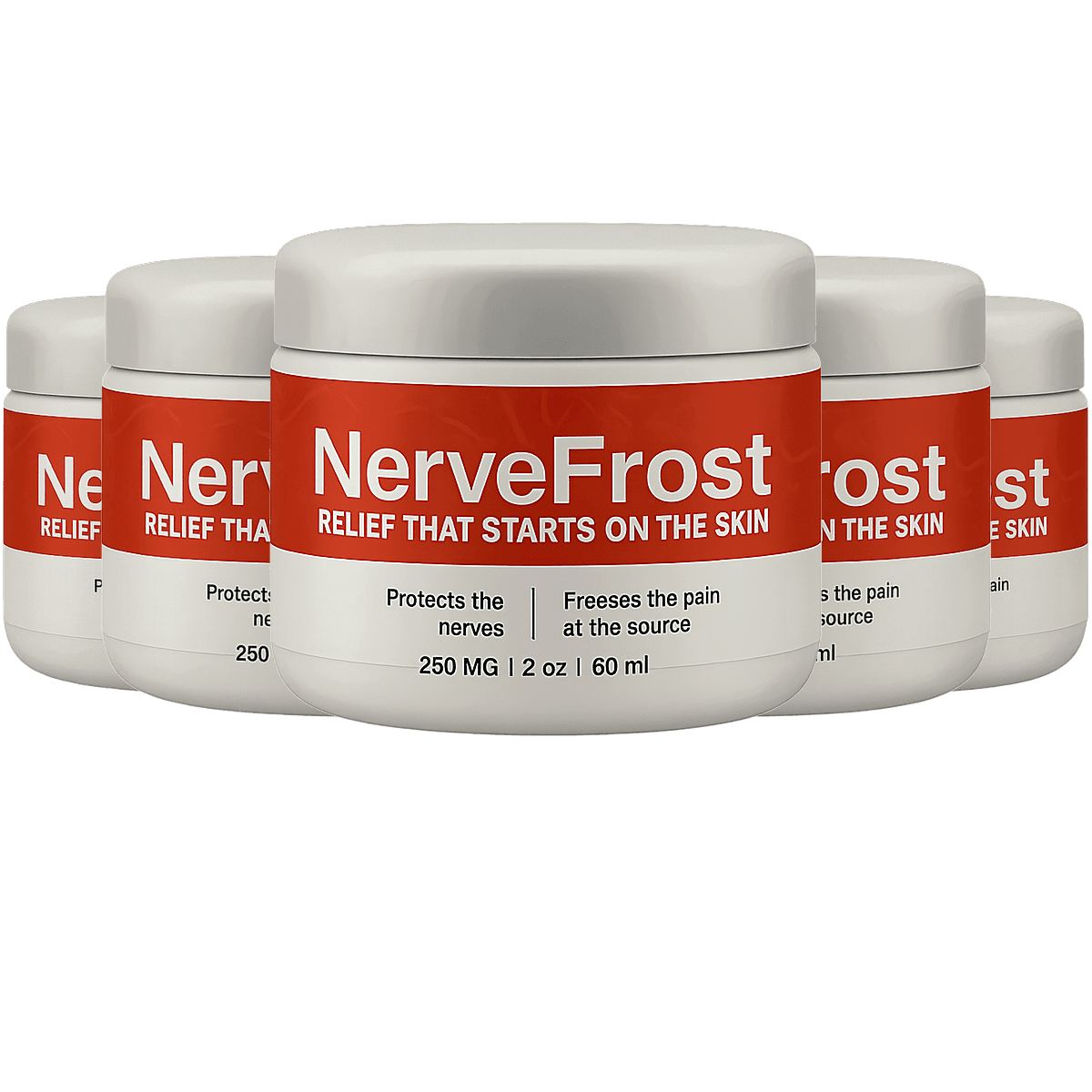
What Is Nervefrost
Based on the transcript, Nervefrost is a nerve-focused health offer promoted through a direct-response VSL built around neuropathy symptoms and a natural discovery story. The product’s exact physical form is not disclosed in the provided transcript. It may be a supplement, topical, protocol, or another format, but the transcript itself does not give enough information to say that confidently.
What the transcript does clearly establish is the offer’s positioning. Nervefrost sits in the nerve discomfort and neuropathy symptom category. It targets people dealing with burning pain in the feet, numbness, tingling, electric shocks, poor sleep, and fear that their body is losing strength. The VSL is written for an older audience, especially people “past 50,” who have already tried common interventions and feel disappointed by them.
The presentation’s main concept is the yellow ice trick. The narrator says it is a simple at-home method connected to a frozen yellow fruit consumed in Iceland. Later in the VSL, that fruit is named as yellow hippophae. The claim is that when consumed frozen, this fruit can affect the underlying cause of neuropathy rather than merely dulling pain. The transcript says this is not magic but “neural biochemistry,” although the provided section does not give enough technical detail to independently evaluate the mechanism.
The VSL also positions Nervefrost against mainstream approaches. It says medications like gabapentin, pregabalin, and amitriptyline only numb the impact of pain for a few hours. It says compression socks may help circulation and swelling but do not address nerve pain. It says massage and vibration platforms may create short-term relaxation but can worsen nerve hypersensitivity for many neuropathy sufferers. These are claims made by the presentation and should not be treated as medical guidance.
From a marketing standpoint, Nervefrost is not introduced as a modest nerve-support product. It is framed as a disruptive solution that conventional medicine missed, dismissed, or ignored. The VSL uses phrases like “Forbidden Cure for Nerve Pain”, “Big Pharma”, “corrosive enzyme”, and “nerve regeneration” to make the offer feel like a suppressed breakthrough rather than another supplement.
The Problem It Targets
The VSL targets the lived experience of neuropathy symptoms, especially when those symptoms affect the feet, hands, sleep, and mobility. The opening focuses on “numbness,” “tingling,” and “unbearable burning pain” in the feet. The narrator says the pain kept him from sleeping at night, creating an immediate connection with viewers who may be awake, uncomfortable, and searching for relief.
The transcript repeatedly uses vivid sensory language. Neuropathy is described as feeling like walking on shards of glass, walking on hot coals, or being shocked by a live wire. Tingling is compared to termites devouring the hands. Nerves are described as exposed wires inside an electrical grid. These images are not clinical explanations; they are emotional translation devices. The VSL wants the viewer to feel seen before it asks them to believe the mechanism.
The secondary problem is failed treatment fatigue. The narrator says he tried “everything,” including gabapentin, pregabalin, compression socks, physical therapy, massages, vitamins, natural supplements, drops, pills, diets, acupuncture, and Tai Chi. The script is written for viewers who recognize that list because they have already moved from one option to another without lasting satisfaction.
The third problem is fear of progression. The VSL claims that many Americans only realize they have a serious problem after losing more than 40% of nerve function, attributing this to the National Institutes of Health. It warns that tingling and numbness mean nerves are already deteriorating and links inaction to chronic pain, progressive disability, and amputation. The transcript does not provide the underlying NIH citation, so this should be treated as a cited claim inside the presentation, not a verified statistic.
The fourth problem is loss of identity. The narrator is not merely a patient; he says he was a high-status doctor involved in complex surgeries. In the story, neuropathy costs him his hands, career, license, marriage, and self-respect. That is the emotional arc the VSL wants viewers to project onto themselves: if neuropathy can destroy a successful doctor, it can destroy anyone’s independence.
How Nervefrost Works
According to the presentation, the key mechanism behind Nervefrost is not circulation, age, diabetes, or genetics. The VSL claims neuropathy pain is caused by a silent corrosive enzyme that slowly damages the protective layer around nerves. That protective layer is identified as the myelin sheath, compared to the plastic coating around electrical wires.
The script says that when this protective covering is damaged, nerves become exposed and vulnerable, creating an “internal short circuit” that turns into burning, tingling, numbness, and electric-shock sensations. This analogy is central to the VSL. It gives the viewer a simple mental model: your nerves are wires, the myelin sheath is insulation, and the hidden enzyme is corroding that insulation.
The VSL claims the yellow ice trick works because yellow hippophae, when frozen, acts on this enzyme and supports nerve recovery. The narrator says it does not merely turn off the pain alarm like medications. Instead, he claims it attacks the “root cause” traditional medicine ignores. He also claims it can stimulate nerve regeneration.
Those are major health claims, and they require caution. The provided transcript does not name the enzyme. It does not show clinical trial data. It does not identify the dose of yellow hippophae. It does not explain whether Nervefrost contains hippophae, an extract, a frozen preparation, or something else. It also does not provide a supplement facts panel. So the mechanism is best understood as the VSL’s claimed mechanism, not a verified explanation.
The presentation also uses contrast to make the mechanism feel stronger. Medications are described as turning off a fire alarm while the house is still burning. Compression socks are dismissed because neuropathy is framed as a nerve problem rather than a circulation problem. Massage and vibration are described as short-term relief that may increase hypersensitivity. Against that backdrop, Nervefrost is framed as the only approach in the story that addresses the alleged underlying nerve damage.
Key Ingredients and Components
The provided transcript does not disclose a complete Nervefrost ingredients list. That is one of the most important findings in this review. The only named natural component is yellow hippophae, described as a golden fruit consumed frozen by people in a region of Iceland.
The VSL says Icelanders consume yellow hippophae first thing in the morning and that they are used to eating frozen fruits. The narrator claims that when Marcus and his team studied this habit, they noticed something remarkable: yellow hippophae, when consumed frozen, could “naturally outperform” the beneficial effects of synthetic drugs like gabapentin by up to 16 times. That is a very strong claim, but the transcript does not provide the study name, data, dosage, endpoints, population, or publication details needed to evaluate it.
Because no full label is provided, it would be inaccurate to say that Nervefrost definitely contains specific vitamins, minerals, herbs, amino acids, or antioxidants beyond the named hippophae concept. Many nerve-health supplements in the broader category commonly feature ingredients such as B vitamins, alpha-lipoic acid, acetyl-L-carnitine, benfotiamine, magnesium, or plant antioxidants. However, those are typical category nutrients, not confirmed Nervefrost ingredients from this transcript.
The technical differentiator is not a large formula stack. It is the presentation’s claim that the frozen state of the yellow fruit matters. The phrase “yellow ice trick” makes the method feel visual, memorable, and easy to repeat. It also makes the hook more curiosity-driven than a normal supplement label would be.
A buyer evaluating this offer would need more information than the transcript provides. The critical missing pieces are the Supplement Facts panel, the exact amount of yellow hippophae or extract, whether the product is frozen or shelf-stable, the serving instructions, allergen details, inactive ingredients, warnings, manufacturing standards, and whether any human trials were conducted on the finished Nervefrost product.
The VSL Hook and Story
The main hook is direct and aggressive: “It was this yellow ice trick that in just 60 seconds completely relieved the symptoms of my neuropathy.” The opening promises speed, simplicity, and a dramatic reversal of symptoms. It names the pains immediately: numbness, tingling, and burning pain in the feet. Then it adds a larger timeline: in 12 days, the narrator claims the neuropathy that tortured him for years “simply disappeared.”
The story then establishes identity and credibility. The narrator says he is a doctor with access to modern medicine. He claims associations with Massachusetts General, Brigham and Women’s, Harvard, MIT, the New England Journal of Medicine, and JAMA. The purpose is clear: if someone with elite medical resources could not solve his neuropathy through conventional means, then the viewer may be more willing to believe that an unconventional discovery was necessary.
The villain is introduced early: Big Pharma. The VSL says people are trapped in at least one of three lies created by the pharmaceutical industry. Lie one is that medications control pain. Lie two is that compression socks relieve neuropathy pain. Lie three is that massage or vibration platforms can provide meaningful relief. This structure gives the VSL a clean sequence: identify false beliefs, dismantle them, then reveal the hidden alternative.
The personal story intensifies when the narrator describes losing control during surgery. He says neuropathy caused numbness in his hands, a scalpel slipped, a patient died, and his career collapsed. Then his wife Deborah asks for a divorce. This is the most emotionally charged part of the VSL. It takes nerve pain out of the category of discomfort and places it in the category of life destruction.
After that, the discovery arc begins. The narrator consults Dr. Richard Coleman, hears that neuropathy has no cure and can only be managed, rejects that verdict, and spends six weeks searching through medical articles, YouTube videos, Facebook groups, Reddit, and old research files. He reconnects with Marcus, a doctor friend working in Iceland, who tells him about a region where almost no one supposedly suffers from neuropathy and where frozen yellow hippophae is consumed widely.
The VSL’s story architecture is classic: pain, failure, humiliation, rejected authority, secret research, exotic discovery, mechanism reveal, and viewer invitation.
Ads Breakdown
The strongest ad angle for Nervefrost is the yellow ice trick itself. It is short, visual, odd, and benefit-loaded. A cold yellow object linked to nerve pain creates immediate curiosity because it does not sound like a standard pill, cream, or medical device.
A likely top-of-funnel hook is: “This yellow ice trick relieved my burning feet in 60 seconds.” That angle combines a strange object, a specific symptom, and a fast result. It is built for people who are actively searching for relief from nighttime burning, tingling, and foot pain.
Another major ad angle is the doctor failed by modern medicine story. The narrator says he had access to the best resources and still could not escape neuropathy. This angle is designed to disarm skepticism: if a doctor tried the standard path and failed, the viewer may feel less alone in their own failed attempts.
The three Big Pharma lies angle is another obvious traffic driver. It lets ads target people frustrated with gabapentin, pregabalin, compression socks, and massage devices without leading with a product claim. The ad does not have to say “buy this supplement” first. It can say, “If you use compression socks for neuropathy, watch this.”
The Iceland mystery angle is also central. The VSL claims that in one Icelandic region, neuropathy is nearly nonexistent and connects that to a frozen golden fruit. This is a geographic curiosity hook similar to blue-zone longevity marketing. It suggests there is a population-level secret hiding in plain sight.
The hidden enzyme angle is the mechanism ad. Instead of saying “nerve pain,” it says there is a silent enzyme damaging the nerve covering. This gives the viewer a new enemy and makes previous solutions seem incomplete.
The fear of progression angle targets people worried about mobility, falls, amputation, or losing independence. The VSL mentions canes, walkers, wheelchairs, and amputation. These are high-fear images, and the presentation uses them to increase urgency.
Finally, the nighttime relief angle is strong because the transcript repeatedly references sleep disruption. Burning feet and electric shocks that wake someone at night are concrete, emotionally salient problems. An ad focused on “stop waking up like a zombie” would match the VSL’s language closely.
Psychological Triggers and Persuasion Tactics
The VSL uses authority bias heavily. The narrator is not just presented as a user. He is presented as a doctor with elite associations. The transcript references prestigious institutions and publications to borrow credibility before introducing the unconventional claim.
It uses enemy creation through Big Pharma. By naming a villain, the VSL gives the viewer someone to blame for years of pain and failed attempts. This can be emotionally powerful because it converts personal frustration into righteous anger.
It uses specificity through timeframes: seven seconds, 60 seconds, three days, and 12 days. Specific numbers make promises feel more concrete, even when the transcript does not provide supporting data.
It uses mechanism certainty. The “corrosive enzyme” and myelin sheath explanation gives the pitch a scientific texture. Even without naming the enzyme or studies, the VSL creates a clear cause-and-effect story.
It uses loss aversion by emphasizing what neuropathy can take away: sleep, balance, handwriting, jar-opening, walking, career, marriage, and independence. The viewer is pushed to think not only about current pain but about future loss.
It uses social proof with the claim that over 18,000 Americans got rid of their pain using the same trick. However, the transcript does not include named buyers or complete first-person testimonials, so this remains a broad numerical claim rather than testimonial evidence.
It uses forbidden knowledge framing. Phrases like “Forbidden Cure for Nerve Pain” and claims that studies were silenced or neglected suggest the solution is powerful precisely because it is hidden.
It uses identity rescue. The promised outcome is not just pain reduction. It is writing your name, opening a jar, holding a fork, sleeping, walking steadily, and regaining dignity.
Scientific and Authority Signals
The VSL contains many authority signals but few verifiable details in the provided transcript. The narrator claims to be a doctor connected to Massachusetts General, Brigham and Women’s, Harvard, MIT, the New England Journal of Medicine, and JAMA. These references are meant to establish trust before the sales argument develops.
The presentation also references Dr. Richard Coleman, described as a respected neurologist, and Marcus, an old doctor friend working at a research center in Iceland. Coleman represents conventional medicine’s limitation: “no cure, only manage symptoms.” Marcus represents the outsider researcher who discovers what mainstream medicine missed.
The transcript mentions the National Institutes of Health for a statistic about Americans recognizing serious nerve problems only after major nerve-function loss. However, no citation is included in the transcript.
It also says Marcus sent more than 100 clinical studies and that a 20-year-old preliminary study existed in old research files. Again, no study names, journals, authors, or links are provided.
The scientific concept most clearly explained is the myelin sheath analogy. The VSL compares nerves to electrical wires and the myelin sheath to protective plastic coating. It claims a corrosive enzyme damages that coating, causing nerve signals to short-circuit into pain. This is persuasive as an analogy, but the transcript does not provide enough evidence to validate the product’s claimed effect on that process.
What Real Buyers Say
The provided transcript does not include real buyer testimonials. It does not quote named customers, show before-and-after stories from buyers, or include complete first-person testimonial sentences.
The only social proof claim is that over 18,000 Americans allegedly got rid of their pain with the same trick. That is a broad results claim from the presentation, not a testimonial quote.
This distinction matters. A review grounded only in the transcript cannot invent testimonials or attribute experiences to buyers who are not shown. The VSL itself provides a detailed first-person story from the narrator, but that is positioned as the doctor’s origin story rather than a collection of customer reviews.
For a prospective buyer, the missing testimonial layer is a gap. Stronger evidence would include named or at least consistently documented customer experiences, symptom timelines, refund patterns, adverse-event reporting, and clear separation between anecdotal stories and clinical evidence.
The Offer / Pricing / Risk Reversal
The provided transcript does not disclose the Nervefrost price. It does not mention a one-bottle cost, multi-bottle package, discount, shipping fee, subscription model, or checkout terms.
It also does not mention a money-back guarantee, refund period, trial offer, bonus material, or scarcity deadline. The urgency in the transcript is not commercial scarcity. It is health-based urgency. The viewer is told that neuropathy may worsen, nerves may continue deteriorating, and delayed action could lead to disability or amputation.
The VSL does use price anchoring indirectly. It contrasts the yellow ice trick with the cost and frustration of medications, compression socks, physical therapy, massages, acupuncture, vitamins, natural supplements, drops, diets, and other failed solutions. The implication is that the promoted approach is simpler and more effective than a long chain of expensive attempts.
Because the offer details are missing, a buyer would need to inspect the order page carefully before making any decision. The important items would be final price, billing terms, shipping costs, refund policy, subscription enrollment, customer support contact, ingredient label, safety warnings, and whether the claims on the order page match or soften the claims in the VSL.
Who This Is For (and Who It Isn't)
The Nervefrost VSL is aimed at adults with neuropathy-like symptoms who feel ignored, dismissed, or disappointed by common approaches. The ideal viewer is likely over 50, has burning feet, tingling, numbness, or electric shocks, sleeps poorly, and fears losing mobility or independence.
It is also written for people who have tried gabapentin, pregabalin, socks, massage, vitamins, supplements, acupuncture, diets, or physical therapy and are emotionally ready to hear that those approaches missed the real cause.
It is not a good fit for someone looking for a calm, evidence-first presentation with complete citations. The VSL is dramatic, urgent, and adversarial. It uses strong claims and strong villains.
It is also not enough for anyone who needs a clear ingredient label before evaluating safety. The transcript does not disclose the full formula, dose, contraindications, or interactions. People with medical conditions, diabetes, neuropathy symptoms, medication use, pregnancy concerns, allergies, or worsening pain should speak with a qualified healthcare professional rather than relying on a sales presentation.
Most importantly, the VSL should not be read as proof that Nervefrost cures neuropathy. The presentation uses cure-like phrasing, but this review treats those as marketing claims from the manufacturer’s presentation, not established medical facts.
Frequently Asked Questions
What is Nervefrost?
Based on the transcript, Nervefrost is a nerve-health offer promoted through a VSL about neuropathy symptoms and the yellow ice trick. The exact product format is not disclosed in the provided transcript.
What does the Nervefrost VSL claim?
The presentation claims the yellow ice trick can relieve burning pain quickly, reduce tingling, stop electric shocks, restore sensation, and support nerve regeneration. These are claims made by the presentation.
What is the yellow ice trick?
The VSL describes it as an at-home trick connected to frozen yellow hippophae, a golden fruit associated with an Icelandic community where neuropathy is claimed to be extremely rare.
Does the transcript disclose Nervefrost ingredients?
No. The only named component is yellow hippophae. The full Nervefrost ingredients list is not provided in the transcript.
Is Nervefrost presented as a cure for neuropathy?
The VSL uses aggressive cure-like language, but editorially those statements should be treated as marketing claims. The transcript does not prove that Nervefrost cures, treats, or prevents neuropathy.
What price or guarantee is mentioned?
No price, refund policy, guarantee, bonus, or package structure is mentioned in the provided transcript.
What scientific evidence is named?
The VSL references the NIH, a 20-year-old preliminary study, and more than 100 clinical studies, but it does not name those studies or provide publication details in the transcript.
Who is the VSL targeting?
It targets people over 50 with neuropathy symptoms, especially those frustrated with conventional medications, compression socks, massage, supplements, and other attempted solutions.
Final Take
The Nervefrost review takeaway is that the VSL is powerful as direct-response storytelling but incomplete as evidence. It delivers a memorable hook in the yellow ice trick, a clear villain in Big Pharma, an emotional doctor-origin story, and a mechanism based on a corrosive enzyme damaging the myelin sheath. It speaks directly to people with burning feet, tingling, numbness, shocks, poor sleep, and fear of losing independence.
At the same time, the transcript leaves out several buyer-critical details. It does not disclose the full ingredient list, price, guarantee, finished-product evidence, named studies, or buyer testimonials. The only named natural component is yellow hippophae, and the major claims should be attributed to the presentation rather than stated as fact.
For research purposes, Nervefrost is best understood as a neuropathy-focused offer built around a dramatic VSL mechanism and a high-curiosity Icelandic fruit story. Anyone considering it should look for the complete label, pricing, refund terms, safety information, and independent medical guidance before relying on the claims.
Disclaimer: This article is for research and educational purposes only. It is not medical, legal, or financial advice, and it is not affiliated with the product or its makers. Always consult a qualified professional before making health or financial decisions.
Comments(0)
No comments yet. Members, start the conversation below.
Related reads
- DISreviews
Truque do Mel - Nerve Guard Review and Ads Breakdown
Truque do Mel - Nerve Guard is promoted through a dramatic neuropathy VSL built around one memorable idea: a spoonful of honey plus another common ingredient, taken every morning, can allegedly hel…
Read  reviews
Jocko Greens Review: Does One Scoop Match the Evidence?
Jocko Greens is a one-scoop powder with approximately 30 calories and 9 billion colony-forming units of probiotics per serving. Jocko Fuel also confirms ashwagandha extract and makes a digestive-support claim. The harder question is whether the available research matches this specific formula. It does not match closely enough to establish a finished-product outcome.
Read reviews
NooCube Review: Does the 250 mg Bacopa Dose Match the Research?
NooCube is one of the few nootropics that prints a milligram number next to an ingredient instead of hiding it in a blend. This review takes that one number, 250 mg Bacopa monnieri, and checks it against a real trial that used 300 mg in a very different population, then shows exactly where the comparison breaks down.
Read