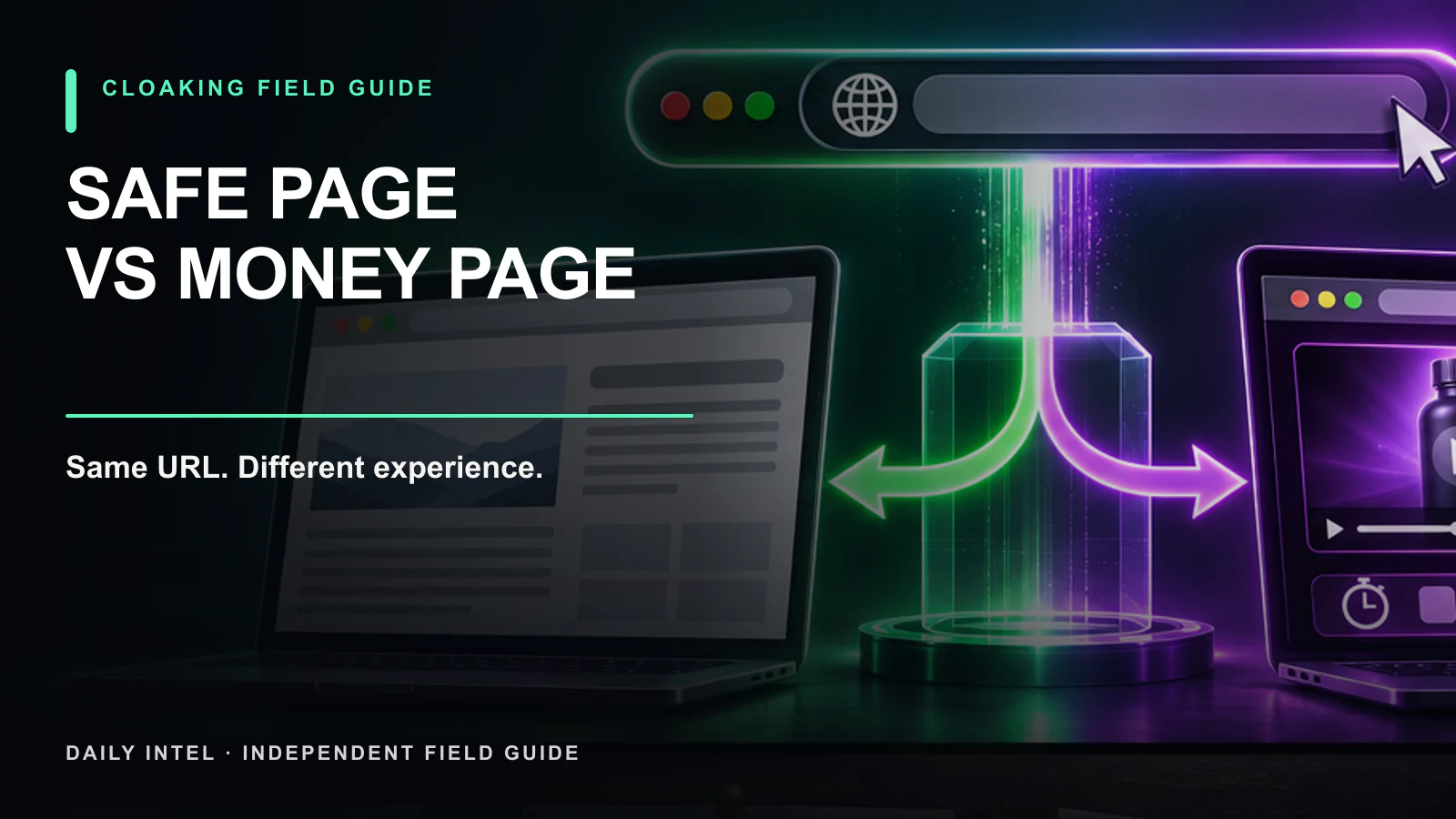
The three terms answer different questions
A white page describes what the page contains: a compliant, public-facing experience. A safe page describes what the page does inside a routing system: it is the version selected for a reviewer, crawler, or visitor scored as risky. A money page is the commercial destination selected for the visitor the system wants to monetize. One page can look white without being part of a cloak; the split is what matters.
Meta defines cloaking as disguising an ad's true destination or destination-page content to bypass review. Google draws the same boundary more precisely: language, location, offers, and connection-speed adaptations can be legitimate when the promoted product stays the same, while showing Google a compliant destination and users a prohibited one is not. Those definitions make intent observable through continuity: did the product, claim set, or transaction path materially change? See Meta's description of cloaking and Google Ads' current circumventing-systems policy.
| Question | White page | Safe page | Money page |
|---|---|---|---|
| Who sees it? | Usually everyone | Reviewers, crawlers, or flagged visitors | Visitors admitted by the routing rules |
| Is a second version required? | No | Yes, otherwise it is not a split | Yes, paired with another experience |
| Does the promoted offer stay the same? | Normally yes | May hide or soften the actual offer | Carries the actual commercial path |
| Strongest evidence | Consistent content across contexts | Repeated reviewer-linked selection | Repeated buyer-linked selection |
A controlled comparison beats a dramatic screenshot
Start with one ad, one click URL, and a timestamp. Preserve the complete URL before opening it. Then compare observations in a small matrix: ordinary desktop and mobile, the advertised country and one out-of-market country, and the original ad click versus a direct revisit. Change one variable at a time. If five variables move together, you learn only that the page changed.
The first capture is not the truth and the second is not automatically the reveal. A campaign may expire between visits. A consent wall may disappear after a cookie is stored. A responsive layout may move the CTA without changing the offer. Record status codes, final URLs, product identity, headline claim, and whether checkout exists. Those fields let another analyst reproduce the observation.
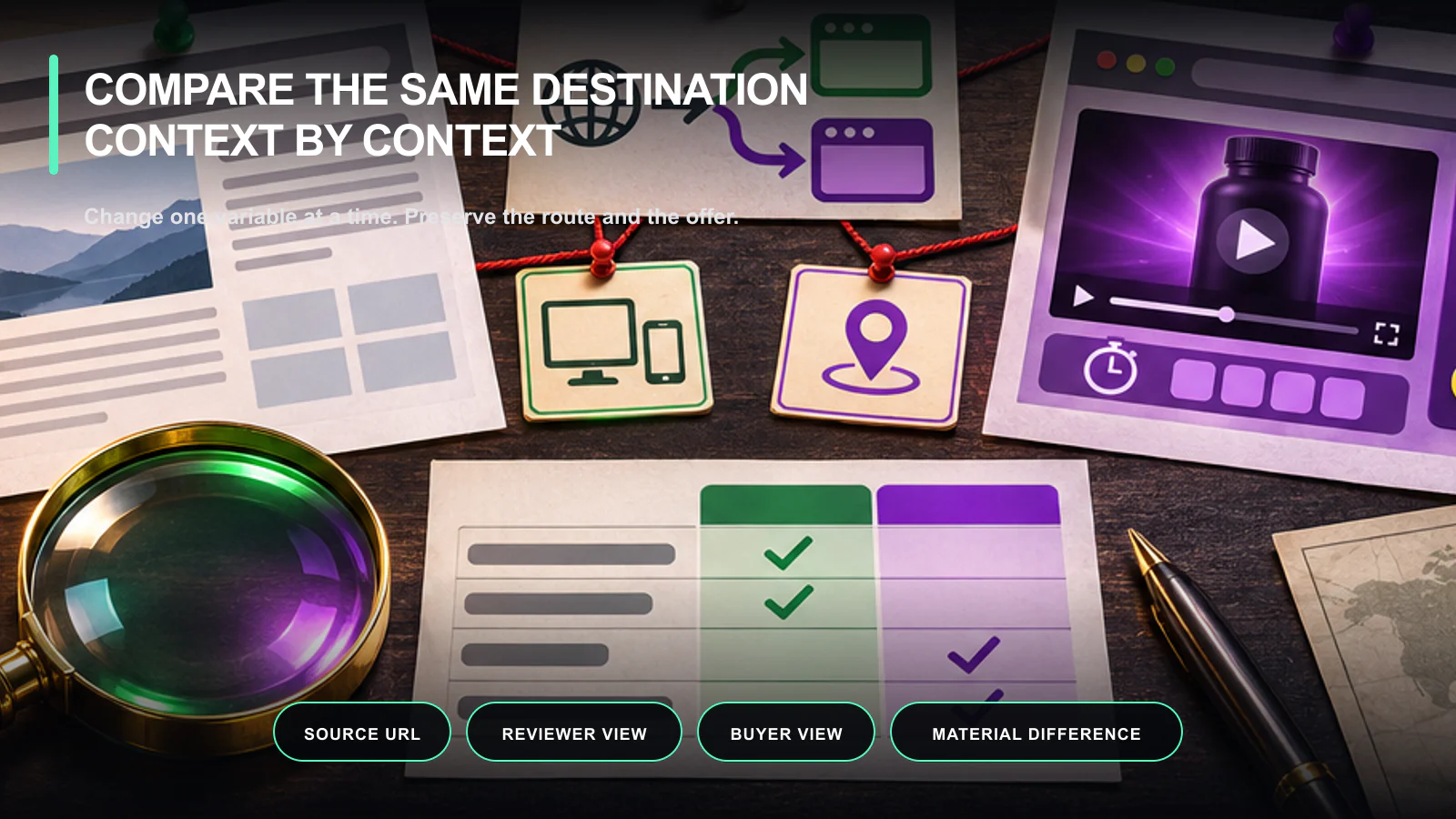
Ten differences worth annotating
No single difference proves a cloak. The strongest case combines a material offer change, a repeatable context-dependent split, and a preserved redirect chain. That is why the annotated comparison should sit beside the raw captures rather than replace them.
- Product identity: category-only content versus a named offer or seller.
- Claim intensity: general education versus a specific outcome or guarantee.
- Commercial action: no transaction path versus a checkout or lead form.
- Destination: identical final URL versus a different domain or path.
- Redirect count: stable route versus an extra conditional hop.
- Media: stock editorial image versus an autoplay VSL or product demo.
- Price and continuity: no terms versus a price, subscription, or upsell path.
- Urgency: neutral page versus timers, scarcity, or limited-availability prompts.
- Entity: the same advertiser and product versus an unrelated merchant or offer.
- Persistence: a repeatable split versus a one-time error, experiment, or outage.
Five false positives to eliminate first
Our dedicated cloaker-versus-dynamic-content field guide turns these checks into a triage sequence. Use it before labeling a campaign.
| Looks suspicious | Common benign cause | Check |
|---|---|---|
| Different country, different page | Localization or availability rules | Is the product still the same? |
| Mobile and desktop diverge | Responsive or device-specific UX | Do claims and transaction destination match? |
| A later visit changes | A/B assignment or campaign expiry | Does the variant persist with the same cookie? |
| Direct visit shows less | Missing click token or session state | Does the original ad click restore the same offer? |
| Crawler sees a wall | Consent, login, or bot protection | Can an ordinary user reach the same content without identity-based selection? |
white page は safe page と同じですか?
いいえ、white page は同じものではありません。ベンダーやフォーラムのスレッドでは両者を同義のように使うことがよくありますが、実際は違います。white page は、完全に規約適合したキャンペーンの恒久的な表側そのもので、存在する唯一のページであり、全員に表示され、隠された第2版はありません。これに対して safe page は、意図的な2枚組の片方です。単独では審査に通らないマネーページを守るためだけに存在します。
The next step is not to copy the hidden page. It is to understand the funnel you were previously missing: hook, mechanism, offer, checkout continuity, and traffic-source fit. Continue with the research-oriented guide to seeing cloaked affiliate funnels, or use the cloaked-funnel evidence log when the finding needs to survive review by another person.
調査手法と情報源について
Daily Intel pages are written from a research workflow that reviews active VSLs, Meta ad creatives, transcripts, UTMs, funnel paths, checkout steps, upsells, recovery sequences, and compliance-sensitive claim patterns. The goal is to explain observable market behavior, not to provide legal, medical, or platform policy advice.
For educational pages, the supporting references should help readers verify search, crawlability, and public ad research context, especially Google helpful content guidance, Google SEO link best practices, and Meta Ad Library. Daily Intel then adds the direct-response interpretation layer so the page explains what the signal means for actual affiliate research decisions.
For deeper evaluation, continue through Direct response glossary hub, Copywriting Podcasts for DR Writers: What's Live, What's an Archive, The 9 Direct Response Books That Still Print Money in 2026, Reddit for Nutra Media Buyers: 8 Subs and How to Read Them, STM Forum vs affLIFT: Which Paid Community Pays for Itself, and What is a VSL?. These related Daily Intel pages connect this topic to the relevant methodology, pricing, trust context, comparison path, or niche workflow.
Founding rate — locked forever
厳選された VSL インテリジェンスを月額 $29.90 で
- 50–100 manually validated VSLs every day at 11PM EST
- major niches niches, 14+ languages, blackhat-to-whitehat pattern coverage
- live catalog VSL/ad catalog, transcripts, UTMs, full funnel maps
- Cancel anytime — founding rate stays yours forever
Daily Intel Service は、実際にスケール中の VSL、Meta のクリエイティブ、UTM、ファネル、nutra 市場の動きについて、人手で厳選したリサーチを提供します。
よくある質問
セーフページとマネーページの組み合わせを運用するのは違法ですか?
この組み合わせの運用は、多くの法域で違法ではありませんが、ほぼ常に広告プラットフォームの利用規約に違反します。Facebook、Google、そしてほとんどのネイティブネットワークは、審査担当者に有料訪問者とは別のページを見せることを明確に禁じており、違反は通常、法的措置ではなくアカウント停止に終わります。広告プラットフォームは通常、どのように cloak を見抜きますか?
広告プラットフォームは通常、再クロール、ユーザーレポート、または既知の cloaking ドメイン全体での自動パターン照合によって cloak を見抜きます。住宅用IPからの再クロールや競合によるレポートで、数日以内に不一致が露見することが多いですが、よく作られた設定なら、検出まで数週間動き続けることもあります。すべてのアフィリエイトオファーがセーフページを使うのですか?
いいえ、ほとんどのアフィリエイトオファーは、分離のない単一の規約適合ページで運用されます。セーフページ / マネーページのパターンが出るのは主に、サプリメントの強い主張、crypto、クレジット修復のような制限付き、または境界線上の vertical です。そうした領域では、実際のオファーがそれ自体の内容だけでは審査を通過できません。
リサーチの続きへ