The domain is the weakest campaign identifier
A domain can be replaced in minutes while the expensive parts of a campaign remain: the creative set, VSL, checkout, affiliate offer, tracking stack and launch schedule. Domain-first monitoring therefore fragments one campaign into several rows. The research task is entity resolution: deciding which observations refer to the same operating campaign without merging unrelated advertisers that use common infrastructure.
Use an evidence bundle rather than one magic identifier. Shared Cloudflare nameservers, the same registrar, or a similar WordPress theme are weak signals because thousands of unrelated sites share them. A matching checkout merchant plus an identical video asset is materially stronger.
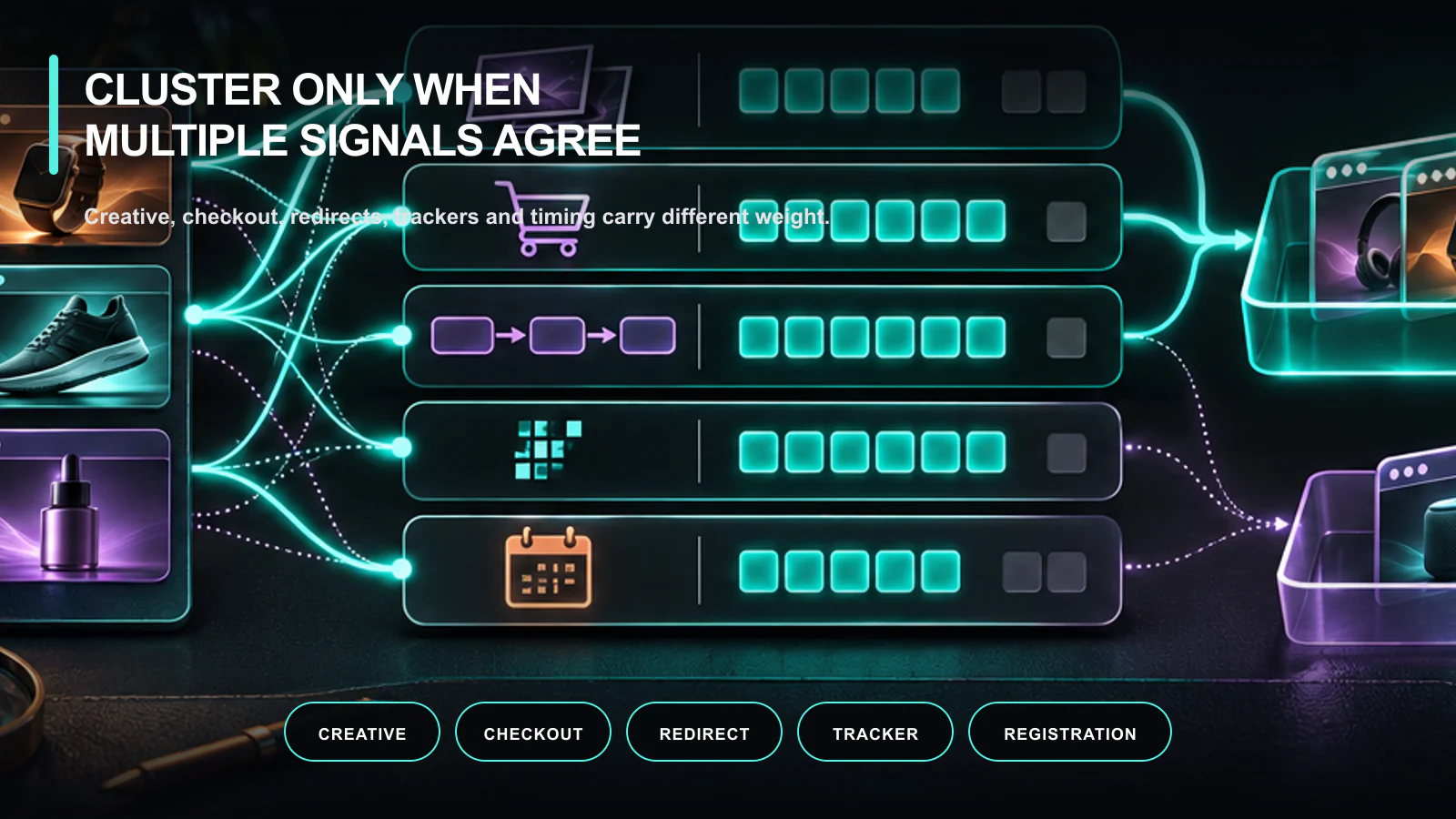
Five signal families
ICANN's RDAP provides standardized access to current registration data, but privacy and differentiated access mean registrant identity may be unavailable. Use RDAP as supporting context, not as a requirement for a match. See ICANN's RDAP overview.
| Signal | Examples | Typical weight |
|---|---|---|
| Creative identity | Same video, image crop, script passage, file hash | Strong when exact |
| Offer and transaction | Same product, checkout host, merchant, order form or affiliate offer | Strong |
| Redirect topology | Same sequence shape, path tokens, outgoing destination | Medium to strong |
| Tracking identity | Shared pixel IDs, tracker domains, campaign parameters | Medium; IDs can be reused or copied |
| Registration and infrastructure | Registrar, creation window, DNS, certificate or hosting timing | Supporting only |
Build the cluster from the inside out
Start with the least replaceable object you can verify: a checkout identity, affiliate offer, full VSL file, or exact creative. Find every observed domain connected to that object. Then compare redirect paths and trackers. Add registration or infrastructure timing last, as corroboration.
This order reduces a common error: starting with a shared IP address or CDN and pulling unrelated sites into the same cluster. Infrastructure is cheap and multi-tenant. A transaction path is closer to the commercial entity you are trying to resolve.
A confidence score that resists false links
Use a simple evidence score rather than a black-box probability. Award 3 points for an exact creative or VSL hash, 3 for the same verified checkout or offer identity, 2 for a highly similar redirect chain, 1 for a shared tracking identifier, and 1 for aligned registration or launch timing. Require evidence from at least two families; never approve a cluster from infrastructure alone.
Example: Domain A and Domain B share an exact 18-minute video file (3), the same checkout merchant and product (3), and the same tracker domain (1). Score 7 across three families: strong cluster. Domain C shares only Cloudflare and a registrar created in the same month. Score 1: do not merge.
| Score | Label | Use |
|---|---|---|
| 0-2 | Unlinked | Keep separate; collect more evidence |
| 3-5 | Possible family | Monitor together but report separately |
| 6-8 | Probable family | Cluster with evidence notes |
| 9-10 | Strong family | Cluster; retain the decisive artifacts |
Read redirects without over-interpreting them
HTTP redirects expose a sequence of destinations through 3xx responses and Location headers. Record the full path, but remember that trackers, link shorteners and affiliate networks can legitimately create shared hops across unrelated campaigns. The strongest redirect evidence is a distinctive sequence that ends in the same offer or transaction identity.
Client-side redirects require a rendered capture and may not appear in a header-only trace. Separate server redirects from JavaScript or meta-refresh transitions in the log. That distinction makes later comparisons more reliable.
Turn clusters into monitoring, not attribution theater
A campaign-family cluster helps answer operational questions: did the offer move domains, did the redirect chain change, did new creative appear, and which observed destinations remain live? It does not prove who owns the campaign, how much they spend, or whether the campaign is profitable.
Attach every cluster decision to the cloaked-funnel evidence log. When the research begins from a Meta ad and the destination is hidden, continue through the existing cloaker-research guide. For tool selection, use the claims-to-evidence matrix.
Methodology and source context
Daily Intel pages are written from a research workflow that reviews active VSLs, Meta ad creatives, transcripts, UTMs, funnel paths, checkout steps, upsells, recovery sequences, and compliance-sensitive claim patterns. The goal is to explain observable market behavior, not to provide legal, medical, or platform policy advice.
For educational pages, the supporting references should help readers verify search, crawlability, and public ad research context, especially Google helpful content guidance, Google SEO link best practices, and Meta Ad Library. Daily Intel then adds the direct-response interpretation layer so the page explains what the signal means for actual affiliate research decisions.
For deeper evaluation, continue through Direct response glossary hub, Can You Estimate a Competitor's Facebook Ad Spend?, How Meta Ad Review Works: Automation vs Human Eyes, Affiliate vs Offer Owner: Which Model Makes More Money, Near-Miss Brand Spellings in Ads: A Detection Guide, and What is a VSL?. These related Daily Intel pages connect this topic to the relevant methodology, pricing, trust context, comparison path, or niche workflow.
Founding rate — locked forever
Access curated VSL intelligence for $29.90/mo
- 50–100 manually validated VSLs every day at 11PM EST
- major niches niches, 14+ languages, blackhat-to-whitehat pattern coverage
- live catalog VSL/ad catalog, transcripts, UTMs, full funnel maps
- Cancel anytime — founding rate stays yours forever
Daily Intel Service delivers manually curated research around active-scaling VSLs, Meta creatives, UTMs, funnels, and nutra market movement.
Frequently asked questions
Does shared hosting prove two domains belong to one campaign?
No. CDNs and hosting platforms are multi-tenant. Treat shared infrastructure as supporting evidence only and require agreement from creative, offer, checkout, redirect or tracking signals.What is the strongest cross-domain signal?
An exact creative or VSL asset combined with the same verified offer or checkout identity is substantially stronger than a shared registrar, template or IP address.Can RDAP always identify the domain owner?
No. RDAP standardizes access to registration data, but privacy services and differentiated access can hide registrant details. Use available registration timing and registrar data as supporting context.
Continue the research path