
Happy Paws Skin & Coat Dog Chews Review: Facts, Terms, Safety Limits, and Proof Gaps
A source-linked review of Happy Paws Skin & Coat Dog Chews covering price, servings, recurring terms, refunds, safety cautions, and proof gaps.

8,226+
Videos & Ads
+50-100
Fresh Daily
$29.90
Per Month
Full Access
12.5 TB database · 72+ niches · 13 min read
The short verdict
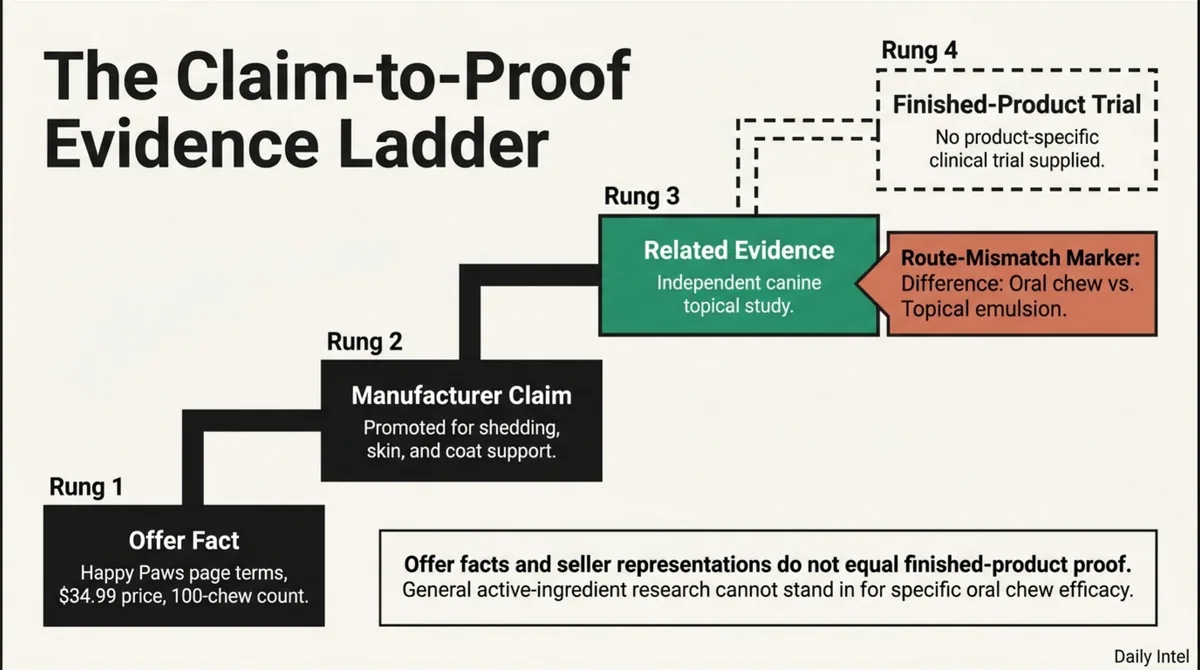
Offer facts and seller representations do not equal proof that the finished oral chew produces a health outcome.
Happy Paws provides enough information to identify the offer and estimate its cost, but the supplied evidence does not establish that this finished chew improves itching, shedding, hair growth, skin condition, coat quality, allergies, or gut health.
The captured offer is a weight-served, 100-soft-chew canine supplement. The captured page supplies directions and important cautions, while the return policy limits which opened products qualify for refunds. What is missing is equally important: no finished-product clinical trial, complete quantitative ingredient amounts, lot-specific report, or verified checkout record establishing the current recurring frequency and cancellation process was supplied.
That produces a conditional decision. An evidence-conscious owner might keep the product on a comparison list after reviewing suitability with a veterinarian when appropriate and confirming every checkout term. Owners seeking treatment for an unexplained skin problem, dose-matched product research, or transparent lot documentation should wait or compare better-documented options.
This review concerns the exact Happy Paws Skin & Coat Dog Chews: Dog Supplements for Skin and Coat offer. Facts from the brand's probiotic chew or any other pet supplement do not transfer to it.
What the captured Happy Paws page offers
The captured official product page presented the following offer facts in the October 29, 2026 capture:
- The captured official page listed a price of $34.99.
- The container is described as holding 100 soft chews.
- The page listed a vegan chicken flavor and weight-based daily directions.
- It instructed purchasers to store the product in a cool, dry place after opening.
- It displayed a recurring-purchase notice and a Subscribe & Save promotion.
- Free shipping was advertised for orders of at least $99, not necessarily for one container.
These are offer facts or seller representations—not proof of a health outcome.
The captured directions were one chew daily for dogs under 10 pounds, two for dogs from 10–30 pounds, three for 31–60 pounds, four for 61–90 pounds, and five for dogs over 90 pounds. They also suggested using the product for at least 30 consecutive days. That last instruction is a manufacturer direction, not evidence that an outcome will appear after 30 days.
The displayed ingredient panel included a chew base containing oat flour, sunflower oil, flaxseed meal, vegetable glycerin, sunflower lecithin, guar gum, brewer's yeast, an organic vegetable blend, and flavoring. Promotional sections also named substances such as biotin and coconut oil. The packet does not provide complete quantities for the promoted actives, so it cannot support a dose-matched efficacy judgment.
The real cost depends on the dog's weight
A 100-chew count is not automatically a 100-day supply. Using the captured directions and the displayed $34.99 price gives this original arithmetic:
| Listed weight band | Chews per day | Container runway | Approximate product cost per day |
|---|---|---|---|
| Under 10 lb | 1 | 100 days | $0.35 |
| 10–30 lb | 2 | 50 days | $0.70 |
| 31–60 lb | 3 | 33 full days, with one chew left | $1.05 |
| 61–90 lb | 4 | 25 days | $1.40 |
| Over 90 lb | 5 | 20 days | $1.75 |
These figures exclude tax, shipping, discounts, and any price change. They are budgeting calculations, not individualized dosing advice.
For a dog listed at four or five chews daily, one container would not cover the page's suggested 30-day period. A buyer should therefore calculate the required container count before treating the displayed unit price as the full commitment.
Recurring charges, shipping, and refunds
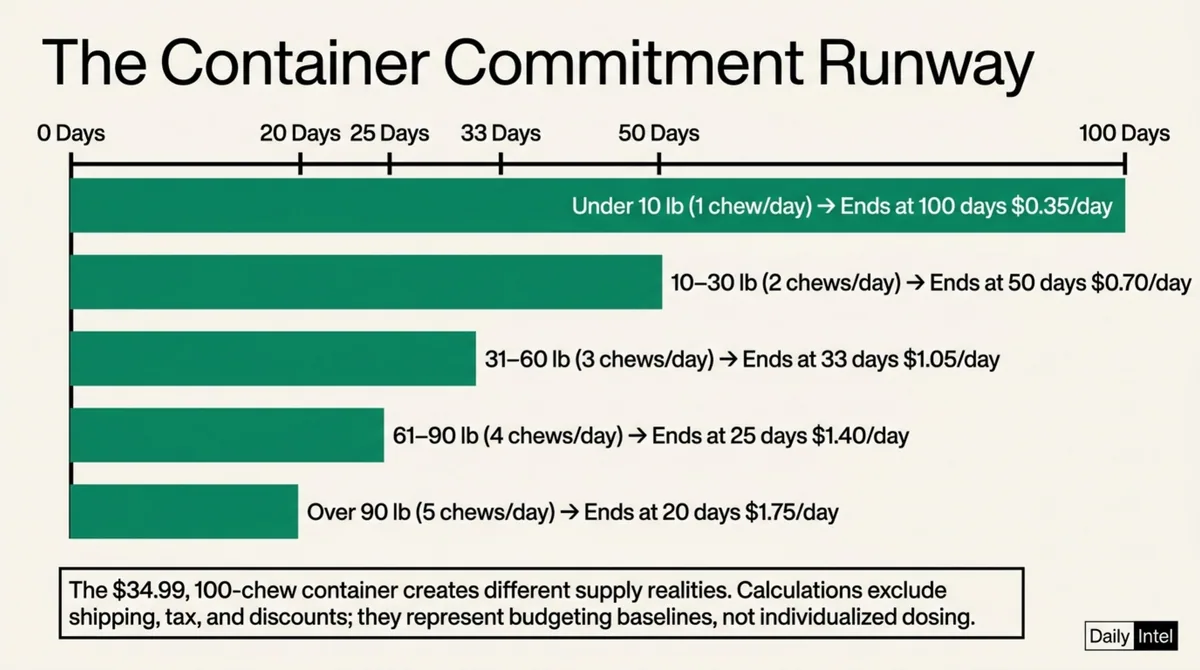
The same 34.99-dollar container creates different supply durations and product-only daily costs by listed weight band.
The captured product page said the item could be a deferred, subscription, or recurring purchase and displayed a Subscribe & Save promotion claiming a 25% reduction on subscription orders. The packet does not contain a completed checkout showing the selected frequency, charge dates, cancellation controls, renewal notices, or final delivered price. Those fields must be checked before enrollment.
The stated return policy describes a 60-day window measured from the order date, but that headline does not mean every used container is unconditionally refundable. The stated return policy restricts refunds to unopened or minimally used items in original packaging. The policy directs buyers who are unsure about an opened product to contact customer service.
The stated return policy does not refund shipping charges. Promotional gifts may also need to be returned, and the policy says damaged items should be reported within 48 hours of delivery. The separate shipping policy describes estimated—not guaranteed—delivery windows and additional restrictions.
Affiliate disclosure: Daily Intel may earn a commission if the reader buys through this link.
View the exact Happy Paws Skin & Coat Dog Chews offer
Before ordering, record whether the cart says one-time purchase or subscription, the delivery interval, the next charge date, the cancellation method, shipping, tax, and the final quantity. Do not rely on the product-page headline alone.
What Happy Paws claims—and what those claims prove
The page markets the chew around skin and coat support and connects individual ingredients with shedding, hair growth, skin condition, and the gut microbiome. Those statements establish the seller's positioning. They do not demonstrate that the complete commercial formula produces those outcomes.
Customer reviews are also unsuitable as product-efficacy evidence here. They do not establish diagnosis, concurrent diet or treatment, adherence, comparison conditions, or whether an observed change resulted from the chew.
Likewise, labels such as natural, organic, veterinarian recommended, or third-party tested need documentation matched to the exact assertion. A useful testing record would identify the laboratory, lot, date, methods, analytes, specifications, and results. None of that detail was supplied.
The claim-to-proof ladder
The method used in this review asks where each statement sits on a four-rung ladder:
- Offer fact: What the captured page, label, or policy actually displays.
- Manufacturer claim: What Happy Paws says the product or an ingredient can do.
- Related evidence: Research on another ingredient, formula, route, population, or outcome.
- Finished-product proof: Research on the marketed chew, at its marketed doses, in a relevant canine population, measuring the promoted outcome.
Only the fourth rung can directly test whether this exact chew produces a claimed effect. Lower rungs can inform questions, but they cannot impersonate finished-product evidence.
Worked example: auditing a skin-support claim
Suppose a copy researcher is evaluating the broad proposition that the chew supports healthier skin.
First, convert the proposition into an observable question: Did dogs receiving the marketed chew show a prespecified improvement in a defined skin outcome compared with an appropriate control?
Next, lock the evidence match:
- Product: Was the tested intervention this exact commercial chew?
- Dose: Did each weight group receive the marketed amount and known active quantities?
- Population: Were the dogs comparable to the intended buyers' dogs?
- Outcome: Was the result a validated skin measure rather than a testimonial or unrelated laboratory marker?
- Duration and comparison: Was follow-up long enough, with a suitable comparator and transparent analysis?
The supplied packet answers none of those questions with a finished-product trial. The correct copy decision is therefore to attribute the skin-support proposition to Happy Paws and state that product-specific effectiveness remains unestablished.
Counterexample: a real study that does not transfer
The supplied independent study tested a topical emulsion, not this oral chew. The randomized pilot study involved dogs with nonseasonal canine atopic dermatitis and examined a topical formula containing blackcurrant-derived lipids, ceramides, fatty acids, and glycyrrhetinic acid.
Its route, formula, enrolled population, and measured outcomes differ from the Happy Paws chew. The study concluded that its emulsion was not effective for controlling pruritus as monotherapy. Even a more favorable result would not prove the efficacy of this oral product; it could provide only bounded category context.
This is the common research error the ladder prevents: finding a canine skin paper and allowing topic similarity to stand in for product equivalence.
A worksheet for product and copy research
Use one row for every claim that might appear in an ad, presell, VSL, review, or product module.
| Field | Research question | Happy Paws example |
|---|---|---|
| Exact claim | What would the audience reasonably think is promised? | A measurable improvement in a defined skin or coat outcome |
| Claim owner | Seller, reviewer, study author, or Daily Intel? | Seller unless direct product evidence supports editorial wording |
| Exact product | Was this commercial formula tested? | Not established |
| Active quantities | Are forms and amounts available per serving? | Incomplete in the packet |
| Population | What dogs were studied, and with what baseline condition? | No finished-product population supplied |
| Route | Oral chew, topical product, injection, or diet? | Marketed product is an oral chew |
| Comparator | Placebo, active control, usual care, or none? | Not supplied for the finished product |
| Outcome | What was measured, when, and with which instrument? | Not supplied for the finished product |
| Safety record | Were adverse events and interactions reported? | No systematic finished-product account supplied |
| Copy decision | State, attribute, qualify, or remove? | Attribute the seller's positioning; remove efficacy certainty |
A media buyer or copy chief can add two operational columns: source URL and capture date and approved wording. That creates a traceable claim library instead of letting a promising ingredient paragraph migrate unchecked into every campaign asset.
Safety boundaries the sales page cannot settle
The official caution recommends a veterinary examination before use. The captured page also says to stop giving the product and consult a veterinarian if the animal's condition worsens or fails to improve.
It further states that safe use has not been proven for pregnant animals or animals intended for breeding; a captured FAQ extends that uncertainty to lactating animals. The caution also says simultaneous use may delay the absorption of drugs.
Those manufacturer cautions are part of the buying decision, alongside the incomplete product-specific evidence. A sales page cannot diagnose the cause or determine whether a supplement is compatible with a particular dog's medications, diet, pregnancy status, or medical history.
This review therefore does not recommend the chew as treatment. Owners dealing with worsening signs, marked discomfort, open skin, medication questions, pregnancy, lactation, breeding, or an existing medical condition should resolve suitability with a veterinarian rather than using promotional language as clinical guidance.
Who might keep it on a comparison list
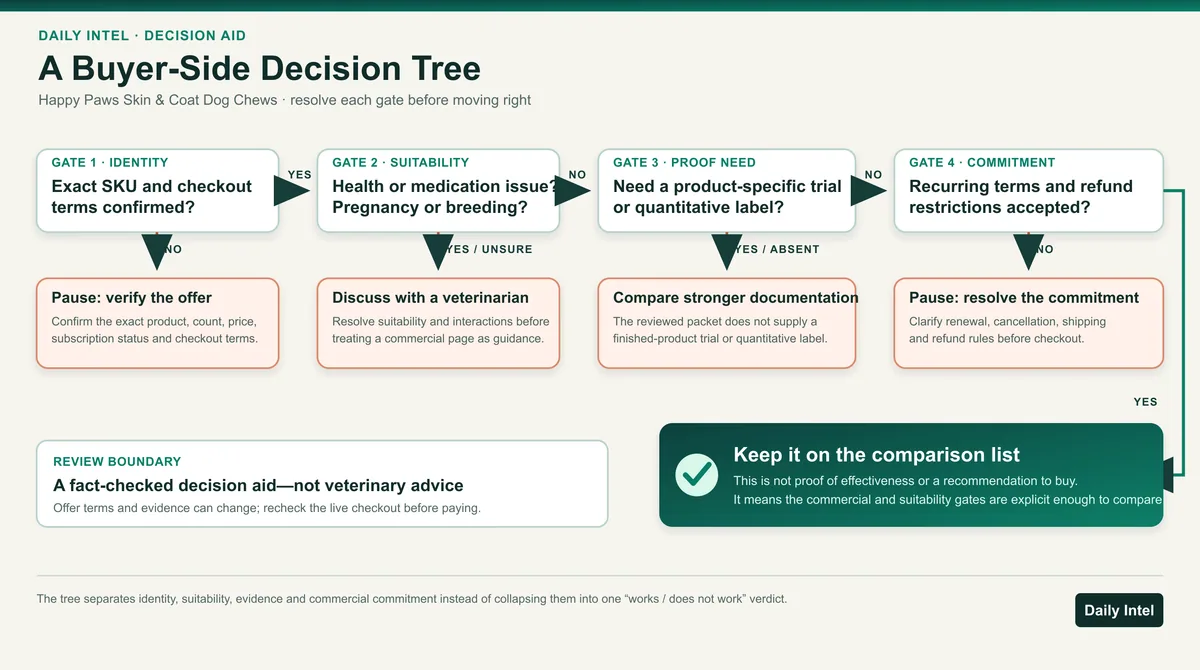
A neutral decision aid separates reasons to pause, seek veterinary input, compare documentation, or keep the product on a comparison list.
The product may remain under consideration for an owner who:
- specifically wants a soft-chew format;
- has calculated the supply duration for the dog's listed weight band;
- accepts that finished-product effectiveness has not been demonstrated in the supplied evidence;
- confirms whether the transaction is one-time or recurring before paying;
- understands the return restrictions; and
- obtains veterinary input when the page's cautions or the dog's circumstances make that appropriate.
It is a weaker fit for a buyer who requires quantitative active amounts, a lot-specific certificate or report, controlled research on the marketed formula, an unconditional used-product refund, or fully captured cancellation terms before purchase.
What could be a better alternative
The packet does not support ranking another commercial product by name. A responsible comparison should instead look for evidence characteristics that materially improve the decision:
- a complete quantitative label for every promoted active;
- lot-linked quality results with methods and specifications;
- safety information relevant to the dog's circumstances;
- finished-product research matching formula, dose, route, population, and outcome;
- clear one-time and recurring checkout choices; and
- return and cancellation terms visible before payment.
For an unexplained or worsening skin problem, obtaining a veterinary assessment before selecting a supplement is the more defensible next step. That is a decision boundary, not a claim that any particular treatment is required.
Original Daily Intel VSL strategy we would test
This is a proposed research-led structure, not the advertiser's actual script and not a forecast of performance.
A private canine joint-supplement transcript was used only to study the order of questions and objections. It concerns a different product and condition; it is not a skin-and-coat example or evidence for this chew. It concentrates its risk-heavy hook and lead at 00:00.00–02:10.60, returns to an extended mechanism explanation at 07:10.00–09:51.18, moves into price and guarantee handling at 21:56.38–24:58.52, and adds a post-decision FAQ at 31:17.44–35:16.42. Its medical, testimonial, urgency, scarcity, outcome, and guarantee language is not evidence for Happy Paws and should not be reused.
For this product, the useful structural idea is sequencing objections—not copying the transcript's claims.
Proposed execution
Hook: A 100-chew container can represent anywhere from 20 to 100 days under the displayed directions, so the real buying decision begins with the dog's weight and the evidence standard—not the unit price alone.
Lead: Identify the exact $34.99 Happy Paws product, then separate what the page displays from what remains unproven. Show the container runway before discussing promoted benefits.
Mechanism frame: Introduce the claim-to-proof ladder. For each promoted ingredient, require a match on form, amount, route, population, and outcome before allowing it to support finished-product copy.
Labeled hypothetical path: Consider a hypothetical owner of a 70-pound dog. The displayed direction is four chews daily, making the container a 25-day supply at roughly $1.40 per day before shipping or discounts. The owner then checks medication compatibility, recurring status, active quantities, refund eligibility, and product-specific evidence. No fabricated improvement or customer story is needed.
Proof sequence: Present offer facts first, manufacturer representations second, independent evidence third, and the missing finished-product rung last. The absence of direct proof becomes an explicit decision variable rather than a detail hidden after the CTA.
Objections: Handle suitability and drug timing first, then evidence mismatch, supply duration, recurring charges, cancellation visibility, shipping, and return restrictions. Do not answer an evidence objection with testimonials.
Offer logic: Describe the dated price and subscription promotion without manufacturing urgency. Display one-time versus recurring status, delivery frequency, next charge, and cancellation method only if a fresh checkout capture verifies them.
CTA: Invite qualified readers to inspect the exact offer after the limitations are visible. The CTA should not promise a coat, itching, shedding, hair-growth, allergy, or gut-health outcome.
For ad and VSL researchers, the practical test is comprehension: can a viewer accurately state the supply duration, proof gap, recurring status, and refund restriction after seeing the asset? That can be measured without claiming sales or health effects.
What would change this verdict
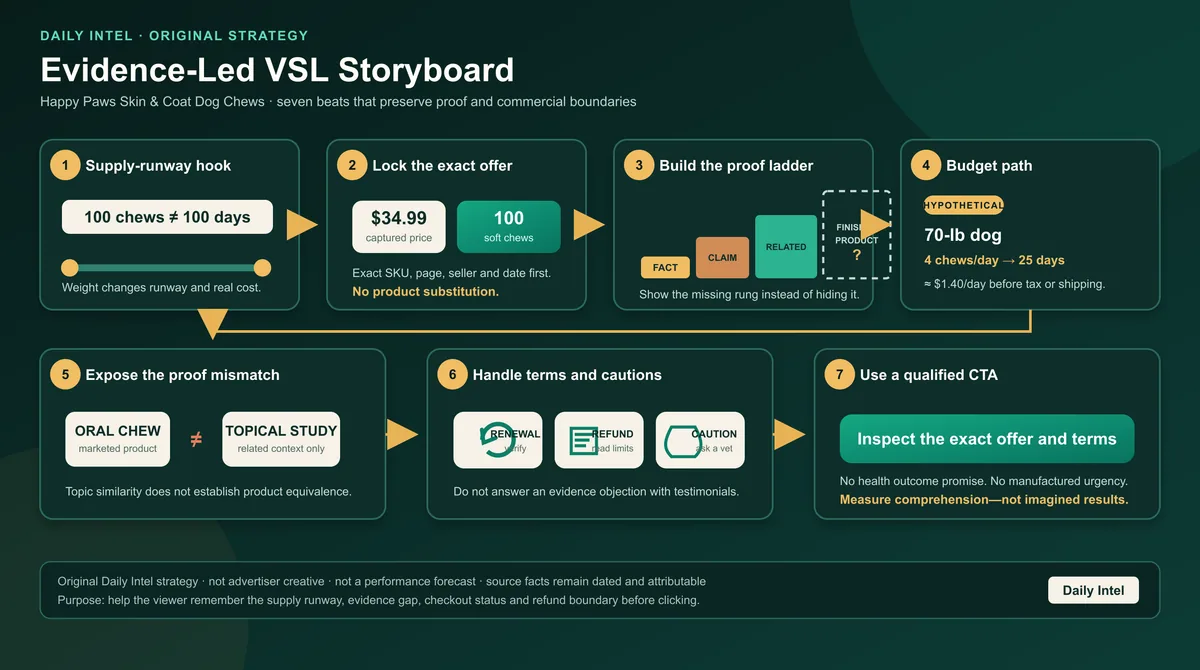
Original Daily Intel VSL research structure—not advertiser creative, a health claim, or a performance forecast.
The verdict could become more favorable if Happy Paws supplied a complete quantitative formula, current lot-linked testing, and credible finished-product research using the marketed chew in a relevant canine population with prespecified outcomes and transparent safety reporting.
It could become less favorable if fresh checkout review revealed unclear recurring charges, cancellation friction, materially different terms, or product information inconsistent with the captured page.
Until those gaps are resolved, the most accurate conclusion is narrow: the product and basic offer are identifiable, but the supplied evidence does not establish that the finished chew delivers its promoted health outcomes.
Sources and evidence notes
- Happy Paws product page: source for the captured price, count, directions, seller positioning, recurring-purchase notice, and cautions. Seller claims remain attributed.
- Happy Paws return policy: source for the 60-day window, product-condition restrictions, shipping exclusion, and damaged-item process.
- Happy Paws shipping policy: source for captured processing and estimated-delivery terms. Checkout remains the authority for the actual order total and available method.
- Canine topical-emulsion pilot study: independent category context with major formula and route mismatches; it is not evidence for the finished Happy Paws chew.
Related Daily Intel research
- probiotic dog chews gastrointestinal support review — A related Happy Paws review that explains proof gaps for a different SKU; link only to compare review methodology, not product facts or conclusions.
- skin and hair offer seasonality sun season and shedding — Useful for copy researchers studying skin-offer framing, provided the link is presented as corpus-pattern context rather than evidence about this product.
- vsls scaling in may hearing skin and sun season offers — Supports the operator-facing VSL research task by showing how to separate measured transcript patterns from unverified timing assumptions.
Download the teaching materials
Download the reviewed teaching slides (PDF). The file contains 3 pages and searchable English text.
Comments(0)
No comments yet. Members, start the conversation below.
Related reads
 reviews
Probiotic Dog Chews: Gastrointestinal Support review: Proof Gaps
Happy Paws provides a 100-chew count, weight-based directions, commercial terms, and material safety cautions. The unresolved issue is finished-product evidence: the packet contains no complete formula, product-specific clinical trial, batch report, or complete subscription and guarantee terms.
Read reviews
Finasteride 1mg Review: HealthRX’s $67 Plan and the Study Mismatch
HealthRX presents Finasteride 1mg as a once-daily prescription option supplied through an online provider review and pharmacy-fulfillment service. The commercial path is documented more clearly than the medical evidence for the exact dispensed product. The packet does not contain its full label, manufacturer, complete safety information, or a finished-product clinical trial.
Read reviews
Oral Minoxidil Tablets review: Convenience Does Not Close the Gap
Strut Health offers clinician-screened oral minoxidil for hair loss, but the supplied study did not test the exact Strut product. The prescribed dose, customer price, recurring terms, and parts of the safety framework also remain unresolved.
Read