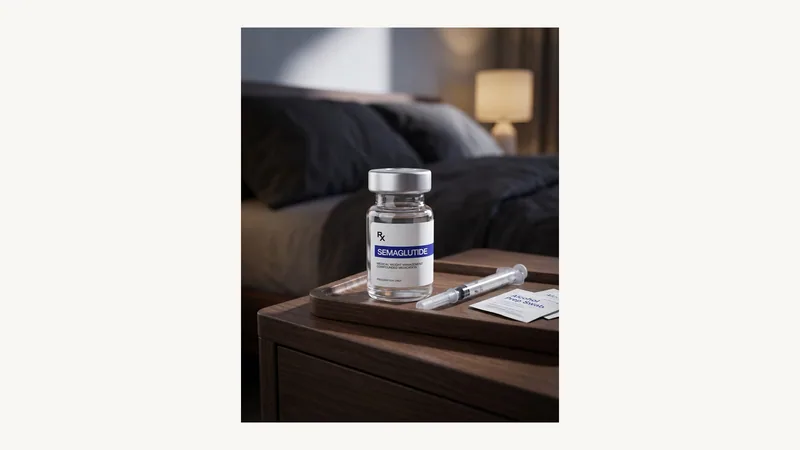
Strut Injectable Semaglutide Offer Review: Evidence Audit
An evidence audit of Strut Health’s compounded Injectable Semaglutide offer: price, prescription process, safety gaps, study limits and questions to resolve.

8,226+
Videos & Ads
+50-100
Fresh Daily
$29.90
Per Month
Full Access
12.5 TB database · 72+ niches · 12 min read
Bottom line: Strut Health’s page identifies a prescription-required, compounded semaglutide injection with weekly administration, provider support and an advertised monthly price. It does not establish that this finished product is safe, effective or suitable for a particular person.
A buyer can compare the disclosed process and apparent cost, but should resolve product, pharmacy, safety, prescribing and recurring-term questions before treating an official-page claim as evidence of medical fit or treatment results.
Product decision summary

The official Strut Health offer page, retrieved on November 10, 2026, supports these limited findings:
- The seller is Strut Health, and the named variant is Injectable Semaglutide.
- The product is described as compounded and prescription-required.
- The page describes a once-weekly subcutaneous injection.
- The displayed offer is a $129 monthly vial, with healthcare-provider consultations and shipping presented as included.
- The page presents provider messaging, follow-ups, regular monthly delivery and cancellation at any time.
- The page says compounded drug products are not FDA-approved or evaluated for safety, effectiveness or quality.
The packet does not establish the exact prescribed strength, concentration, titration plan, dispensing pharmacy, state availability, complete label, finished-product testing, renewal mechanics or finished-product evidence for this particular compounded product. The advertised price and terms are a dated page observation, not a guarantee of the amount or conditions a reader will receive.
Terms used in this audit
- Compounded: The product category described on Strut’s page. FDA states that compounded drugs are not FDA-approved.
- GLP-1: An abbreviation used on Strut’s page; the page describes semaglutide as a GLP-1 receptor agonist.
- Subcutaneous: An injection given under the skin. Strut describes this offer as a once-weekly subcutaneous injection.
- Titration: A provider-directed process of adjusting a prescribed dose over time. The packet does not provide Strut’s titration plan.
- Beyond-use date: A date on a compounded product’s label that the buyer should review with the dispensing pharmacy to understand the use period for that dispensed preparation. No such date was supplied in this packet.
- Finished-product evidence: Evidence about the actual compounded product a patient receives, rather than evidence about semaglutide generally, a different formulation or a different patient population.
What the offer verifies—and what it does not
| Offer element | What the supplied page supports | Boundary of the evidence |
|---|---|---|
| Product identity | Compounded injectable semaglutide offered through Strut Health | No complete dispensing label or finished-product specification was supplied |
| Access | The page states that prescription medications require a valid and complete online consultation before approval and final prescription | Eligibility criteria, excluded states and dispensing-pharmacy details were not supplied |
| Administration format | Once-weekly subcutaneous injection | Frequency is not the same as the prescribed dose, concentration or titration schedule |
| Advertised price | $129 for a monthly vial on the retrieved page | Taxes, later renewal prices, dose-related price changes and complete auto-refill terms remain unverified |
| Included service | The page presents healthcare-provider consultations, follow-ups, messaging and shipping as included | Response standards, follow-up cadence and service limitations are not stated in the packet |
| Cancellation | The page presents cancellation as available at any time | Cutoff dates, already-processing shipments, refund rules and the cancellation channel remain unknown |
| Product status | The page discloses that the compounded product is not FDA-approved or FDA-evaluated | That disclosure does not establish facts about a particular dispensed order or pharmacy |
Claim-versus-proof audit
| Page proposition | Evidence available here | Audit result |
|---|---|---|
| The product may support appetite management | Strut Health’s attributed marketing and mechanism description | Unresolved. Ingredient-level or mechanism wording cannot prove the efficacy of the dispensed finished product |
| Weekly use offers convenience | The page identifies weekly rather than daily administration | Partly verifiable. The schedule is stated, but convenience depends on storage, injection comfort, travel and the prescribed regimen |
| The plan is personalized | The page describes an online consultation followed by provider approval and a treatment plan | Process claim only. The packet does not show what clinical information is reviewed or how a prescription is individualized |
| Pricing is simple and transparent | A monthly-vial price and included services appear on the page | Incomplete. Full renewal, auto-refill, refund and dose-dependent terms are absent |
| Provider support is included | Messaging, visits and follow-ups are presented as included | Unverified in operation. No service-level documentation or independent account of delivery was supplied |
| Semaglutide-related mechanism statements apply to this offer | The seller describes how semaglutide is proposed to work | Not transferable. A mechanism or study involving an ingredient, another formulation or another population does not establish outcomes for this compounded product |
Regulatory context and the evidence boundary
The supplied FDA Compounding Q&A states, “Compounded drugs are not FDA-approved.” The same FDA source says, “A drug may be compounded for a patient who cannot be treated with an FDA-approved medication.”
These are general regulatory statements, not a finding that Strut’s offer or any individual prescription satisfies a particular compounding circumstance. They also do not establish the quality, safety, effectiveness, eligibility or appropriateness of this exact compounded product.
The supplied primary study is likewise not finished-product evidence for this offer. It studied once-weekly subcutaneous semaglutide at 2.4 mg in participants with obesity and knee osteoarthritis, alongside physical-activity counseling and a reduced-calorie diet. The packet does not establish that Strut’s compounded product, prescribed dose, formulation or prospective patient population matches that intervention.
Safety, labeling and use boundaries
The supplied materials do not provide a product-specific contraindication list, interaction review, adverse-effect profile, missed-dose directions or instructions about when to seek urgent medical advice. Those omissions mean this audit cannot assess individual safety, compatibility or appropriate dosing.
The cited study cannot fill that gap. It reports results for a specified 2.4 mg intervention and population, not for Strut’s compounded product or an individual reader’s medical history.
Strut’s page says to keep the vial refrigerated as directed by the pharmacy label, protected from light and away from freezing temperatures. That is an attributed page statement, not a substitute for the complete label accompanying a dispensed vial. The packet supplies no product-specific missed-dose guidance or results timeline.
Before considering a prescription, a buyer should ask the prescribing provider to review their health history, current medicines, potential contraindications, interactions, adverse effects, monitoring needs and circumstances requiring professional advice. A complete pharmacy label and provider instructions should control over general website wording.
The commercial commitment map

The visible price is only one part of the decision. Map the offer as a sequence before treating $129 as the expected total commitment:
- Before consultation: confirm the consultation process, what information is required and whether entering payment details starts any recurring authorization.
- After provider review: confirm the billing condition, including whether medication is charged only after provider approval; then request the prescribed concentration, dose schedule, vial quantity, dispensing pharmacy and complete patient-facing label.
- At checkout: record the exact first charge, renewal amount, billing interval, auto-refill status, taxes and any dose-related price changes.
- Before shipment: determine when an order becomes noncancelable and whether a prescription or prepared medication can be refunded.
- During recurring service: verify the refill approval process, provider follow-up cadence, shipment timing and method for stopping renewal.
The official page combines a monthly-vial price, an auto-refill message and a cancel-anytime statement. It also presents healthcare-provider consultations as included and ties final prescription approval to a valid and complete online consultation. Without dated checkout terms and complete billing language, those elements do not reveal the final cancellation cutoff or financial exposure.
Why the evidence mismatch changes the buyer decision
This is a bounded evidence audit. The packet includes an official commercial page, FDA regulatory context and one primary study, but it lacks a complete specification for the product that would actually be dispensed and lacks matched finished-product evidence.
That prevents three common but invalid leaps:
- Evidence about semaglutide generally cannot automatically establish the efficacy or quality of Strut Health’s finished compounded product.
- A telehealth prescription process cannot by itself establish that a treatment is appropriate for an individual.
- General FDA compounding guidance is not a substitute for current pharmacy verification, product-specific safety documentation or an individualized clinical review.
A buyer whose standard requires independently supported efficacy, verified production quality or a complete comparison with approved alternatives does not yet have enough matched evidence. The appropriate decision state is unresolved, not favorable.
An original evidence-first VSL strategy
The private structural reference is an adjacent weight-loss direct-response promotion, not a Strut Health ad and not an injectable-prescription offer. It addresses a broadly similar weight-loss audience in a long-form commercial format, but promotes a different product category. Its language, stories, mechanisms, numbers and outcomes therefore cannot be transferred.
Only its abstract sequence is useful: it moves from an attention-grabbing premise through objections and then toward a commercial close. Here, that sequence should be reversed into an evidence-first path that makes the proof boundary visible.
Worked example
Hook: Lead with the concrete discrepancy: the $129 headline is easy to see, while the prescribed dose, pharmacy and full recurring terms are not.
Lead: Identify the exact offer as Strut Health’s compounded, prescription-required Injectable Semaglutide. State immediately that the audit can verify page facts but cannot establish medical suitability or finished-product efficacy.
Mechanism: Explain that a mechanism claim becomes decision-relevant only after matching four fields: product form, prescribed dose, studied population and measured outcome. If one field is missing, label the comparison incomplete.
Evidence-audit decision path: A hypothetical reader first records the displayed $129 price and included-consultation statement. Before clicking through, that reader marks the dose, pharmacy, label, safety instructions and renewal terms as unresolved. After provider review, the reader compares the actual prescription and label with the study fields. If the form, dose or population does not match, the reader retains the uncertainty instead of treating the study as proof for the compounded vial.
Proof: Move through an evidence ladder: official page facts, complete label and pharmacy records, regulator context, matched primary studies and any finished-product evidence. Stop at the highest rung actually supported rather than filling gaps with testimonials or ingredient claims.
Objections: Address the likely purchase blockers in order: unknown medical fit, incomplete product specification, monthly cost, recurring commitment, fulfillment, cancellation and alternatives. Answer only with documented facts.
Offer: Present the retrieved $129 monthly-vial price as a November 10, 2026 page observation. Separate what appears included from what still needs checkout or provider confirmation.
CTA: Invite the reader to inspect the official offer only after providing a checklist for the unresolved questions. The click should begin verification, not imply endorsement.
Counterexample
A non-auditable version would call the product proven because studies of semaglutide exist, describe the compounded vial as FDA-approved, imply a standard dose for every buyer, add an invented success story and create urgency around an unverified discount. It would collapse ingredient evidence, product evidence, medical eligibility and commercial terms into one persuasive claim.
That approach fails even if its sequence resembles a familiar VSL. Structure can organize evidence; it cannot manufacture it.
Buyer worksheet
Use this worksheet during the provider consultation and again at checkout. A blank or verbal-only answer should remain marked unresolved.
| Decision field | Evidence to request | Current packet status | Your record |
|---|---|---|---|
| Exact product | Full name, formulation, concentration and vial volume | Incomplete | ____ |
| Prescribed regimen | Patient-specific written directions and titration plan | Not supplied | ____ |
| Dispensing source | Pharmacy name, location, licensure and contact details | Not supplied | ____ |
| Product documentation | Complete label, ingredients, storage instructions and beyond-use date | Incomplete | ____ |
| Quality evidence | Applicable testing or quality documentation for the dispensed product | Not supplied | ____ |
| Medical screening | Eligibility criteria, contraindication review, interaction review and monitoring plan | Not supplied in sufficient detail | ____ |
| Evidence match | Study form, dose, population and outcome matched to the proposed prescription | No matched finished-product studies supplied | ____ |
| First charge | Medication, consultation, shipping, taxes and other fees | Advertised base price and included services only | ____ |
| Approval and payment | Whether medication is charged only after provider approval | Complete billing condition not supplied | ____ |
| Recurring charge | Renewal price, billing date and dose-related changes | Incomplete | ____ |
| Cancellation | Method, cutoff, pending-shipment treatment and refund rules | Incomplete | ____ |
| Fulfillment | Shipping schedule, delay procedure and damaged-package process | Incomplete | ____ |
| Alternatives | Approved and compounded options compared on evidence, cost and access | Not supplied | ____ |
Questions to settle before committing
- What exact concentration and vial quantity would be prescribed and dispensed?
- Which pharmacy fills the prescription, and is it licensed to ship to the buyer’s state?
- What complete label, storage instructions, beyond-use date and missed-dose instructions accompany the vial?
- What monitoring, contraindication review, interaction review and follow-up does the provider require for the individual prescription?
- Which evidence matches the actual form, dose, population and intended outcome?
- Does the advertised price change with the prescribed dose or after the first month?
- Is medication charged only after provider approval, and when does auto-refill begin?
- What is the cancellation cutoff for the next shipment, and what happens to a charge if a shipment is already being prepared?
- Which material commercial terms will appear at checkout, and can the buyer retain a dated copy?
For distinct business-facing context, see Semaglutide Affiliate Offers: CPA Payouts Compared. It addresses affiliate-operator economics, not consumer product evidence or medical fit.
Bounded verdict
The offer page is sufficient to identify the seller, compounded prescription status, weekly format, advertised base price and outline of the consultation process. The FDA source supplies general compounding context, and the cited study supplies evidence about a specified semaglutide intervention in a different, defined study setting. Neither establishes that this exact compounded offer is safe, effective, equivalent to the study intervention or appropriate for an individual.
The central buyer decision is therefore conditional: compare the visible service and price only after obtaining the missing label, pharmacy, regimen, safety and recurring-term details. If those answers remain unavailable or cannot be documented, the uncertainty should pause commitment rather than be interpreted in the seller’s favor.
Affiliate disclosure: Daily Intel may earn a commission if the reader buys through this link.
Inspect the official Strut Health offer and verify the open questions.
Source notes

- Official product page — Seller-provided product identity, formula, process and commercial statements used in this audit.
- Compounding and the FDA: Questions and Answers — General regulator context only; it does not establish the safety, effectiveness, quality or status of this exact finished product.
Related Daily Intel research
- semaglutide affiliate offers cpa payouts compared — This verified published owner covers affiliate-operator economics and may be linked only as partner-business context, not as consumer product evidence.
- BioNature research first review — A related example of separating offer claims, evidence and buyer uncertainty.
- BioNature VSL evidence analysis — A related example of analyzing sales structure without treating it as product proof.
Download the teaching materials
Download the reviewed teaching slides (PDF). The file contains 3 pages and searchable English text.
Comments(0)
No comments yet. Members, start the conversation below.
Related reads
- DISreviews
Strut Health Women's Weight Loss Review: What's Verified and What's Not
A bounded evidence audit of the Women's Weight Loss offer: what the official material verifies, what remains unknown, and how those gaps affect a buyer decision.
Read - DISreviews
Strut Health Men's Weight Loss Review: Verified vs. Unknown
A bounded audit of Strut Health Men's Weight Loss, including verified offer facts, missing terms, evidence limits, and a buyer worksheet.
Read - DISreviews
Live Vital Glutathione Review: What the Offer Shows and Doesn’t
A source-linked review of Live Vital’s compounded glutathione injection, including cost, renewal terms, safety boundaries and evidence gaps.
Read