Quick answer
A curiosity gap earns more scrutiny, not less. Before approving a VSL opening, a copywriter should be able to identify **the exact unknown introduced by the hook, the beat that resolves it, and the evidence needed to make that resolution credible**.
The practical rule is simple: if you cannot draw a clean line from the opening question to a later, inspectable answer, the script has not created one controlled gap. It has created unresolved debt.
This matters especially in nutra and telehealth copy. A gap can organize information, but it cannot turn an advertiser’s mechanism, testimonial, or product claim into verified health evidence. The method below evaluates structure only. It does not establish that the example offer, its mechanism, or its promised outcomes are true.
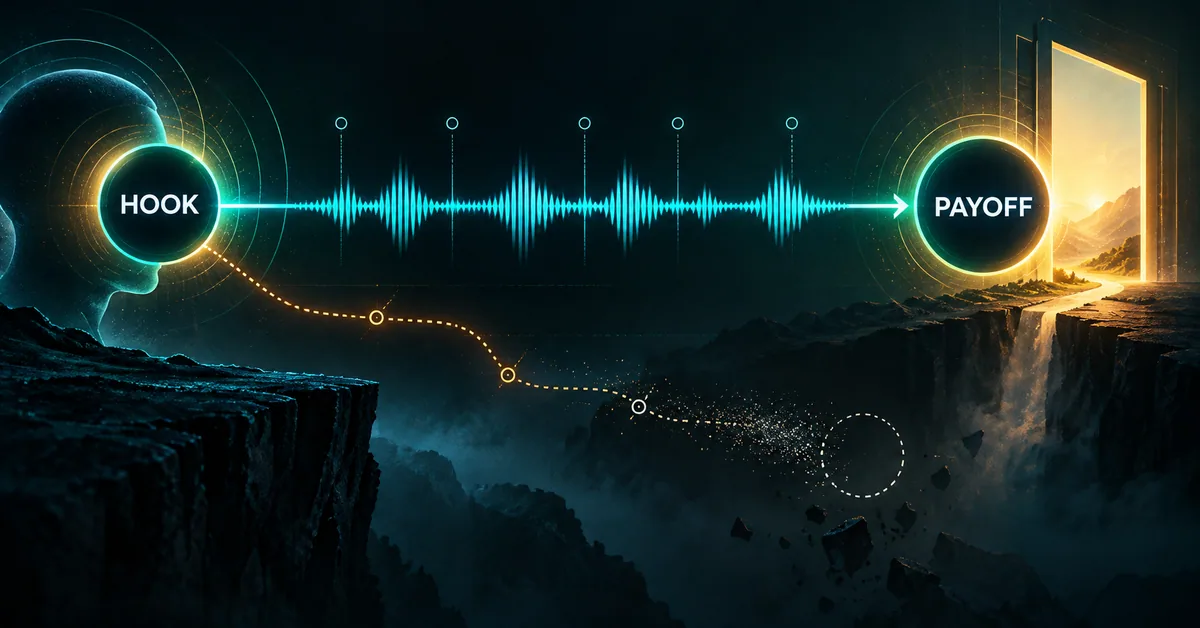
What an information gap means—and what the research does not prove
An information gap is the distance between what someone currently knows and what they want to know. For a VSL editor, that definition becomes operational when the opening gives the intended viewer a specific question whose answer appears relevant enough to pursue.
A study by Spitzer and colleagues examined curiosity, confidence, perceived importance, and decisions to wait for answers using trivia and COVID-19-related questions. The primary article is available through PubMed Central. Full reference: Spitzer, M. W. H., Janz, J., Nie, M., and Kiesel, A. (2024). *On the interplay of curiosity, confidence, and importance in knowing information*. Psychological Research, 88(1), 101–115. doi:10.1007/s00426-023-01841-9. Published online June 6, 2023; the journal issue is dated February 2024.
In the reported analyses, higher perceived importance was associated with a greater likelihood of choosing to wait for an answer.
That finding supplies useful conceptual context: an unknown is not automatically interesting merely because it is withheld. The audience also needs a reason to care about knowing it.
The study did not test VSLs, Facebook video ads, health-product purchases, conversion rates, or sales. It therefore cannot validate a curiosity-gap formula for advertising. Applying its concepts to copy is an editorial hypothesis that still requires campaign-specific testing.
For a preflight review, separate four questions:
If the script answers a different question, repeats the mystery in new words, or replaces evidence with another promise, the original gap remains open.
- **Unknown:** What exactly does the viewer not know?
- **Importance:** Why would this audience value the answer now?
- **Payoff:** Which later beat answers that same unknown?
- **Proof:** What makes the answer inspectable rather than merely dramatic?
A timestamped audit of the supplied VSL opening
The English-language Nitrox Pro transcript, catalogued as “Nitroxpro” in the private source collection, is used here as one bounded structural example. It is not representative of nutra VSLs generally, and none of its health, scientific, biographical, testimonial, product, scarcity, or efficacy statements has been verified for this article.
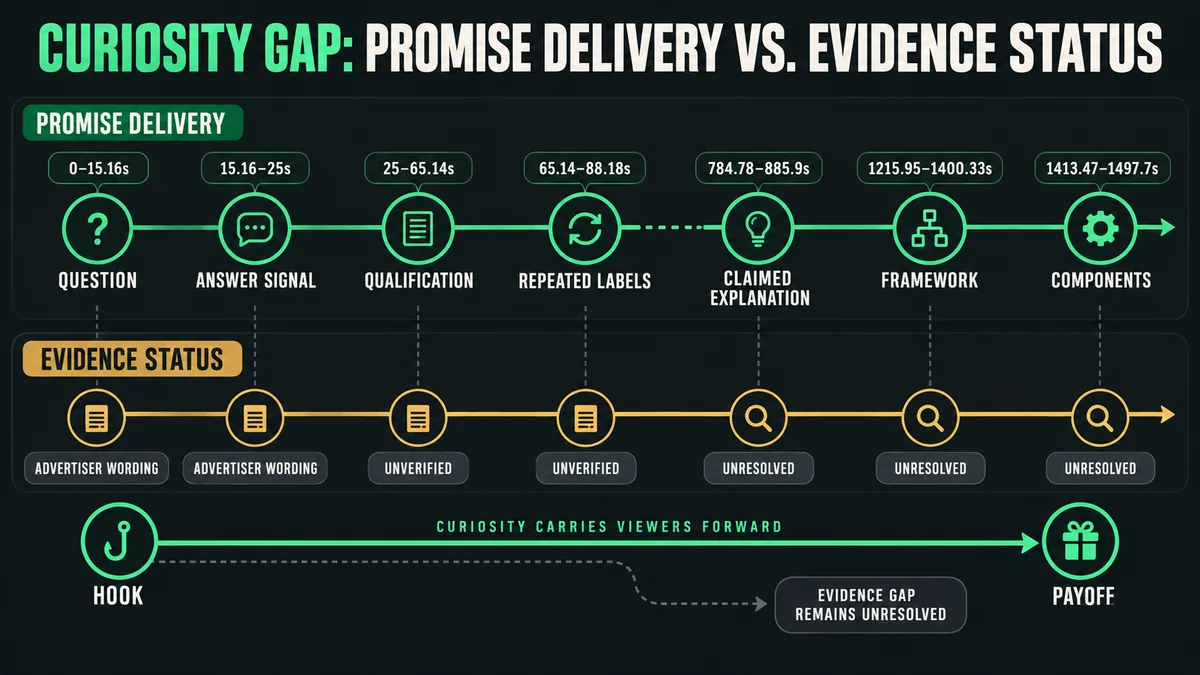
The supplied transcript opens with an explicit question across [0–15.16s].
That opening bundles several implied unknowns together: what the advertiser says NASA observed, what the coined condition means, and what the promoted ritual supposedly does. Because these are different questions, they do not necessarily share one payoff.
The script itself later labels the unresolved NASA thread a “major cliffhanger” at [814.06–815.58s]. That is a revealing structural signal: by this point, the script acknowledges that the earlier thread is still carrying attention forward.
The important editorial observation is not simply that the answer is delayed. It is that **different parts of the opening are paid off at different times and with different levels of specificity**. The claimed NASA connection receives one kind of explanation; the ritual receives another; the proposed components arrive later still.
Calling the first later explanation “the payoff” would hide this fragmentation. A better transcript map treats each promised unknown separately.
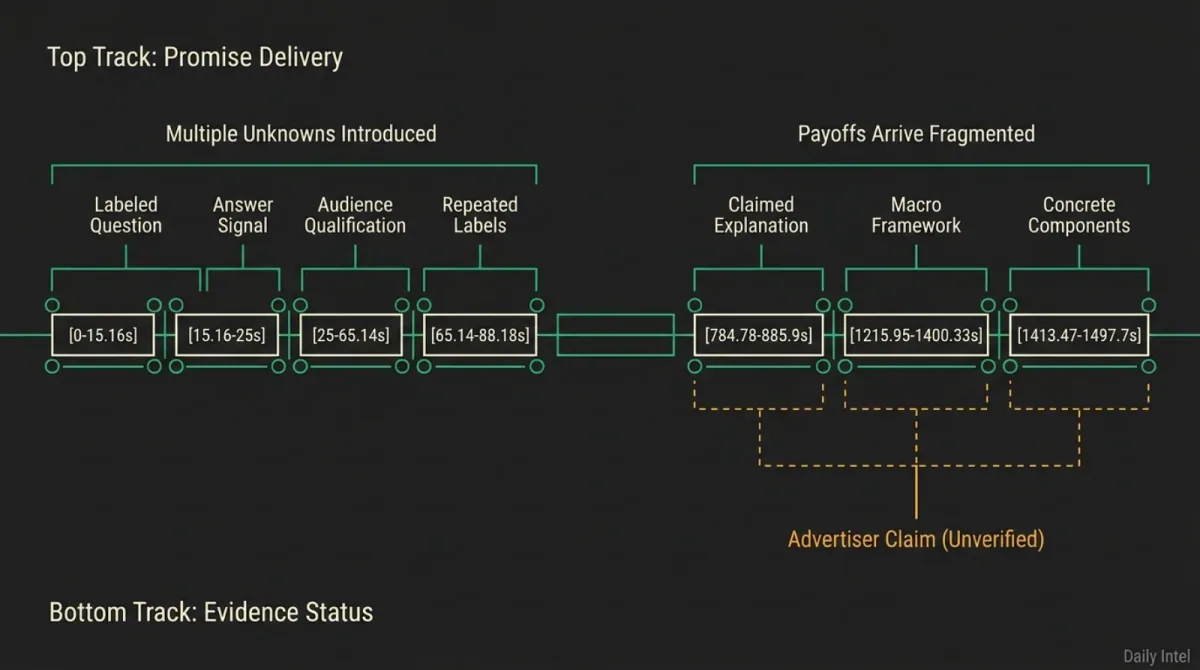
| Transcript beat | Structural job | Audit result |
|---|---|---|
| [0–15.16s] | Introduces the NASA, condition, and ritual threads as one question | Creates several unknowns rather than one precisely bounded gap |
| [15.16–25s] | Announces that an answer exists | Signals a future payoff but does not deliver one |
| [25–65.14s] | Qualifies the intended audience through symptoms and fears | Raises relevance while leaving the opening questions unresolved |
| [65.14–88.18s] | Repeats the advertiser’s mechanism and solution labels | Names the proposed ideas but supplies no verification for them |
| [784.78–885.9s] | Returns to the NASA narrative and expands the claimed mechanism | Provides the advertiser’s explanation after an extended narrative delay |
| [1215.95–1400.33s] | Introduces a three-part solution framework | Supplies a macro-level answer, still as advertiser wording rather than established evidence |
| [1413.47–1497.7s] | Begins naming proposed components | Moves from a branded mystery toward concrete product-related assertions |
The hook-to-payoff method
Use two tracks when reviewing an opening.
Track one: promise delivery
Write the opening unknown as a plain question without promotional language. Then locate the first later beat that attempts to answer it.
Compare the two beats using three checks:
Classify the result as delivered, partially delivered, substituted, or absent.
Track two: evidence status
A structurally complete payoff may still be unsupported. Label the later answer as one of the following:
This second track prevents a common review error: praising a satisfying narrative resolution as though it proves the underlying claim.
- **Object match:** Are they about the same thing?
- **Specificity match:** Is the answer at least as concrete as the question implied?
- **Completion:** Does the viewer receive an answer, or only another reason to keep watching?
- Directly observable within the asset
- Supported by a supplied product or evidence dossier
- Advertiser interpretation
- Advertiser claim requiring verification
- Not assessable from the available material
Worked example: shorten the gap without inventing a product claim
Consider a hypothetical opening for a training VSL aimed at copy researchers. It is an original example, not a report of campaign performance:
> Your VSL opens with three questions, but only one can guide the next beat. Which one should survive the edit?
The opening establishes a specific unknown: which question should remain. It also establishes relevance for someone editing a VSL.
The next beat can deliver the method immediately:
> Underline the audience’s unknown, circle why the answer matters now, and draw a line to the first sentence that resolves it. Keep the question only if all three marks connect.
The payoff is bounded because it answers the same editorial question with an inspectable procedure. It does not promise higher conversion, universal attention, or a winning hook. It gives the viewer a tool that can be evaluated on the page.
A longer version could then demonstrate the procedure:
This is a useful gap because the payoff changes the viewer’s next copy-research action. The explanation does not depend on withholding a secret for several minutes.
- **Unknown:** Which opening question should remain?
- **Importance:** The editor needs one organizing question before story and proof beats are arranged.
- **Payoff:** Keep the question that connects audience, relevance, and a later answer.
- **Verification:** The viewer can mark those elements in the transcript and check the connection.
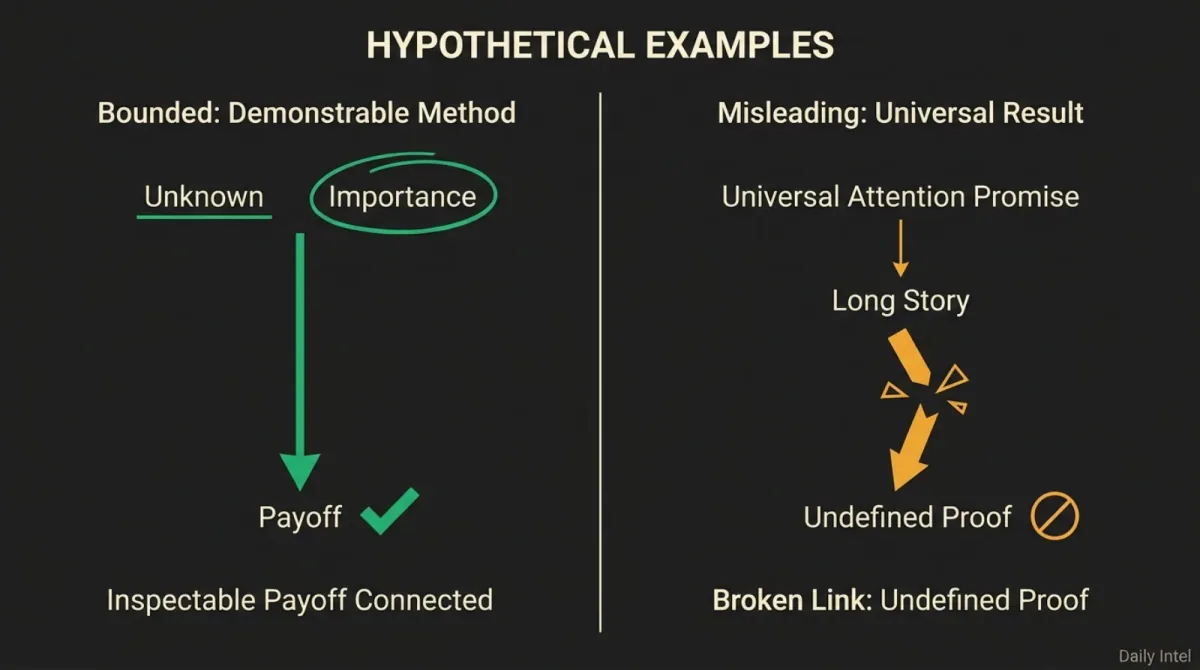
Counterexample: suspense replaces the answer
Now consider this hypothetical opening:
> One overlooked phrase makes every ad impossible to ignore. Stay until the end to see the proof.
This fails before any performance test begins.
First, “impossible to ignore” is an unsupported universal outcome. Second, the unknown is poorly bounded: the viewer does not know whether the promised phrase is a headline pattern, a targeting cue, a proof device, or something else. Third, “the proof” is undefined.
Suppose the next beat tells a long story about a copywriter discovering the phrase but never supplies comparative creatives, audience conditions, or a measurable result. The script may eventually reveal a phrase, yet it has not delivered the promised proof. The reveal and the proof are different payoffs.
The appropriate repair is not to make the mystery louder. Narrow the promise:
> Here is one sentence pattern for stating an audience’s unanswered question. We will mark where its answer appears in the next 30-second script.
That revision promises a demonstration rather than an outcome. The viewer can judge whether the answer appears where promised.
Hook-to-payoff worksheet
Complete one row for every distinct unknown in the opening. Do not compress multiple questions into a single row.
For a dense opening, add a simple promise ledger:
If two rows point to the same vague payoff, the script may be substituting one branded explanation for several distinct answers.
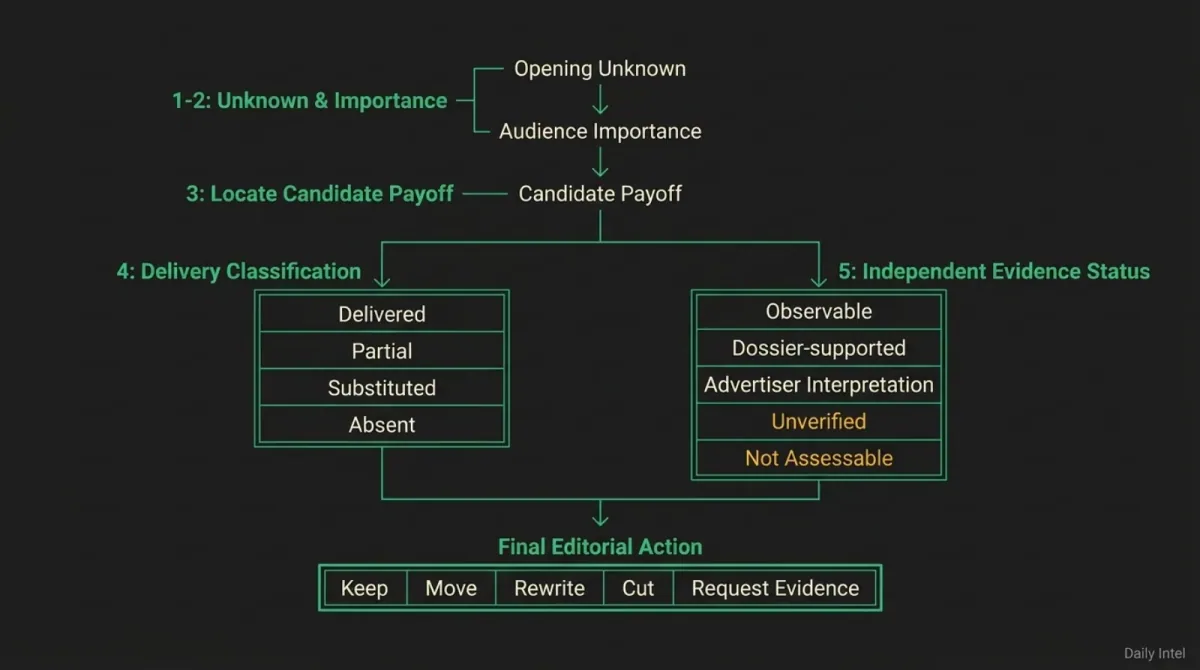
| Field | Entry |
|---|---|
| Asset and version | |
| Intended audience | |
| Opening timestamp | |
| Opening unknown, paraphrased plainly | |
| Why this audience would consider the answer important | |
| Answer type promised: explanation, demonstration, evidence, identity, process, or offer detail | |
| First candidate payoff timestamp | |
| Does it answer the same unknown? | Delivered / Partial / Substituted / Absent |
| What remains unresolved? | |
| Evidence status of the payoff | Observable / Dossier-supported / Advertiser interpretation / Unverified / Not assessable |
| Unsupported claim to remove or qualify | |
| Shorter payoff location available? | |
| Editorial action | Keep / Move / Rewrite / Cut / Request evidence |
A practical test protocol
Run the structural audit before interpreting campaign metrics:
Do not collapse early attention, qualified clicks, and purchases into one result. A higher view rate alone is not proof of better sales. Likewise, a structural repair does not guarantee that any campaign metric will improve.
For the supplied transcript, the next research action would be to obtain an appropriate product dossier and independent primary evidence for any product or health assertion considered for publication. Until then, the timestamp map can support a copy-structure lesson—but not a product recommendation, clinical conclusion, or performance claim.
- Transcribe the opening and preserve exact timestamps.
- Mark every explicit question and implied unknown.
- Paraphrase each unknown without the script’s dramatic language.
- Locate the first candidate payoff for each one.
- Classify delivery as complete, partial, substituted, or absent.
- Label the evidence status independently from the narrative status.
- Rewrite only the failed connection, preserving any useful audience relevance.
- Compare the original and revision under the same declared traffic, audience, placement, and measurement conditions if a campaign test is authorized.
The editorial decision
A curiosity gap is ready for a VSL draft when the editor can state:
If those answers cannot be written in one worksheet row, shorten the gap, separate the bundled questions, or remove the promise. Curiosity can organize a lead. It cannot substitute for delivery or proof.
- what the intended viewer is waiting to learn;
- why that answer is relevant;
- where the matching payoff occurs;
- whether the payoff is a real answer or another open loop; and
- what evidence status applies to it.
Related Daily Intel research
- [big idea unique mechanism copywriting](/blog/networks-and-copy/big-idea-unique-mechanism-copywriting) — Useful adjacent guidance for distinguishing an attention hook from the mechanism and proof sequence that must support it.
- [copywriting frameworks list](/blog/networks-and-copy/copywriting-frameworks-list) — Helps readers place the hook-to-payoff audit inside a wider VSL or MOFU structure without treating one framework as universally effective.
- [toxic bacteria vsl review](/blog/vsl-reviews/toxic-bacteria-vsl-review) — Provides a product-specific example of open-loop withholding and evidence risk, while the present draft supplies the general timestamp-mapping method.
Download the teaching materials
Download the reviewed teaching slides (PDF). The file contains 3 pages and searchable English text.
Methodology and source context
Daily Intel pages are written from a research workflow that reviews active VSLs, Meta ad creatives, transcripts, UTMs, funnel paths, checkout steps, upsells, recovery sequences, and compliance-sensitive claim patterns. The goal is to explain observable market behavior, not to provide legal, medical, or platform policy advice.
For external context, readers should compare advertising and research decisions against authoritative primary references such as Google helpful content guidance, Google SEO link best practices, and Meta Ad Library. Daily Intel adds the proprietary direct-response layer: blackhat, greyhat, and whitehat campaign pattern comparison across VSL-heavy niches and 14+ language markets.
For deeper evaluation, continue through Copywriting research library, VSL Script Generator: Build an Evidence-Led Script From Research to Beat Map, What Is Copywriting? An Evidence-Led Guide, Advertorial vs Editorial: Differences, Tradeoffs, and Message Continuity, Advertorial vs. Landing Page: How to Choose the Right Bridge to Your VSL, and What is a VSL?. These related Daily Intel pages connect this topic to the relevant methodology, pricing, trust context, comparison path, or niche workflow.
Founding rate — locked forever
Access curated VSL intelligence for $29.90/mo
- 50–100 manually validated VSLs every day at 11PM EST
- major niches niches, 14+ languages, blackhat-to-whitehat pattern coverage
- live catalog VSL/ad catalog, transcripts, UTMs, full funnel maps
- Cancel anytime — founding rate stays yours forever
Daily Intel Service delivers manually curated research around active-scaling VSLs, Meta creatives, UTMs, funnels, and nutra market movement.
Frequently asked questions
Continue the research path