Quick answer
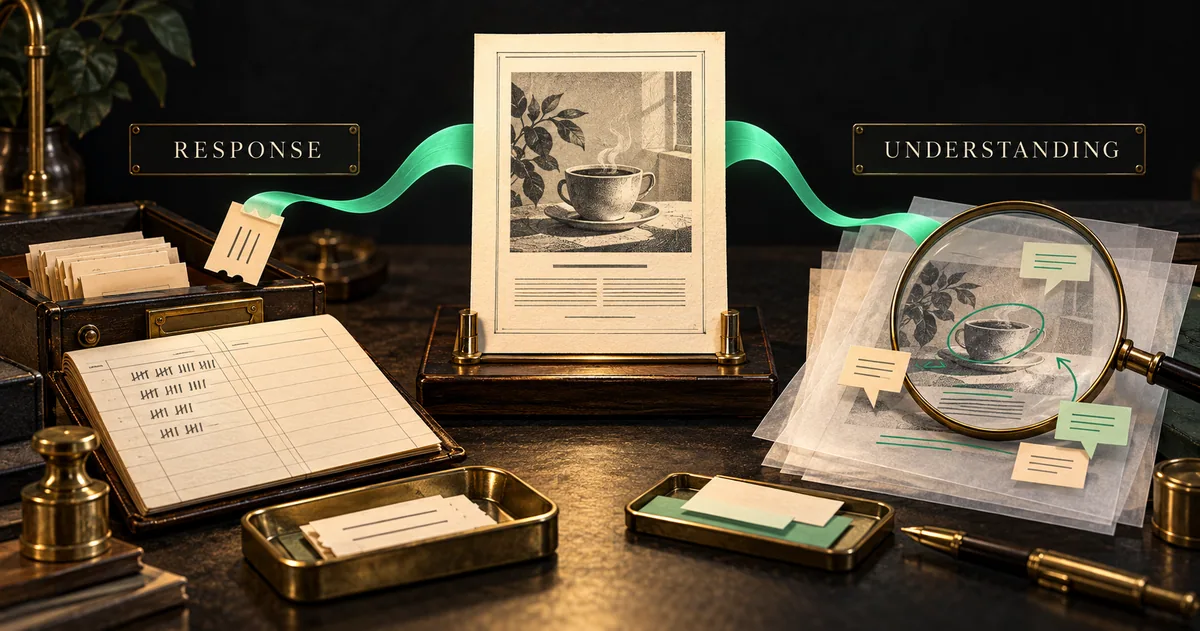
Claude Hopkins and Walter Dill Scott offer a useful historical distinction for copywriters researching an ad or VSL:
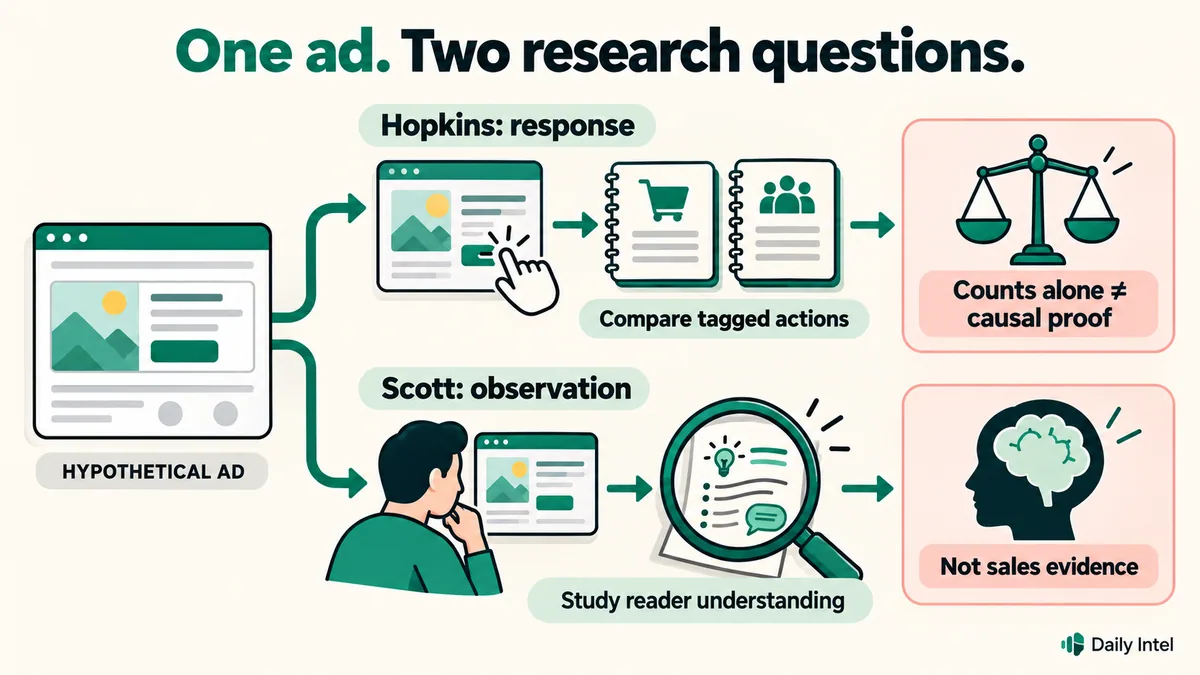
- A response test asks which controlled advertising path generated a traceable action.
- A reader-observation study asks what a bounded group noticed, recalled or understood.
These are complementary questions, not competing claims about a universally superior method. Neither historical approach, by itself, proves why someone acted, validates an advertising claim or predicts modern conversion performance.
The practical difference
| Research question | Hopkins-style response test | Scott-style reader observation |
|---|---|---|
| What is examined? | A traceable action associated with an ad path | What sampled readers notice, recall or understand |
| Typical evidence | Keyed replies, tagged visits, requests or recorded sales | Reader reports, recall notes and coded interpretations |
| What can it support? | A bounded comparison between controlled paths | A bounded description of the sampled readers’ reactions |
| What can it not establish alone? | Attention, comprehension, causation or claim truth | Market response, sales, representativeness or profitability |
| Main design risk | Changing several variables while crediting one | Treating a small convenience sample as the audience |
The working rule is simple: write the research question before choosing the method.
Hopkins: trace the response and preserve the comparison
Hopkins’s described method compares advertising approaches through traceable returns and recorded results. In Scientific Advertising, he writes: “We compare one way with many others, backward and forward, and record the results.” See Claude Hopkins, Scientific Advertising (1923), PDF scan 8.
The surrounding passage describes keyed advertising, coupons, reply costs and comparisons among elements such as headlines, arguments and pictures. That historical account suggests a modern operational discipline:
- Give each ad path a distinct identifier.
- Define the response event before launch.
- Keep the offer, audience, placement and measurement window aligned where possible.
- Record the relevant denominator, not just the response count.
- Limit the conclusion to the comparison that was actually run.
A tagged URL is a contemporary analogue to a keyed coupon, but tagging does not make the design controlled. If one path receives different traffic, a different price and a different landing page, its identifier reveals where responses arrived—not which copy element caused the difference.
Hopkins’s broad certainty language belongs to a 1923 practitioner text. It should not be treated as contemporary causal evidence or a guarantee that a historical advertising rule will transfer to a current platform.
Scott: observe the reader without turning observation into sales evidence
Scott’s supplied passage narrows a broad profitability question to what he calls attention value and then describes an advertisement test. Scott’s supplied example used forty students and one current magazine issue. His description begins: “I handed each of the forty students in my class a copy of the current issue of the Century Magazine.” See Walter Dill Scott, The Psychology of Advertising (1913), printed page 159.
That setup has immediate limits. It concerns one classroom sample, one publication issue and a historically specific reading environment. It does not establish how all readers behave, what current platform users notice or whether an advertisement produces profitable action.
For a modern copywriter, the transferable lesson is narrower: reader observation can expose what a selected group attends to or takes away from the material. A present-day session might investigate:
- Which idea participants mention without prompting.
- How they explain the offer in their own words.
- Whether they can identify the price and next step.
- Which statement they misunderstand.
- What they believe still requires evidence.
Those observations remain sample-bound. Recall is not the same as comprehension, and neither is the same as purchase intent or response.
A private VSL observation shows why the questions must remain separate
A sampled private VSL provides a structural example without supplying verified claims or performance evidence. Its opening moves from a curiosity-led question at 0–25.00s, through problem agitation at 28.78–60.42s, to a named explanatory mechanism at 60.42–88.18s. It later returns to an earlier unresolved question at 814.06–831.94s, promises a later proof discussion at 1693.10–1709.90s, and shifts from problem framing into cost and price presentation at 2664.06–2750.24s.
These timestamps document sequence only. They do not verify the speaker’s medical assertions, identities, testimonials, offer terms or results.
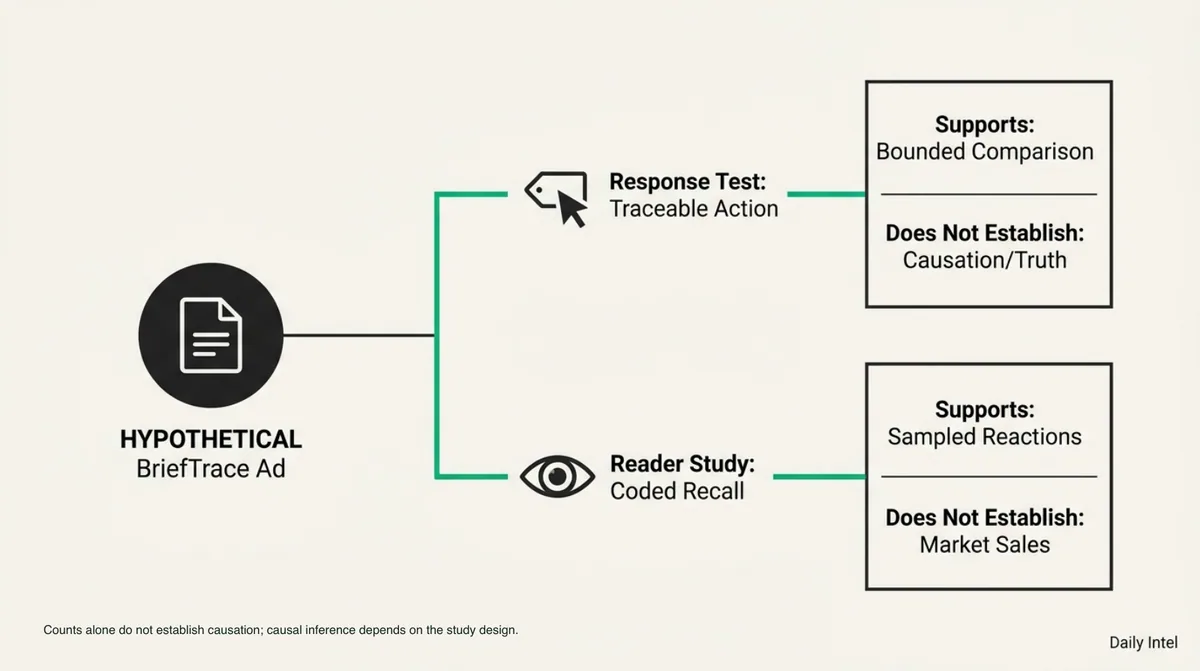
A response test could compare which opening path is associated with a predefined action. A reader-observation session could ask what proposition participants think the opening made, what evidence they expect and whether they understand the eventual offer. Neither result would establish that the VSL’s health mechanism is true.
Worked example: two questions for one fictional ad
Assume a copywriter is preparing an ad for BriefTrace, an entirely fictional workspace that connects saved advertisements to source notes. The invented offer is a 14-day trial followed by a clearly disclosed monthly charge.
Two headline drafts are under consideration:
Draft A: Your swipe file is full. Can you still find the evidence?
Draft B: Build every ad brief with a source trail.
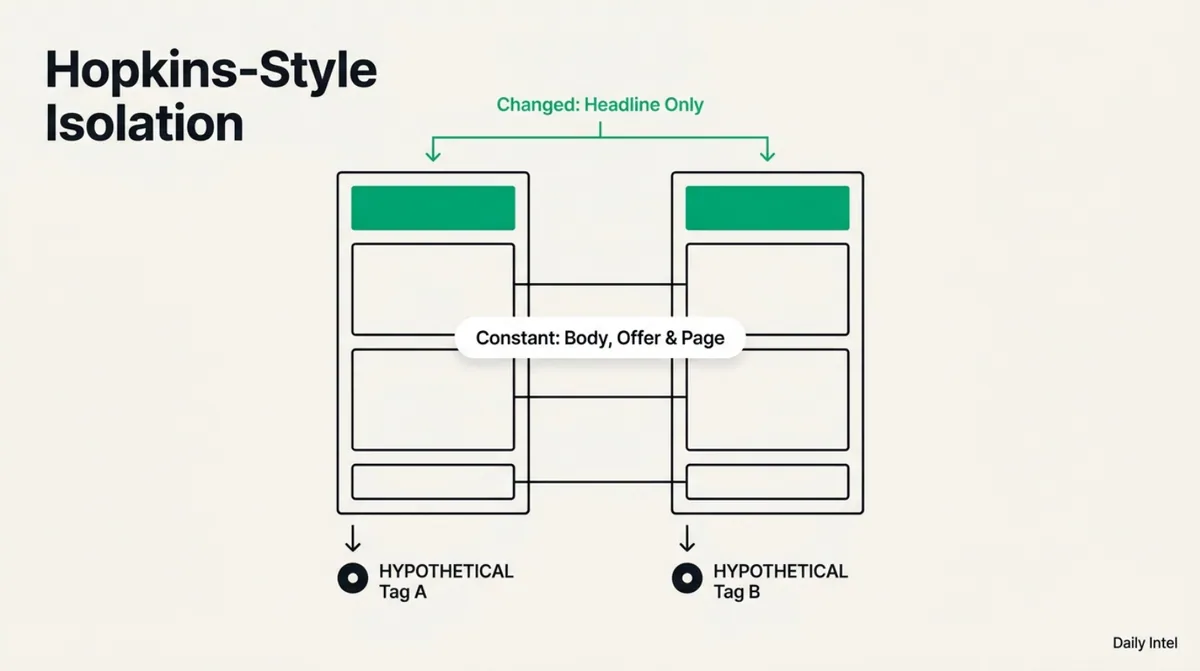
Both drafts use the same body copy, visual, landing page, trial terms and call to action: Review the sample brief.
Question one: which headline path produces the defined response?
A Hopkins-style plan would be:
- Randomly assign otherwise eligible impressions to Draft A or Draft B where the platform permits it.
- Use a distinct tag for each path.
- Define the primary response as a completed sample-brief request—not a click, impression or unspecified engagement.
- Record exposures, verified landing visits, completed requests, spend and measurement window separately.
- Check that the landing page displays the post-trial price, billing cadence and cancellation terms consistently.
- Compare the recorded paths only after the log is complete.
This design could support a bounded statement about which path was associated with more of the predefined responses under the recorded conditions. It would not reveal whether readers understood the product, why they acted or whether the headline alone caused a difference if delivery was uneven.
Question two: what do selected readers understand after seeing each draft?
A Scott-inspired—but fully original—reader protocol would be:
- Recruit a declared sample of people who actually write or review ad briefs.
- Record how they were recruited and why they may differ from the intended market.
- Randomly show each participant one draft under a consistent viewing condition.
- Remove the ad and ask an unprompted question: What was this offer asking you to do?
- Ask participants to explain the product, trial terms and next step in their own words.
- Ask what claim they would need substantiated before acting.
- Code responses using categories fixed before reviewing the answers: correct offer, incorrect offer, correct terms, missed terms, unsupported inference and unresolved question.
This session could identify misunderstandings within that sample. It could not forecast conversion or establish that the broader market would react the same way. The recall and comprehension prompts are an original extension for the present brief, not a claim that Scott used this exact protocol.
Counterexample: when the methods are applied to the wrong problem
Suppose Draft A runs as a short video to a warm retargeting audience, while Draft B runs as a static image to cold traffic. Draft A also uses a different landing page and omits the post-trial price.
The tags would still identify the response paths, but the comparison would not isolate the headline. Format, audience, landing experience and term visibility all changed.
Now suppose the reader session recruits only employees who already know the fictional product. Their explanations may be clear because of prior knowledge. That observation would say little about first-time prospects.
Combining these two weak designs would not repair them. The response log and reader notes would simply describe two differently biased exercises.
A further mismatch occurs when the business question is claim substantiation. Neither a tagged response nor a participant’s recollection can prove that an objective health, financial or performance claim is true. That question requires evidence appropriate to the claim.
The two-question copy-research worksheet
Complete one worksheet for each proposed comparison.
| Field | Response-testing entry | Reader-observation entry |
|---|---|---|
| Decision to make | Which controlled path advances? | Which message needs clarification? |
| Exact research question | Which path records more of the predefined response? | What does the declared sample notice or understand? |
| Unit shown | Ad path, headline or complete execution | The exact stimulus each participant sees |
| Variables held constant | Audience, format, offer, terms, page and window | Exposure condition, prompt order and coding rules |
| Deliberate difference | One named variable | One named message difference |
| Sample or traffic source | Eligibility, allocation and exclusions | Recruitment source, relevant experience and exclusions |
| Primary measure | Predefined response plus denominator | Predefined observation or comprehension category |
| Terms check | Price, billing, eligibility, delivery and cancellation | Whether participants can accurately explain those terms |
| Known confounders | Delivery, tracking loss, page speed or unequal spend | Prior knowledge, facilitator cues or convenience sampling |
| Permitted conclusion | Bounded comparison between logged paths | Bounded description of the sampled readers |
| Prohibited conclusion | Why people acted; universal performance | Market conversion; profitability; population-wide behavior |
| Next evidence needed | Replication or a more controlled comparison | Revised copy and a new, appropriately recruited session |
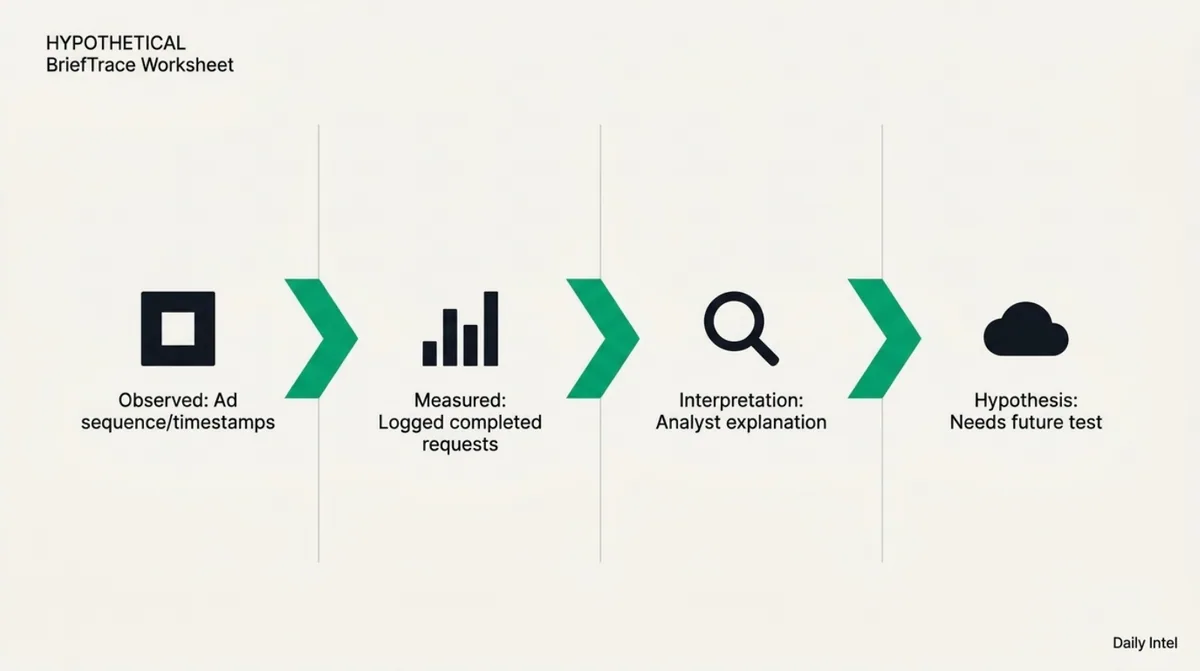
Evidence-labeling protocol
Use one of four labels beside every note:
- Observed: Directly present in the ad, transcript, reader response or source.
- Measured: Recorded under a stated protocol with a defined unit and denominator.
- Interpretation: The analyst’s explanation of an observation or measurement.
- Hypothesis: A proposition requiring a future test or another form of evidence.
For example, “the mechanism label appears before the authority segment” is a structural observation when supported by timestamps. “That order increases trust” is a hypothesis unless an appropriate study measures that effect. “Draft A produced more qualified requests” would be a measured claim only after a real, adequately documented comparison—not in this fictional exercise.
The next research action
Before launching another ad, write two separate sentences:
- Response question: Which controlled path is associated with the action we have defined?
- Reader question: What does our declared sample notice, understand or misinterpret?
Then complete the worksheet twice. Confirm that the offer’s cost and terms are visible before interpreting a response as commercially useful. If the response log and reader observations point in different directions, preserve the disagreement: a message can invite action without being understood, or be understood without producing the selected action.
That divergence is not a failed research project. It is the reason the two questions should never be collapsed into one.
Related Daily Intel research
- creative research methods what the evidence shows — Provides broader context on contemporary creative-research artifacts and the limits of treating persistence or visible activity as performance evidence.
- attention research and copy length — Extends the distinction between attention observations and unsupported conclusions about copy length or conversion.
- avatar research for copywriters — Supports the worksheet’s evidence-tagging discipline and explains why sampled customer language must not be treated as market prevalence.
- how do ad spy tools get their data methods compared — Helps readers distinguish traceable ad-library observations from unavailable conversion and post-click evidence.
Download the teaching materials
Download the reviewed teaching slides (PDF). The file contains 3 pages and searchable English text.
Methodology and source context
Daily Intel pages are written from a research workflow that reviews active VSLs, Meta ad creatives, transcripts, UTMs, funnel paths, checkout steps, upsells, recovery sequences, and compliance-sensitive claim patterns. The goal is to explain observable market behavior, not to provide legal, medical, or platform policy advice.
For external context, readers should compare advertising and research decisions against authoritative primary references such as Google helpful content guidance, Google SEO link best practices, and Meta Ad Library. Daily Intel adds the proprietary direct-response layer: blackhat, greyhat, and whitehat campaign pattern comparison across VSL-heavy niches and 14+ language markets.
For deeper evaluation, continue through Copywriting research library, How to Build a Sales Letter Landing Page Around One Clear Idea, Sales Letter vs Sales Page: Differences, Tradeoffs, and Examples, Sales Page Copy: The Evidence-Led Guide to Message Hierarchy, Sales Page Copy Template: A Section-by-Section Working Framework, and What is a VSL?. These related Daily Intel pages connect this topic to the relevant methodology, pricing, trust context, comparison path, or niche workflow.
Founding rate — locked forever
Access curated VSL intelligence for $29.90/mo
- 50–100 manually validated VSLs every day at 11PM EST
- major niches niches, 14+ languages, blackhat-to-whitehat pattern coverage
- live catalog VSL/ad catalog, transcripts, UTMs, full funnel maps
- Cancel anytime — founding rate stays yours forever
Daily Intel Service delivers manually curated research around active-scaling VSLs, Meta creatives, UTMs, funnels, and nutra market movement.
Frequently asked questions
Continue the research path