The report must survive a second analyst
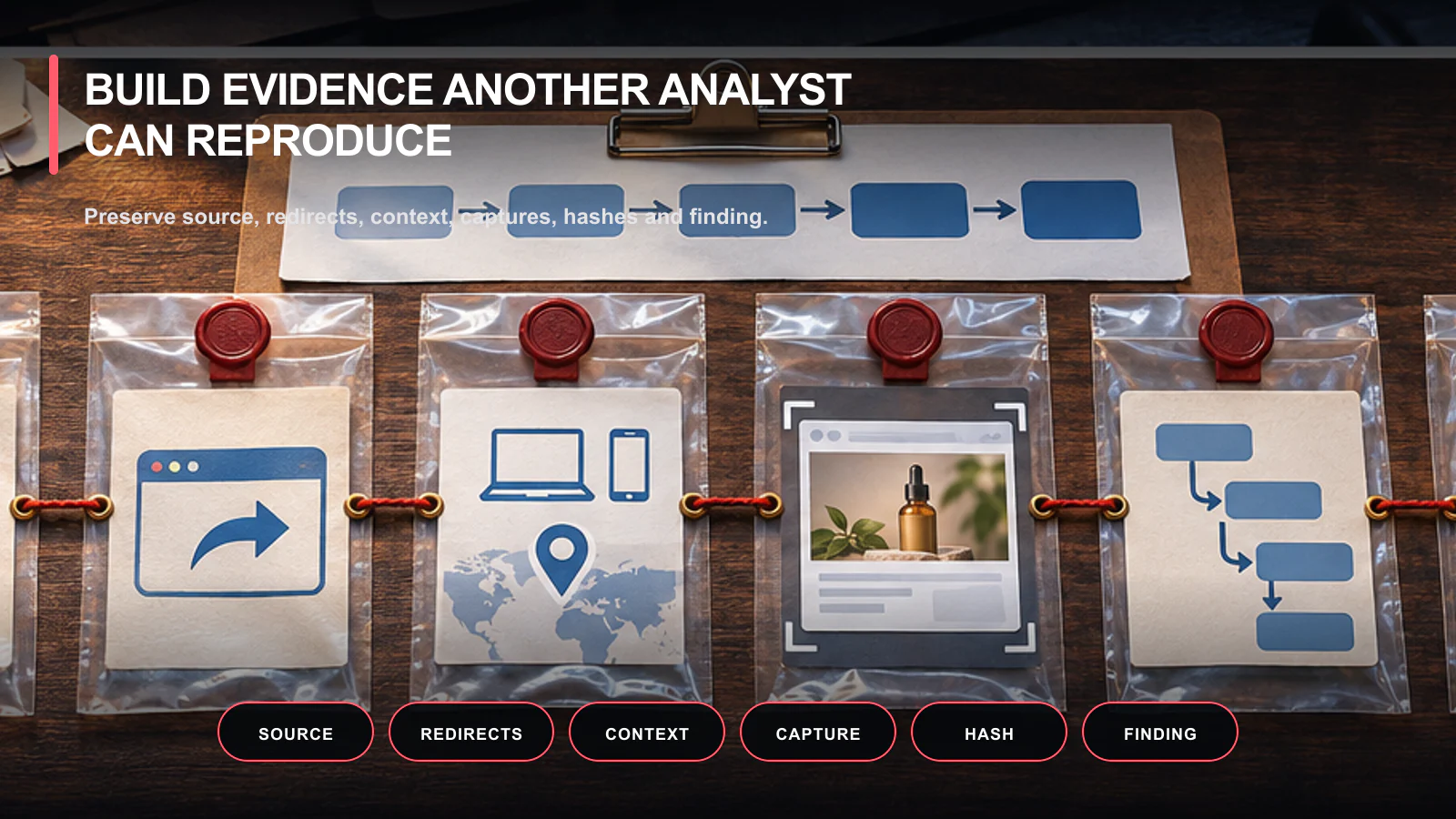
A screenshot without context is an illustration, not a reproducible finding. The second analyst needs the exact starting point, the context in which it was opened, the route the browser followed, and the files that support the conclusion. Build the record as you observe the funnel; reconstructing it later introduces memory and naming errors.
The goal is not to collect the most data. It is to preserve the minimum chain that answers three questions: what did we start from, what did we observe, and what changed when one controlled variable changed?
Welche Metadaten müssen jede Erfassung begleiten?
Jede Erfassung braucht mindestens sechs Felder, sonst ist es kein Beweis, sondern nur ein Bild. Prüfer bewerten einen Bericht nach dem, was den Screenshot umgibt, nicht nach dem Screenshot selbst.
- UTC-Zeitstempel mit Zeitzonenoffset, entnommen aus der Systemuhr des Capture-Tools, nicht manuell eingetippt
- Vollständige ausgehende Request-Daten: Methode, URL, gesendete Header und Referrer-Kette
- Ursprungs-IP-Adresse und die registrierte ASN/Geolokalisierung, da sich eine Residential-IP in Ohio anders verhält als eine Rechenzentrums-IP in Amsterdam
- Geräte- und Browser-Fingerprint: User-Agent-String, Bildschirmauflösung und ob JavaScript ausgeführt wurde
- Vollständige rohe Response-Header, einschließlich jeder Redirect-Kette mit Statuscodes bei jedem Hop
- Ein kryptografischer Hash (SHA-256 ist Standard) der gespeicherten HTML-Datei, zum Zeitpunkt der Erfassung erzeugt
During navigation: record context and every hop
For each observation, record device class, browser version, viewport, country, network category, referrer path, cookie or login state, and whether the click began inside the original platform. These fields explain differences without pretending the analyst knows the cloaker's internal rules.
Capture each 3xx response and Location target where tooling permits, plus any client-side redirect visible after render. MDN documents that HTTP redirects use 3xx responses and a Location header; JavaScript and meta-refresh transitions need separate notation because they are not the same evidence. See HTTP redirections and the Location header.
After render: describe content, not intent
Intent belongs in the analysis section, not the observation log. Write 'the desktop view ended at a general article; the original mobile ad click ended at a checkout for Product X' before writing 'this pattern is consistent with cloaking.' The first sentence is evidence. The second is an inference.
| Field | Record | Avoid |
|---|---|---|
| Identity | Named product, seller, domain | It was obviously a scam |
| Claim | Exact visible claim or bounded paraphrase | Aggressive claims |
| Commercial action | Checkout, lead form, phone call, no action | Calling it a money page without evidence |
| Difference | What changed between controlled views | The cloaker detected us |
| Confidence | Observed, inferred, unresolved | Claiming certainty without reproducibility |
File integrity and chain of custody
A checksum does not prove the page was truthful. It proves the retained file has not changed since the checksum was calculated. That narrower claim is exactly what a chain of custody needs.
- Use stable filenames that include case ID, observation ID and timestamp.
- Retain the original file and make annotations on a derivative copy.
- Calculate SHA-256 for captures, HAR files and exported HTML.
- Record who captured, reviewed and modified each artifact.
- Remove secrets, personal data and payment details before wider sharing.
- Keep an access-controlled original when redaction changes the visible evidence.
A compact finding template
Use this structure: 'On [date and timezone], observation A began from [ad ID and untouched URL] in [context] and ended at [destination and offer]. Observation B changed only [variable] and ended at [destination and offer]. The product, claim, or transaction path [did/did not] materially change. The result reproduced [count] times. This is [consistent with / insufficient to establish] cloaking because [bounded reason].'
Attach a limitations line: what could not be observed, which variable was not controlled, and what evidence would change the classification. Then link the record to the false-positive diagnostic, the Meta cloaker research guide, and the cross-domain clustering method if the campaign moved between domains.
Methodik und Quellenkontext
Daily Intel pages are written from a research workflow that reviews active VSLs, Meta ad creatives, transcripts, UTMs, funnel paths, checkout steps, upsells, recovery sequences, and compliance-sensitive claim patterns. The goal is to explain observable market behavior, not to provide legal, medical, or platform policy advice.
When the topic touches health claims, platform policy, or GLP-1 market research, validate the observable campaign signals against primary references such as Meta advertising standards, FTC health claims guidance, and Google helpful content guidance. Daily Intel adds the proprietary direct-response layer by mapping how those rules show up in active VSLs, Meta creatives, funnels, transcripts, UTMs, and checkout paths.
For deeper evaluation, continue through Daily Intel compliance and legal disclaimer, Rogue Affiliate Cloaking: How Offer Owners Detect It, Affiliate Network Rules on Cloaking: ClickBank to BuyGoods, Testimonial Disclaimers in Supplement Ads: What's Required, Are Antidetect Browsers Legal for Ad Research? 2026, and What is a VSL?. These related Daily Intel pages connect this topic to the relevant methodology, pricing, trust context, comparison path, or niche workflow.
Founding rate — locked forever
Kuratierte VSL-Intelligence für $29.90/Monat
- 50–100 manually validated VSLs every day at 11PM EST
- major niches niches, 14+ languages, blackhat-to-whitehat pattern coverage
- live catalog VSL/ad catalog, transcripts, UTMs, full funnel maps
- Cancel anytime — founding rate stays yours forever
Daily Intel Service liefert manuell kuratierte Recherche zu aktiv skalierenden VSLs, Meta-Creatives, UTMs, Funnels und Bewegungen im Nutra-Markt.
Häufig gestellte Fragen
Was ist die Mindestmenge an Beweisen, um einen getarnten Funnel für die Compliance zu dokumentieren?
Eine gematchte Paar-Erfassung mit vollständigen Request-/Response-Headern, Zeitstempeln, Ursprungs-IP, Geräte-Fingerprint und einem Inhalts-Hash ist die Untergrenze. Alles Dünnere - ein einzelner Screenshot, keine Header, kein Kontrollvergleich - wird eher als nicht verifizierbar abgewiesen als inhaltlich geprüft.Zählt ein Screenshot allein als Compliance-Beweis?
Nein, ein Screenshot beweist nur, dass ein Bild existiert, nicht wie oder unter welchen Bedingungen es erstellt wurde. Kombinieren Sie ihn mit rohem HTML, Response-Headern und einem Zeitstempel aus einer Quelle, die Sie nicht kontrollieren, sonst wird der Betreiber einfach behaupten, er sei gefälscht.Wie lange sollten erfasste Beweise aufbewahrt werden?
Aufbewahrungsfristen variieren je nach Netzwerk und Zuständigkeit, also bestätigen Sie die aktuellen Anforderungen, bevor Sie sich auf eine feste Zahl verlassen; ein Jahr ist für die meisten Beschwerdezyklen von Affiliate-Netzwerken ein sinnvoller Arbeitsstandard. Bewahren Sie die Originaldateien und Hashes während dieses gesamten Zeitraums unverändert auf, getrennt von allen Arbeitskopien, die Sie kommentieren.
Setzen Sie den Rechercheweg fort