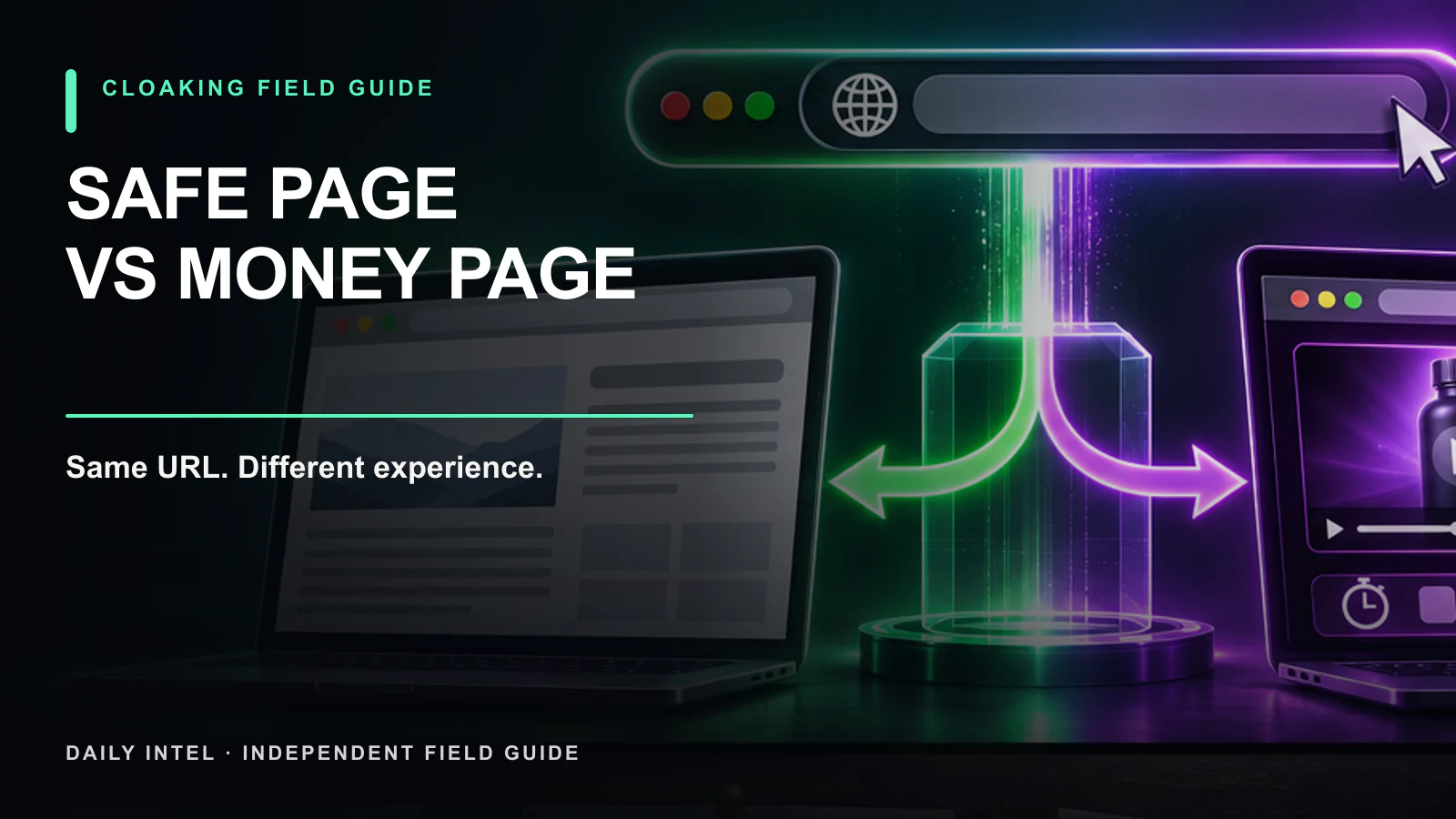
The three terms answer different questions
A white page describes what the page contains: a compliant, public-facing experience. A safe page describes what the page does inside a routing system: it is the version selected for a reviewer, crawler, or visitor scored as risky. A money page is the commercial destination selected for the visitor the system wants to monetize. One page can look white without being part of a cloak; the split is what matters.
Meta defines cloaking as disguising an ad's true destination or destination-page content to bypass review. Google draws the same boundary more precisely: language, location, offers, and connection-speed adaptations can be legitimate when the promoted product stays the same, while showing Google a compliant destination and users a prohibited one is not. Those definitions make intent observable through continuity: did the product, claim set, or transaction path materially change? See Meta's description of cloaking and Google Ads' current circumventing-systems policy.
| Question | White page | Safe page | Money page |
|---|---|---|---|
| Who sees it? | Usually everyone | Reviewers, crawlers, or flagged visitors | Visitors admitted by the routing rules |
| Is a second version required? | No | Yes, otherwise it is not a split | Yes, paired with another experience |
| Does the promoted offer stay the same? | Normally yes | May hide or soften the actual offer | Carries the actual commercial path |
| Strongest evidence | Consistent content across contexts | Repeated reviewer-linked selection | Repeated buyer-linked selection |
A controlled comparison beats a dramatic screenshot
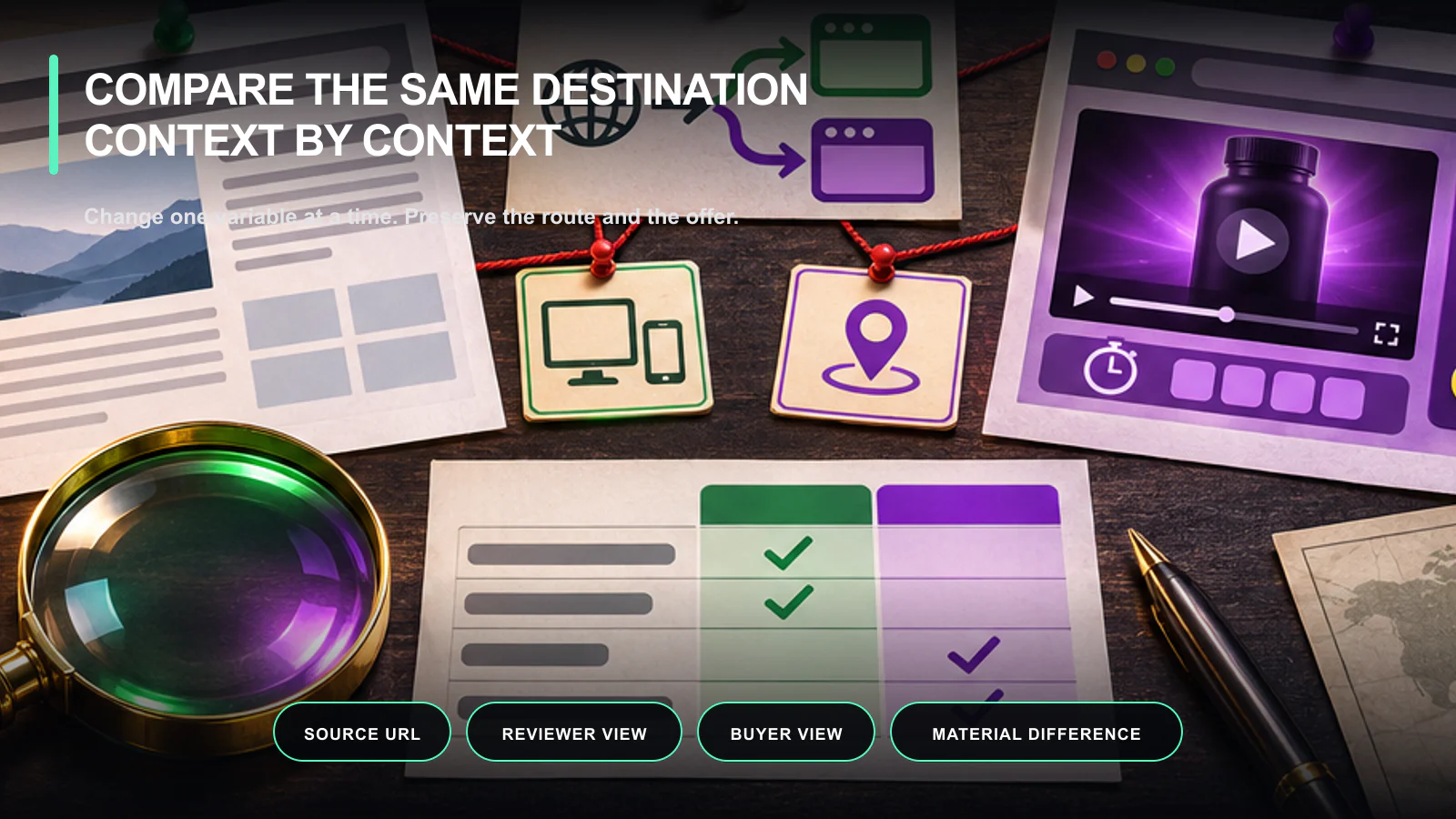
Start with one ad, one click URL, and a timestamp. Preserve the complete URL before opening it. Then compare observations in a small matrix: ordinary desktop and mobile, the advertised country and one out-of-market country, and the original ad click versus a direct revisit. Change one variable at a time. If five variables move together, you learn only that the page changed.
The first capture is not the truth and the second is not automatically the reveal. A campaign may expire between visits. A consent wall may disappear after a cookie is stored. A responsive layout may move the CTA without changing the offer. Record status codes, final URLs, product identity, headline claim, and whether checkout exists. Those fields let another analyst reproduce the observation.
Ten differences worth annotating
No single difference proves a cloak. The strongest case combines a material offer change, a repeatable context-dependent split, and a preserved redirect chain. That is why the annotated comparison should sit beside the raw captures rather than replace them.
- Product identity: category-only content versus a named offer or seller.
- Claim intensity: general education versus a specific outcome or guarantee.
- Commercial action: no transaction path versus a checkout or lead form.
- Destination: identical final URL versus a different domain or path.
- Redirect count: stable route versus an extra conditional hop.
- Media: stock editorial image versus an autoplay VSL or product demo.
- Price and continuity: no terms versus a price, subscription, or upsell path.
- Urgency: neutral page versus timers, scarcity, or limited-availability prompts.
- Entity: the same advertiser and product versus an unrelated merchant or offer.
- Persistence: a repeatable split versus a one-time error, experiment, or outage.
Five false positives to eliminate first
Our dedicated cloaker-versus-dynamic-content field guide turns these checks into a triage sequence. Use it before labeling a campaign.
| Looks suspicious | Common benign cause | Check |
|---|---|---|
| Different country, different page | Localization or availability rules | Is the product still the same? |
| Mobile and desktop diverge | Responsive or device-specific UX | Do claims and transaction destination match? |
| A later visit changes | A/B assignment or campaign expiry | Does the variant persist with the same cookie? |
| Direct visit shows less | Missing click token or session state | Does the original ad click restore the same offer? |
| Crawler sees a wall | Consent, login, or bot protection | Can an ordinary user reach the same content without identity-based selection? |
Ist eine White Page dasselbe wie eine Safe Page?
Nein, eine White Page ist nicht dasselbe, obwohl Anbieter und Forenthreads die beiden Begriffe oft austauschbar verwenden. Eine White Page ist die gesamte, dauerhafte Front einer vollständig konformen Kampagne - die einzige Seite, die existiert, allen gezeigt wird und keine versteckte zweite Version hat. Eine Safe Page hingegen ist eine Hälfte eines absichtlichen Paares; sie existiert nur, um eine Money Page zu schützen, die allein die Prüfung nicht bestehen würde.
The next step is not to copy the hidden page. It is to understand the funnel you were previously missing: hook, mechanism, offer, checkout continuity, and traffic-source fit. Continue with the research-oriented guide to seeing cloaked affiliate funnels, or use the cloaked-funnel evidence log when the finding needs to survive review by another person.
Methodik und Quellenkontext
Daily Intel pages are written from a research workflow that reviews active VSLs, Meta ad creatives, transcripts, UTMs, funnel paths, checkout steps, upsells, recovery sequences, and compliance-sensitive claim patterns. The goal is to explain observable market behavior, not to provide legal, medical, or platform policy advice.
For educational pages, the supporting references should help readers verify search, crawlability, and public ad research context, especially Google helpful content guidance, Google SEO link best practices, and Meta Ad Library. Daily Intel then adds the direct-response interpretation layer so the page explains what the signal means for actual affiliate research decisions.
For deeper evaluation, continue through Direct response glossary hub, Copywriting Podcasts for DR Writers: What's Live, What's an Archive, The 9 Direct Response Books That Still Print Money in 2026, Reddit for Nutra Media Buyers: 8 Subs and How to Read Them, STM Forum vs affLIFT: Which Paid Community Pays for Itself, and What is a VSL?. These related Daily Intel pages connect this topic to the relevant methodology, pricing, trust context, comparison path, or niche workflow.
Founding rate — locked forever
Kuratierte VSL-Intelligence für $29.90/Monat
- 50–100 manually validated VSLs every day at 11PM EST
- major niches niches, 14+ languages, blackhat-to-whitehat pattern coverage
- live catalog VSL/ad catalog, transcripts, UTMs, full funnel maps
- Cancel anytime — founding rate stays yours forever
Daily Intel Service liefert manuell kuratierte Recherche zu aktiv skalierenden VSLs, Meta-Creatives, UTMs, Funnels und Bewegungen im Nutra-Markt.
Häufig gestellte Fragen
Ist der Betrieb eines Safe-Page-und-Money-Page-Paares illegal?
Der Betrieb des Paares ist in den meisten Rechtsordnungen nicht illegal, verstößt aber fast immer gegen die Nutzungsbedingungen der Werbeplattform. Facebook, Google und die meisten nativen Netzwerke verbieten ausdrücklich, Prüfern eine andere Seite zu zeigen als die, die zahlende Besucher sehen, und Verstöße enden typischerweise mit einer Kontosperre statt mit rechtlichen Schritten.Wie entdecken Werbeplattformen das Cloaking normalerweise?
Werbeplattformen entdecken das Cloaking normalerweise durch erneutes Crawling, Nutzerberichte oder automatischen Musterabgleich über bekannte Cloaking-Domains hinweg. Ein Re-Crawl von einer Residential-IP oder eine Meldung eines Konkurrenten legt die Abweichung oft innerhalb weniger Tage offen, obwohl ein gut aufgebautes Setup wochenlang unentdeckt laufen kann.Nutzen alle Affiliate-Angebote eine Safe Page?
Nein, die meisten Affiliate-Angebote laufen mit nur einer konformen Seite ohne Trennung. Das Safe-Page/Money-Page-Muster taucht vor allem in eingeschränkten oder grenzwertigen Verticals auf - Supplements mit aggressiven Behauptungen, Crypto, Kreditreparatur - wo das echte Angebot die Prüfung aus eigenen Verdiensten nicht bestehen kann.
Setzen Sie den Rechercheweg fort