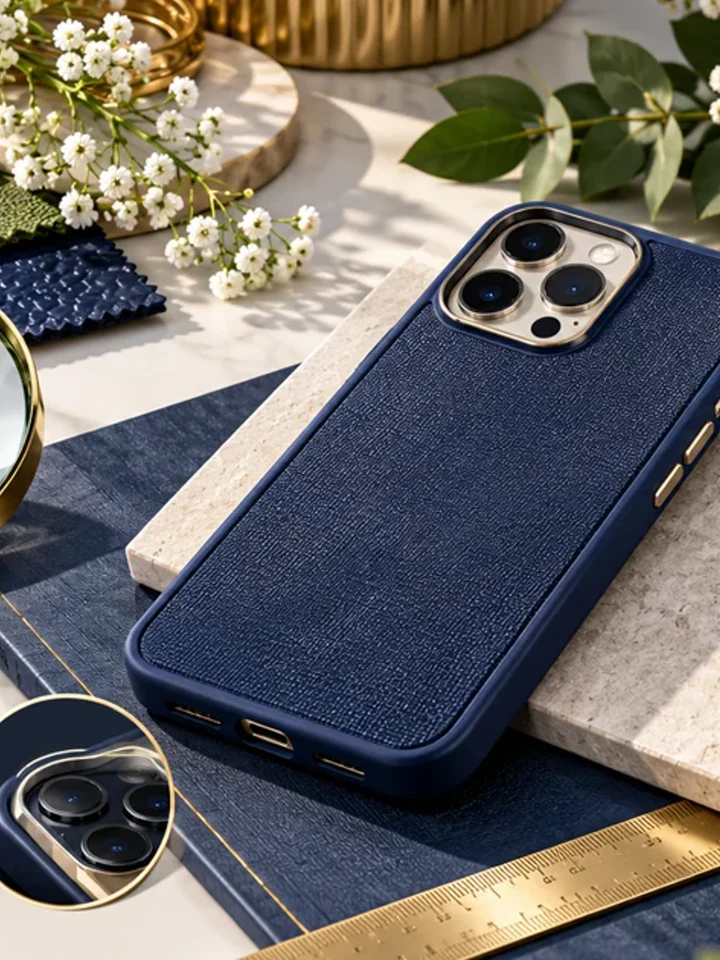
Case-Mate Review: Product Fit Matters More Than Style
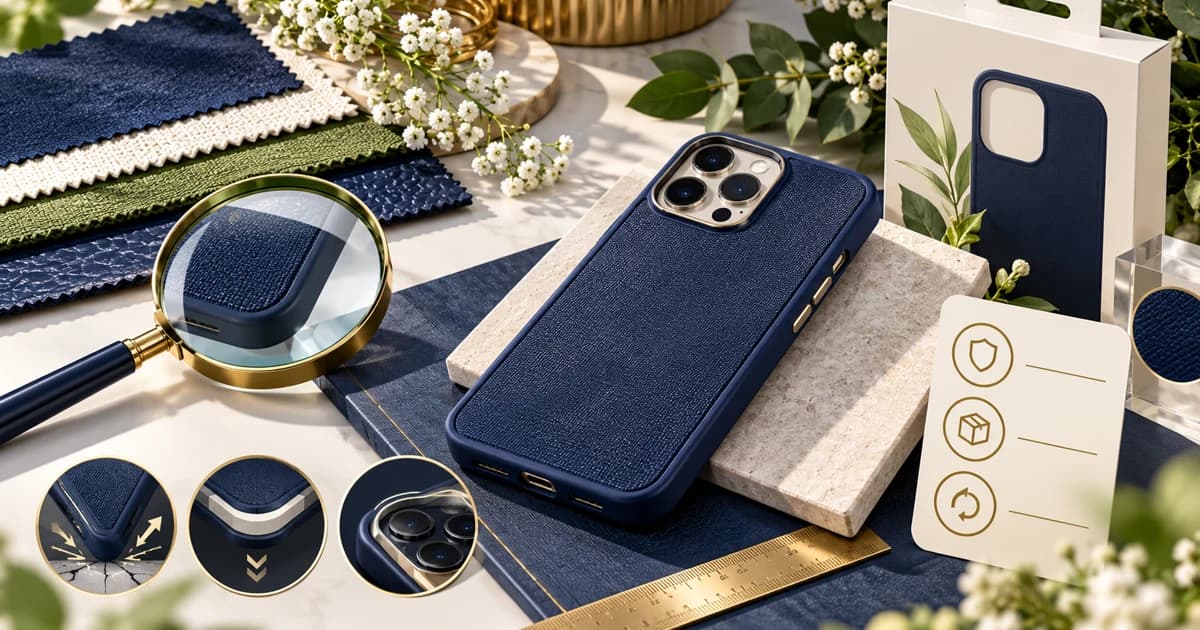
Case-Mate operates a broad storefront for phone cases, jelly totes, pouches, and tech accessories. The available evidence supports evaluating each exact item separately because compatibility, performance claims, warranty coverage, fulfillment, and total cost vary by product and buying path.
8,226+
Videos & Ads
+50-100
Fresh Daily
$29.90
Per Month
Full Access
12.5 TB database · 72+ niches · 28 min read
Commission disclosure: Daily Intel may earn a commission if a reader purchases through the commercial link associated with this review. That relationship does not change our evidence standard or conclusion. The captured publisher link was deliberately not opened during research, so its current tracking redirect remains unverified. Confirm that it reaches Case-Mate before entering information or purchasing.
Case-Mate is worth considering only after you identify the exact accessory and verify that it fits your hardware, intended environment, budget, and tolerance for ownership friction. The supplied evidence confirms a broad storefront containing phone cases, jelly totes, pouches, organizers, and other tech accessories. It does not support one verdict for everything sold under the Case-Mate name.
That distinction drives this Case-Mate review. A phone case may look suitable while being wrong for the buyer’s device or charging setup. A tote may match the desired style while leaving its dimensions, construction, closure, or water-exposure limits unclear. A warranty can provide a remedy for a qualifying defect without covering normal wear, accidental damage, or the device placed inside the accessory.
The strongest verified facts concern the storefront and Case-Mate’s published policies. Case-Mate states that most eligible items purchased from Case-Mate.com may be returned within 30 days from shipment. Its warranty table lists a limited lifetime warranty for phone cases and one-year warranties for many other accessories. Its FAQ states that standard domestic shipping is free at $90 or more after product discounts.
The largest uncertainty is product specificity. The packet does not lock this review to one case, tote, charger, pouch, material, device model, or bundle. It also contains no independent finished-product testing. The responsible conclusion is conditional: Case-Mate may be a reasonable place to look, but each exact product must earn the purchase separately.
The Decision Case-Mate Still Needs to Earn
Case-Mate has established that it operates a broad accessories storefront. It has not established through the supplied evidence that an unspecified Case-Mate product is the correct choice for a particular buyer.
The practical reason is simple. The cost of a poor match is not limited to the displayed price. A mismatched case may interfere with charging, controls, ports, cameras, or attached accessories. A tote chosen for water exposure may leave its contents vulnerable if the seller’s use of waterproof does not cover seams, openings, closures, or the buyer’s actual conditions. A return may also involve nonrefundable original shipping, a return-label cost, and time spent documenting or sending the item back.
The evidence as of October 27, 2026 supports four bounded findings:
- Case-Mate’s official storefront presents jelly totes, phone cases, tech accessories, pouches, cosmetic bags, organizers, and related products.
- The captured storefront displayed selected prices from $30 to $150. This was a snapshot of visible products, not a complete range or a quote for a particular order.
- Case-Mate publishes return, shipping, warranty, tracking, and support information, including category-specific warranty periods.
- The packet supplies no independent finished-product testing, like-for-like competitor comparison, verified customer dataset, or exact-item compatibility assessment.
This means the brand clears an identity and policy threshold, not a product-performance threshold. The case for buying becomes stronger when the selected listing supplies an exact model identifier, measurable specifications, relevant test conditions, current commercial terms, and a policy path that addresses the buyer’s likely problem.
For a phone case, useful evidence would include the supported device model, construction, charging behavior, control and port access, camera clearance, and reproducible protection testing. For a tote, it would include dimensions, capacity, materials, closure design, intended exposure conditions, and a defined water test. Those requirements are not interchangeable.
The commercial route also remains partly unresolved. The affiliate contract was recorded as active, but the captured tracking link was not opened. Its current redirect was therefore not verified. That does not establish a broken link, but it prevents this review from presenting the tracked destination as independently confirmed.
What the Case-Mate Storefront Actually Offers
The reviewed subject is the Case-Mate storefront, not one locked product. The official page title refers to jelly tote bags, phone cases, and tech accessories. Its meta description also mentions pouches. The captured page showed additional categories and products, including cosmetic bags, makeup bags, tote organizers, stadium bags, cooler totes, canvas totes, and a mahjong tote set.
That assortment matters because evidence does not transfer automatically between categories. A warranty period for a phone case does not establish the warranty for a beach tote. A seller statement about waterproof totes does not prove that every bag resists water under every condition. A price attached to a makeup bag says nothing about the price, compatibility, or value of a phone case.
The October 27, 2026 storefront snapshot contained several concrete examples:
- An Oxford Navy Jelly Makeup Bag was listed at $30.
- A Mulberry Tote Organizer in the Classic size was listed at $40.
- A Varsity Red Bow Jelly Stadium Bag was listed at $60.
- Medium-sized jelly totes appeared at $80.
- Multiple Classic jelly tote styles appeared at $100.
- A 7-liter jelly cooler tote appeared at $150.
- A Carolina Blue Crochet Wave Mahjong Jelly Tote Set appeared at $150 and was labeled for preorder.
These examples establish different functions and visible price points. They do not establish a normal Case-Mate price, a complete range, continuing availability, or like-for-like value. The $30 and $150 endpoints belong to different items and should not be treated as prices for one representative product.
The captured page also used labels such as new arrivals and best sellers. Those are merchandising labels. Best seller is not independent evidence of quality, durability, compatibility, or customer satisfaction. New arrival does not establish that a product is improved.
The preorder label creates a distinct fulfillment issue. Case-Mate’s FAQ states that when an order contains both in-stock and preorder items, the entire order may be held until everything is available. A buyer who needs one item quickly should therefore inspect the status of every item in a combined order.
The storefront also offered an email-list promotion stating that subscribers could get 20% off a first order. Separately, the return-policy page displayed 20% off a first in-app order. These are different promotional descriptions. The packet does not establish whether either promotion applies to a selected product, whether both remain available at checkout, or which would produce a better total. The FAQ also says only one code may be applied per order and notes an exclusion for Limited Edition Jelly Totes in the described sale context.
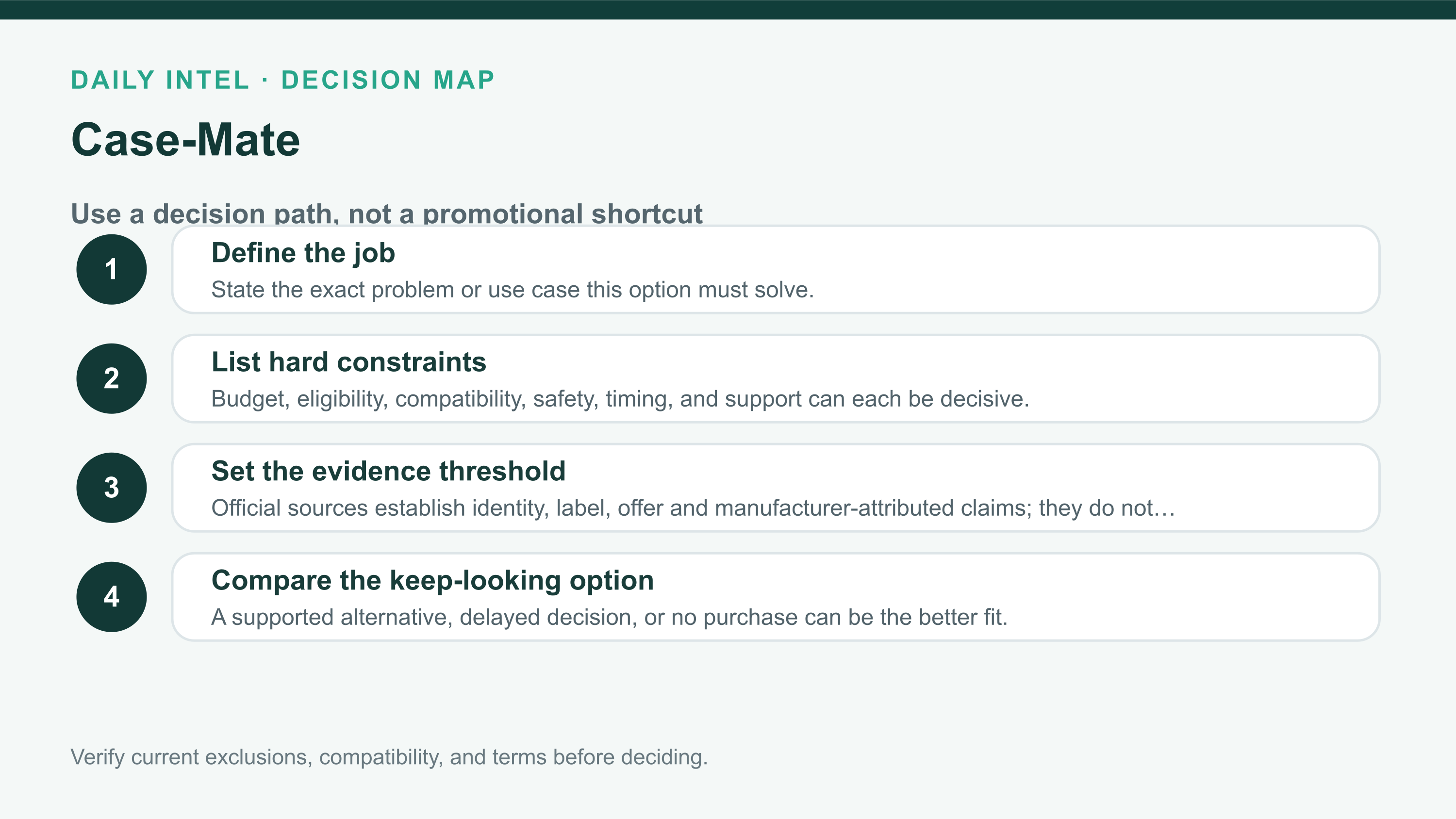
The correct workflow is to move from the broad storefront to an exact listing. Record the product name, version, current price, stock or preorder status, and the specifications that control fit. Then check the commercial and policy terms that apply to that purchase.
The Exact Version Under Review Is Not Locked
No single Case-Mate model, device configuration, material, size, color, or bundle is designated as the representative product in the packet. The exact version under review is therefore the storefront path itself.
This is more than a labeling issue. Product identity controls what can be said responsibly about compatibility, use, cost, fulfillment, returns, and warranty coverage.
A phone case needs an exact device match. A listing that says only iPhone case would not be sufficient when different generations and sizes may have different dimensions, cameras, controls, and port layouts. The evidence mentions iPhone, AirTag, AirPod, MagSafe, Apple Watch, and Google Pixel in policy or trademark text, but it does not provide a compatibility table for a selected product. Those names cannot become blanket compatibility claims.
A charger requires a different audit. Relevant details could include connector type, power output, supported devices, included components, and interaction with a case or magnetic accessory. The packet supplies none of those specifications for an exact charger.
A tote requires dimensions and construction details. Intended contents, closure design, openings, organizer fit, and exposure conditions can affect whether the item suits the job. The 7-liter notation attached to one cooler tote is a product-specific fact. It does not establish the capacity of other tote styles.
Bundles create another evidence boundary. The storefront showed a mahjong tote set, while the return-policy extract discussed replacement tiles for current sets. That support language may be relevant to qualifying tile sets currently sold by Case-Mate. It does not establish replacement-part support for unrelated totes, cases, chargers, or accessories.
Before ordering, the identity lock should include:
- The exact product name and listed version.
- The intended device model, contents, or use environment.
- The size, capacity, material, or electrical specifications that determine fit.
- Every included component in a set or bundle.
- Whether the item is in stock, on preorder, or subject to a waitlist.
- The product category used to determine the stated warranty period.
If a decisive field remains ambiguous, the product case remains incomplete. A general recommendation for Case-Mate cannot repair a version mismatch.
Product Claims That Need a Stress Test
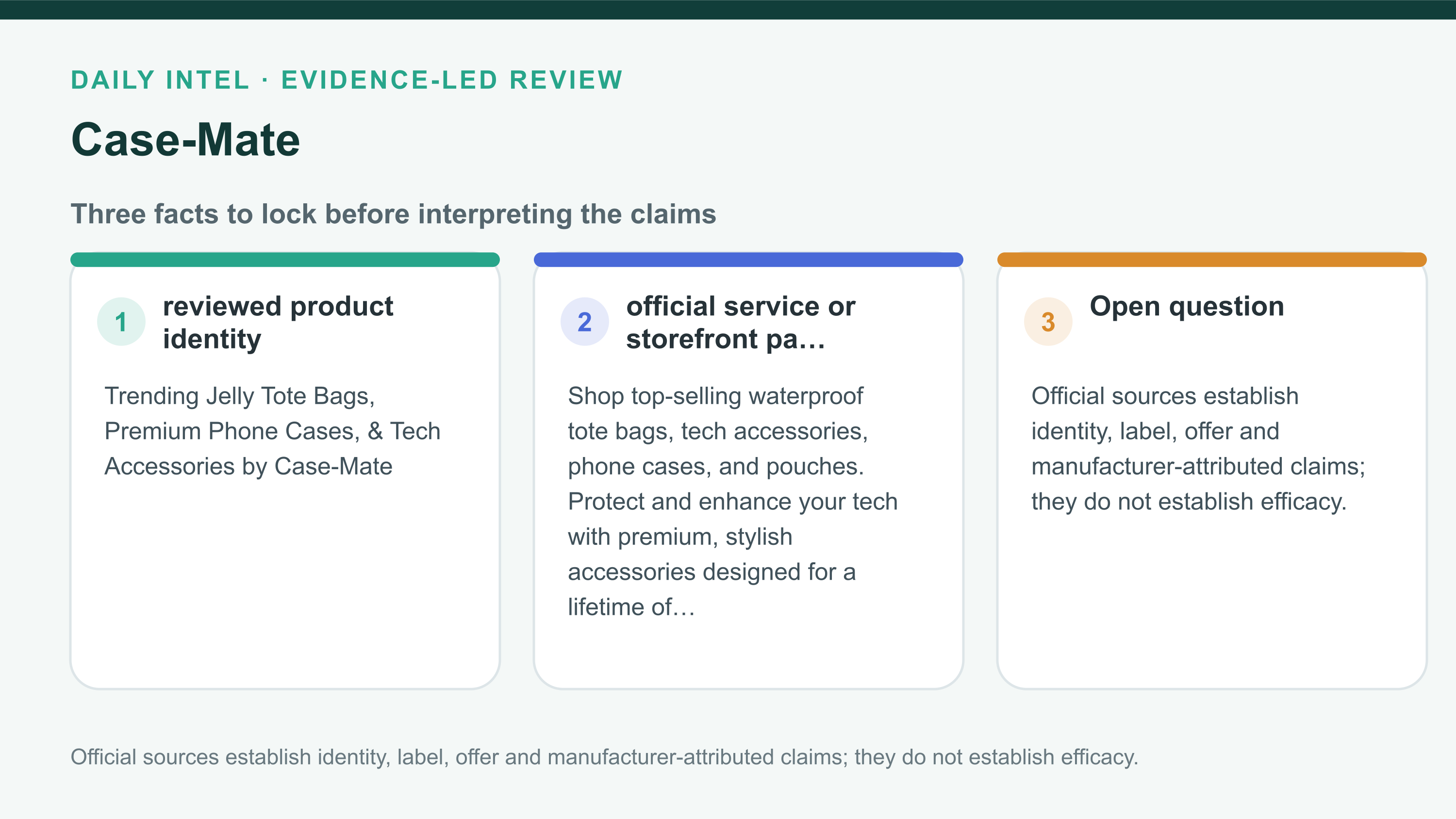
The official storefront describes top-selling waterproof tote bags and premium, stylish accessories designed for a lifetime of use. These phrases establish Case-Mate’s positioning. They do not constitute independent performance findings.
claim versus evidence boundary: Case-Mate’s words establish the seller’s positioning; the packet does not establish exact-item performance.
Waterproof is the most technically important wording in the packet. Readers may interpret it as meaning that water cannot enter the finished product. The supplied evidence does not define the term. It does not state whether it applies to the body material, the assembled tote, or both. It gives no test method, exposure duration, depth, pressure, closure condition, seam assessment, or acceptable leakage level.
The unresolved questions include:
- Does waterproof describe the material, the completed bag, or both?
- Are the seams, opening, handles, and closure included?
- Is the intended exposure limited to splashes or rain, or does it include immersion?
- Was the item tested only when new or after flexing and wear?
- Does the wording extend to electronics or other contents placed inside?
Nothing in the packet answers those questions. Waterproof should remain attributed to Case-Mate. It should not be rewritten as a demonstrated ability to protect contents.
Premium is not a measurable specification in this record. It does not identify a material grade, construction tolerance, quality-control process, expected lifespan, or comparative result. Stylish is a subjective positioning term. Neither establishes durability or value.
Designed for a lifetime of use also requires restraint. A design intention is not a service-life result. It is not equivalent to a warranty. The published table lists a limited lifetime warranty for phone cases, while many other product categories receive one year. The warranty also contains conditions and exclusions. The storefront phrase cannot support a conclusion that every Case-Mate accessory will last for a buyer’s lifetime.
A warranty does not itself prove durability. It defines the seller’s stated obligations for qualifying defects. Performance evidence would address how a product behaves under specified conditions. These questions are related but distinct.
Each important adjective should become a checkable request. Waterproof requires defined exposure conditions. Protective requires a defined risk and test. Compatible requires an exact device and configuration match. Durable requires product-specific construction information, relevant testing, or credible long-term evidence. Lifetime language requires a distinction among expected service life, product lifetime, and limited warranty duration.
The Evidence Ladder Stops Before Finished-Product Proof
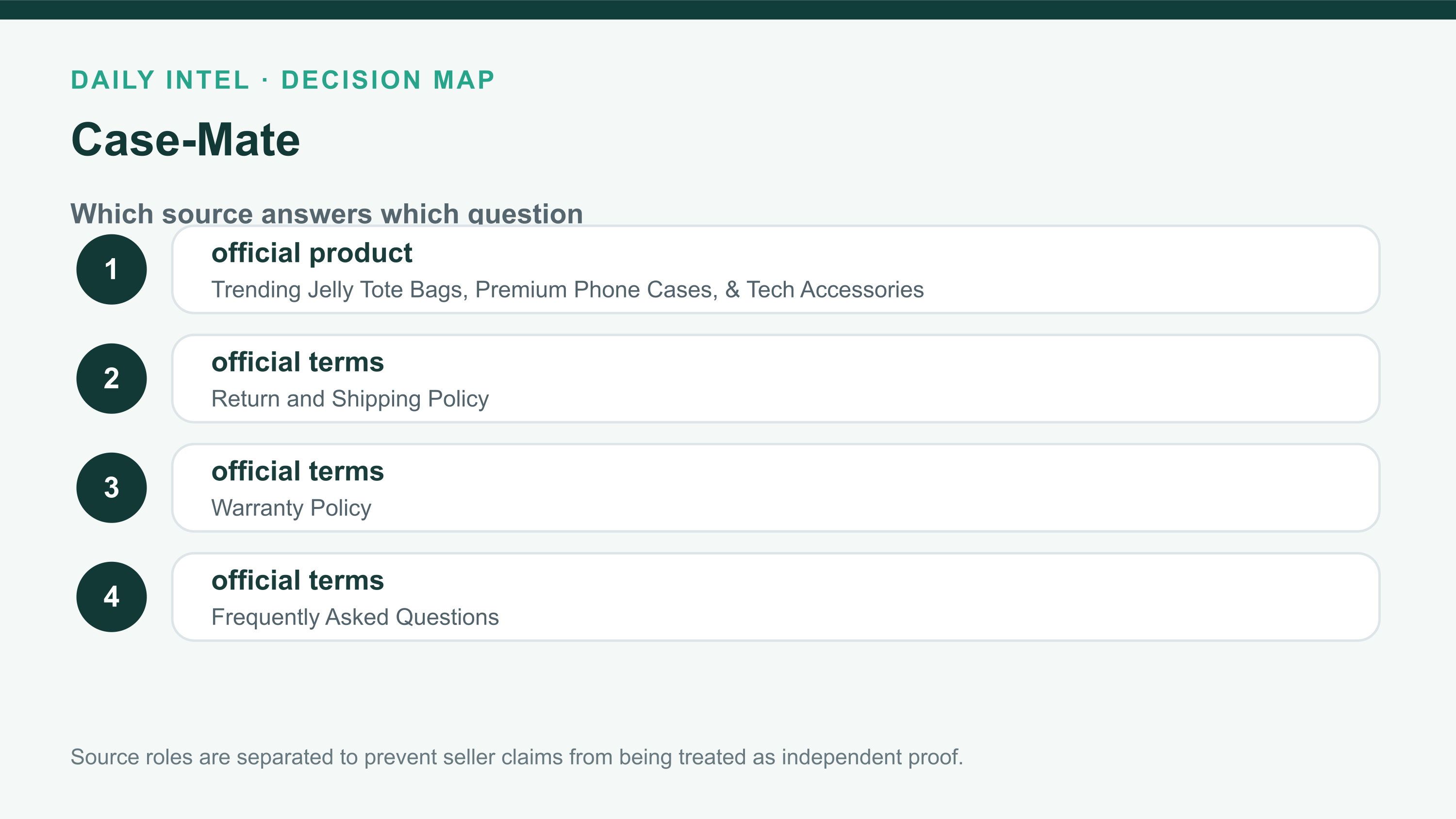
The first rung is identity. The official storefront confirms the Case-Mate name, visible product categories, selected products, and the path to purchase. This is appropriate evidence for what the seller offers.
The second rung is seller documentation. Case-Mate’s return, warranty, and FAQ pages provide operational terms. These sources can document Case-Mate’s policies when the statements remain attributed and dated. They do not independently validate product-performance claims.
The third rung is exact-product documentation. This should include the model identifier, materials, dimensions, compatibility, included components, relevant test conditions, and exclusions. The packet does not contain a completed exact-product record.
The fourth rung would be reproducible or independent finished-product evidence. None is supplied. There is no independent water test, drop test, charging assessment, material analysis, durability comparison, verified customer dataset, or documented hands-on evaluation. No ratings or testimonials are included for provenance review.
This missing evidence does not prove poor quality. It limits what can be concluded.
Category or component evidence would not close the gap. A general explanation of how cases can absorb impact would not prove that one Case-Mate case provides a particular level of protection. A material’s water-related properties would not establish the performance of a completed tote. Seams, openings, thickness, geometry, manufacturing variation, and wear can affect the finished product.
The evidence ladder therefore supports a narrow conclusion. Case-Mate has a verified storefront and documented ownership policies. The packet does not support a universal statement that its products are more protective, more durable, or better value than alternatives.
For a low-stakes decorative purchase, a buyer may accept that uncertainty. For an accessory expected to protect expensive hardware or carry electronics near water, missing product-specific evidence deserves greater weight.
Price, Shipping, Returns, and the Real Commitment
The price snapshot is broad rather than representative. Selected items visible on October 27, 2026 ranged from $30 to $150. The products had different purposes, sizes, and components, so the endpoints should not be used as a universal Case-Mate range or direct value comparison.
exact offer snapshot: The current price and terms are a dated snapshot as of October 27, 2026. Re-verify the selected item’s price, discount, stock or preorder status, shipping, optional return coverage, and payment terms at checkout.
The promotional record also contains distinct offers. The storefront invited readers to join an email list for 20% off a first order. The return-policy page displayed 20% off a first in-app order. The FAQ says one code may be applied per order and contains a Limited Edition Jelly Tote exclusion for the described sale. The packet does not establish which promotion would apply to a selected product. A discount should be verified in the final checkout rather than assumed.
Case-Mate’s FAQ states that standard shipping is free for domestic orders of $90 or more. The threshold is calculated after product discounts. This creates a possible interaction: a discount could move the merchandise total below the stated free-shipping threshold. The packet does not supply the shipping charge that would then apply.
The FAQ states that expedited domestic orders placed before 2 p.m. EST Monday through Friday ship the same business day, while those placed after that time ship the next business day. This is a processing statement, not proof of delivery on a particular date. Preorders introduce a separate delay because a mixed order may wait until every item is available.
Case-Mate states that on most eligible domestic and international orders, items purchased through Case-Mate.com may be returned for any reason within 30 days from shipment. The phrases most orders and eligible items matter. Product-specific exclusions and conditions should be checked before relying on the return path.
The 30 days run from shipment, not delivery. A long transit period could therefore consume part of the practical inspection time. Original shipping charges are not refundable.
Case-Mate offers return coverage at checkout. If the buyer opts in, the return shipping label is included for an eligible refund or exchange. If the buyer declines coverage, an eligible return may still be possible, but the buyer is responsible for the return-label cost. The packet does not give the price of the checkout coverage or a worked comparison against a later label cost.
For an item that arrives damaged, defective, or incorrect, Case-Mate directs the customer to provide an order number, a description, and photographs of the item and packaging. The policy states that Case-Mate will send a replacement or issue a refund and cover required return shipping. That process differs from a return based on preference or fit.
The FAQ says Case-Mate processes returns within a few business days after receiving them. Refunds go to the original payment method, and the buyer is advised to allow up to five business days for the refund to appear, depending on the financial institution. Those periods begin after Case-Mate receives and processes the return, not when the buyer ships it.
No paid subscription or recurring product charge is identified in the evidence. Joining the email list involves marketing communications, not a demonstrated recurring charge. However, the packet does not contain a completed checkout for a selected product. The final order summary remains the controlling record for price, taxes, shipping, optional coverage, discounts, and payment terms.
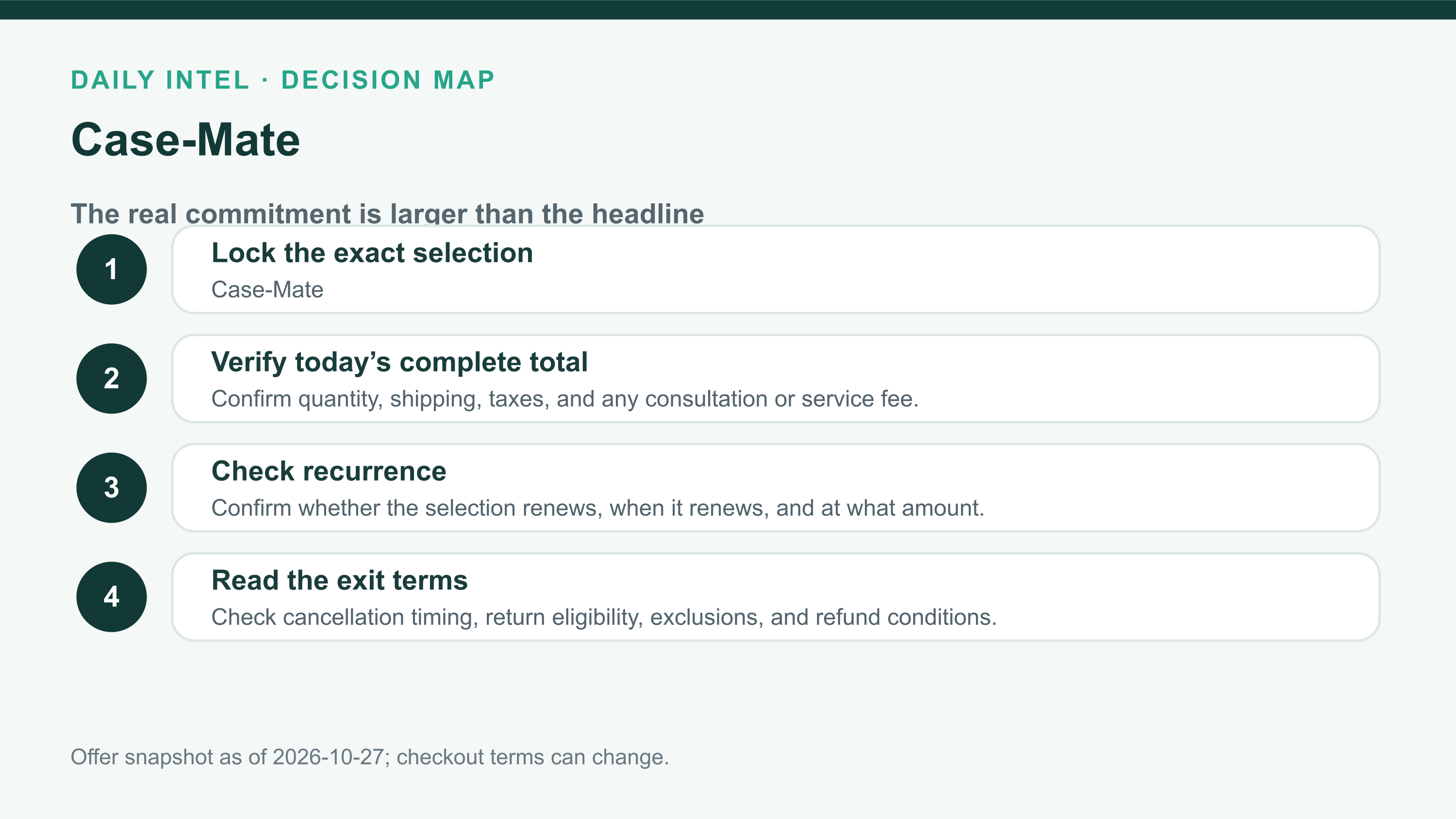
The real commitment may therefore exceed the displayed product price. It can include outbound shipping, optional return coverage, or a later return-label cost. The buyer should compare the exact checkout total with the likely cost of reversing the decision.
Where Ownership Friction Is Most Likely to Appear
Compatibility is the first likely friction point for phone and tech accessories. The packet does not confirm that a selected case, charger, protector, band, sleeve, or magnetic accessory works with a particular device configuration. Buyers should verify the complete model name rather than relying on appearance or a broad device family.
Interactions deserve separate attention. A case may fit a phone while affecting magnetic alignment, wireless charging, port access, button operation, camera clearance, or another attached accessory. The supplied evidence neither confirms nor disproves those interactions for an exact item.
Order correction is another friction point. Case-Mate’s FAQ says an order using standard shipping can be modified or canceled for up to 30 minutes after placement. Expedited orders are processed immediately and cannot be modified or canceled. If an address was entered incorrectly, a replacement order may incur additional shipping charges. Checkout details should therefore be treated as difficult to reverse, especially with expedited shipping.
Returns add several conditions. The window begins at shipment. Original shipping is not refunded. Return-label responsibility depends on checkout coverage and eligibility. The packet does not provide a universal statement about the required condition of every product category, so the current policy for the exact item should control.
Warranty support requires documentation. Proof of purchase may be required to show that the product was bought in new condition. Coverage applies to the original purchaser or initial gift recipient and is otherwise nontransferable. Case-Mate says registration is not required for most products, but the policy names exceptions involving iPhone 17 Series, Google Pixel 10 Series, and lens-protector purchases with a Lens Protection Guarantee. Saving the receipt is therefore important.
The warranty addresses defects in materials or workmanship under normal use for the stated period. It does not make Case-Mate responsible for a smartphone or another product Case-Mate did not make. The listed limitations include normal wear and aging, certain cosmetic damage, improper use or maintenance, failure to follow instructions, accidents, excess moisture, misuse, and unauthorized alteration. The complete policy controls an actual claim.
The category table is more informative than a generic lifetime statement. Phone cases receive a limited lifetime warranty. Screen protectors, lens protectors, MagSafe accessories, adhesive accessories, waterproof accessories, beach totes, cooler totes, travel tech organizers, wireless chargers, USB-C or wall chargers, phone charms, phone crossbodies, AirTag cases, AirPod cases, Apple Watch bands and bumpers, and laptop sleeves are listed with one-year warranties.
A limited lifetime warranty should not be interpreted as a promise that a phone case will never wear out or that Case-Mate will pay for damage to a phone. Coverage remains subject to the stated defect standard, limitations, proof requirements, and remedy process.
Purchasing from an authorized reseller changes the return path. Case-Mate’s FAQ says returns and exchanges must go through the seller because Case-Mate did not process the transaction. Case-Mate says it may still assist with a qualifying manufacturing defect. The reseller’s price and return rules therefore become part of the decision.
International orders have additional considerations. Case-Mate’s FAQ says international duties and taxes may apply and are prepaid during checkout. The return policy states that risk of loss and title can pass when the products are transferred to the carrier, shipping agent, or United States Postal Service in the United States. An international buyer should read the current terms directly before ordering.
Who Case-Mate Fits—and Who Should Keep Looking
Case-Mate is a plausible fit for a buyer who values the available styles and categories, can identify the exact product needed, and is willing to verify product-specific details. The storefront may also suit someone who wants multiple accessory categories available through one seller.
The decision is more defensible when the listing clearly names the supported device or size, the intended use does not depend on an undefined performance claim, and the buyer accepts the return-label and warranty conditions. A direct purchase may be preferable when the buyer wants Case-Mate’s own return workflow rather than a reseller’s process.
A buyer should keep looking when a decisive specification is absent. That includes an uncertain phone model, unknown dimensions, unexplained charging interaction, unclear material, or undefined waterproof conditions. Style cannot repair a mismatch that prevents normal use.
Buyers with a low tolerance for return costs should calculate the full downside before ordering. Shipping charges are not refunded, and declining checkout return coverage can leave the buyer responsible for a return label.
Someone buying an accessory to protect expensive hardware should demand stronger evidence than someone buying a decorative pouch. The packet provides no independent protection testing. If a verified drop test, charging assessment, or precise environmental specification is essential, the current brand-level evidence is insufficient.
Waiting is a valid decision. A missing specification may later appear on an exact listing or be clarified through support. Uncertainty does not need to be converted into either trust or distrust. The evidence-led response is to pause when the missing fact could change the outcome.
The Closest Alternatives Change With the Buying Path
The packet includes no current, like-for-like evidence for a named competing product. Calling another brand better would require unsupported assumptions about compatibility, price, testing, returns, warranty, and support. The supported alternatives are therefore buying paths rather than competitor recommendations.
Buying directly from Case-Mate makes the Case-Mate.com return process relevant. This may be the clearer route when direct return handling matters, provided the exact item is eligible.
Buying from an authorized reseller may become preferable if that seller provides a better documented price, delivery option, or return arrangement. The tradeoff is that returns and exchanges must go through the reseller. A Case-Mate warranty path may remain available for a qualifying manufacturing defect, subject to proof and policy conditions.
Choosing a different Case-Mate item can make sense when it has a clearer model match, specification, size, or fulfillment status. A best-seller label alone is not enough.
Delaying the purchase is better when compatibility, water exposure, warranty category, or total checkout cost remains unresolved. Not buying is also rational when the expected utility does not justify the cost and reversal friction.
A named competitor should enter the analysis only after equivalent evidence is captured for both exact products. The comparison should use the same criteria: model fit, disclosed materials, relevant tests, included components, checkout total, shipping, return cost, warranty scope, and support path.
The VSL Strategy We Would Test for Case-Mate
This is Daily Intel’s original strategy for explaining the Case-Mate decision. It is not an actual Case-Mate video sales letter, advertisement, or campaign. Case-Mate did not supply, approve, or run it. No sales, conversion, or advertising performance is claimed.
Hook: choose the job before the accessory
The opening would begin with a concrete failure point: an accessory can look right and still be wrong for the job.
A phone case that does not match the exact device is not useful. A case that fits physically but interferes with a required charging setup may still fail the buyer. A tote described as waterproof should not be assumed to protect electronics when the claim’s conditions are not disclosed. Category and appearance are only the beginning of the decision.
The hook would not claim that Case-Mate products are unusually risky or uniquely effective. The tension comes from a normal buying problem. A broad storefront cannot answer an exact-product question.
Lead: reframe the purchase around fit
The lead would identify what is verified. Case-Mate presents phone cases, jelly totes, pouches, organizers, chargers, protectors, and other accessories. The captured storefront showed different functions and selected prices from $30 to $150.
It would then state the boundary. The evidence does not identify one representative Case-Mate product. It contains no independent water test, impact test, charging assessment, durability comparison, or exact-item compatibility review. The useful question is not whether Case-Mate is universally good. It is whether one selected product fits one defined use case.
The viewer would be promised a decision method rather than a predetermined outcome. By the end, the viewer should be able to identify the exact item, inspect the relevant evidence, calculate the commitment, and recognize a reason to pause.
Utility mechanism: job, match, proof
The mechanism would have three stages.
First, define the job. For a phone case, that might include device fit, daily handling, charging, port access, camera clearance, or protection from a defined risk. For a tote, it might involve dimensions, capacity, closure, transport, or exposure to rain and splashes. For a charger, it might involve connector type, power requirements, supported devices, and included components.
Second, establish the match. Lock the exact product name, version, size, model, and bundle. Compatibility means that two products can work together as intended. It should not be inferred from a photograph, a trademark reference, or a broad category label.
Third, inspect the proof. Convert seller adjectives into evidence questions. Waterproof becomes: under what conditions, for how long, and which parts of the item? The packet provides no product-specific construction information or durability testing for an exact item. Compatible becomes: which exact model and configuration were checked? Lifetime language becomes: is this about intended use, expected service life, or a limited warranty?
The method scales with the stakes. A decorative makeup bag may justify a lighter check. The packet provides no exact-item evidence establishing protection for hardware or water protection for electronics carried in a tote.
Story: a labeled hypothetical path
The worked story would be explicitly hypothetical. It would not be a buyer testimonial or a claim of firsthand use.
Imagine a buyer needs a phone case for commuting and a tote for outdoor events. The Case-Mate storefront appears relevant because it sells both categories. The buyer does not treat category availability as proof of suitability.
For the case, the buyer records the complete phone model and required interactions: charging, controls, ports, cameras, and any attached accessory. The buyer checks the exact listing. If the model is ambiguous or a required interaction is unexplained, the case remains unqualified.
For the tote, the buyer defines the expected water exposure. Occasional splashes, rain, and immersion are different conditions. Because the packet does not define Case-Mate’s use of waterproof, the buyer looks for a product-specific test description or asks support what the term covers. Carrying electronics would justify a higher evidence threshold.
The buyer then checks the commercial terms. The displayed price is not treated as the complete commitment. The free-shipping threshold is calculated after discounts. A return may involve nonrefundable original shipping and a return-label cost unless applicable coverage was purchased. Warranty duration depends on category, while normal wear and accidental damage may be excluded.
The hypothetical path can end in three ways. The buyer can proceed because the exact items pass the checklist. The buyer can select products with clearer documentation. Or the buyer can wait. None is presented as a failure.
Proof: show the ladder and the missing rung
The proof sequence would begin with the official storefront. That establishes identity, categories, visible price examples, and Case-Mate’s own positioning.
It would then move to operational evidence. Case-Mate publishes return, warranty, FAQ, tracking, and support paths. The strategy could accurately state that Case-Mate describes a 30-day return window from shipment for most eligible Case-Mate.com purchases, does not refund original shipping, places free standard domestic shipping at $90 after discounts, and assigns different warranty periods by category.
The next step would expose the limit. Seller policies show how Case-Mate says it handles transactions and qualifying defects. They do not prove waterproof performance, impact protection, charging behavior, or product longevity.
The missing rung is independent finished-product evidence. The strategy would not replace it with testimonials, generic material claims, popularity labels, or an invented demonstration. It would tell the viewer which evidence would improve the decision.
Objections: address reasons not to proceed
The first objection is complexity. The answer is that the method is short after the exact item is selected: define the job, confirm the match, and inspect the proof.
The second is that an accessory may not justify extensive research. The answer is proportionality. Use a lighter check for a low-cost decorative purchase and a stricter one when expensive hardware, water exposure, or difficult returns are involved.
The third is trust in premium wording. In this packet, premium communicates seller positioning rather than a measurable specification.
The fourth is trust in warranty language. Warranty and expected durability are different. Phone cases have a limited lifetime warranty, while many accessories have one year. Coverage is also subject to proof, ownership, normal-use requirements, and exclusions.
The fifth objection is cost. The strategy would not claim savings. It would show the captured $30-to-$150 examples and explain why products from different categories cannot form a direct value comparison. The exact checkout total controls.
The sixth is choosing another brand. No sourced competitor comparison is available. A better-documented alternative may deserve preference, but it must be assessed using equivalent evidence.
The seventh is the affiliate path itself. The contract was captured as active, but the publisher link was deliberately not opened. The strategy must disclose that the live redirect remains unverified and tell the viewer to confirm the destination before proceeding.
Offer: storefront access, not universal endorsement
The offer explanation would be calm and dated. It would describe the commercial destination as a captured publisher route intended to reach the Case-Mate storefront, while making clear that the redirect was not independently verified during research.
It would not imply that every product is recommended. Prices, availability, discounts, shipping, and policies can change. Any preorder status would be checked because a preorder may hold an entire mixed order. The buyer would also compare the unknown price of checkout return coverage with the possibility of paying for a later return label.
The affiliate relationship would be disclosed before the commercial action. Daily Intel may earn a commission from a qualifying purchase. That relationship is commercial provenance, not product evidence.
CTA: a low-pressure verification step
The CTA would invite only qualified readers to inspect the exact product and current terms. It would not claim scarcity, promise savings, or imply that waiting creates a loss.
The instruction would be direct: first confirm that the captured link reaches Case-Mate. Then proceed only if the exact model or size is clear, compatibility is documented, decisive performance wording is defined, and the checkout and ownership terms fit your risk tolerance.
That is the VSL strategy we would test. Its mechanism is the reduction of avoidable uncertainty, not urgency or an unsupported product promise.
Frequently Asked Questions
Q: Is Case-Mate a legitimate storefront?
A: The supplied evidence confirms a responding Case-Mate storefront, official support pages, an active affiliate contract, and published return and warranty policies. That establishes commercial identity and a documented service path. It does not prove that every product will meet expectations or that every seller claim has been independently tested.
Q: How much do Case-Mate products cost?
A: The captured storefront displayed selected products from $30 to $150 on October 27, 2026. Examples included makeup bags, totes, an organizer, a stadium bag, and a mahjong tote set. This was not a complete price range. Taxes, shipping, discounts, and the checkout total were not established for a selected order.
Q: Can Case-Mate purchases be returned?
A: Case-Mate states that most eligible domestic and international Case-Mate.com purchases may be returned for any reason within 30 days from shipment. Original shipping charges are not refundable. Buyers without return coverage are responsible for the return-label cost, and product-specific exclusions or conditions may apply.
Q: What warranty does Case-Mate provide?
A: Coverage depends on product type. The published table lists a limited lifetime warranty for phone cases and one-year warranties for many other categories, including screen protectors, MagSafe accessories, beach totes, cooler totes, chargers, and laptop sleeves. Claims remain subject to purchase, ownership, use, proof, and exclusion requirements.
Q: Are Case-Mate jelly totes proven waterproof?
A: The official storefront describes certain totes as waterproof, but the supplied packet contains no test method, exposure duration, depth, closure assessment, or independent finished-product test. Treat waterproof as seller wording unless the exact product page defines the conditions and evidence behind the claim.
Q: Should I buy directly from Case-Mate or an authorized reseller?
A: Buying directly makes Case-Mate’s return process relevant to the transaction. Purchases from authorized resellers must be returned or exchanged through that seller, although Case-Mate says it may assist with qualifying manufacturing defects. Compare the current price, return costs, warranty eligibility, and support path before choosing.
Sources and Evidence Notes
Evidence card: Case-Mate official storefront
This source supports brand identity, visible categories, selected price examples, merchandising labels, and Case-Mate’s description of its offer. It is also the source of wording such as waterproof, premium, stylish, and designed for a lifetime of use. It does not independently prove compatibility, water protection, durability, value, or expected service life for an exact product.
Evidence card: Case-Mate Return and Shipping Policy
This source supports Case-Mate’s stated 30-day framework for most eligible direct orders, the nonrefundability of original shipping, checkout return coverage, return-label responsibility, and damaged or incorrect order handling. It is a seller-controlled policy with conditions and possible exclusions. The version applicable to the purchase controls.
Evidence card: Case-Mate Warranty Policy
This source supplies the category warranty table, purchase and ownership requirements, defect standard, registration notes, and limitations. It documents Case-Mate’s stated limited lifetime warranty for phone cases and stated one-year warranties for many accessories. It does not establish that a product will last for a particular period or protect a non-Case-Mate device.
Evidence card: Case-Mate Frequently Asked Questions
The FAQ supports statements about order changes, expedited processing, preorder holds, the free-shipping threshold, refund timing, reseller returns, international duties and taxes, and support. These remain seller statements about its workflow. They do not prove delivery performance for a particular order.
Evidence card: Federal Trade Commission disclosure guidance
The FTC source matters because Daily Intel has a financial relationship connected to the commercial link. It states that a material connection should be clearly disclosed and hard to miss. It does not evaluate Case-Mate products, prices, policies, compatibility, or performance.
Final Take: What Would Change the Verdict
Case-Mate earns consideration as a documented storefront, not a blanket recommendation. The strongest case for proceeding exists when an exact product matches the buyer’s device or intended environment, decisive specifications are disclosed, and the return and warranty terms address realistic concerns.
The published ownership terms reduce some uncertainty. Case-Mate describes a return path for most eligible direct purchases, handling for damaged or incorrect orders, category-specific warranty periods, and support procedures. Those protections remain conditional. Original shipping is not refunded, return-label responsibility varies, warranty exclusions are meaningful, and reseller returns follow the reseller’s process.
The product case remains incomplete. No independent finished-product testing is included. Waterproof lacks disclosed test conditions in this packet. Premium and designed for a lifetime of use remain seller positioning. Compatibility cannot be confirmed without selecting an exact product and device configuration.
The commercial link also carries a verification limit. It was captured from the affiliate system but deliberately not opened. Its present redirect remains unverified. A reader who uses it should confirm the destination before entering information or purchasing.
Our decision is therefore conditional. Consider Case-Mate when its styles and categories appeal to you and the exact listing passes a fit, proof, price, and policy check. Keep looking or wait when a missing specification could affect normal use, hardware protection, water exposure, fulfillment, or return cost.
what would change the verdict:
This conclusion can change. It would become more favorable if exact-model specifications, defined protection claims, reproducible tests, and clearer item-level compatibility evidence were supplied. It would become less favorable if a selected listing conflicted with the buyer’s hardware, the captured commercial route did not reach the intended destination, or applicable exclusions left the likely problem uncovered.
This article is for informational and educational purposes only. Daily Intel is independent and may earn an affiliate commission. Case-Mate did not write, review, or control this article.
Comments(0)
No comments yet. Members, start the conversation below.
Related reads
 reviews
ARMRA Colostrum Review: Evidence, Dose Gaps, Price, and Verdict
ARMRA’s 120-serving colostrum powder comes with notable manufacturer-reported survey percentages. However, the undisclosed amount per serving and a materially different ingredient trial leave the finished product’s highlighted outcomes unproven.
Read reviews
Olly Goodbye Stress Review: Label Claims vs. Evidence
OLLY Goodbye Stress combines GABA, L-theanine, and lemon balm extract in a Berry Verbena gummy aimed at occasional stress, not sleep. Here's what the label discloses, what a real L-theanine trial found, and exactly where the evidence stops.
Read reviews
Kaged Pre-Kaged Sport Review: Does the Citrulline Study Fit?
Kaged Pre-Kaged Sport provides 3.5 grams of fermented L-citrulline in each 13-gram scoop. The supplied trial tested a higher dose of isolated L-citrulline and found no performance benefit, so it cannot prove whether this finished formula works.
Read