
Compounded CJC-1295 (No DAC)/Ipamorelin Review: Offer Facts, Risks, Cost, and Missing Proof
A bounded review of Live Vital’s compounded CJC-1295/Ipamorelin offer, including cost, recurring terms, safety boundaries, and evidence gaps.

8,226+
Videos & Ads
+50-100
Fresh Daily
$29.90
Per Month
Full Access
12.5 TB database · 72+ niches · 11 min read
Bottom line: Live Vital provides enough information to identify a clinician-reviewed, compounded injectable offer and its recurring price. The supplied sources do not establish that the finished preparation produces weight loss or another defined clinical benefit. That gap prevents a favorable effectiveness conclusion.
This review can help a US reader audit the offer before completing an intake. It cannot determine individual suitability, replace a licensed clinician, or recommend starting, stopping, dosing, or combining a prescription treatment.
The exact offer under review
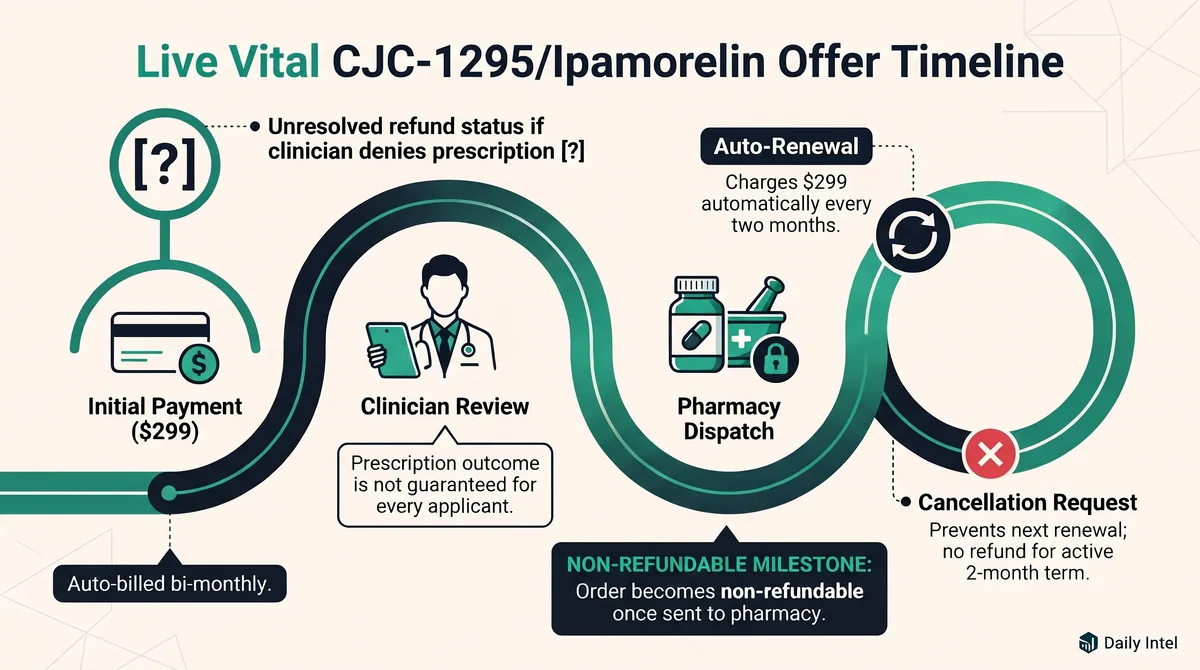
The reviewed offer is billed every two months; the captured sources leave the pre-prescription refund status unresolved.
The product is Live Vital’s Compounded CJC-1295 (No DAC)/Ipamorelin: Physician-Prescribed plan. The official treatment page describes:
- A compounded combination of CJC-1295 without DAC and ipamorelin.
- Subcutaneous administration on a schedule selected by the clinician.
- A medical intake and clinician review before prescribing.
- Preparation by a licensed US pharmacy if prescribed.
- Follow-up access through the care team.
Live Vital says a licensed clinician must evaluate the request and that not every applicant qualifies. This is a prescription-access condition, not evidence that the preparation is effective for a particular outcome.
The supplied page does not specify the concentration, prescribed dose, vial size, exact pharmacy, batch-testing documentation or sterility records for the product a particular patient would receive. Those omissions matter because evidence about an ingredient or similarly named preparation cannot automatically be transferred to an unspecified finished formulation.
Cost, renewal and the real commitment
The reviewed page lists the plan at $299 every two months, described as $150 per month. The displayed monthly figure should therefore be read as an equivalent rate rather than a month-to-month payment option.
Live Vital’s refund and cancellation policy describes peptide and longevity plans as automatically renewing two-month subscriptions. Live Vital’s policy says cancellation takes effect after the current billing period ends. A cancellation may stop the next renewal without reversing the charge for the period already underway.
The policy says medication is generally non-refundable once the prescription has been sent to the pharmacy and the medication has been compounded or shipped. The captured public policy does not clearly state whether payment is collected before clinician review or what refund applies if no prescription is issued. Those questions should be answered in writing before payment.
Live Vital describes itself as a cash-pay practice that does not accept insurance. Its FAQ says eligible HSA or FSA funds may be usable, while its terms discuss possible superbills. Neither statement guarantees reimbursement or tax eligibility for a particular reader.
A practical commitment check is therefore:
- Confirm the amount charged at checkout and when the first charge occurs.
- Ask what is refunded if the clinician does not prescribe.
- Record the deadline and method for preventing the next renewal.
- Ask when an order becomes non-refundable.
- Confirm whether consultation, supplies, shipping, laboratory work or follow-ups create additional charges.
What the page establishes—and what it does not
The official page is appropriate evidence for offer identity, displayed price, administration route and Live Vital’s own process. It is not independent clinical substantiation.
Live Vital says the compounded preparation is not FDA-approved and has not been evaluated by the FDA for safety, effectiveness or quality. The page also presents a proposed receptor-signaling explanation. Even if that explanation accurately describes an ingredient-level mechanism, it does not establish a patient outcome for this finished preparation.
FDA says compounded drugs are not FDA-approved and that the agency does not verify their safety, effectiveness or quality before marketing (compounding Q&A). FDA also identifies potential immunogenicity, peptide-impurity and characterization concerns for CJC-1295 and ipamorelin acetate. Its current bulk-substance safety-risk page describes limited safety information. Those are regulator-level risk signals, not proof that this exact Live Vital preparation will cause a particular event. No matched clinical trial or product-specific outcome study was supplied. In particular, the packet does not establish:
- Weight loss or a specific change in body composition.
- A longevity, wellness or general-health benefit.
- Comparative effectiveness against another treatment.
- A quantified benefit at the formulation and dose a patient would receive.
- Superior safety or suitability for any individual.
The defensible conclusion is not that the preparation does or does not work. It is that the supplied evidence does not resolve the effectiveness question.
Is this a weight-loss offer?
The captured Live Vital page positions this as a clinician-supervised longevity protocol. The supplied sources do not establish weight-loss suitability or efficacy for this preparation. A weight-loss category label or a weight-loss transcript cannot supply that missing evidence.
The claim-to-proof ladder
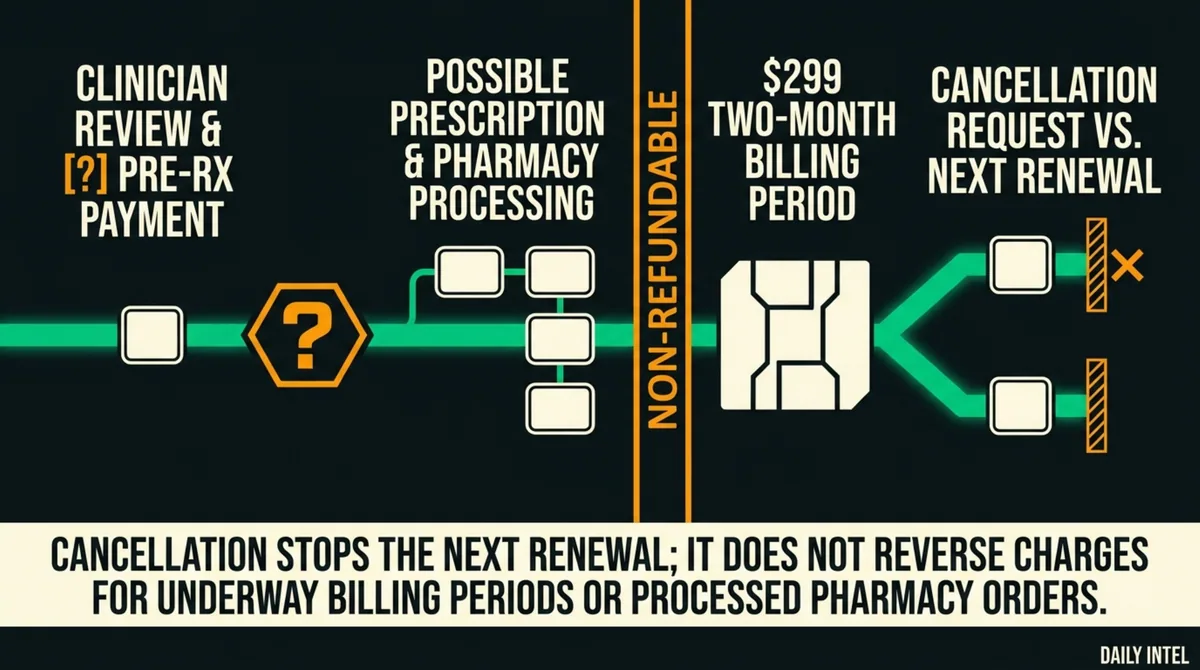
Cancellation prevents a later renewal but does not reverse an underway billing period or a processed pharmacy order.
The claim-to-proof ladder prevents an ad, VSL or review from treating every source as if it answered the same question.
- Offer fact: What product, price or process does the provider currently display?
- Composition fact: What exactly is in the dispensed preparation, at what concentration and dose?
- Mechanism evidence: Does a source show a biological interaction under matched conditions?
- Ingredient or category outcome evidence: Was a relevant outcome measured in an appropriate population?
- Finished-product evidence: Was the exact preparation evaluated at a matched dose, schedule and population?
- Individual decision: Has a licensed clinician assessed the person’s history, risks, alternatives and monitoring needs?
A claim should stop at the highest rung its evidence actually reaches.
Worked example: auditing an outcome claim
Consider a hypothetical ad claim: This compounded blend produces meaningful weight loss.
- Claim class: Clinical outcome, not merely a product description.
- Proof required: Evidence for the finished CJC-1295 without DAC/ipamorelin preparation, including its formulation, dose, schedule, study population, comparator, measured outcome and adverse events.
- Evidence available here: An official page describing the offer and a proposed signaling mechanism.
- Mismatch: A provider’s mechanism description does not measure weight loss, and an ingredient-level explanation does not identify the finished formulation’s net effect.
- Editorial treatment: Do not publish the outcome claim. State that product-specific effectiveness remains unresolved.
- Update condition: Reassess if a sufficiently matched, independently reviewable study or regulator document becomes available.
This method gives a copywriter a concrete decision: remove the claim, narrow it to an attributed product description, or obtain better evidence before drafting.
Counterexample: a fact that does not need clinical evidence
Now consider: The plan is displayed at $299 every two months and renews automatically.
That is an offer-term claim. A dated product page and policy can support it without a clinical trial. But the fact remains on the first rung: it says nothing about efficacy, safety or value. Moving a verified price beside an unsupported outcome does not make the outcome better supported.
Safety and eligibility boundaries
The treatment page lists possible effects including fluid retention, headache, flushing, injection-site reactions, temporary hunger changes, lightheadedness, and tingling or numbness. It also directs people with pregnancy or breastfeeding, cancer history, pituitary disorders, diabetic retinopathy or uncontrolled diabetes to raise those issues before proceeding.
Those are Live Vital’s warnings, not an independently verified or necessarily complete safety profile. The supplied material does not establish rates, severity, interaction risks, long-term outcomes or how risks change with dose and patient characteristics.
Useful questions for a licensed clinician include:
- What exact diagnosis or treatment objective is being considered?
- What evidence supports this formulation for that objective?
- What concentration, dose, schedule and intended duration would apply?
- Which medical history, medications or laboratory findings could change the decision?
- What adverse effects require a message, an appointment or urgent care?
- What monitoring is planned, and who reviews the results?
- What FDA-approved or non-drug alternatives are relevant to the same objective?
- Which pharmacy will dispense the prescription, and what testing documentation is available?
These questions support an informed discussion; they are not a dosing or treatment protocol.
Who might continue the evaluation—and who should pause
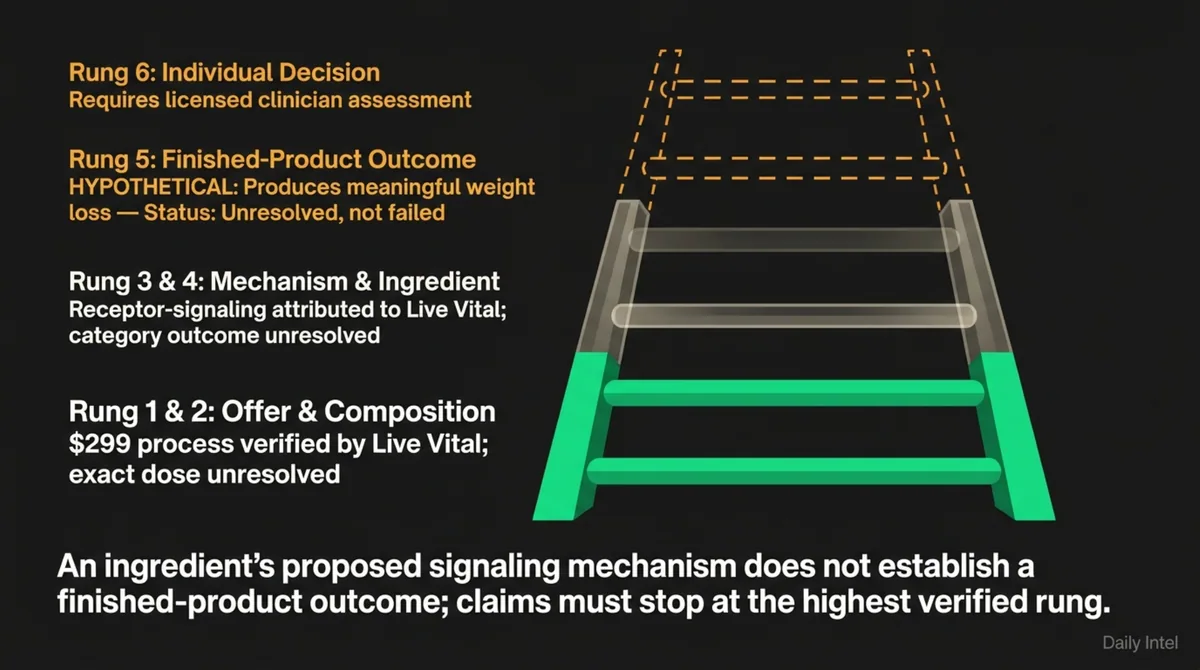
A proposed ingredient mechanism does not establish an outcome for the finished compounded preparation.
Further clinician discussion may be reasonable for a reader who understands that this is a compounded prescription offer, can absorb the two-month cash-pay commitment, and is willing to treat efficacy as unresolved until better evidence is provided.
Pause before paying if any of the following applies:
- You require FDA evaluation of the finished product.
- A weight-loss or health outcome is the main reason for considering the offer, but you have not received matched evidence for it.
- The provider has not clarified payment and refund treatment when no prescription is issued.
- You do not know the formulation, dispensing pharmacy, monitoring plan or full cost.
- Your history overlaps with a warning on the provider’s page and you have not discussed it with an appropriately licensed professional.
The packet contains no sufficiently sourced comparison with named alternatives. Inventing one would create the same evidence-transfer problem this review is designed to prevent.
Affiliate disclosure: Daily Intel may earn a commission if the reader buys through this link.
If the unresolved questions have been answered and you want to inspect the captured official destination, view the Live Vital CJC offer. Completing an intake does not guarantee a prescription.
Original Daily Intel VSL strategy we would test
This is an original editorial strategy for ad and VSL research, not a claim that Live Vital has used it or that it will improve performance.
The private comparison transcript uses a rapid claim-heavy opening at [0–116.14s], expands into a long origin-and-mechanism narrative at [1212.26–2598.26s], and then shifts through naming, bundles, price anchoring, scarcity and a guarantee at [3059.06–3997.78s]. The close repeats projected outcomes and urgency through [3997.78–5055.94s]. These timestamps describe structure only; the transcript’s claims, testimonials and outcomes are not evidence.
For this prescription offer, the testable adaptation should reverse that proof order:
- Hook: “Before committing $299 to a recurring compounded peptide plan, separate the offer facts from the outcome the page has not proved.”
- Lead: Identify the exact CJC-1295 without DAC/ipamorelin preparation and the clinician-review requirement.
- Evidence boundary: Show a two-column distinction between provider-verified offer facts and unresolved clinical questions.
- Mechanism frame: Attribute the proposed signaling explanation to Live Vital, then state why mechanism is not a measured patient outcome.
- Worked audit: Apply the claim-to-proof ladder to one outcome claim, as demonstrated above.
- Objections: Address evidence, safety uncertainty, two-month billing, cancellation, refund timing and missing formulation details before presenting a link.
- Offer: State the dated price and renewal terms without discounts, countdowns or implied scarcity.
- CTA: Invite an evidence-aware reader to inspect the official offer or prepare questions for a clinician—without implying that clicking, qualifying or purchasing is the correct choice.
The research hypothesis is narrow: leading with the decision and evidence boundary may attract readers who want an exact-offer audit. Attention, comprehension, completed intakes and clinical outcomes would remain separate measurements.
Copy and VSL evidence worksheet
Use one row for every meaningful product, mechanism, safety or outcome claim. If the source does not match the claim, the worksheet should force a revision before the copy reaches layout.
| Proposed claim | Claim type | Best supplied source | Formulation, dose and population match? | What remains missing? | Draft treatment | Update trigger |
|---|---|---|---|---|---|---|
| The displayed plan costs $299 every two months | Offer term | Dated treatment page | Not applicable | Checkout confirmation | State as a dated offer fact | Price or terms change |
| This preparation produces weight loss | Clinical outcome | None supplied | No | Finished-product outcome evidence | Omit; describe the gap | Matched independent evidence |
| This plan is FDA-approved | Regulatory status | FDA compounding Q&A and provider page | Exact preparation is not FDA-approved | No FDA premarket review of this compounded preparation | Remove the claim; state the regulatory boundary | FDA approval or an applicable regulator record |
Before approving a line, ask:
- Is this an observation, an attributed claim, an interpretation or a measured effect?
- Does the source support the exact product rather than a category or ingredient?
- Are formulation, dose, population and outcome aligned?
- Does the sentence imply more certainty than the source provides?
- Would the claim still be clear if testimonials, authority cues and urgency were removed?
Verdict and what would change it
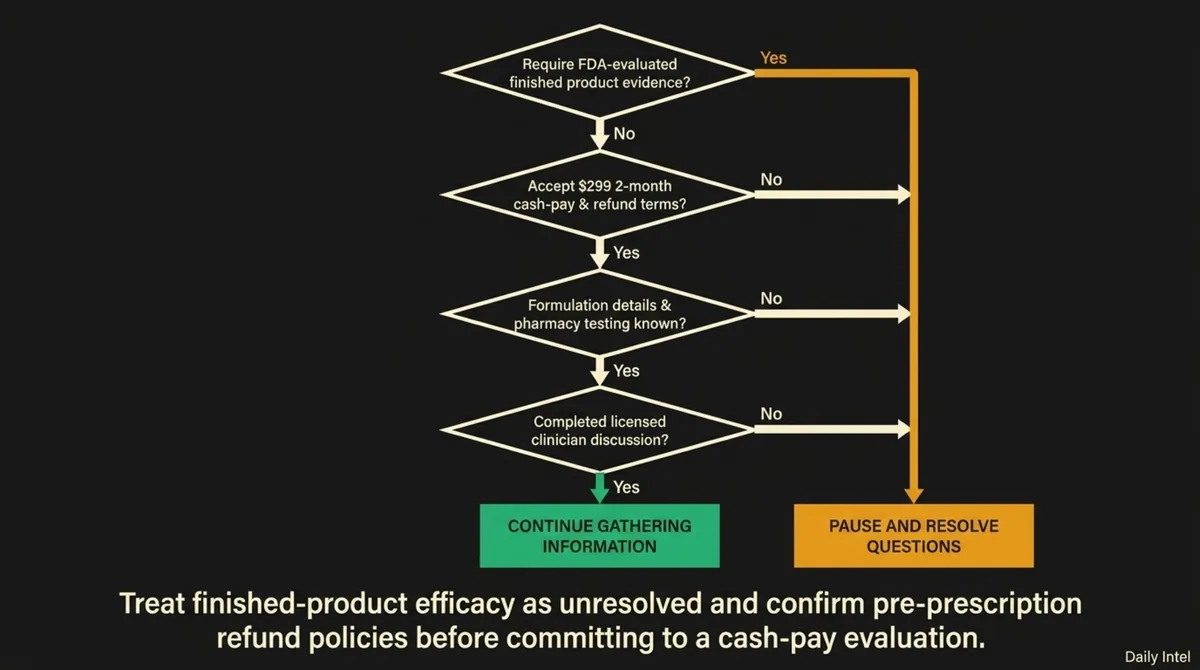
A neutral decision aid for information gathering, not a treatment recommendation.
Live Vital’s pages provide a usable description of the offer, recurring charge and prescription process. They also make clear that the compounded preparation has not received FDA evaluation for safety, effectiveness or quality.
The decisive limitation is the absence of independently supplied, product-matched outcome evidence. On this packet, the offer merits questions for a licensed clinician, not an effectiveness recommendation.
The assessment could change if the provider supplies the exact formulation and dose, pharmacy and testing documentation, a complete payment/refund answer, and independently reviewable evidence matched to the intended clinical outcome and population.
Sources and evidence notes
- Live Vital treatment page: Supports the provider’s product identity, displayed price, process, administration description and attributed warnings. It does not independently substantiate clinical outcomes.
- Refund and cancellation policy: Supports the captured renewal, cancellation and non-refundability terms. Its unresolved payment/refund note requires clarification.
- Live Vital FAQ: Describes the provider’s intake, pharmacy, billing and shipping process. These remain provider statements.
- Terms of Service: Supplies general contractual context but should be rechecked against checkout terms immediately before publication.
- FDA compounding questions and answers: Establishes the general regulatory boundary for compounded drugs, including the absence of FDA premarket verification of safety, effectiveness and quality.
- FDA bulk-substance safety-risk page: Supplies regulator context specific to CJC-1295 and ipamorelin acetate. It does not identify the formulation or predict an individual outcome for the reviewed offer.
The web sources in this review were captured on October 29, 2026. Confirm current terms and availability directly with the provider.
Related Daily Intel research
- Telehealth VSL and ad research — Related research on the evidence, offer and compliance questions that shape telehealth campaigns.
- Copy research methods — A practical framework for separating response measurement from reader observation and unsupported causal inference.
Download the teaching materials
Download the reviewed teaching slides (PDF). The file contains 3 pages and searchable English text.
Comments(0)
No comments yet. Members, start the conversation below.
Related reads
 reviews
Finasteride 1mg Review: HealthRX’s $67 Plan and the Study Mismatch
HealthRX presents Finasteride 1mg as a once-daily prescription option supplied through an online provider review and pharmacy-fulfillment service. The commercial path is documented more clearly than the medical evidence for the exact dispensed product. The packet does not contain its full label, manufacturer, complete safety information, or a finished-product clinical trial.
Read reviews
Oral Minoxidil Tablets review: Convenience Does Not Close the Gap
Strut Health offers clinician-screened oral minoxidil for hair loss, but the supplied study did not test the exact Strut product. The prescribed dose, customer price, recurring terms, and parts of the safety framework also remain unresolved.
Read reviews
Audien review: What the evidence can and cannot prove before checkout
Audien has a documented order page, but the supplied evidence does not independently verify the seller’s regulatory wording, finished-product performance, intended-user boundaries or complete purchase terms. This review identifies what remains to be checked.
Read