Hip & Joint Dog Chews Review: What the Happy Paws Offer Shows—and What It Does Not Prove
A source-led review of Happy Paws Hip & Joint Dog Chews covering the formula uncertainty, evidence, price, recurring terms, safety and refund limits.

8,226+
Videos & Ads
+50-100
Fresh Daily
$29.90
Per Month
Full Access
12.5 TB database · 72+ niches · 11 min read
Private editorial draft. Offer details were captured on October 29, 2026, and require fresh verification before publication.
Affiliate disclosure: Daily Intel may earn a commission if the reader buys through this link.
The bounded verdict
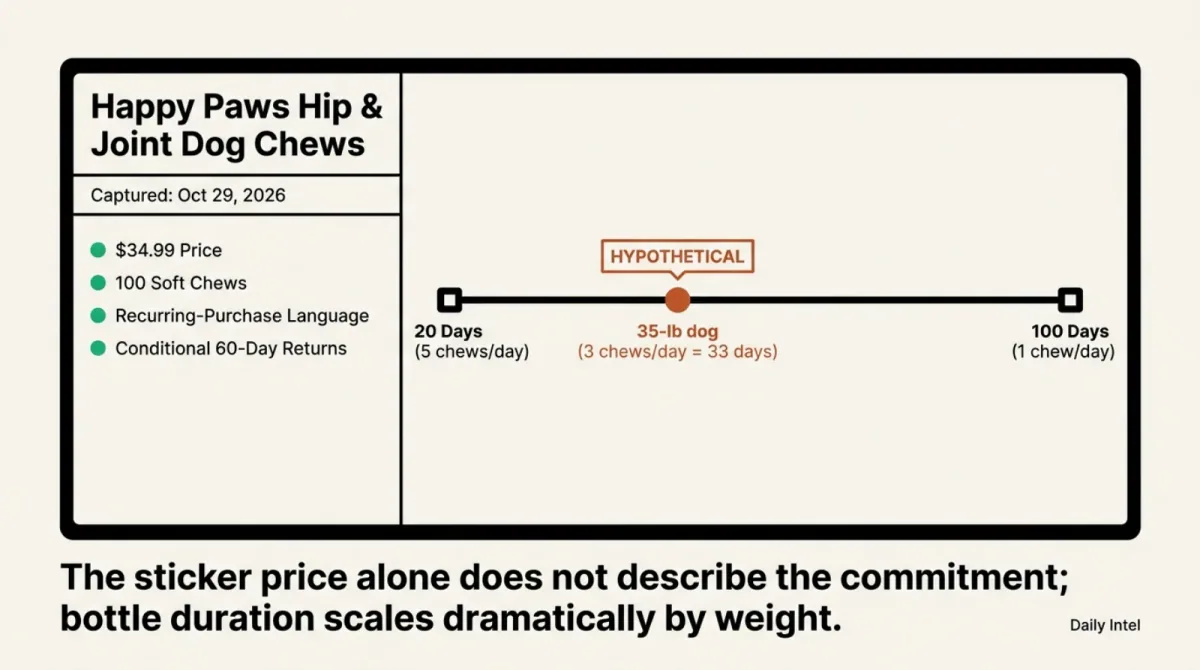
Reviewed Daily Intel teaching slide 1 of 3.
Happy Paws presents its Hip & Joint Dog Chews as a 100-count canine supplement with weight-based directions and a captured price of $34.99. Those offer facts are reasonably clear. The evidence needed to establish that the finished chews improve pain, arthritis or mobility is not.
The largest immediate uncertainty is even more basic: the promotional copy names glucosamine, chondroitin, MSM, turmeric, green-lipped mussel and hyaluronic acid, but those substances do not appear in the displayed ingredient list captured from the same official product page. The supplied packet contains no complete supplement-facts panel, amounts per chew, certificate of analysis or finished-product trial that resolves this discrepancy.
That makes this a pause-and-verify offer, not an evidence-backed recommendation. A current label showing the complete formula and amounts would resolve the identity question. Appropriate finished-product research would be needed to change the efficacy assessment.
What the captured offer actually shows
The captured official offer displays a price of $34.99.
The captured official product page states a count of 100 soft chews.
The page also provides serving directions based on the dog's weight, beginning at one chew daily for dogs below 10 lb and increasing across larger weight brackets. The official page gives a weight-based serving example for dogs under 10 lb. Reproducing those directions describes the seller's label; it is not an individualized dosage recommendation.
The official page asks for use for 30 or more consecutive days; this is seller guidance, not independently established onset.
Other captured promotional statements include natural or organic positioning, third-party purity testing and US manufacturing. The packet does not include the underlying certification, laboratory report or manufacturing documentation, so those statements remain attributed to Happy Paws rather than independently verified.
The unresolved formula question
The promotional section and displayed ingredient list do not presently reconcile:
- Promotional formula: glucosamine, chondroitin, MSM, turmeric, green-lipped mussel and hyaluronic acid are named.
- Displayed list: oat flour, oils, water, flaxseed meal, glycerin, lecithin, guar gum, potassium sorbate, brewer's yeast, a vegetable blend and flavoring are shown.
- Missing from the packet: quantities per chew, a complete panel that reconciles both lists and testing tied to the reviewed batch.
It would be unsafe to infer that an ingredient appears at a meaningful amount merely because marketing copy names it. Before comparing this product with a study or another supplement, a buyer needs the current package label and amounts for the exact 100-chew version.
The claim-to-proof ladder
The useful research method here is a claim-to-proof ladder. It prevents a familiar mistake in supplement reviews: moving from a plausible ingredient story directly to certainty about the finished product.
- Offer fact: Does a dated official page establish the price, count, directions or purchase term?
- Formula fact: Does the exact label identify every active ingredient, form and amount per serving?
- Category evidence: Has a similar ingredient or nutraceutical been studied in dogs with a relevant condition?
- Finished-product evidence: Was this exact formula, at its marketed dose, tested against an appropriate comparison?
- Decision fit: Do the evidence, safety boundaries, cost and purchase terms meet this particular buyer's standard?
The first rung can verify what is sold. It cannot carry a reader to the fourth rung by itself.
Worked example: auditing the mobility implication
Suppose the working claim is: “These chews support better mobility in a dog with osteoarthritis.” Here is how to audit it without converting marketing into proof.
- Define the outcome. “Mobility” could mean owner impressions, gait measurement, stair use or another specified outcome. These are not interchangeable.
- Lock the product. Confirm the exact ingredients, chemical forms, amounts per chew and the dog's resulting daily exposure under the label directions.
- Match the population. Evidence from dogs diagnosed with osteoarthritis is not automatically evidence for healthy dogs, and the reverse is also true.
- Match the intervention. Research on another nutraceutical or one isolated ingredient does not establish the effect of Happy Paws chews.
- Check the comparison and result. A useful study should make clear what the product was compared with and which predefined outcome changed.
- Set the verdict. In this packet, the formula is not adequately reconciled and no finished-product trial is supplied. The mobility implication therefore remains unestablished.
This method does not prove that the product cannot help. It identifies what the current sources cannot support.
Counterexample: when a relevant study still does not transfer
The supplied canine study evaluated a nutraceutical in dogs with osteoarthritis but reported no significant improvement from the nutraceutical on the measured ground-reaction-force outcome.
The PubMed abstract describes a prospective, double-blind study involving 71 dogs assigned to a nutraceutical, carprofen, meloxicam or placebo. It is relevant category context because it shows a canine osteoarthritis population and a measured gait outcome.
It is not a trial of Happy Paws Hip & Joint Dog Chews. The packet does not establish that the study's nutraceutical matched this product's formula, forms or amounts. The negative result therefore neither validates nor definitively disproves these chews. It demonstrates why “a canine joint supplement was studied” is not enough to cross the finished-product rung.
Price, bottle duration and the actual commitment
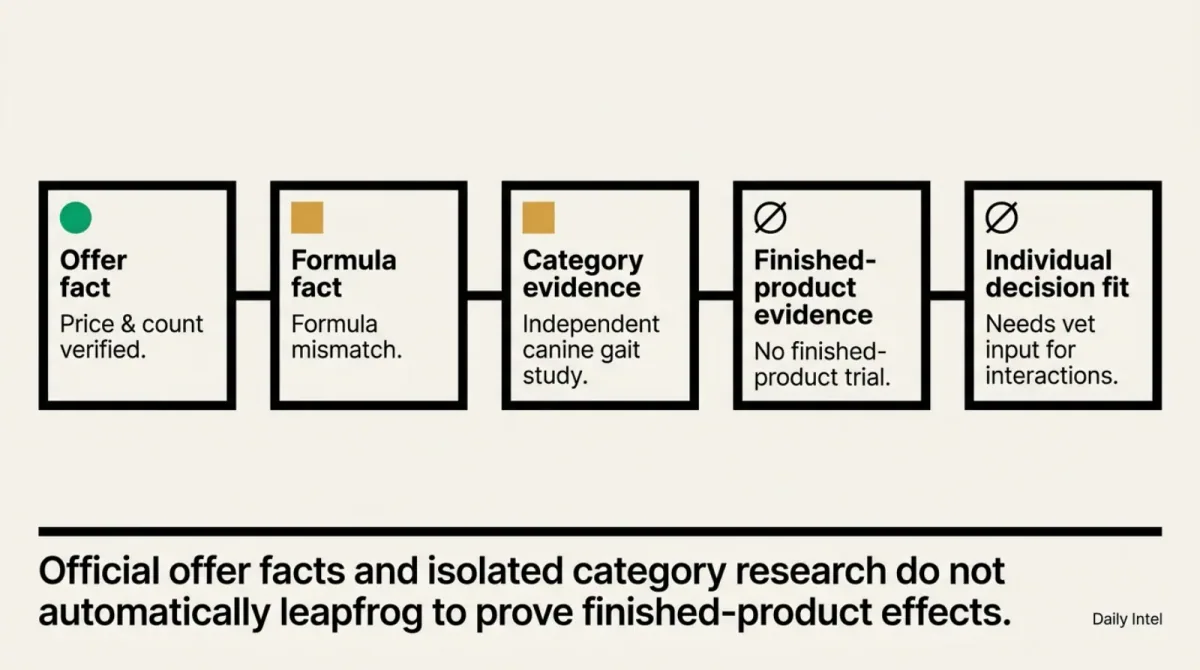
Reviewed Daily Intel teaching slide 2 of 3.
The sticker price alone does not describe the commitment. Bottle duration changes with the seller's weight-based directions.
Consider a hypothetical 35-lb dog. The captured directions place that dog in the three-chews-per-day bracket. At that rate, 100 chews cover 33 full days with one chew remaining. Using the captured one-bottle price, the product cost is approximately $1.05 per labeled day before tax or shipping. This is arithmetic from the dated offer, not a recommendation for that dog.
At the listed extremes, one chew daily would make the bottle last 100 days, while five chews daily would make it last 20 days. Buyers should calculate from the relevant label bracket rather than assume that one bottle represents one month.
The captured official page contains recurring-purchase language. It also advertises a subscribe-and-save option, but the supplied page capture does not establish the exact frequency, selectable checkout state or cancellation steps for a particular order. Confirm those details before submitting payment; do not infer that a displayed percentage answers the full recurring-cost question.
The official return policy limits refunds to unopened or minimally used products in original packaging within 60 days. The return policy also says shipping charges are non-refundable and directs customers to contact support about whether an opened product qualifies. This is a conditional return process, not a promise that every trial will be refunded.
The captured shipping policy lists several estimated delivery methods and says shipping charges are non-refundable. Rates and checkout availability still need confirmation for the buyer's address.
Safety boundaries the offer cannot settle
A sales page cannot determine whether a supplement is appropriate for an individual dog. The captured product page advises stopping and consulting a veterinarian if the animal's condition worsens or fails to improve. It says safe use in pregnant animals or animals intended for breeding has not been proven and recommends a veterinary examination before use.
The page warns that taking the product at the same time as drugs may delay drug absorption.
That warning matters for any dog receiving medication, but the packet does not identify which drugs, the size of the interaction or a safe timing interval. Daily Intel cannot fill those gaps by inference. A veterinarian who knows the dog's diagnosis, medications, age and reproductive status is the appropriate person to assess them.
Owners should pause before treating limping, pain or reduced movement as a supplement-shopping problem. Those signs do not identify their own cause, and this review cannot diagnose them. The product should not be framed as a substitute for veterinary evaluation or established treatment.
Who may keep researching—and who should pause
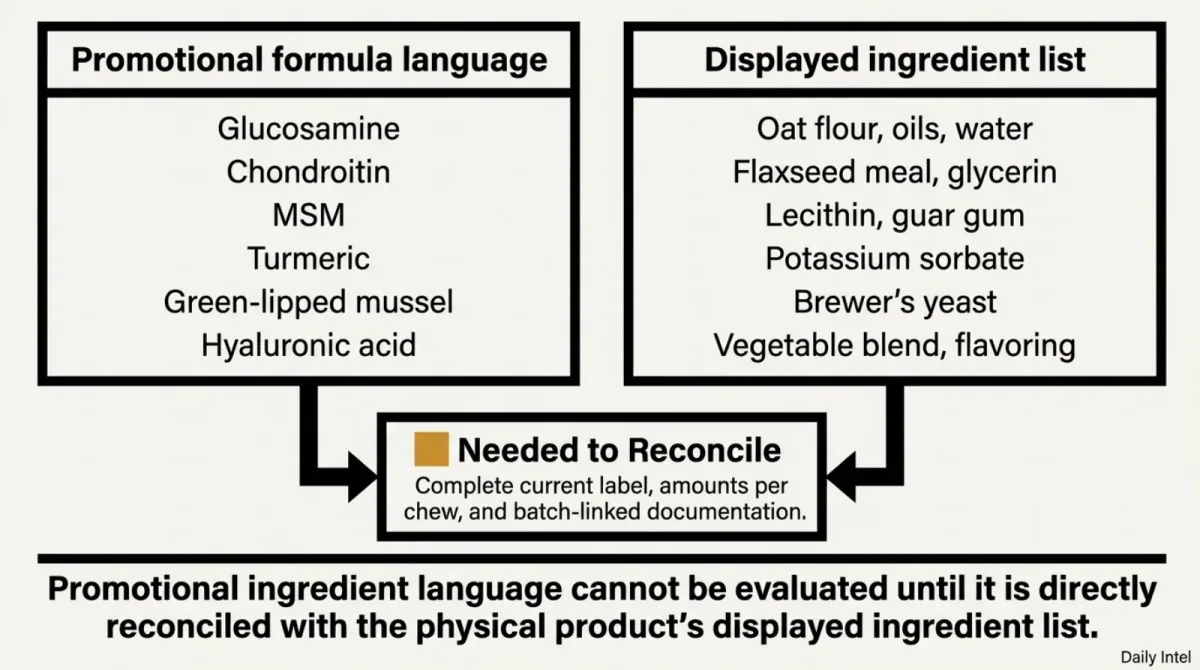
Reviewed Daily Intel teaching slide 3 of 3.
Further offer research may be reasonable for an owner who:
- has already discussed supplementation with the dog's veterinarian;
- can obtain a complete current label that reconciles the promotional and displayed ingredient information;
- understands that finished-product effectiveness has not been established by the supplied evidence;
- has checked whether the purchase is one-time or recurring; and
- accepts the bottle duration and conditional return terms.
Pause and seek veterinary input before considering the offer when the dog has unexplained or worsening symptoms, a diagnosed joint condition, concurrent medication, pregnancy or breeding status, or another medical issue. A buyer who requires product-specific clinical evidence should also keep looking unless new evidence becomes available.
No named product alternative can be fairly ranked from this packet. The better alternative may instead be a veterinary evaluation or a product with a complete, reconcilable label and evidence matched to its exact formula. That is an evidence criterion, not an endorsement.
A worksheet for auditing any canine joint-supplement claim
Use one row for each meaningful claim. Do not let a source answer a broader question than it actually studied.
| Claim to audit | Source type | Exact product matched? | Form and amount matched? | Dog population matched? | Outcome measured? | Current status | Next evidence needed |
|---|---|---|---|---|---|---|---|
| Happy Paws chews improve mobility | Official page | Yes for the marketing claim | No; displayed information is unresolved | Not applicable | No independent outcome supplied | Unestablished | Complete label plus an appropriate finished-product study |
| The bottle contains 100 chews | Dated official page | Yes | Not applicable | Not applicable | Count shown | Verified offer fact | Recheck the live page and package before publication |
| Another canine nutraceutical changed gait forces | Primary-study abstract | No | Match not established | Dogs with osteoarthritis | Ground-reaction force | Category context only | Full study and exact intervention comparison |
| A subscription saves money overall | Sales page and checkout | Exact offer requires live confirmation | Not applicable | Buyer-specific | Total recurring cost | Unresolved | Frequency, cancellation method, shipping and total checkout price |
| The product is suitable with a dog's medication | Product warning plus veterinary assessment | Product identified | Interaction details missing | Individual dog not assessed | Safety compatibility | Cannot be determined here | Current label, medication list and veterinarian input |
A practical decision rule follows: if the formula, population, amount or outcome does not match, move the evidence down the ladder rather than stretching the claim upward.
Original Daily Intel VSL strategy we would test
This is an original editorial and copy-research exercise. It is not an advertisement Happy Paws has run, and it makes no prediction about campaign performance.
A private joint-mobility VSL sample provides a useful structural counterpoint. At 0–186.6 seconds, it escalates visible symptoms into a hidden-cause narrative and urgency before establishing source quality. At 430–711.32 seconds, it expands the proposed biological mechanism with simplified metaphors. At 1013.34–1107.92 seconds, outcome stories make that mechanism feel concrete. From 1212.14–1761.12 seconds, quality signals, price anchoring, scarcity and a guarantee carry the offer close.
Those observations concern sequence only. The sample's wording, testimonials, mechanisms, statistics, outcomes, product and commercial terms do not transfer to Happy Paws.
For this offer, Daily Intel would reverse the proof order:
- Hook: Put the unresolved label question first: the promotional actives and displayed ingredient list need to reconcile before a buyer can evaluate the formula.
- Lead: Establish the exact 100-chew product, dated $34.99 price and weight-dependent bottle duration.
- Mechanism frame: Explain that any biological mechanism must match the ingredient's form, amount, canine population and measured outcome. Do not name a proprietary “root cause” without suitable evidence.
- Proof: Move from official offer facts to the independent study, explicitly showing why category research is not finished-product proof.
- Objections: Address formula identity, veterinary compatibility, medication timing, recurring charges, bottle duration and refund eligibility before presenting a link.
- Offer: Describe only the dated terms that can be verified. Omit fake urgency, outcome timelines and unverified savings.
- CTA: Invite only readers who have cleared the evidence and safety questions to inspect the current offer.
The copy test would compare this evidence-first sequence with a conventional benefit-first opening while holding the offer and audience constant. The research question is whether each version changes qualified engagement or post-click behavior; no result should be assumed in advance.
Final decision
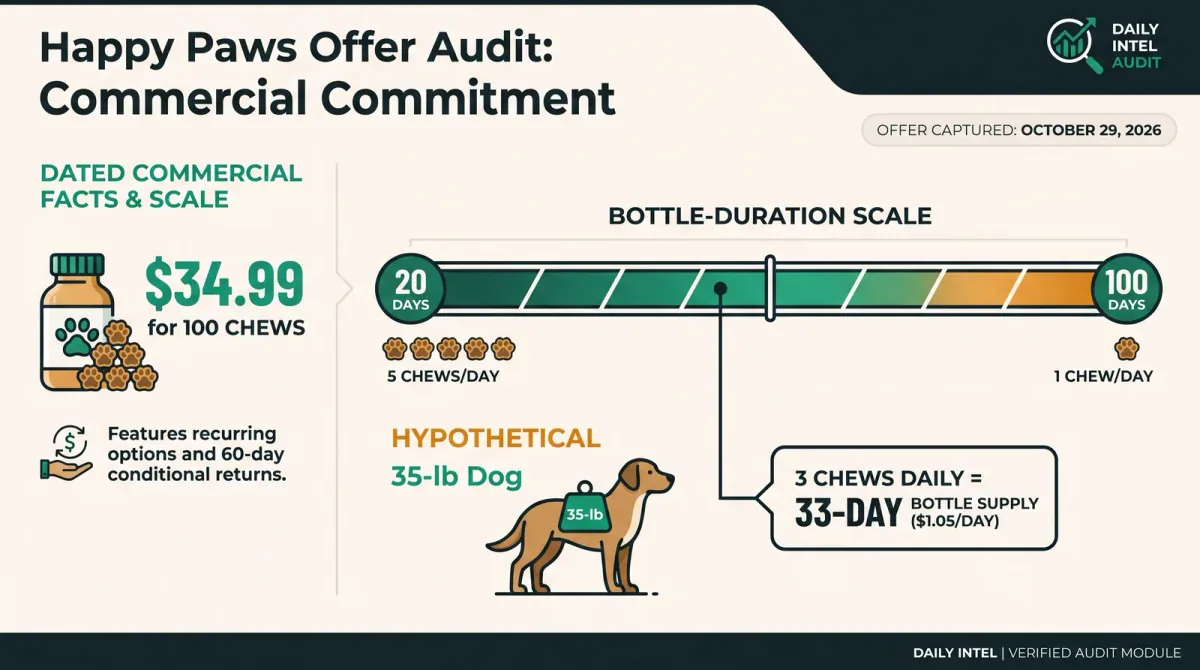
Reviewed Daily Intel infographic separating documented facts, claims, evidence and unresolved questions.
The captured offer establishes a product name, 100-chew count, $34.99 price, weight-based directions, recurring-purchase language and conditional return rules. It does not establish that the finished chews treat arthritis, reduce pain or improve mobility.
The promotional formula and displayed ingredient list also need reconciliation. Until a complete current label identifies the actual active ingredients and amounts, even ingredient-level comparison is premature. A finished-product study with a relevant canine population and meaningful outcomes would be required to move the efficacy verdict.
If those unresolved points fit your evidence standard and your veterinarian has addressed the individual safety questions, you can inspect the current terms at the official offer. Confirm the label, purchase type, total checkout cost and cancellation terms before ordering.
Sources and evidence notes
- Happy Paws product page: establishes the captured offer, directions, displayed ingredients, promotional formula and safety language. It does not independently substantiate efficacy.
- Happy Paws return policy: establishes the captured return conditions and non-refundable shipping language. Eligibility for a particular opened item remains conditional.
- Happy Paws shipping policy: records estimated shipping methods and limitations. Checkout-specific cost and availability can change.
- Happy Paws terms and conditions: provides broader purchase and dispute terms. The final live terms require review before publication.
- Canine osteoarthritis study abstract: supplies category context for a different nutraceutical and measured gait outcomes. It is not evidence for the finished Happy Paws product.
Related Daily Intel research
- cartilage revive marketing analysis review — Useful adjacent reading on how mechanism-led joint marketing can make a single explanation feel more certain than the underlying evidence.
- joint genesis review biodynamix vsl analysis — Provides a separate human-supplement example for readers studying mechanism ownership, authority signals and proof transfer in VSLs.
- joint genesis neuropure affiliate review — Relevant for media buyers who want the operational distinction between medical claims, funnel observations and measurable campaign evidence.
Download the teaching materials
Download the reviewed teaching slides (PDF). The file contains 3 pages and searchable English text.
Comments(0)
No comments yet. Members, start the conversation below.
Related reads
 reviews
Probiotic Dog Chews: Gastrointestinal Support review: Proof Gaps
Happy Paws provides a 100-chew count, weight-based directions, commercial terms, and material safety cautions. The unresolved issue is finished-product evidence: the packet contains no complete formula, product-specific clinical trial, batch report, or complete subscription and guarantee terms.
Read reviews
Finasteride 1mg Review: HealthRX’s $67 Plan and the Study Mismatch
HealthRX presents Finasteride 1mg as a once-daily prescription option supplied through an online provider review and pharmacy-fulfillment service. The commercial path is documented more clearly than the medical evidence for the exact dispensed product. The packet does not contain its full label, manufacturer, complete safety information, or a finished-product clinical trial.
Read reviews
Oral Minoxidil Tablets review: Convenience Does Not Close the Gap
Strut Health offers clinician-screened oral minoxidil for hair loss, but the supplied study did not test the exact Strut product. The prescribed dose, customer price, recurring terms, and parts of the safety framework also remain unresolved.
Read