
Sermorelin review: What the $179 HealthRX offer proves
HealthRX documents a clinician-reviewed telehealth path and a $179 Sermorelin price snapshot. The packet does not establish the exact dispensed formulation, FDA review of that compounded product, or meaningful long-term outcomes.

8,226+
Videos & Ads
+50-100
Fresh Daily
$29.90
Per Month
Full Access
12.5 TB database · 72+ niches · 27 min read
HealthRX has a documented Sermorelin offer and a stated telehealth service path. The captured structured offer showed $179. Those facts support a closer evaluation of the transaction. They do not establish that the compounded medication is effective, safe, suitable, or worth its total cost.
The central limitation is product-level uncertainty. The evidence packet does not identify the exact formulation, concentration, dispensed quantity, prescribed dose, schedule, treatment duration, dispensing pharmacy, or monitoring protocol attached to the reviewed $179 option. It also contains no clinical trial of the finished compounded product delivered through HealthRX.
Our decision is therefore conditional. HealthRX may be worth evaluating for an adult who has a specific objective, accepts the limits of compounded-product evidence, and is prepared for individualized clinical screening. It is not a strong evidence match for someone seeking FDA review of the dispensed product or robust trials showing meaningful long-term outcomes for the same formulation, route, dose, population, and duration.
Complete product specifications, unambiguous billing terms, a clear monitoring and interaction process, and relevant finished-product evidence would change that judgment. Until then, the $179 figure and the proposed biological mechanism should be treated as starting points for questions, not as a recommendation.
The decision this Sermorelin offer has to earn
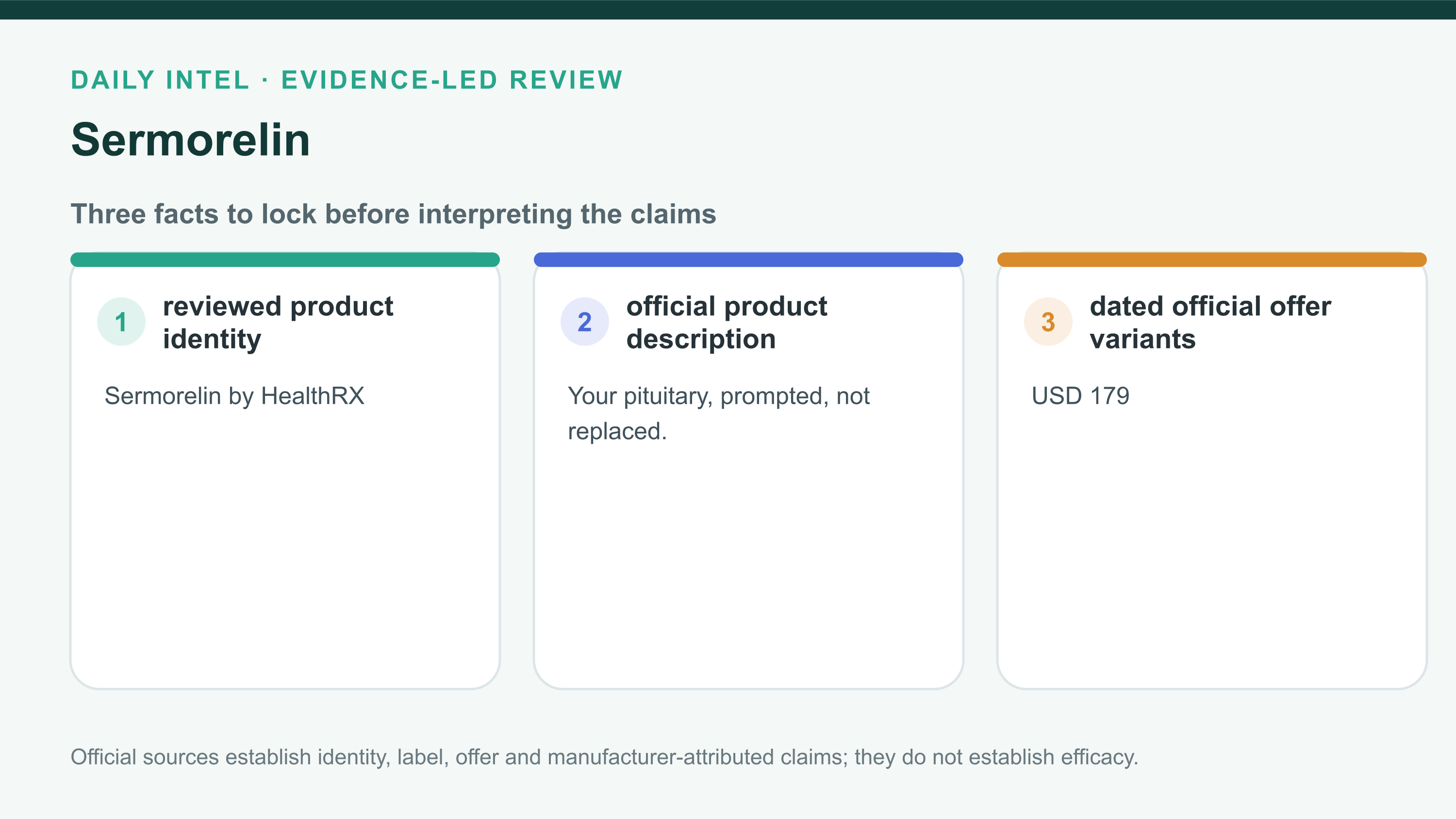
The offer has to earn confidence on three separate levels.
First, it has to be identifiable. A buyer should know what will be dispensed, in what form and quantity, by which pharmacy, and under what directions. The packet identifies Sermorelin by HealthRX but does not lock those remaining details for the $179 version.
Second, the evidence must fit the desired outcome. The packet contains a small human experiment involving growth hormone-releasing factors. It shows a short-term laboratory response under specific research conditions. It does not establish a lasting change in function, recovery, sleep, body composition, appearance, quality of life, or disease risk. Those outcomes should not be imported into the study.
Third, the complete commercial commitment must be understandable. A displayed price does not reveal whether the charge is monthly, prepaid, introductory, or tied to a particular supply. HealthRX’s general terms describe subscription renewals, clinical review, pharmacy fulfillment, and cancellation. The structured Sermorelin offer itself does not connect the $179 amount to a defined billing interval.
These levels cannot substitute for one another. A licensed-provider review does not prove efficacy. A plausible mechanism does not resolve pharmacy quality. A refund when a provider declines to prescribe does not establish a right to return medication after dispensing. A documented business process does not establish that treatment is appropriate for a particular person.
That separation is the foundation of this review. HealthRX has supplied enough information to describe its proposed service model. The packet does not supply enough evidence to predict a meaningful personal outcome.
What the HealthRX page actually offers
HealthRX presents itself as a marketplace platform. According to its captured official material, it connects patients with independently licensed healthcare providers through a patient portal. HealthRX says independent providers make clinical decisions and that US-licensed pharmacies fill prescriptions. HealthRX says it does not directly dispense medication or provide medical services.
The service path described by HealthRX has four broad stages. A prospective patient completes an online medical questionnaire. A US-licensed provider reviews the answers. If the provider considers treatment appropriate, a pharmacy fills and ships the prescription. HealthRX also advertises access to follow-up messaging.
The page says the online visit takes about three minutes. It also says delivery takes three to five days from prescription to the customer’s door and describes free shipping in plain packaging. These are seller representations about its service. They are not guarantees that a particular request will be approved, that every shipment will meet that timing, or that treatment will produce an outcome.
Approval is not automatic. HealthRX’s terms say payment does not guarantee a prescription or dispensing. A provider can decline care when treatment is not medically or ethically appropriate. The terms also say customers must be at least 18 years old. The affiliate program permits United States traffic, while the captured HealthRX page advertises service in 50 states. Neither point proves that a particular provider or dispensing arrangement is available or appropriate for an individual case.
The page describes Sermorelin with the line, “Your pituitary, prompted, not replaced.” That is seller positioning. It suggests stimulation of the body’s own hormone release rather than direct replacement with growth hormone. It does not prove that the finished product achieves a clinically meaningful benefit or has a preferable risk profile.
The official page also contains material about vitamin B12, methylene blue, NAD+ products, dietary supplements, semaglutide, and tirzepatide. Those passages do not substantiate Sermorelin. Evidence, prices, warnings, or outcomes associated with one of those products cannot be transferred to this offer merely because they appear on the same website.
The exact Sermorelin version is not locked down
The reviewed identity is Sermorelin by HealthRX. The captured structured product data listed HealthRX.com as the brand, described the offer using the pituitary-focused phrase, marked it in stock, and displayed $179.
That identity is narrower than the general longevity category but not narrow enough for a finished-product assessment. The packet does not provide a SKU, concentration, vial size, quantity, excipients, storage requirements, beyond-use date, starting dose, titration process, or prescribed schedule for the selected version. HealthRX’s terms say packaging and prescription labels can vary by dispensing pharmacy.
HealthRX’s captured FAQ discusses injections and says Sermorelin is usually injected at night. That is a general seller statement. It does not establish the route or directions that an individual would receive. A prescription schedule must come from the evaluating provider and the actual pharmacy label. This review cannot convert general website copy into dosing advice.
The distinction matters because a product is not defined solely by its active component. Formulation, concentration, route, dose, handling, pharmacy practices, patient characteristics, and monitoring all influence the evidence question. If any of those details differ from a study, the study’s transfer becomes weaker.
The packet also contains HealthRX’s statement that Sermorelin is compounded and used off-label in adults. Off-label use generally refers to a purpose, population, dose, or other condition outside an FDA-approved labeling basis. That concept must not be confused with approval of the compounded medication. The exact compounded product that may be dispensed through this offer is not FDA-approved.
Even evidence involving an FDA-approved active ingredient would not establish FDA review of a compounded finished product. FDA evaluates approved drugs through its approval process. The FDA source in this packet states that compounded drugs are not FDA-approved and are not verified by the agency for safety, effectiveness, or quality before marketing.
Before payment, a prospective patient should request the exact product description, quantity, route, proposed schedule, expected supply period, dispensing pharmacy, storage instructions, included supplies, monitoring process, and full charge. If some details are available only after clinical approval, the buyer should ask when they will be disclosed and what cancellation or refund rights remain at that stage.
HealthRX claims versus what the packet proves
HealthRX says Sermorelin signals the pituitary gland to release more of the body’s own growth hormone rather than replacing growth hormone directly. The pituitary is a gland involved in hormone signaling. The packet contains limited mechanism evidence that makes a related biological question reasonable. It does not validate every part of the seller’s presentation or prove an individual benefit.
Reader checkpoint—claim versus evidence boundary: the seller’s mechanism description is not finished-product efficacy evidence.
HealthRX also says most people notice initial changes within two to three months and fuller effects over six months. The supplied evidence packet does not contain a matched source establishing those timelines for the exact HealthRX compounded product. It provides no definition of “changes,” measured endpoints, population characteristics, response rate, or comparison group. That timeline remains a seller claim, not a verified expectation.
The captured site says Sermorelin’s adult use is off-label and supported mostly by observational data. That is HealthRX’s characterization. The packet does not supply the underlying observational studies. Readers therefore cannot assess the tested formulations, doses, populations, durations, endpoints, or limitations from that statement alone.
The page’s language about prompting rather than replacing may create an impression of a more natural or controlled option. The packet does not provide a comparative clinical trial showing that the offered approach is safer or more effective than another intervention. A conceptual mechanism distinction cannot be converted into a superiority claim.
HealthRX’s service claims have more direct documentation within the packet. Its pages describe online screening, independent provider review, licensed-pharmacy fulfillment, included follow-ups, and shipping. Its terms confirm that clinical approval is not guaranteed and that packaging can vary by pharmacy. These sources document the proposed service process more directly than they establish medical results.
A useful claim audit produces four different answers:
- Identity: Supported. The official data identifies a HealthRX Sermorelin offer.
- Dated price: Supported with limits. The captured offer displayed $179, but its billing interval and total commitment are not established.
- Service path: Documented as HealthRX’s stated process. An independent provider reviews the request before pharmacy fulfillment.
- Clinical results: Not established for the finished product. The packet contains neither a HealthRX-product trial nor verified patient outcomes.
No buyer ratings, testimonials, verified treatment outcomes, or comparative performance data were supplied. Their absence should remain visible. This review does not invent a customer consensus.
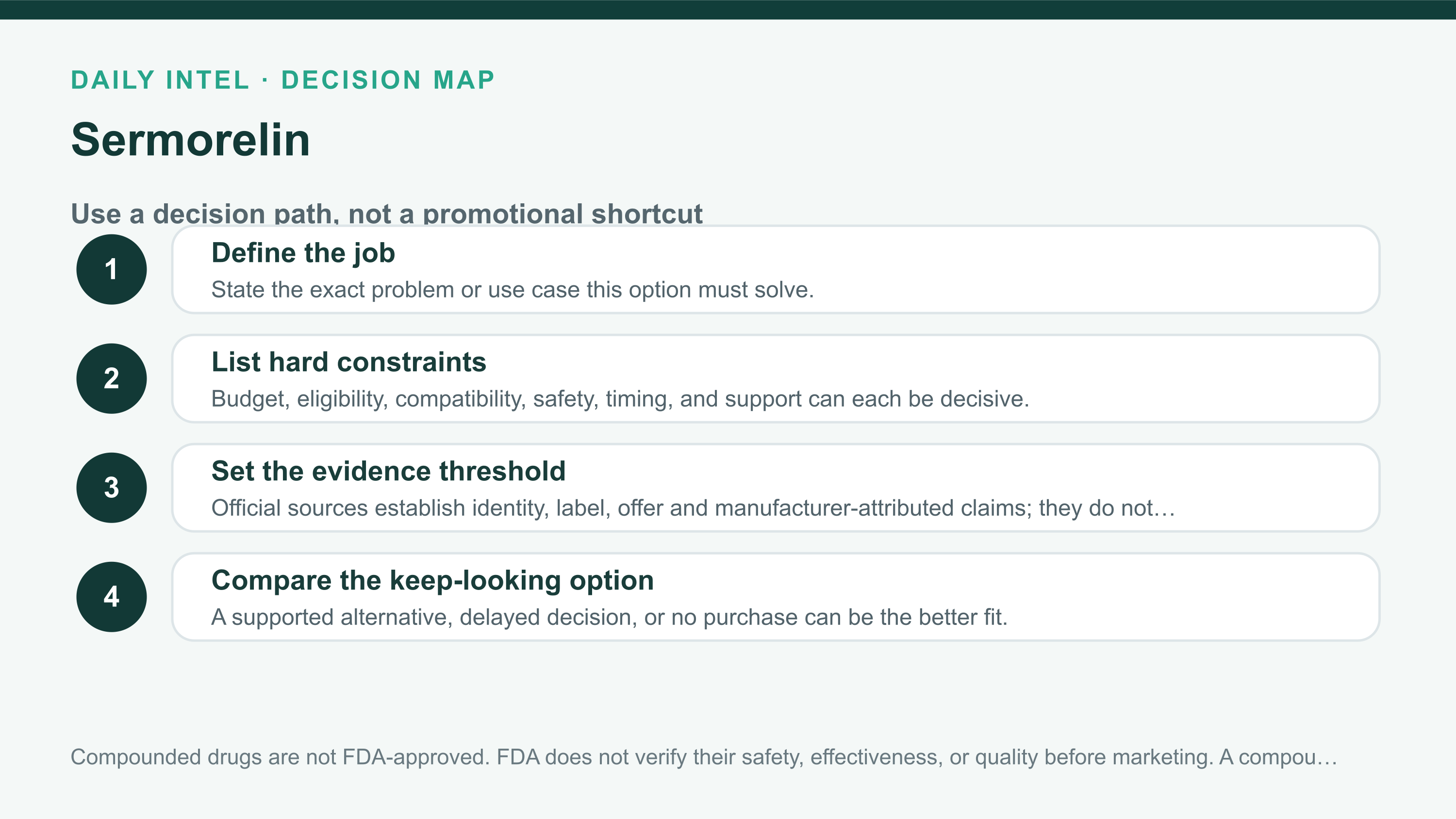
Where dose, form, population, and duration break the study fit
The relevant primary study was published in 1983. Researchers administered growth hormone-releasing factors of different chain lengths to five healthy volunteers. The peptides were given as 50-microgram intravenous boluses, and blood was collected before administration and for 120 minutes afterward. The study reported clear acute increases in growth-hormone levels compared with placebo controls.
That result is mechanism evidence. It indicates that the tested factors produced a short-term hormone response in that small research setting. It does not show that the HealthRX product changes how a person feels or functions. It does not establish long-term benefit, optimal dosing, suitability for an older or medically complex population, or the value of a telehealth plan.
Every major fit dimension is limited:
- Product: The researchers did not test a finished HealthRX compounded medication.
- Formulation: The packet does not show that the research material matches what a pharmacy would dispense.
- Route: The study used an intravenous bolus. HealthRX discusses an injectable prescription, but the packet does not lock the route of the exact $179 version.
- Dose: The research dose was 50 micrograms. No HealthRX dose is supplied, so no dose match can be claimed.
- Population: The study involved five healthy volunteers. The HealthRX audience and individual eligibility criteria are not equivalent to that group.
- Duration: The principal acute response was followed for 120 minutes. That cannot establish outcomes over months.
- Endpoint: The measured result was growth-hormone response. It was not a demonstrated improvement in health, function, body composition, sleep, recovery, or longevity.
The study abstract reported no serious side effects in that small experiment. That statement cannot be enlarged into a safety assurance. Five volunteers observed over a short period cannot establish the adverse-effect profile of a different compounded product used repeatedly.
The abstract also described repeated GRF1-44 administration to five normal subjects over two days at six- and 18-hour intervals. It reported growth-hormone responses after the injections. This remains short, small mechanism research. It does not repair the mismatch with the HealthRX formulation, prescribed schedule, intended population, repeated treatment period, or clinical outcomes.
The study is useful because it narrows what can honestly be said. Tested growth hormone-releasing factors produced acute laboratory responses in a small group. It is insufficient because the purchase decision concerns an exact compounded product, a real patient, repeated use, clinical goals, and a service commitment. Those are different questions.
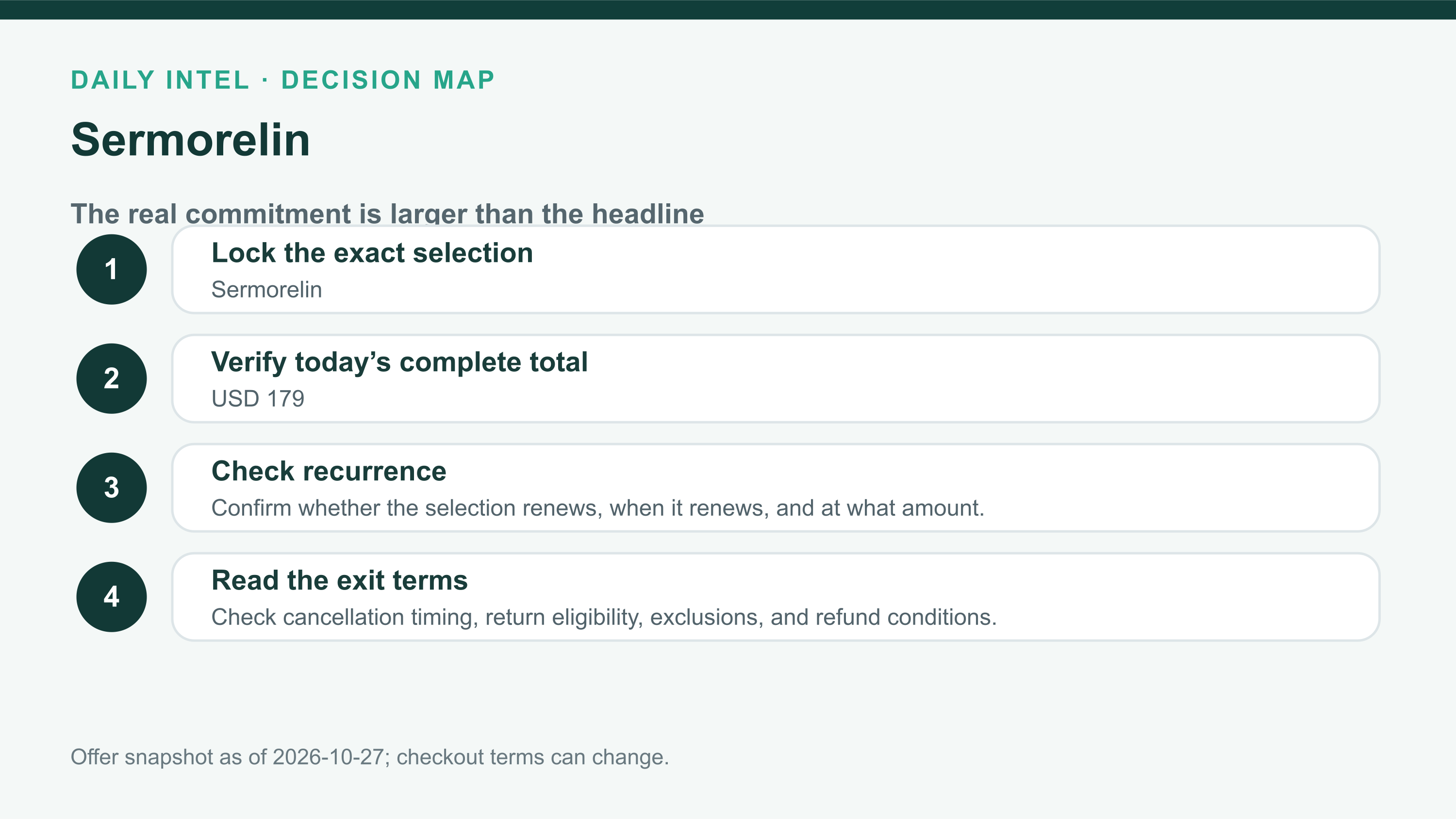
Price, recurring charges, refunds, and the real commitment
The official structured snapshot displayed $179 for Sermorelin. It was captured on October 20, 2026. Prices and terms can change, so the figure should not be treated as permanent.
Reader checkpoint—exact offer snapshot: the captured official price was $179 on October 20, 2026, but the billing interval and total commitment were not established.
More importantly, the structured offer did not state whether $179 was a monthly charge, a one-time purchase, the first payment, or a starting price for a particular plan. It did not define the dose, quantity, supply period, or total expected treatment cost. A price without those denominators cannot support a value judgment.
HealthRX’s general pricing material says the displayed plan price includes the provider visit, medication, and shipping. Its subscription terms say a plan purchased as a subscription renews automatically at the price and interval shown at checkout until canceled. An introductory discount, when applicable, covers only the first payment, with the recurring amount disclosed before payment. The packet does not establish that the $179 Sermorelin snapshot includes an introductory discount or even that this exact option is a subscription.
The affiliate contract contains internal payout and revenue rows labeled for three-, six-, and 12-month Sermorelin plans. Those network figures describe the commercial arrangement between the program and publisher. They are not verified consumer prices. They cannot be used to calculate a buyer’s charge or commitment.
Refund rights depend on timing and reason. HealthRX’s terms state that if a provider declines to prescribe after payment, HealthRX will issue a full refund of the related charge to the original payment method. Support processes the refund after the clinical decline is recorded, and the customer’s financial institution affects when it appears.
HealthRX’s refund policy says prescription medication cannot be returned after dispensing. It further says that once an order is charged and handed to a carrier, the sale is final. Customers can modify orders before shipment. Canceling a subscription can stop future renewals, but it does not refund medication already dispensed.
There is an unresolved operational conflict. A captured FAQ says customers can pause, change, or cancel from their account. The formal refund policy says future renewals can be canceled by emailing support. The packet does not establish whether both methods apply to every Sermorelin plan or which deadline controls. Obtain the current procedure before relying on either route.
A careful checkout review should record the selected plan, charge today, recurring amount, billing interval, next billing date, supplied quantity, pharmacy, shipping terms, clinician services, included supplies, cancellation method, and refund boundary. Saved checkout terms can document the dated agreement.
Affiliate disclosure: Daily Intel may earn a commission if a reader uses the rendered HealthRX offer link. That relationship is not evidence of effectiveness, safety, suitability, product quality, or FDA approval.
The tracking redirect had not been opened and independently verified when the evidence packet was assembled. Promotional-image rights were also unverified. Those are publication controls, not clinical evidence. Both should be cleared before this draft is published with commercial surfaces or promotional product imagery.
Safety boundaries the sales page cannot settle
The strongest safety boundary comes from the FDA. Compounded drugs are not FDA-approved. FDA does not verify their safety, effectiveness, or quality before marketing. The agency says compounding can meet an important need when an FDA-approved drug cannot meet a patient’s medical requirements. It also says compounded drugs should be used only for patients whose medical needs cannot be met by an FDA-approved drug and warns that unnecessary use can expose patients to potentially serious risks.
FDA identifies possible quality failures such as contamination or too much or too little active ingredient. That does not prove that the product arranged through HealthRX has such a defect. It explains why the identity and oversight of the compounder matter and why compounded status cannot be treated as a minor technicality.
HealthRX says its compounded medications are prepared by licensed compounding pharmacies under Section 503A of the Federal Food, Drug, and Cosmetic Act and a valid patient-specific prescription. That is HealthRX’s statement about its fulfillment model. A Section 503A compounding arrangement is not FDA approval of the finished medication. The packet also does not identify the pharmacy that would fill this particular prescription.
The captured HealthRX FAQ names injection-site reactions, flushing, and headache as common Sermorelin side effects. The packet provides no product-specific frequency, severity distribution, discontinuation rate, or long-term adverse-event data. It also does not contain a product-specific approved label for the compounded medication.
No complete contraindication or interaction list is supplied. That gap must not be translated into “no known interactions” or “safe for most people.” A prospective patient should give the reviewing clinician a complete list of prescription drugs, over-the-counter products, supplements, medical conditions, and prior reactions. Only an appropriately licensed professional with access to the actual proposed prescription can assess individual compatibility.
HealthRX says its provider reviews growth-hormone-related and blood-pressure-related history. That is a seller description of part of its screening process, not a complete eligibility standard. The packet does not establish product-specific rules for pregnancy, particular diseases, prior cancers, endocrine disorders, or other populations. This review will not invent those exclusions.
Age 18 or older is a contractual requirement in the captured terms. It is not proof of medical eligibility for every adult. Approval remains subject to a provider’s professional judgment, and a prescription can be refused.
A clinical review should resolve at least four questions: what objective is being evaluated, whether that objective has been properly assessed, whether an FDA-approved drug can meet the medical need, and how potential benefit and harm would be monitored if compounded Sermorelin is selected. This is a medical decision, not a conclusion that can be reached from a price card.
Who has a reason to continue—and who should wait
The offer may justify further evaluation for an adult with a clearly defined objective who understands that clinical review can end without a prescription. That person should be comfortable asking for product and pharmacy details, disclosing a complete health history, and accepting that the packet does not establish a predictable result.
Evidence tolerance matters. A reader may decide that limited mechanism evidence plus individualized clinical judgment is enough to request a consultation. That is different from concluding that the medication works. Continuing to screening is an information-gathering step, not evidence of benefit or a commitment to treatment.
Budget tolerance also matters. The $179 snapshot cannot be judged in isolation. A reader needs the billing interval, duration, included supply, renewal date, possible additional costs, and cancellation deadline. Someone unable to accept an unclear recurring commitment should wait until every charge is disclosed.
Keep looking or pause if any of these conditions applies:
Reader checkpoint—who should keep looking: readers whose evidence, budget, or risk limits are not met by the missing product, billing, and safety details should wait.
- You require FDA approval of the exact product that will be dispensed.
- You require a clinical trial of the same formulation, route, dose, population, duration, and outcome.
- HealthRX cannot identify the dispensing pharmacy or exact prescription details at the appropriate stage.
- The selected plan’s total cost and renewal schedule remain unclear.
- You expect a short-term hormone result to guarantee a meaningful long-term health change.
- You cannot obtain an adequate review of conditions, medications, supplements, interactions, and monitoring.
- You are uncomfortable with final-sale rules for medication after dispensing.
A reader should define one desired outcome before comparing options. The outcome should be specific enough to measure and important enough to justify medical uncertainty and cost. Broad language such as “healthy aging” is not yet a decision criterion.
The alternatives supported by this evidence
The packet does not support naming a competing Sermorelin brand, clinic, or drug as a direct winner. It contains no current like-for-like evidence for another provider’s formulation, price, monitoring, or outcomes. Naming a winner would create false precision.
The supported alternatives are decision pathways.
The first is an evaluation centered on the underlying objective rather than a requested product. A licensed professional can assess whether a symptom or concern requires diagnosis and whether treatment is appropriate. This becomes the better path when the goal is vague or a possible medical cause has not been evaluated.
The second is asking whether an FDA-approved medication can meet the identified medical need. FDA says compounded drugs should be used only for patients whose needs cannot be met by an approved drug. The packet does not name an approved substitute for a particular reader, so that question belongs in individualized clinical review.
The third is no immediate purchase. Waiting becomes the better choice when the product specification, pharmacy, monitoring, total charge, or evidence threshold remains unresolved. The packet supplies no evidence-based reason for urgency.
HealthRX lists other longevity products, including NAD+ options, rapamycin, metformin, glutathione, methylene blue, and vitamin B12. Listing them does not make them substitutes for Sermorelin. Their mechanisms, regulatory status, risks, and appropriate populations may differ, and this packet does not support a comparative recommendation.
The VSL strategy we would test for Sermorelin
The following is Daily Intel’s original strategy for an evidence-led video sales letter, or VSL. It is a worked editorial execution, not a HealthRX advertisement. HealthRX did not provide, approve, run, or report results for this script. No conversion performance is claimed.
Hook
A $179 Sermorelin offer should not be judged by whether its mechanism sounds appealing. It should be judged by whether the exact product, evidence, medical process, and financial commitment match the result a reader wants.
Start by writing down one outcome. Avoid a broad phrase such as “better aging.” Name what would materially change and how it would be measured. Then ask whether that outcome was studied in a product like the one that may be dispensed.
The evidence packet gives a clear reason for this discipline. HealthRX documents a Sermorelin offer and describes a clinician-reviewed service. The independent study documents an acute laboratory response in five healthy volunteers. Those are real but different facts. Neither proves a meaningful long-term outcome from the compounded prescription offered today.
Lead
The offer combines several decisions that can look like one. There is the decision to request medical review. There is the provider’s decision about whether to prescribe. There is the pharmacy’s compounded formulation. There is the buyer’s decision about recurring cost. And there is the clinical question of whether any observed change is meaningful and worth its risks.
The packet does not support treating a plausible active component as proof of the entire service. The service may offer a convenient process. A provider may conduct an individualized review. A pharmacy may prepare medication under compounding rules. None of those points demonstrates that the finished medication will produce the outcome a particular person expects.
Mechanism and its limit
HealthRX frames Sermorelin as a signal to the pituitary rather than a direct replacement for growth hormone. The pituitary is a gland involved in hormone regulation. HealthRX’s proposed mechanism is that the signal prompts the body to release more of its own growth hormone.
The packet supplies a narrow test of related growth hormone-releasing factors. In 1983, five healthy volunteers received 50-microgram intravenous boluses. Researchers tracked hormone levels for 120 minutes after administration. They observed acute growth-hormone increases compared with placebo.
The cited 1983 study reported one narrow observation: the tested factors were followed by short-term laboratory responses in that research setting. It does not supply the remaining links. It does not show that HealthRX’s compounded formulation matches the research material. It does not match an undisclosed prescription dose. It does not establish repeated-use safety. It does not demonstrate better function, sleep, body composition, appearance, recovery, quality of life, or longevity.
A mechanism can justify further investigation. It cannot complete the evidence chain by itself.
A hypothetical decision story
Consider a hypothetical reader named Morgan. No outcome is claimed for Morgan. This example shows how to examine the decision without inventing a testimonial.
Morgan encounters the phrase “prompted, not replaced” and initially finds the distinction reassuring. Morgan then pauses before converting that impression into a safety or efficacy conclusion.
First, Morgan defines the objective. Instead of saying “I want to feel younger,” Morgan identifies the actual concern and decides that an appropriate clinician should evaluate possible causes before a product is selected.
Morgan then asks what the $179 amount buys. Is it one month, one shipment, an initial charge, or part of a prepaid plan? What quantity will the pharmacy dispense? What route and schedule might be prescribed? Which pharmacy will fill it? Are supplies and follow-ups included? Is monitoring required, and would it create an additional charge?
Next, Morgan prepares a complete medication and supplement list. The evidence packet does not provide a complete interaction or contraindication list, so Morgan does not assume that the absence of a warning on a marketing page means the absence of risk.
Finally, Morgan compares the desired outcome with the evidence. The five-person study measured acute hormone responses, not Morgan’s selected outcome. Morgan may still choose to complete the clinical questionnaire. But the purpose would be to obtain an individualized assessment and missing information, not because the study predicted success.
Proof ladder
The first proof level is identity. HealthRX has an offer called Sermorelin. The captured price is $179.
The second level is the stated service process. HealthRX says an independent licensed provider reviews requests and a licensed pharmacy fills approved prescriptions. Its terms confirm that payment does not guarantee approval.
The third level is mechanism evidence. The small primary study observed acute hormone responses after intravenous research doses.
The fourth level would be matched finished-product evidence. That would require evidence relevant to the same compounded formulation, route, dose, population, duration, and meaningful outcomes. This level is missing from the packet.
The regulatory evidence adds a non-negotiable boundary. FDA states that compounded drugs are not FDA-approved and that the agency does not verify their safety, effectiveness, or quality before marketing. Approval history or research concerning an active ingredient would not mean that the compounded prescription dispensed to a patient received FDA review.
Objections
If the mechanism is real, why hesitate? Because biological activity and clinical value are different conclusions. A hormone measurement can change without establishing a lasting benefit that matters to the patient.
What about HealthRX’s two-to-three-month and six-month timelines? Those are seller claims in the captured material. The packet does not include matched finished-product evidence validating those expectations.
Is the product safe because a clinician reviews the request? Clinical screening is an important part of medical care, but it does not eliminate uncertainty or transform a compounded product into an FDA-approved one. The packet lacks product-specific adverse-event rates, a complete interaction list, and long-term safety evidence.
Does $179 make the offer affordable? It may or may not. The number is incomplete until the billing interval, quantity, duration, renewals, and any additional charges are known.
Can a buyer cancel? HealthRX says subscription plans renew until canceled. Its materials allow cancellation of future renewals but distinguish that from a refund for medication already dispensed. The captured FAQ and formal policy describe different cancellation channels, so the current method and deadline should be confirmed.
Does a prior approval history for Sermorelin resolve the issue? No. Even evidence for an approved active ingredient or an earlier branded product would not establish FDA review of the compounded finished product arranged through this offer.
Offer explanation
The responsible offer presentation is limited. HealthRX displayed Sermorelin at $179 when captured. It describes online clinical review, pharmacy fulfillment, shipping, and follow-up support. Approval is not automatic. If the provider declines to prescribe after payment, HealthRX’s terms say the related charge is refunded. If prescription medication has already been dispensed and transferred to the carrier, the refund policy says the sale is final.
Before proceeding, a reader should verify the exact formulation, route, quantity, proposed schedule, pharmacy, monitoring process, charge today, renewal amount, next charge date, cancellation procedure, and refund boundary. The internal affiliate payout rows are not consumer prices and should play no role in the decision. No artificial deadline is justified by this packet.
CTA
Daily Intel may earn a commission from the rendered HealthRX offer link. That financial relationship does not validate the product, service, or medical decision.
If the evidence limits are acceptable and the goal is specific, the next step would be to review HealthRX’s current eligibility and offer details. Treat that as a request for information and clinical assessment. It is not a promise that a prescription will be issued or that treatment will help.
If the details remain incomplete, do not force the decision. Ask for the missing terms, discuss the objective and approved options with a licensed professional, or wait. The evidence supports an informed decision, including the decision not to buy.
Frequently Asked Questions Before Paying
Is HealthRX Sermorelin FDA-approved?
A: No evidence in the packet establishes FDA approval of the compounded Sermorelin product HealthRX may arrange. FDA states that compounded drugs are not FDA-approved and are not verified by the agency for safety, effectiveness, or quality before marketing. Evidence concerning an active ingredient would not change that finished-product boundary.
How much does HealthRX Sermorelin cost?
A: The captured structured offer showed $179. That is a dated snapshot, not a complete cost calculation. The supplied structured data does not identify the billing interval, dispensed quantity, dose, expected duration, or total commitment attached to that exact price. Check the complete charge and renewal schedule before payment.
Does the $179 Sermorelin offer renew automatically?
A: The packet does not establish whether the exact $179 option is a subscription. HealthRX’s general terms say that a plan purchased as a subscription renews automatically at the price and interval shown at checkout. Confirm whether the selected Sermorelin plan is recurring and retain the checkout terms.
Is HealthRX Sermorelin legitimate?
A: The packet documents an official HealthRX offer, a stated provider-review process, pharmacy fulfillment, terms, and refund policies. That does not prove the exact compounded product’s quality, safety, effectiveness, or suitability. A documented service path and clinical proof of a finished product are separate questions.
What are the side effects and interaction risks?
A: HealthRX’s captured FAQ names injection-site reactions, flushing, and headache as common effects, but the packet supplies no verified rate or complete product-specific safety profile. It also lacks a contraindication and interaction list for the dispensed formulation. A licensed professional needs the reader’s complete health, medication, and supplement history.
Can I get a refund or cancel?
A: HealthRX says a clinician’s decision not to prescribe after payment leads to a full refund. Its refund policy says dispensed prescription medication cannot be returned and that canceling does not refund medication already dispensed. Future subscription renewals can be canceled, but the captured pages describe different operational paths, so confirm the current procedure.
What are the best Sermorelin alternatives?
A: The packet does not support naming a like-for-like product alternative. The evidence-supported alternatives are decision paths: seek an assessment based on the actual objective, ask whether an FDA-approved option can meet the medical need, or defer treatment until the formulation, evidence, monitoring, and total cost are clear.
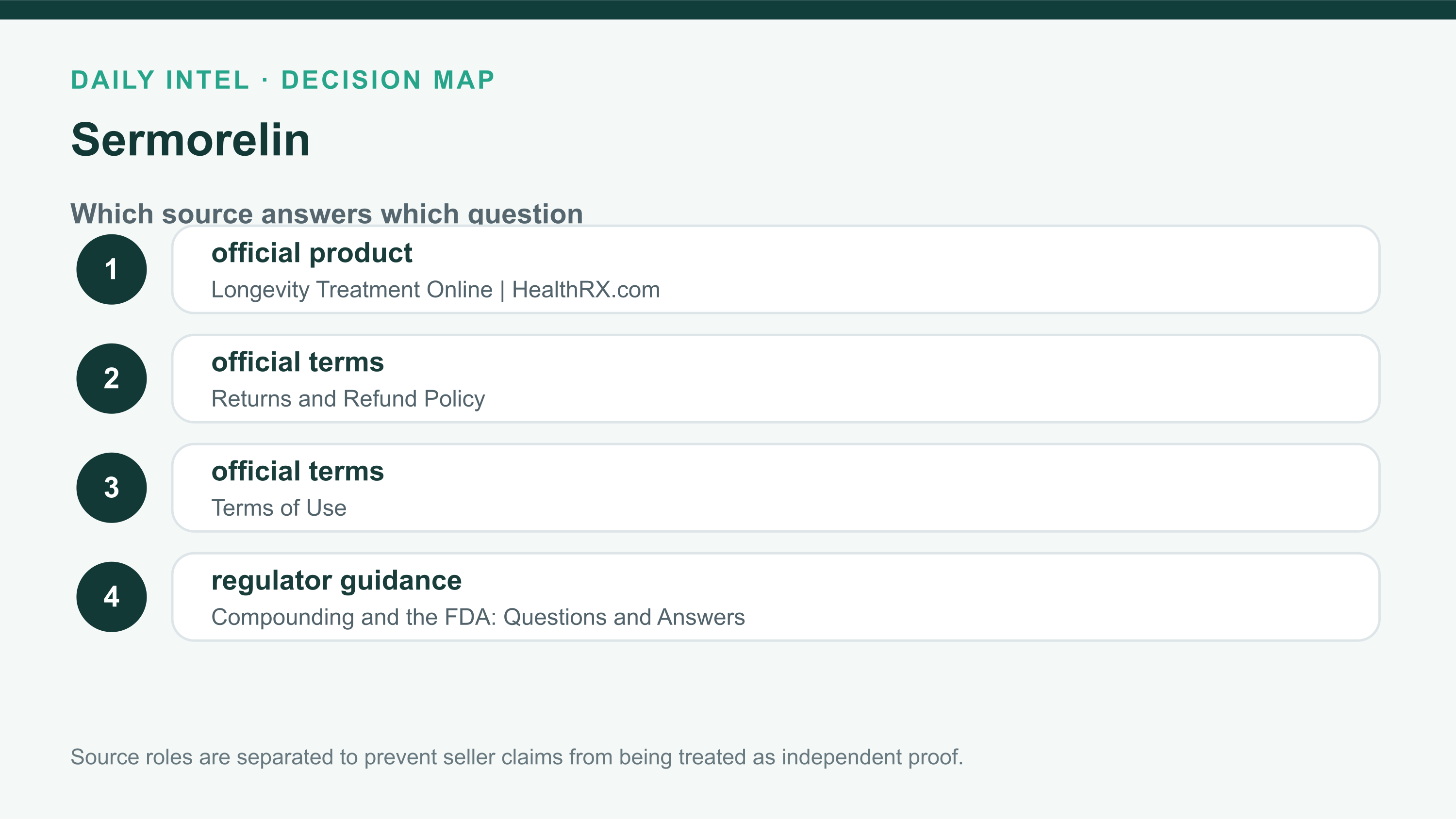
Sources and evidence notes
Evidence card: HealthRX Sermorelin destination — This is the program-specific official destination associated with the reviewed product. It may provide current offer and eligibility information. The affiliate tracking redirect leading to it was deliberately not opened during research, so that redirect still requires independent verification before publication. An official destination is not efficacy evidence.
Evidence card: HealthRX longevity-care page — This captured page established product identity, the $179 structured snapshot, seller positioning, and HealthRX’s description of its telehealth pathway. It also contained timing and expected-change claims that remain seller-attributed because the packet did not supply matched substantiation.
Evidence card: HealthRX Returns and Refund Policy — This source distinguishes automatic subscription renewal, future cancellation, one-time purchases, and the final-sale boundary after prescription medication is dispensed and transferred to a carrier. It does not establish that the $179 option is recurring or resolve the difference between account-based and email cancellation instructions.
Evidence card: HealthRX Terms of Use — The terms document the minimum age, provider discretion, lack of guaranteed prescribing, refund following a clinical decline, subscription renewal language, and pharmacy-dependent packaging. They establish the stated contractual process, not clinical outcomes or suitability.
Evidence card: FDA questions and answers on compounding — This regulator source establishes that compounded drugs are not FDA-approved and are not verified by FDA for safety, effectiveness, or quality before marketing. It explains why compounding may serve an unmet patient need and why unnecessary use can create serious risks. It does not assess the specific pharmacy or prescription that HealthRX may arrange.
Evidence card: 1983 human growth hormone-releasing factor study — This primary study reported acute growth-hormone responses after 50-microgram intravenous doses in five healthy volunteers. The principal acute response was followed for 120 minutes, and the abstract also described repeated GRF1-44 administration over two days. The study supports limited mechanism observations only. It does not test HealthRX, a matched compounded formulation, prolonged use, or meaningful long-term outcomes.
Final Take: What Would Change the Verdict
HealthRX has documented a service proposition: an online request, independent provider review, pharmacy fulfillment when approved, follow-up access, and a captured $179 Sermorelin offer. The packet also documents a refund process when a provider declines to prescribe after payment.
Reader checkpoint—what would change the verdict: matched finished-product evidence plus the missing formulation, pharmacy, monitoring, and complete billing details.
The offer has not earned a product-level recommendation. Its exact formulation and plan details are incomplete in the supplied evidence. The primary study is too small, brief, and mismatched to predict a clinical outcome from the finished compounded medication. FDA’s compounding boundary also prevents evidence about a related active component from being presented as review or approval of the dispensed product.
The verdict would become more favorable if HealthRX disclosed the exact formulation, concentration, route, quantity, schedule, pharmacy, monitoring process, billing interval, and total commitment, then supported its intended outcomes with relevant evidence matching the offered product and population. It would become less favorable if checkout terms obscured renewal, if product identification remained unavailable at the appropriate stage, or if promotional claims expanded without matched evidence.
For now, the defensible action is conditional evaluation, not endorsement. A reader who accepts the uncertainty can use the clinical process to ask questions and determine eligibility. A reader who requires FDA-reviewed finished-product evidence, predictable outcomes, or complete specifications before payment should wait or discuss other pathways with a licensed professional.
This article is for informational and educational purposes only. It is not medical advice. Daily Intel is independent and may earn an affiliate commission. HealthRX did not write, review, or control this article.
Comments(0)
No comments yet. Members, start the conversation below.
Related reads
 reviews
ARMRA Colostrum Review: Evidence, Dose Gaps, Price, and Verdict
ARMRA’s 120-serving colostrum powder comes with notable manufacturer-reported survey percentages. However, the undisclosed amount per serving and a materially different ingredient trial leave the finished product’s highlighted outcomes unproven.
Read reviews
Olly Goodbye Stress Review: Label Claims vs. Evidence
OLLY Goodbye Stress combines GABA, L-theanine, and lemon balm extract in a Berry Verbena gummy aimed at occasional stress, not sleep. Here's what the label discloses, what a real L-theanine trial found, and exactly where the evidence stops.
Read reviews
Kaged Pre-Kaged Sport Review: Does the Citrulline Study Fit?
Kaged Pre-Kaged Sport provides 3.5 grams of fermented L-citrulline in each 13-gram scoop. The supplied trial tested a higher dose of isolated L-citrulline and found no performance benefit, so it cannot prove whether this finished formula works.
Read