
HealthRX NAD+ Injection Review: Real Offer, Unsettled Product Proof
HealthRX documents a telehealth path to an at-home compounded NAD+ injection, but the packet does not establish one reliable current price or finished-product efficacy. This review separates verified service terms from unresolved clinical, product, and payment questions.

8,226+
Videos & Ads
+50-100
Fresh Daily
$29.90
Per Month
Full Access
12.5 TB database · 72+ niches · 25 min read
HealthRX documents a telehealth path to an at-home NAD+ injection, but the supplied record does not support a confident product-level effectiveness conclusion. The service is identifiable. HealthRX describes clinician review, pharmacy fulfillment, injection supplies, shipping, and follow-up. The packet does not lock down the exact formulation, concentration, prescribed dose, schedule, assigned pharmacy, complete safety instructions, or one reliable current price.
The most important evidence gap is clinical. No supplied study tested the finished HealthRX product. The one primary study involved 500 milligrams of intravenous NAD+ on four consecutive treatment days in a commercial setting. Intravenous means delivered into a vein. HealthRX describes its reviewed product as a subcutaneous injection, meaning administered into tissue beneath the skin. The study examined preliminary tolerability rather than whether the HealthRX treatment works.
The price record also conflicts. The packet captures a $179 offer, but that field carries the description HealthRX used for Sermorelin, a different product. The responsible conclusion is that the packet contains conflicting product data—not that $179 is a settled current NAD+ charge.
Our verdict is therefore conditional. The offer may merit a clinician discussion if you accept limited product-specific evidence and can verify the prescription, pharmacy, safety controls, and complete payment terms. It is a weak fit if you require a finished-product efficacy trial or complete specifications before entering an eligibility and payment process.
The Decision HealthRX NAD+ Injection Needs to Earn
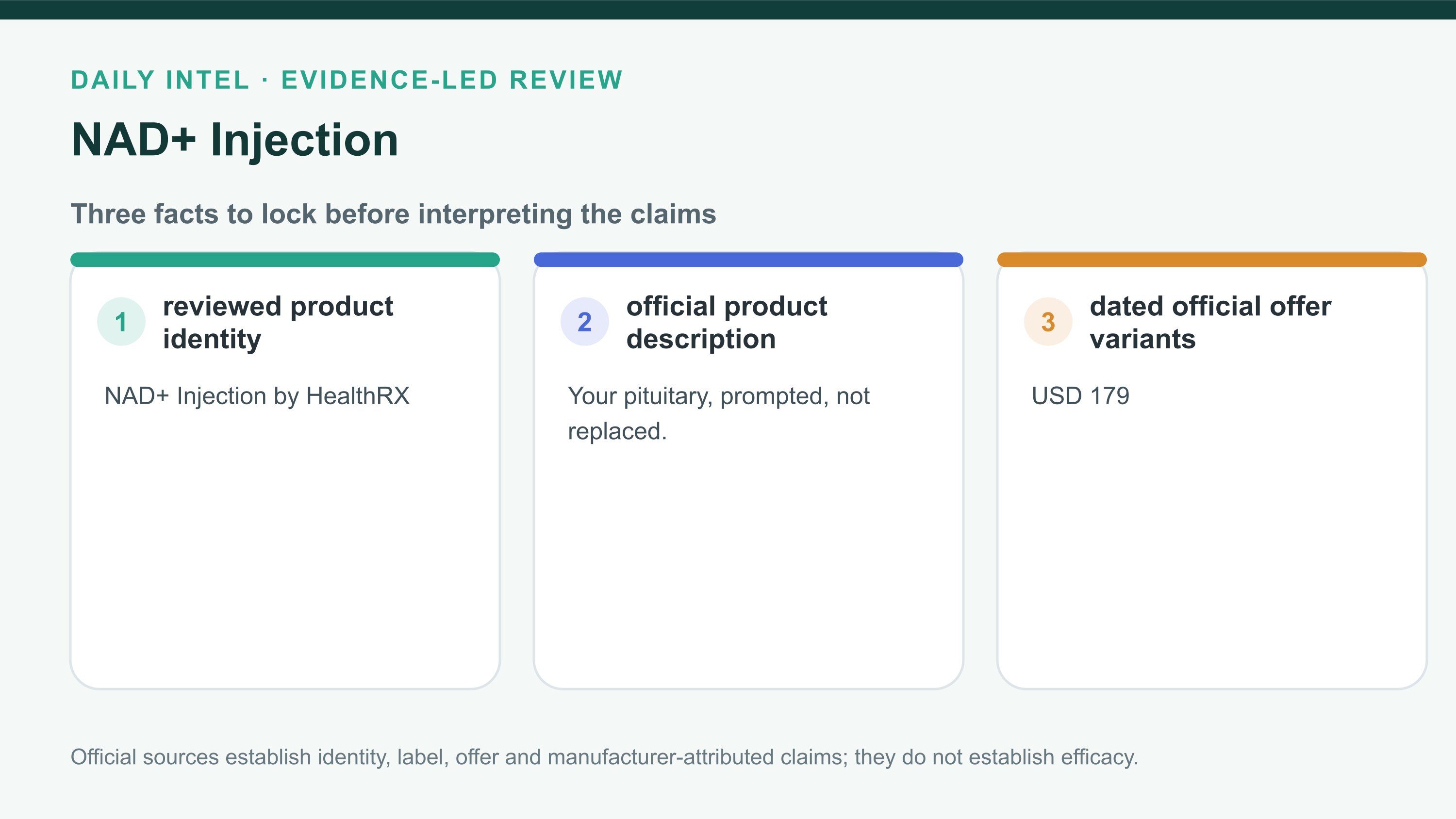
HealthRX NAD+ Injection needs to earn two decisions. First, is the service sufficiently transparent for the financial commitment? Second, is the proposed medication clinically appropriate for the individual patient? A documented telehealth workflow does not answer the clinical question by itself.
The service side is partly established by HealthRX's own pages and terms. HealthRX says a customer completes an online medical questionnaire, an independent US-licensed provider reviews the request, and an approved prescription is filled by a US-licensed pharmacy. HealthRX operates the platform but says it does not directly provide medical care or dispense medication. Clinical decisions remain with the independent provider.
Payment does not guarantee a prescription. HealthRX's terms say a provider may decline care when treatment is not considered medically or ethically appropriate or when misuse is suspected. If a provider declines to prescribe after payment, HealthRX says it will issue a full refund of the related charge to the original payment method. Support processes the refund after the clinical decline is recorded, and posting time depends on the customer's financial institution.
Those terms establish a review process. They do not provide the eligibility rules for this exact NAD+ regimen, a complete contraindication list, an interaction guide, or evidence that every customer receives the same medication configuration.
The clinical case remains materially incomplete. The packet supplies no finished-product efficacy trial and no verified concentration, vial size, inactive-ingredient list, standard dose, injection frequency, or treatment duration for the exact offer. Without those details, a general description of NAD+ biology cannot show what this product will do for a particular person.
The decision would become more concrete if the proposed prescription, assigned pharmacy, formulation, dose, schedule, storage instructions, quality controls, and full checkout terms were disclosed before fulfillment. Those details would clarify the documented offer. They still would not prove a health outcome.
What the HealthRX Page Actually Offers
The verified subject is NAD+ Injection by HealthRX. HealthRX presents it through a telehealth service rather than as an unrestricted retail supplement. The captured material describes a prescription product intended for injection at home after clinician review.
A HealthRX FAQ in the packet identifies the route as subcutaneous and says an injection kit is included. HealthRX says the provider confirms the schedule and that pharmacy instructions explain how to prepare, inject, and store each dose. Those are seller statements about the intended service. The packet does not contain the patient-specific prescription or pharmacy label needed to confirm what any individual would receive.
HealthRX says the online visit takes about three minutes. It describes three to five days from prescription to delivery, free shipping in plain packaging across 50 states, and unlimited provider follow-up messages at no extra cost. These statements help define the advertised workflow. They are not independent delivery records, response-time measurements, or guarantees that every approved order follows the same timeline.
Customers must be at least 18 under the terms. Approval is not automatic. A completed questionnaire and payment begin an evaluation; they do not establish eligibility or guarantee that medication will be dispensed.
HealthRX identifies the medication as compounded. A compounded medication is prepared by a pharmacy for a patient under a prescription rather than sold as an FDA-approved finished drug. HealthRX says its compounded medications are prepared by licensed compounding pharmacies under Section 503A of the Federal Food, Drug, and Cosmetic Act. It also says packaging and prescription labels can vary by dispensing pharmacy.
The compounded-product boundary is relevant here because HealthRX itself applies it to the offer. HealthRX says compounded medications are not reviewed or approved by FDA for safety or efficacy. Clinician review is important, but it does not convert a compounded medication into an FDA-approved product.
The pharmacy variation also means the commercial product name does not establish every physical detail. The assigned pharmacy, concentration, complete formula, label, storage directions, and dosing instructions may depend on the prescription and fulfillment path. Those details must come from the provider and dispensing pharmacy rather than from assumptions based on the name NAD+ Injection.
The Exact Version Under Review—and the Identity Conflict
The most specific structured record identifies HealthRX NAD+ Injection with SKU CRM-NAD-INJ-1M, categorizes it under longevity, and marks it as available online. The captured description says it is NAD+ injected at home. This review is limited to that offer.
It is not a review of HealthRX NAD+ Nasal Spray. It is not an evaluation of intravenous NAD+ administered in a clinic. It is not a review of Sermorelin, Glutathione Injection, Vitamin B12 Injection, Methylene Blue, or HealthRX's nonprescription supplements. Statements about those products cannot establish this injection's formula, mechanism, safety, or effectiveness.
That separation matters because the packet contains an apparent product-record mismatch. One fact assigns the phrase “Your pituitary, prompted, not replaced” and a $179 price to the reviewed record. The same wording is associated with Sermorelin, while the commercial payout schedule treats Sermorelin and NAD+ Injection as separate categories.
The affiliate compensation schedule also names Sermorelin and NAD+ injection in separate rows. That schedule does not establish what a patient will pay or which plans are currently offered at checkout. It does, however, confirm that the affiliate program treats the two product categories separately.
The $179 field should not be silently presented as a settled NAD+ price. The evidence supports disclosure of a conflict. A prospective customer should verify the live NAD+ plan name, immediate charge, renewal amount, billing interval, treatment duration, and total payment before authorizing the transaction.
Other material specifications remain unresolved. The packet does not establish the concentration, vial volume, number of doses, injection frequency, complete ingredient list, inactive ingredients, exact supply quantity, or assigned pharmacy. It also does not establish whether every plan uses the same formulation or schedule.
These omissions prevent a precise comparison between the marketed product and a clinical study. They also affect practical instructions. Preparation, storage, injection, and disposal requirements can depend on the medication and supplies actually dispensed. The patient should follow the prescribed label and pharmacy instructions, not a generalized online summary.
What HealthRX Claims—and What Each Claim Proves
HealthRX states that NAD+ is not FDA-approved for any use and that human data remain limited. Its captured FAQ likewise says no NAD+ injection is FDA-approved and describes the plan's medication as compounded by a licensed pharmacy. Those statements set useful evidence and regulatory boundaries.
HealthRX describes NAD+ as a coenzyme involved in cellular energy production and repair. A coenzyme is a molecule that helps enzymes perform chemical reactions. The supplied study describes NAD+ as a cofactor for enzymes involved in cellular processes. The packet contains no finished-product efficacy evidence for energy, longevity, repair, or another practical outcome from this HealthRX formulation.
Biological function, a proposed treatment mechanism, and a demonstrated patient benefit are different evidence levels. A substance may have an important role in the body without a particular dose, route, and formulation producing a clinically meaningful result. The packet contains no finished-product trial connecting those levels for HealthRX NAD+ Injection.
Other promotional statements captured on the HealthRX page concern different products. Vitamin B12 Injection is paired with an energy-support statement. Methylene Blue is paired with a mitochondrial-support statement. Dietary supplements are described as daily support sold separately from prescription treatment. Those statements do not prove anything about the ingredients or performance of NAD+ Injection.
The service claims have firmer documentary support within HealthRX's own terms than any outcome claim. The terms describe provider discretion, pharmacy fulfillment, subscriptions, and refunds after clinical denial. That evidence helps explain how HealthRX says the service operates. It does not independently verify service performance or establish medical benefit.
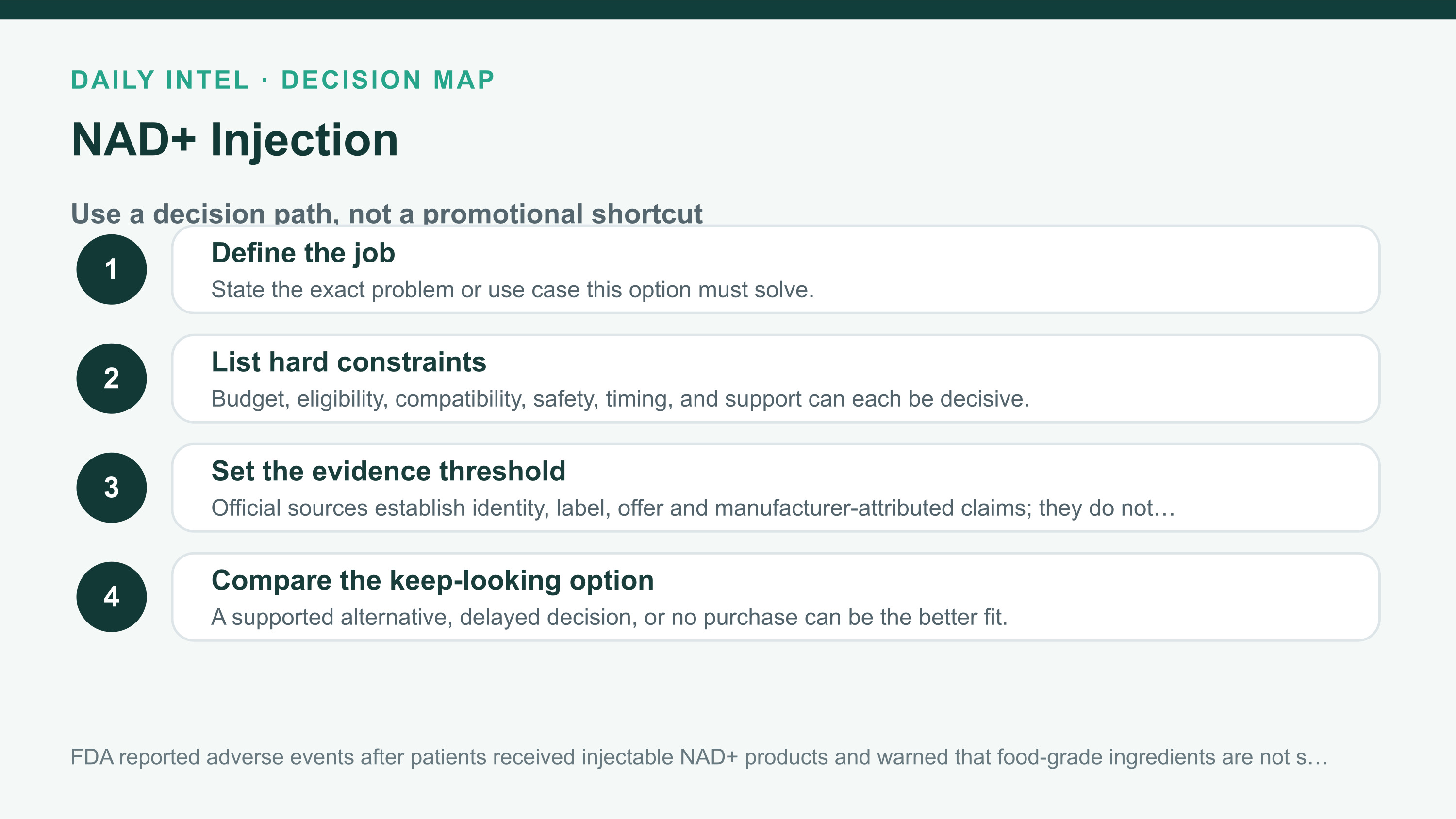
claim versus evidence boundary: HealthRX's statements document what the seller says the service offers. The packet does not establish finished-product efficacy.
The resulting claim audit is narrow:
- HealthRX offers a product identified as NAD+ Injection: supported.
- HealthRX describes it as an at-home subcutaneous prescription treatment: supported as a seller statement.
- An independent provider must approve treatment: supported by HealthRX's terms.
- Payment guarantees a prescription: contradicted by HealthRX's terms.
- This is an FDA-approved NAD+ injection: contradicted by HealthRX's own disclosure.
- The exact HealthRX injection has demonstrated efficacy: not established by the packet.
- A complete product-specific adverse-effect rate is available: not established.
- One dependable current total price is established: not established because the records conflict and plan terms may vary.
This approach avoids dismissing an identifiable offer merely because evidence is incomplete. Operational documentation is service evidence, not finished-product efficacy evidence.
Dose, Route, Formulation, and Population: Where Study Fit Breaks
The packet contains one primary human study involving administered NAD+. It was a preliminary retrospective pilot comparing intravenous NAD+ with intravenous nicotinamide riboside in a commercial setting. Retrospective means the investigators reviewed existing records rather than prospectively assigning participants in a randomized trial.
Participants received 500 milligrams intravenously on four consecutive treatment days, with 30 days of follow-up. The researchers examined infusion time, reported symptoms, blood pressure, resting heart rate, selected laboratory safety markers, and exploratory metabolic measurements.
Participants receiving NAD+ reported moderate to severe gastrointestinal symptoms, increased heart rate, and chest pressure during infusion. The reported symptoms resolved when infusion ended. NAD+ infusions averaged 97 minutes, compared with 37 minutes for nicotinamide riboside.
Those findings do not show that HealthRX NAD+ Injection works. The study was not a finished-product efficacy trial. It did not test a verified HealthRX formulation, an at-home subcutaneous route, or the dose and schedule a HealthRX provider might prescribe. The commercial-clinic setting also differs from self-administration at home.
The exploratory laboratory findings do not establish consumer benefits. The sample was small and non-random, and the report's principal value in this packet is preliminary tolerability information. The authors said additional research was needed to evaluate dosage and effectiveness beyond 30 days.
Route is a major mismatch. Intravenous administration delivers material into a vein during an infusion. Subcutaneous administration places it under the skin. The supplied evidence does not establish that absorption, exposure, administration speed, or adverse effects are equivalent between these routes.
An event observed during intravenous infusion cannot be assigned directly to subcutaneous use. The reverse is also true: the absence of a particular event in this intravenous record would not establish safety for HealthRX's different formulation and route.
Dose and duration do not transfer either. The study's 500-milligram dose over four consecutive days cannot be used as the HealthRX dose. The packet does not provide the reviewed product's prescribed amount or frequency. It would therefore be inaccurate to compare exposure numerically or infer that one regimen is stronger or safer.
Population fit is unresolved as well. The packet characterizes the research sample as small and non-random but does not provide evidence that its experience represents every adult considering an energy- or longevity-oriented treatment. It contains no matched analysis for the patient population HealthRX ultimately approves.
The defensible evidence transfer stops at a limited point: intravenous NAD+ has preliminary human tolerability data, and the supplied report documented reactions during infusion. It cannot establish the effectiveness, dose, expected experience, or complete safety profile of the HealthRX subcutaneous product.
Price, Renewals, Refunds, and the Real Commitment
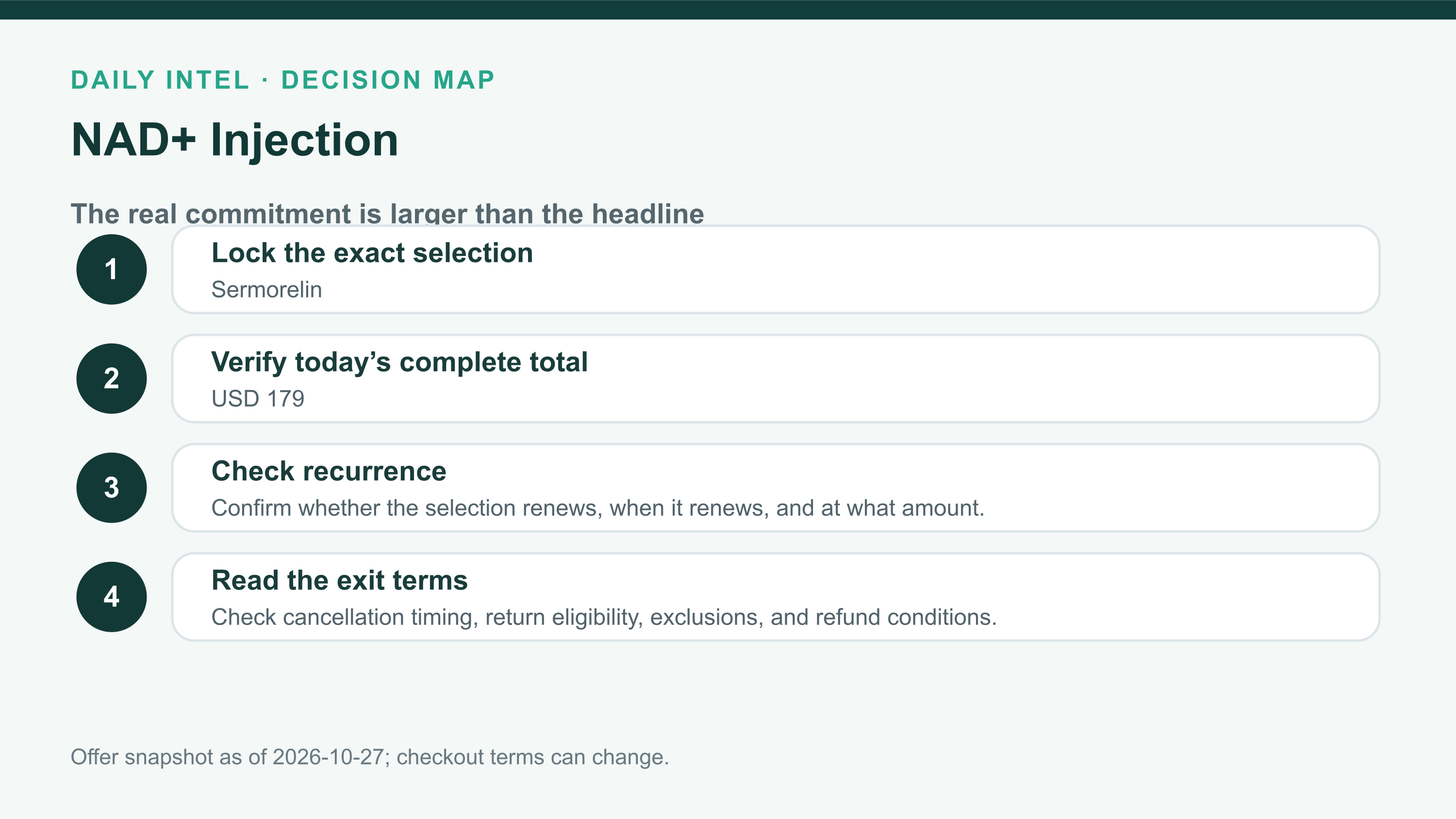
exact offer snapshot: HealthRX's official record captured a $179 offer as of October 27, 2026, but the same record carries wording associated with Sermorelin, a different product. For the purchase decision, the evidence supports treating this as a dated offer snapshot, not a settled NAD+ total. Confirm the current NAD+ charge, plan duration, and renewal terms through the plan selector and checkout disclosure.
The affiliate contract contains publisher-compensation rows labeled for three-, six-, and 12-month NAD+ injection plans. Those rows are not a consumer price sheet. They do not establish current plan availability, patient charges, discounts, supply quantities, or the checkout configuration. Affiliate revenue and payout amounts must not be presented as treatment prices.
HealthRX says plan pricing includes medication, injection supplies, the provider visit, follow-up messages, and shipping. It says no insurance is required. These are seller statements, and the packet does not independently confirm that every NAD+ option includes precisely the same services. The final checkout summary remains controlling for the transaction.
HealthRX's returns policy says prescription medications cannot be returned after dispensing. Once an order has been charged and handed to the carrier, the sale becomes final. Customers can modify orders before shipment through their account. HealthRX directs customers to patient care for damaged items and says lost packages will be reshipped.
Subscription plans renew automatically at the price and interval shown at checkout until canceled. HealthRX says any introductory discount applies only to the first payment and that the recurring price is shown before payment. It also says it will notify the customer by email before a proposed change to the renewal price or billing period takes effect.
The cancellation descriptions are not fully aligned. The returns policy says future renewals can be canceled by emailing support. A captured FAQ says customers can pause, change, or cancel from their account and describes no long-term contracts. Those methods could coexist, but the packet does not establish how they apply to every NAD+ plan. Confirm the operative method and deadline before payment.
Canceling a future renewal does not return prescription medication already dispensed. The policy does not provide a general satisfaction guarantee for this medication. The separate full-refund statement applies when the provider declines to prescribe after payment. It should not be expanded into a post-fulfillment results guarantee.
Before paying, confirm the exact product name, immediate charge, future charge, billing interval, plan length, amount prepaid, medication quantity, renewal date, cancellation deadline, included services, possible additional fees, and clinical-denial refund process. Saving the checkout summary would preserve the terms presented at the time of authorization.
The real commitment is the complete plan, not the first displayed number. That distinction matters when affiliate records contain three-, six-, and 12-month labels but the packet does not supply the corresponding patient prices or prove that those options remain available.
Safety, Interactions, and Eligibility Boundaries
The strongest independent safety source in the packet is an FDA notice about ingredients used in sterile compounding. FDA says it received adverse-event reports following the use of injectable NAD+ products. Reported reactions included severe chills, shaking, vomiting, and fatigue, and some patients required medical treatment.
FDA said the reactions were consistent with excessive endotoxin levels. Endotoxins are potentially harmful bacterial components. The agency warned that ingredients intended for food or dietary supplements may be unsuitable for sterile drugs without appropriate processing because microbial and endotoxin contamination can harm patients. It urged compounders to know their bulk-ingredient and excipient suppliers and use ingredients appropriate for drugs.
The notice does not establish that HealthRX, a HealthRX dispensing pharmacy, or this particular medication caused any reported event. The supplied FDA record does not identify the reviewed product. Calling HealthRX NAD+ Injection contaminated or unsafe on that basis would exceed the evidence.
Ignoring the notice would also be inappropriate. HealthRX describes its medication as compounded, so the assigned pharmacy, ingredient suitability, sterile preparation, sourcing, and adverse-event process are relevant pre-treatment questions. The packet does not provide product-specific answers.
HealthRX's captured FAQ identifies injection-site redness, soreness, or swelling as likely possibilities. It also discusses gastrointestinal symptoms, increased heart rate, and chest pressure observed during intravenous research. The route caveat must remain attached: the packet supplies no published incidence rates for adverse effects from this exact subcutaneous HealthRX regimen.
The packet does not contain a complete product-specific contraindication list, interaction guide, or population-exclusion list. That absence cannot be interpreted as evidence that no contraindications or interactions exist. The packet does not establish individual medical eligibility.
The reviewing clinician should address the patient's history, current treatments, and any other information relevant to the proposed prescription. The dispensing pharmacy should provide the applicable preparation, storage, injection, and disposal instructions. This article cannot replace either source of patient-specific direction.
HealthRX's FAQ advises emergency care for trouble breathing, swelling of the face or throat, chest pain, or a racing heartbeat. That is seller-provided guidance rather than a complete emergency list. A severe or rapidly worsening reaction requires appropriate medical help, not reliance on an affiliate article or routine sales support.
FDA also directs patients, healthcare professionals, and compounders to report adverse events through MedWatch. An adverse-event report does not by itself prove causation, but reporting can help regulators identify patterns requiring investigation.
Who This Offer May Fit—and Who Should Keep Looking
HealthRX NAD+ Injection may fit an adult in the United States who understands that the product is compounded and not FDA-approved, accepts the absence of a matching finished-product efficacy trial, is willing to complete clinician review, and is comfortable with subcutaneous self-injection after receiving instructions.
It may also interest someone who values remote evaluation, home delivery, included supplies, and follow-up messaging. Those conveniences remain seller-described service features. They do not resolve the medication's expected benefit or suitability.
The offer is a weaker fit for anyone requiring evidence that the exact formulation improves energy, longevity, repair, or another specific outcome. No matching trial appears in the packet. It is also a weak fit for someone who cannot obtain clear answers about the prescription, pharmacy, formula, dose, schedule, storage, quality controls, total cost, or renewal process.
Someone who does not want a recurring arrangement should confirm whether a one-time option exists rather than assuming one from general policy language. Someone unwilling to accept nonreturnable prescription medication should understand that cancellation of future renewals does not reverse an order already dispensed and shipped.
The packet does not support diagnosing a symptom, assigning it to NAD+ status, or concluding that this injection is the appropriate response. The clinical evaluation—not the product name or an affiliate review—must determine whether the proposed treatment is appropriate for an individual.
Budget fit depends on the complete expected commitment. A first payment does not reveal the total cost of a multi-month or automatically renewing plan. Until the current checkout terms are verified, price-sensitive readers do not have enough information to make a settled comparison.
The Closest Supported Alternatives Change the Verdict
The closest product alternative documented in the packet is HealthRX NAD+ Nasal Spray. HealthRX displayed a starting price of $134 per month and described the one-month subscription as charged monthly. That was a dated seller snapshot, not a permanent price.
The nasal product uses a different route and avoids a needle. The packet provides no evidence that it produces an effect equivalent to the injection. It should not be described as stronger, weaker, safer, or equally effective without matched evidence.
The nasal option becomes the more relevant product question when avoiding self-injection is the main practical constraint. The injection remains relevant only if the reviewing clinician recommends that route and the patient accepts its evidence and quality-control uncertainties.
Other HealthRX products in the packet are not supported as like-for-like alternatives. They use different ingredients and have different intended purposes. Their prices and promotional descriptions cannot establish the value of NAD+ Injection.
Pausing is also a supported decision. It becomes the better option when the proposed prescription, current terms, or evidence standard remains unclear. Continuing to investigate is not evidence that the product fails. It is a proportionate response to unresolved information.
The VSL Strategy We Would Test for NAD+ Injection
This is an original Daily Intel strategy we would test. It is not HealthRX's video sales letter. The packet contains no evidence that HealthRX ran, approved, or achieved results with this approach. No wording, testimonial, outcome, or claim from the private structural reference is used here.
Hook
The opening would begin with the decision the evidence supports:
“HealthRX offers an NAD+ injection for use at home after clinician review. Before treating the displayed price as the whole decision, verify five things: the medication, the prescribed dose, the dispensing pharmacy, the renewal terms, and the evidence that matches this route.”
This hook avoids promises about energy, aging, repair, or healthspan. It does not tell viewers that they have a deficiency or that NAD+ explains a symptom. Its purpose is to make the unresolved purchase and treatment questions concrete.
Lead
The lead would distinguish the documented service from the unsettled clinical case:
“HealthRX lists NAD+ Injection, describes an independent provider review, and says approved prescriptions are filled by a US-licensed pharmacy. The packet contains a $179 field that carries wording associated with Sermorelin, so the current NAD+ charge remains unsettled. More importantly, it contains no finished-product efficacy trial for the exact at-home injection.”
The next line would explain why the distinction matters. Product identity, telehealth terms, and checkout information can establish that a service is being offered. They cannot show that the medication produces a particular outcome.
That framing prevents operational credibility from doing work that belongs to clinical evidence. It also avoids the opposite error of pretending that an evidence gap proves the treatment cannot work.
Mechanism Frame
The mechanism section would be short. NAD+ can be described as a cofactor or coenzyme involved in cellular processes. The script would immediately add that biological importance does not show that a particular injected dose improves a person's energy, longevity, repair, or another health outcome.
The useful teaching point would be route. HealthRX describes subcutaneous self-injection. The supplied pilot studied intravenous infusion. A simple visual could label one path “beneath the skin” and the other “into a vein,” followed by this boundary: “Different routes are not interchangeable, so evidence from one cannot automatically validate the other.”
The visual would not depict cells being repaired, aging being reversed, or a hidden biological deficit being corrected. Those outcomes are not established for this product.
Evidence-Audit Story
The story would use a labeled hypothetical rather than a customer or testimonial:
“Hypothetical example: Jordan sees HealthRX NAD+ Injection and wants to know whether the displayed amount is reasonable. Jordan first asks what the payment buys. Is it one month or a longer plan? How many doses are supplied? Does it renew? Which pharmacy fills it? What happens if the clinician declines treatment? What evidence matches the prescribed route and dose?”
Jordan would then encounter the product-record conflict. A $179 field contains wording assigned elsewhere to Sermorelin, while the commercial schedule treats Sermorelin and NAD+ Injection as separate categories. The script would explain that an evidence-led review does not use the mismatched field to create a more persuasive pitch. It preserves the conflict and directs the viewer to verify checkout.
The hypothetical would not say that Jordan purchased, benefited, suffered a reaction, or reached any particular medical decision. The story's only outcome would be better-defined questions.
Proof Sequence
The proof would move through separate layers.
First, HealthRX's pages establish the product identity and seller-described workflow: online questions, independent clinician review, pharmacy fulfillment, shipping, supplies, and follow-up.
Second, HealthRX's terms establish commercial boundaries. Payment does not guarantee a prescription. Subscription plans renew at the price and interval shown at checkout. A provider's decision not to prescribe can trigger a refund of the related charge.
Third, the returns policy establishes commitment boundaries. Prescription medication generally cannot be returned after dispensing. Canceling future renewals does not undo a completed pharmacy order.
Fourth, the clinical study supplies narrow tolerability evidence. It involved 500 milligrams of intravenous NAD+ for four consecutive days. Participants reported gastrointestinal symptoms, increased heart rate, and chest pressure during infusions. It was preliminary, retrospective, non-random, and not an efficacy trial of HealthRX's finished product.
Fifth, the FDA notice supplies category-level sterile-compounding context. FDA received reports of severe reactions following some injectable NAD+ products and warned about microbes, endotoxins, and ingredients not appropriate for sterile drugs. The notice does not identify the HealthRX product in this packet.
The proof sequence would end with the missing product-level evidence: no matched trial of the exact formulation, subcutaneous route, prescribed dose, intended population, and treatment duration.
Objections
The first objection would be: “Does missing matched evidence prove the injection cannot work?” No. It limits confidence; it does not prove ineffectiveness.
The second would be: “Does the FDA notice prove HealthRX NAD+ Injection is unsafe?” No. The notice concerns injectable NAD+ and sterile-compounding risks generally. It supports questions about sourcing and preparation but does not establish a defect in this product.
The third would address convenience. HealthRX describes a short online visit and home delivery, but convenience does not determine clinical suitability. Approval remains with an independent provider, and delivery timing remains a seller statement.
The fourth would address price. The script would not treat the captured $179 offer as a settled current NAD+ price. It would tell viewers to confirm the product name, initial charge, recurring amount, billing interval, plan length, and total commitment.
The fifth would address refunds. A refund following clinical denial is not a satisfaction guarantee. Once prescription medication has been dispensed and handed to the carrier, HealthRX says the sale becomes final.
The sixth would address the nasal alternative. Avoiding a needle may make the nasal product worth asking about, but the packet does not establish equivalent effect or safety. Route preference cannot substitute for a clinical comparison.
Offer Logic
The offer segment would explain the seller-described sequence without turning it into proof: submit medical information, receive an independent provider decision, review the prescribed plan, and proceed to pharmacy fulfillment if approved.
Its documented value proposition is access to a remote evaluation and, if prescribed, an at-home compounded medication with supplies, shipping, and follow-up described as included. Each element would remain attributed to HealthRX.
The segment would instruct viewers to obtain the exact prescription, assigned pharmacy, formulation, dose, schedule, storage directions, adverse-effect guidance, interaction review, and complete checkout terms. It would not call the offer a shortcut to more energy or longer life.
CTA
The final invitation would remain low pressure:
“If these evidence limits are acceptable, review the current HealthRX offer and use the clinician process to resolve the prescription, pharmacy, safety, interaction, and payment questions before treatment. If the answers remain unclear, pause and continue comparing.”
The commission disclosure would appear immediately before and near the renderer-owned affiliate link. The presentation would contain no countdown, scarcity claim, guaranteed result, fabricated buyer story, or suggestion that delaying purchase will worsen the viewer's health.
The decision is not whether NAD+ sounds biologically important. It is whether the exact proposed medication, clinical review, safety information, evidence, and financial commitment meet the viewer's standard.
Frequently Asked Questions
Q: Is HealthRX NAD+ Injection legitimate?
A: HealthRX documents an identifiable NAD+ Injection offer, clinician-review process, and pharmacy-fulfillment pathway. That documents HealthRX's stated service pathway. It does not prove that this exact injection is effective, appropriate for a particular patient, or supported by a finished-product clinical trial.
Q: How much does HealthRX NAD+ Injection cost?
A: The packet does not establish one dependable current price. It captures a $179 offer, but that field carries wording associated with Sermorelin. Confirm the initial charge, recurring amount, billing interval, plan duration, and total commitment at checkout.
Q: Is HealthRX NAD+ Injection FDA-approved?
A: No. HealthRX states that no NAD+ injection is FDA-approved for any use and describes this medication as compounded by a licensed pharmacy. Provider review and patient-specific compounding do not make the finished medication FDA-approved or establish FDA-reviewed safety and efficacy.
Q: What evidence shows that HealthRX NAD+ Injection works?
A: No finished-product efficacy trial appears in the packet. The supplied pilot involved 500 milligrams of intravenous NAD+ on four consecutive days and focused on tolerability. Its route, formulation, setting, schedule, and purpose do not match the reviewed at-home subcutaneous regimen.
Q: What are the possible side effects of NAD+ injections?
A: HealthRX identifies injection-site redness, soreness, or swelling as likely possibilities. An intravenous pilot reported gastrointestinal symptoms, increased heart rate, and chest pressure during infusions, but those observations cannot be transferred directly to subcutaneous use. FDA has separately reported severe reactions following some injectable NAD+ products.
Q: Can I cancel or return HealthRX NAD+ Injection?
A: HealthRX says future subscription renewals can be canceled, although the packet describes both account-based management and cancellation by email. Prescription medication generally cannot be returned after dispensing, and sales become final once charged and handed to the carrier. Confirm the operative method and deadline before paying.
Sources and Evidence Notes
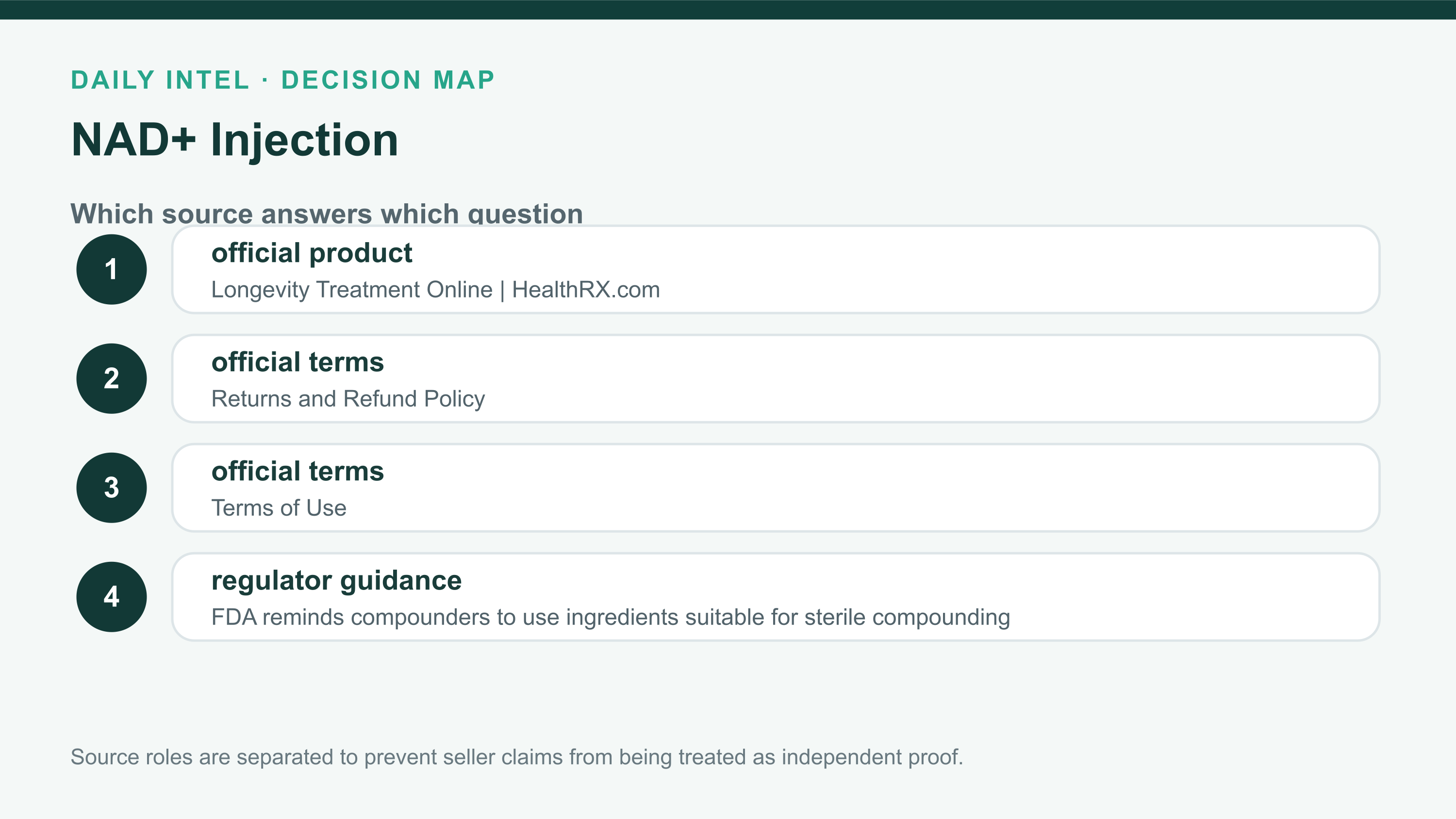
Evidence card: HealthRX longevity treatment page. This official seller source establishes the described telehealth pathway, clinician review, pharmacy fulfillment, shipping, follow-up, product listings, and general NAD+ statements. It does not independently establish effectiveness, consistent service performance, or patient outcomes.
Evidence card: HealthRX Terms of Use. These terms support the platform/provider distinction, age requirement, prescription discretion, subscription renewal, variable pharmacy packaging, and refund following clinical denial. They govern the service process; they do not prove clinical benefit.
Evidence card: HealthRX Returns and Refund Policy. This policy supports the prescription-return restriction, final-sale timing, future-renewal cancellation, introductory-price boundary, and lost- or damaged-package procedures. The plan-specific cancellation method and timing still need checkout confirmation.
Evidence card: FDA notice concerning injectable NAD+ and sterile compounding. FDA reports severe reactions following some injectable NAD+ products and explains microbial, endotoxin, and ingredient-suitability concerns. The notice does not identify HealthRX or prove that this medication was involved.
Evidence card: Intravenous NAD+ and nicotinamide riboside tolerability pilot. This primary report provides preliminary observations from 500-milligram intravenous administrations over four consecutive days. It does not test the HealthRX finished product, establish efficacy, or define the safety of a different subcutaneous formulation and regimen.
Final Take: What Would Change the Verdict
The evidence supports a cautious conclusion. HealthRX documents a telehealth pathway to an at-home compounded NAD+ injection, but the packet does not justify a product-level effectiveness claim. The price record conflicts, the exact prescription configuration is not established, and the only clinical study uses a different route and was not an efficacy trial.
The offer would become easier to evaluate if a prospective patient could verify the assigned pharmacy, drug-appropriate ingredient sourcing, concentration, complete formulation, dose, schedule, storage instructions, interaction review, adverse-event process, current charge, renewal interval, and total commitment. Those answers would improve transparency without proving an outcome.
The clinical verdict would change more substantially if credible research tested the same finished formulation, subcutaneous route, dose, intended population, and duration against a suitable comparison and reported meaningful outcomes and adverse events.
Until then, a reader comfortable with uncertainty may use the clinician-review process to ask patient-specific questions. A reader requiring matched efficacy evidence, settled pricing, or complete specifications before engagement should keep looking. Neither decision requires predicting a result that the packet does not establish.
The exact compounded product reviewed here is not FDA-approved; clinician review and pharmacy fulfillment do not establish FDA review of its safety, effectiveness, or quality.
This article is for informational and educational purposes only. It is not medical advice. Daily Intel is independent and may earn an affiliate commission. HealthRX did not write, review, or control this article.
Comments(0)
No comments yet. Members, start the conversation below.
Related reads
 reviews
ARMRA Colostrum Review: Evidence, Dose Gaps, Price, and Verdict
ARMRA’s 120-serving colostrum powder comes with notable manufacturer-reported survey percentages. However, the undisclosed amount per serving and a materially different ingredient trial leave the finished product’s highlighted outcomes unproven.
Read reviews
Olly Goodbye Stress Review: Label Claims vs. Evidence
OLLY Goodbye Stress combines GABA, L-theanine, and lemon balm extract in a Berry Verbena gummy aimed at occasional stress, not sleep. Here's what the label discloses, what a real L-theanine trial found, and exactly where the evidence stops.
Read reviews
Kaged Pre-Kaged Sport Review: Does the Citrulline Study Fit?
Kaged Pre-Kaged Sport provides 3.5 grams of fermented L-citrulline in each 13-gram scoop. The supplied trial tested a higher dose of isolated L-citrulline and found no performance benefit, so it cannot prove whether this finished formula works.
Read