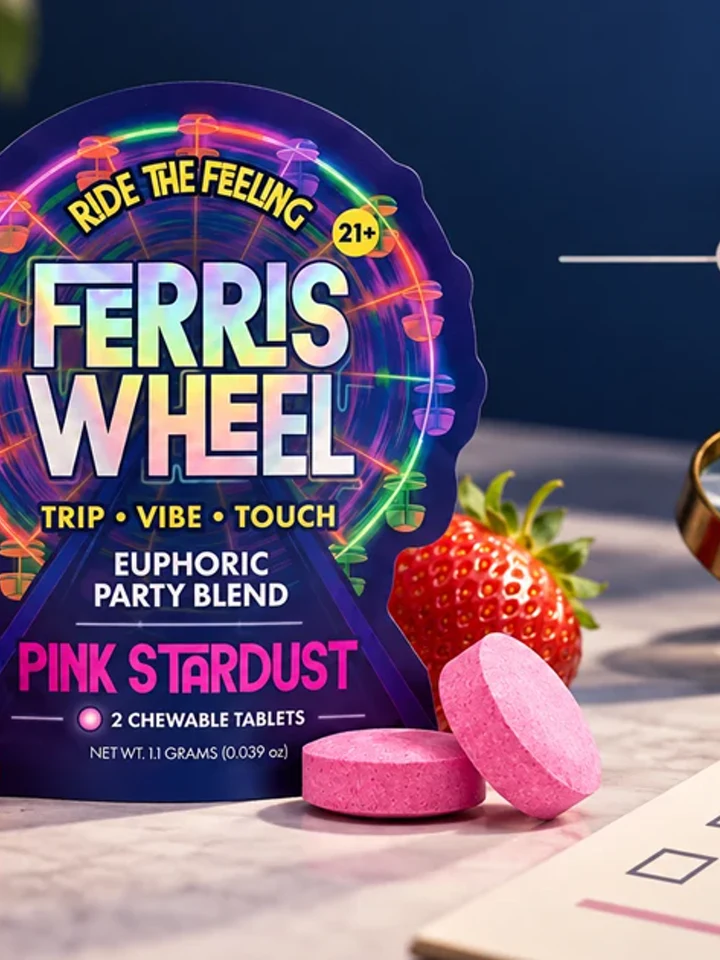
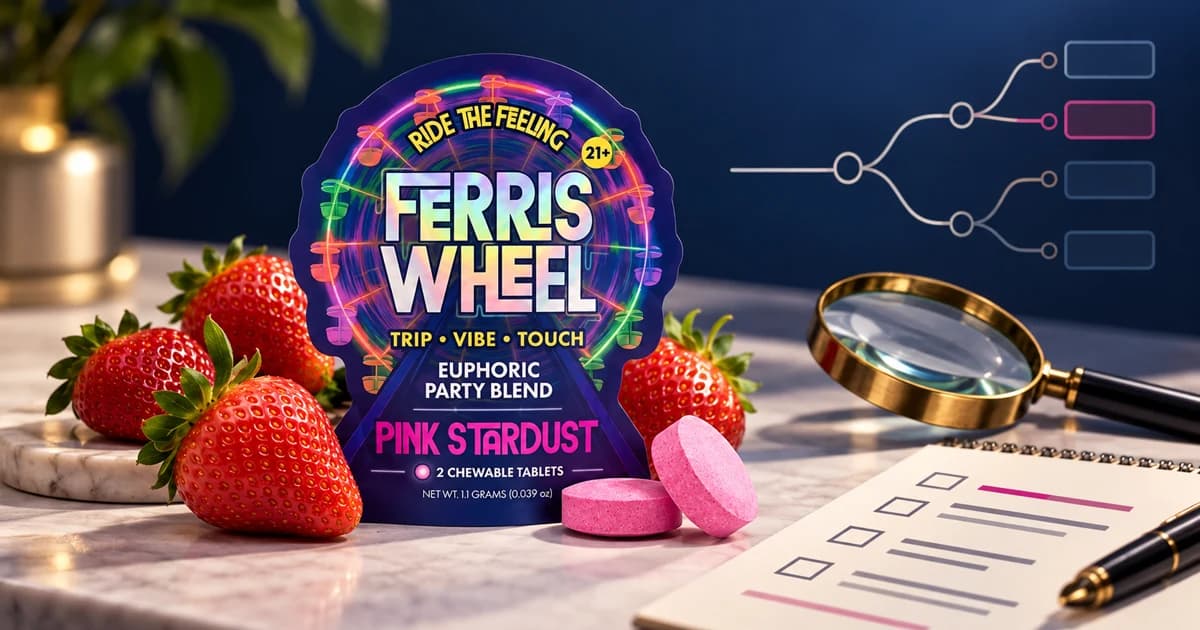
Party Tablets - Pink Stardust Review: Proof Gaps to Check
Pink Stardust is an adult-only, caffeinated kanna tablet sold in two-tablet packs. Ferris Wheel supplies specific use precautions, but the packet contains no finished-product clinical trial, complete readable active formula, exact caffeine amount, or fully mapped price and subscription terms.
8,226+
Videos & Ads
+50-100
Fresh Daily
$29.90
Per Month
Full Access
12.5 TB database · 72+ niches · 24 min read
The decision Party Tablets - Pink Stardust has not yet earned
Party Tablets - Pink Stardust has a verified product identity and a defined format. The supplied evidence does not establish its promoted effects.
Ferris Wheel presents Pink Stardust as a pink-lemonade-flavored kanna tablet for adults 21 and older. The company associates it with elevated mood, social openness, steady energy, and a gentle finish without a crash. Those are seller claims. The packet contains no controlled trial of the finished Pink Stardust product.
The largest uncertainty is not whether an extract associated with kanna has ever been studied. One such study is included. The problem is evidence transfer. That study tested 8 or 25 milligrams daily of a particular standardized Sceletium tortuosum extract in 37 healthy adults for three months. It assessed safety and tolerability. The complete Pink Stardust active formula and amounts are not readable in the supplied extract, and its promoted social and energy outcomes were not evaluated in that study.
The buying terms also remain partly unresolved. Official structured data captured five prices, but the packet does not map every price to a quantity or transaction type. Subscription language appeared on the page without enough captured detail to establish the renewal interval, future charge, or cancellation process.
Pink Stardust may remain relevant to an adult specifically seeking Ferris Wheel's party-oriented tablet format, provided that person verifies the complete label, follows the seller's restrictions, resolves relevant medical questions, and accepts the lack of finished-product efficacy evidence. Someone requiring exact active amounts, product-specific clinical proof, detailed interaction information, or fully mapped recurring terms should keep looking.
What the Ferris Wheel page actually offers
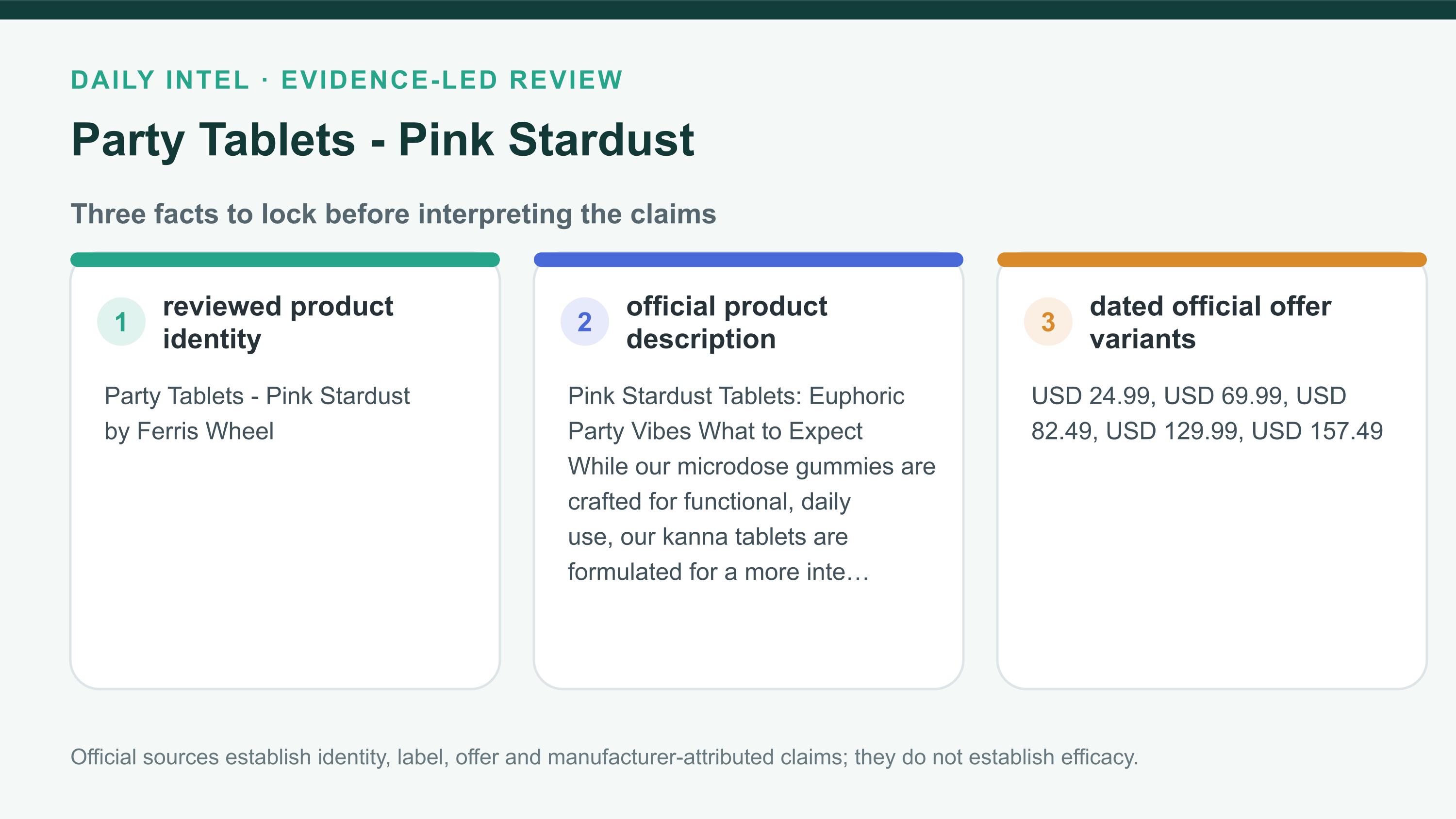
The official source identifies the reviewed item as Party Tablets - Pink Stardust by Ferris Wheel, SKU 850070232241. It describes Pink Stardust as pink-lemonade flavored and says each pack contains two tablets. One tablet is listed as a serving, giving two servings per container.
Ferris Wheel distinguishes these tablets from its microdose gummies. The company positions the gummies for functional daily use and the tablets for a more intense party experience. That distinction identifies the intended offer. It is not evidence that either format is more effective or safer, because the packet includes no direct comparison.
The page displays one-pack, three-pack, and six-pack language. It also contains a Subscribe & Save promotion and five structured prices. The supplied evidence does not reliably connect all five prices with those options. It therefore cannot establish the quantity, discount structure, or one-time-versus-recurring status of every selection.
The product page says the item ships to all US states except Louisiana. The general terms discuss free shipping within the 50 states while excluding US territories and APO/FPO destinations. Those statements are not fully aligned. The narrower, product-specific Louisiana exclusion should be checked at checkout instead of being overridden by the broader terms language.
The affiliate contract was active and permitted US content traffic when captured. That establishes commercial permission, not effectiveness. The tracking link had deliberately not been opened, so its redirect behavior remained unverified as of the evidence date.
The official page also displayed purchase activity, review totals, and customer comments. The packet does not authenticate the individual reviewers or show that their experiences are representative. Different captured data layers showed different review counts. This review therefore does not use those totals or comments as proof.
The exact Party Tablets - Pink Stardust version under review
Variant control matters. A claim about another flavor, gummy, botanical extract, or tablet cannot automatically be applied to Pink Stardust.
This review is limited to Party Tablets - Pink Stardust from Ferris Wheel, represented by SKU 850070232241. The supported identity and label details are:
- Product form: tablet.
- Flavor: Pink Stardust, described by Ferris Wheel as pink lemonade.
- Pack format: two tablets.
- Serving size: one tablet.
- Servings per container: two.
- Intended population: adults 21 and older.
- Caffeine: present, according to the seller's disclaimer.
- Repeat-use direction: wait 45 to 60 minutes before deciding whether to take another tablet.
- Seller maximum: no more than two tablets per day.
- Driving boundary: do not drive or operate heavy machinery after use.
The complete active formula remains unresolved. The official extract begins an active-ingredient section with a truncated reference to a proprietary formulation. It lists inactive ingredients that include natural and artificial flavoring, silicon dioxide, magnesium stearate, sodium starch glycolate, and food-grade colorant. It does not expose enough text to reconstruct every active ingredient or its amount.
That missing information prevents a reliable match to the supplied study. The packet does not establish how much standardized Sceletium tortuosum material is present in one Pink Stardust tablet, whether it is the same extract used in the study, or how much caffeine the product contains.
The official page also contains timing conflicts. Promotional text says the product kicks in within 30 minutes. The directions say to wait 45 to 60 minutes before considering another tablet. The FAQ says it takes about an hour for most people. These statements may refer to somewhat different concepts, but the page does not explain the distinction clearly enough to create one verified onset range.
Duration is similarly inconsistent. The directions describe effects lasting two to four hours, while the FAQ gives a four-to-six-hour range for most people. Both are seller statements. This review does not select the more convenient number or average the two ranges.
What Ferris Wheel claims—and the evidence each claim needs
Ferris Wheel says Pink Stardust can provide mood elevation, a brighter mindset, increased social ease and openness, steady energy, a balanced experience, and a gentle landing without a crash. The page also uses alcohol-alternative, confidence, conversation, zero-hangover, plant-powered, third-party-tested, legal, and non-habit-forming positioning.
The claim versus evidence boundary is clear: these statements describe Ferris Wheel's sales proposition, while the packet does not establish those outcomes for the finished Party Tablets - Pink Stardust product.
These statements describe the commercial proposition. Each still requires product-specific support.
A mood claim would need a study of the exact formulation at a disclosed serving, in a defined population, using a prespecified mood measure and an appropriate comparison. None is supplied.
A social-ease claim would require a defined social outcome rather than favorable customer comments. The packet contains no controlled Pink Stardust study measuring social interaction, conversational behavior, or perceived ease in a specified setting.
An energy claim requires more than the knowledge that the product contains caffeine. The caffeine amount is not supplied. The evidence does not show whether the finished formulation produces energy that is smooth or steady, how long any effect lasts, or how the experience compares with a control.
The no-crash and zero-hangover statements also lack defined outcomes. The page does not explain whether a crash means fatigue, headache, mood change, sleep disruption, or something else. No controlled finished-product comparison is included.
Calling Pink Stardust an alcohol alternative does not establish clinical equivalence with alcohol. The packet does not compare impairment, interaction risk, subjective effects, or suitability for people avoiding alcohol for medical or recovery-related reasons. Similar social positioning is not proof of interchangeability.
The page says the product is third-party lab tested, but the packet contains no certificate of analysis, laboratory identity, batch number, test date, method, analyte list, or contaminant limits. The evidence therefore verifies that Ferris Wheel makes the testing claim, not what was tested or what the results showed.
Ferris Wheel also describes the product as legal while advising customers to check state law. The packet does not support a blanket jurisdiction-by-jurisdiction conclusion. The packet likewise contains no finished-product dependence or abuse-liability study that verifies the non-habit-forming claim.
None of these gaps proves that the claims are false. They show that the supplied evidence cannot independently verify them.
Dose, form, and population: where study fit breaks
The packet includes one randomized, double-blind, parallel-group, placebo-controlled human study. Randomized means participants were assigned to groups by chance. Double-blind means participants and assessors were intended not to know who received the studied extract or placebo during the trial.
The study enrolled 37 healthy adults. Twelve received 8 milligrams of a standardized 2:1 Sceletium tortuosum extract once daily. Twelve received 25 milligrams once daily. Thirteen received placebo. Treatment lasted three months.
The study was designed to assess safety and tolerability. Researchers monitored vital signs, physical examinations, electrocardiograms, laboratory results, and adverse events. No efficacy variables were assessed.
The abstract reports that the two studied doses were well tolerated in this small healthy-adult sample. The most commonly reported adverse event was headache, followed by abdominal pain and upper respiratory tract infections, with greater incidence in the placebo group. Some participants receiving the extract entered unsolicited positive comments about stress coping and sleep in diaries.
Those diary comments were not prespecified efficacy outcomes. They do not establish mood elevation, sociability, confidence, energy, onset, duration, or a crash-free experience. They cannot be repackaged as proof for Pink Stardust.
The transfer limitations are substantial:
- The trial tested a named standardized extract, not Party Tablets - Pink Stardust.
- Pink Stardust's complete active formula and amounts are not readable in the packet.
- The packet does not establish that Pink Stardust uses the same extract.
- The study used once-daily administration for three months, while Pink Stardust is marketed for situational party use.
- The participants were healthy adults in a research setting, not a defined population using a caffeinated commercial tablet during social events.
- The study evaluated safety and tolerability, not the outcomes promoted for Pink Stardust.
- The Pink Stardust disclaimer identifies caffeine in the finished product, while the supplied study does not establish the safety or effects of that commercial combination.
The study remains useful as a narrow ingredient-level data point. It documents what happened with a particular extract, dose, population, and duration. It neither proves that Pink Stardust works nor proves that it does not.
Finished-product evidence would require the commercial formulation, its labeled serving, a relevant population, prespecified outcomes, an appropriate comparison, adverse-event monitoring, and transparent reporting. That evidence was not supplied.
Price, recurring charges, shipping, and the real commitment
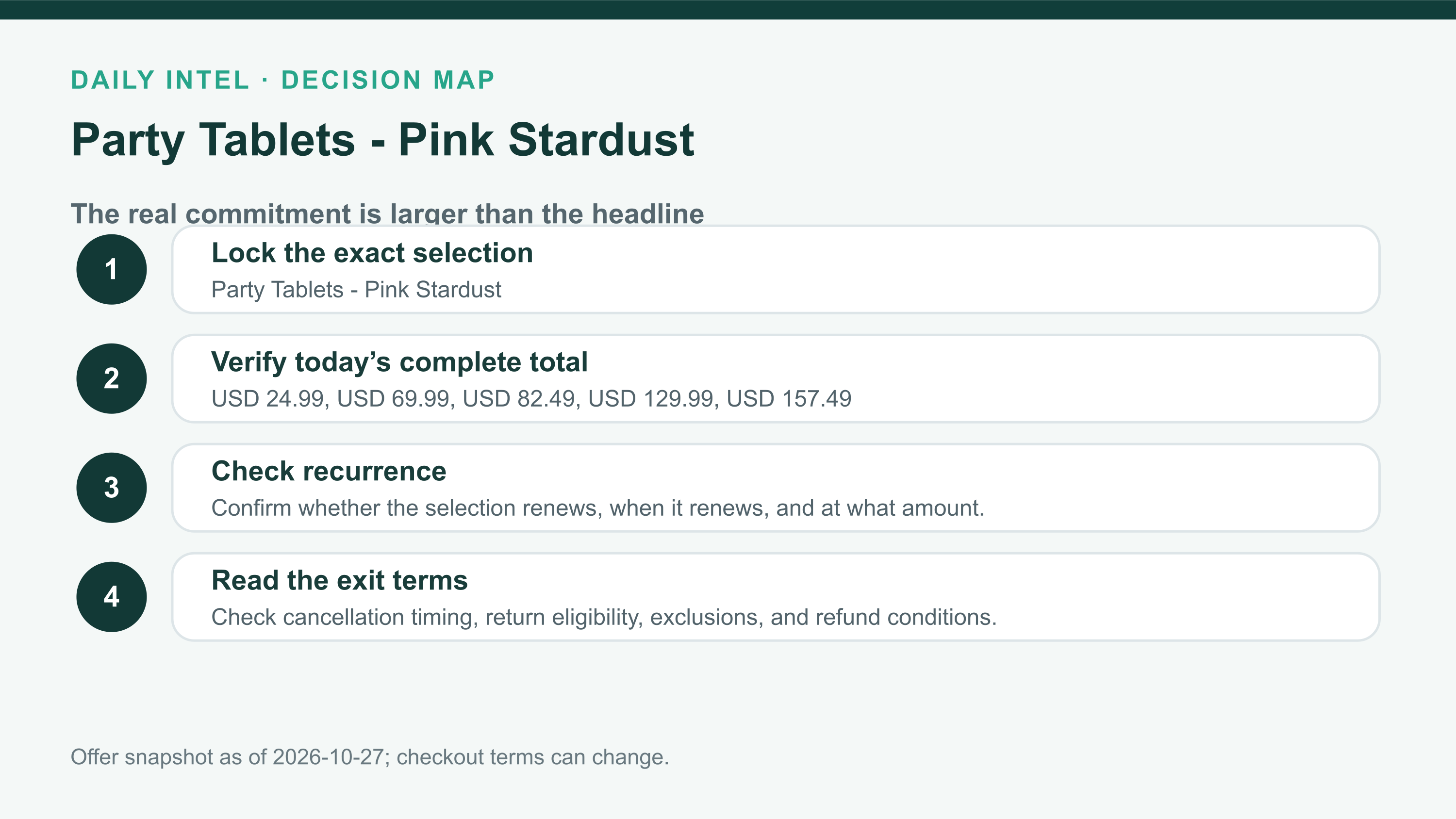
Official structured product data captured on October 20, 2026 listed five prices: $24.99, $69.99, $82.49, $129.99, and $157.49. Each was denominated in US dollars and marked in stock at capture.
This exact offer snapshot helps frame the Party Tablets - Pink Stardust decision, but it is not a complete checkout map.
The page also displayed one-pack, three-pack, six-pack, and Subscribe & Save language. The evidence does not map every price to a specific pack count or establish which prices are one-time purchases and which, if any, initiate recurring charges. It does not capture the subscription renewal interval, renewal amount, cancellation deadline, cancellation method, or whether a recurring option is preselected.
Before paying, verify:
- The number of two-tablet packs in the selected option.
- Whether the transaction is one-time or recurring.
- The amount and date of any future charge.
- The shipping method, shipping fee, tax, and final total.
- The cancellation procedure for any subscription.
- The return conditions that apply to the selected purchase.
The refund policy retrieved on October 27, 2026 describes a 60-day period measured from the order date. It says unopened products, or products containing a reasonable amount of unused product, may be returned in their original packaging for a refund of the purchase price. It also characterizes eligible items as unopened or minimally used.
A customer must submit a return request through the customer account. The request is reviewed before approval and further instructions. The policy directs customers who are uncertain whether an opened product qualifies to contact customer service.
Promotional purchases carry another condition. Items included with the promotion must be returned. If a promotional item is not returned, its value may be deducted from the refund. Shipping charges are nonrefundable. The 60-day language therefore does not establish an unconditional satisfaction guarantee.
The general terms say delivery estimates are not guaranteed. They describe free shipping within the continental United States as taking five to eight business days, with an additional two to three days possible for Alaska and Hawaii. USPS Ground Advantage is described as taking three to seven business days. These are dated estimates, not guaranteed arrival dates.
The product page's Louisiana exclusion remains relevant despite the general 50-state shipping language. Availability and checkout terms should be verified at the time of purchase.
The practical commitment is more than the first displayed price. It includes a two-serving package, an incompletely mapped set of larger prices, possible recurring billing, shipping terms, and conditional return eligibility. A larger option should not be called better value until its pack count and charge type are confirmed.
Affiliate disclosure: Daily Intel may earn a commission if you purchase through the offer presented after this section. That commercial relationship does not change our evidence assessment. Verify the complete label, selected quantity, charge type, final total, shipping, and current return conditions before proceeding.
Safety boundaries the sales page cannot settle
Ferris Wheel limits Pink Stardust to adults 21 and older. The seller says to keep the product away from children, not exceed two tablets per day, and wait 45 to 60 minutes before deciding whether to take another tablet. It also says not to drive or operate heavy machinery after use.
For Party Tablets - Pink Stardust, the safety decision must also account for the evidence gaps described below.
The seller's disclaimer states that the product contains caffeine. It is not recommended for people sensitive to caffeine or for people who are pregnant or nursing. Anyone with a medical condition or taking medication is directed to consult a healthcare professional before use.
Those boundaries should be preserved. They do not establish that the product is suitable for every other adult. The packet lacks a complete readable active formula, exact caffeine amount, product-specific interaction list, contraindication table, and finished-product adverse-event study.
FDA guidance explains that dietary supplements are not approved by the agency for safety and effectiveness before sale. Companies remain responsible for meeting applicable safety and labeling requirements. The FDA can inspect facilities, review labeling, monitor adverse-event reports, and act after products enter the market. Product availability is not evidence of premarket approval.
The FDA also warns that supplements can interact with medicines, interfere with laboratory tests, or cause problems around surgery. Risks can increase when people combine supplements, mix supplements with medicines, take excessive amounts, or substitute supplements for prescribed treatment. The word natural does not guarantee safety.
A medication or medical-history question cannot be resolved with the supplied ingredient study. That study involved a different standardized extract in healthy adults. It did not test Pink Stardust's complete caffeinated formulation.
The seller's maximum of two tablets per day is a ceiling, not a personalized recommendation or a promise that two tablets are appropriate for every adult. The delayed-onset warning matters because uncertainty about onset can lead someone to take another tablet prematurely. The study's 8- and 25-milligram doses should not be borrowed as Pink Stardust directions.
If a concerning reaction occurs, FDA guidance says to stop using the supplement, obtain medical care or advice, and report the adverse event. This review cannot decide whether Pink Stardust is appropriate for a particular medication list, medical condition, procedure, pregnancy, nursing status, or caffeine tolerance.
Who Party Tablets - Pink Stardust may fit—and who should keep looking
Pink Stardust may remain on the shortlist for an adult 21 or older who specifically wants Ferris Wheel's two-tablet party format and accepts the evidence limitations. That person still needs to verify the complete label, caffeine amount, selected purchase option, transportation plan, and current terms. Relevant medication or health questions require qualified professional advice.
A two-tablet pack limits the amount initially purchased compared with an unspecified larger supply. It does not reduce the need to understand the formula or precautions.
Keep looking if any of these requirements is nonnegotiable:
- A fully disclosed active formula and exact caffeine amount.
- A controlled study of the finished Pink Stardust product.
- Verified evidence for mood, social ease, steady energy, or no-crash claims.
- Consistent onset and duration information.
- Detailed interaction or contraindication information.
- Batch-specific documentation identifying the tested batch, methods, and results.
- A clear pack-to-price map and subscription schedule before checkout.
- Compatibility with pregnancy, nursing, caffeine sensitivity, medication use, driving, or a medical condition.
Budget fit cannot be decided from the starting price alone. The larger prices cannot be compared fairly without their quantities and charge types. Evidence tolerance matters too. A reader comfortable with seller positioning and unresolved product-specific questions may reach a different decision from someone requiring finished-product research.
The closest alternatives change the verdict
The packet does not support a ranked comparison with named competing products. It supplies no current competitor formula, label, price, clinical evidence, shipping terms, or refund policy. Naming a winner would require unsupported facts.
One within-brand distinction is documented. Ferris Wheel positions its microdose gummies for functional daily use and Pink Stardust tablets for a more intense party experience. This describes the seller's product segmentation. It does not establish which format is more effective, safer, or more appropriate for a particular person.
A more transparent product becomes the better alternative when exact composition matters. Relevant selection criteria include a complete label, exact caffeine disclosure, clear directions, consistent timing information, identifiable batch testing, and understandable purchase terms. The packet does not identify a named product meeting those standards, so this is a comparison rule rather than a recommendation.
Waiting is the better alternative when medication compatibility, pregnancy, nursing, caffeine sensitivity, driving, a medical condition, or an incomplete label leaves a material safety question unresolved. Waiting for documentation or professional guidance does not prove Pink Stardust harmful. It recognizes that the available evidence cannot answer the individual question.
The VSL strategy we would test for Party Tablets - Pink Stardust
This is an original Daily Intel strategy we would test. It is not a Ferris Wheel advertisement. The packet does not show that Ferris Wheel ran, approved, or measured it, and no performance result is implied.
Hook: map the evening before evaluating the tablet
The opening would start with a practical observation. One person can feel prepared for a quiet afternoon and unprepared for a late event. An after-work gathering, unfamiliar group, creative session, and night out create different demands.
That variation would not be presented as a diagnosis. Social battery would be defined as a planning metaphor: a way to describe how ready someone feels for a particular setting. It would not be offered as a biological mechanism.
The first screen would then state the evidence boundary. Pink Stardust is a two-tablet Ferris Wheel product marketed for a more intense party experience than the company's daily gummies. Ferris Wheel associates it with mood, sociability, energy, and a no-crash finish. The packet contains no clinical trial of the finished product.
The hook would deliver a bounded decision. Pink Stardust may interest an adult who wants this exact tablet format, can verify the label and terms, and accepts product-specific uncertainty. Someone requiring exact active amounts, a disclosed caffeine amount, individualized interaction guidance, or finished-product clinical evidence should pause.
Lead: turn the setting into a decision map
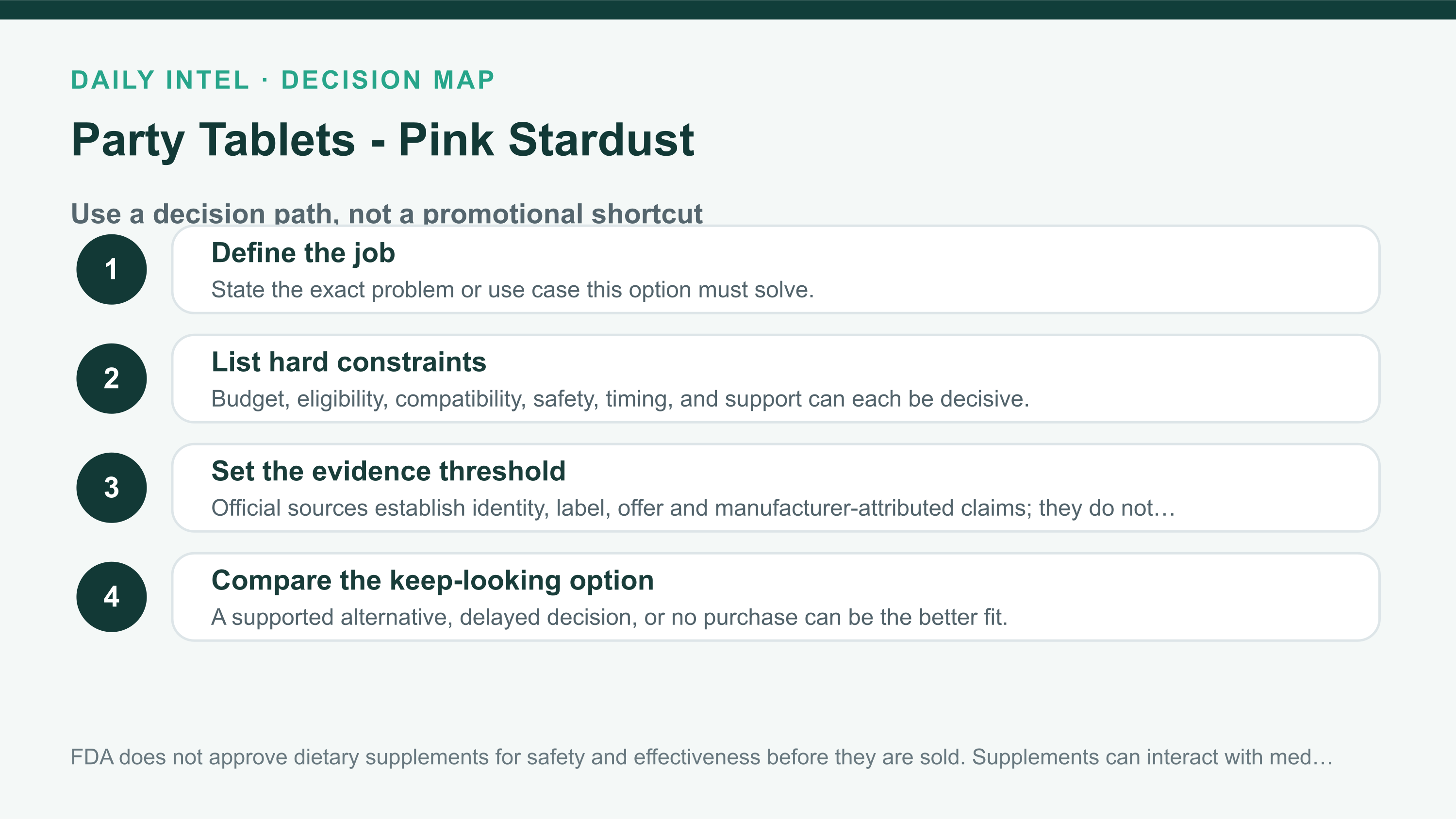
The lead would introduce four fields.
Setting: Where will the event occur? How long could it last? What transportation is required?
Demand: Will the person need to work, speak, perform, make decisions, or stay late?
Constraints: Is medication use, a medical condition, caffeine sensitivity, pregnancy, nursing, or driving involved?
Recovery: What responsibilities follow the event, and how much uncertainty is acceptable?
This structure would put the seller's restrictions before persuasion. A person who must drive would encounter the no-driving direction before the offer. Someone taking medication would see the professional-advice boundary before claims about mood or social ease.
Decision mechanism: context, claim, evidence, safety, commitment
The organizing mechanism would be a decision filter rather than an unsupported biological theory:
Context → claim → evidence → safety → commitment.
Context defines the occasion. Claim converts promotional language into a testable question. Evidence asks whether that question was studied in the exact product. Safety checks the label and personal constraints. Commitment verifies price, recurring charges, shipping, and returns.
For social ease, the evidence question becomes: Was the exact Pink Stardust formulation tested for a defined social outcome in a relevant population?
For steady energy: What active amounts were used, what endpoint was measured, and over what period?
For no crash: How was crash defined, and was the post-use experience compared with a control?
The packet does not answer those questions. The framework makes that absence visible instead of filling it with an ingredient story.
Story: two hypothetical paths
The worked example would be labeled hypothetical. It would not be presented as a testimonial or prediction.
Jordan is considering Pink Stardust for an after-work event. Jordan takes medication and must drive home. The seller's positioning matches the occasion, but Ferris Wheel directs people taking medication to consult a healthcare professional and says not to drive after use. Jordan's plan therefore stops before checkout. The constraint decides the issue.
Casey is an adult with no known medical concern and no driving obligation. Casey still wants the complete active formula, caffeine amount, pack-to-price map, and charge type. The packet confirms a one-tablet serving and two-tablet pack but does not provide all the other answers. Casey checks the current label and checkout rather than assuming favorable terms.
These paths demonstrate how context and evidence tolerance can produce different decisions without inventing a successful user.
Proof: move through the evidence in order
The first rung is identity. The official source establishes the Pink Stardust name, Ferris Wheel brand, tablet form, flavor description, SKU, pack size, serving size, and adult-only positioning.
The second rung is seller positioning. Mood elevation, social openness, energy, and no crash belong here. These claims explain what Ferris Wheel is selling. They are not independently verified outcomes.
The third rung is ingredient-level human research. The supplied trial tested 8 or 25 milligrams daily of a standardized Sceletium tortuosum extract against placebo in 37 healthy adults for three months. It assessed safety and tolerability. It did not assess efficacy.
The fourth rung would be finished-product research. It is absent. The commercial Pink Stardust tablet was not the studied product. Its complete active formula, amounts, and caffeine dose are unavailable in the packet. The regimen, intended use, population, and outcomes also differ.
The execution would state the boundary directly: the study does not prove Pink Stardust works, and it does not prove that Pink Stardust cannot work. It answers a narrower question about a different standardized extract under defined conditions.
Objections: answer what could stop the decision
Is Pink Stardust clinically proven? Not as a finished product in the supplied evidence.
Does kanna research prove the promoted effects? No. Evidence transfer requires an adequate match in formula, dose, form, population, duration, and outcome. That match is not established.
When does it start, and how long does it last? The official page is inconsistent. It refers to onset within 30 minutes, advises waiting 45 to 60 minutes, says about an hour for most people, and gives both two-to-four-hour and four-to-six-hour duration ranges. The strategy would expose those statements without choosing one.
Is it safe for me? The article cannot assess an individual's medication list or health history. The complete label is needed for professional review. Pregnancy, nursing, caffeine sensitivity, and driving are express seller boundaries.
Is the 60-day guarantee risk-free? No. Return eligibility depends on timing, remaining product, original packaging, review of the request, and promotional-item conditions. Shipping charges are nonrefundable.
Is a larger option better value? The packet does not establish that. Five prices are documented, but their quantities and transaction types are not fully mapped.
Offer: explain the commitment before presenting the action
The offer segment would show all five captured prices and date them to October 20, 2026. It would state that pack and subscription language appeared on the page while the supplied evidence does not connect every amount with a precise option.
The viewer would receive a checkout checklist: confirm pack count, one-time or recurring status, renewal amount and interval, shipping, tax, total cost, cancellation method, and return eligibility.
The commission disclosure would appear immediately before and beside the offer link. It would state that Daily Intel may earn a commission and that this relationship does not alter the evidence assessment.
CTA: verification instead of urgency
The final action would invite the reader to inspect the current offer only if Pink Stardust remains compatible with the decision map. The CTA would focus on verifying the label, selected option, total price, and terms. It would not promise results, imply scarcity, or recommend a larger bundle without a verified reason.
Proceed to verification only if the adult-only format fits, relevant medical questions have been addressed, driving is not involved, and the remaining evidence limitations are acceptable. Do not proceed when a complete formula, finished-product proof, clearer interaction guidance, or settled transaction terms are required.
The strategy's central idea is simple: the product must fit the setting, safety constraints, budget, and evidence standard. The evening should not be redesigned around the offer.
What would change our view of Party Tablets - Pink Stardust
The verdict would improve with a complete current label showing every active ingredient, amount per serving, and caffeine amount. Batch-specific documents would need to identify the tested batch, laboratory, methods, analytes, and results rather than merely repeat a testing claim.
Ferris Wheel could also resolve the conflicting onset and duration statements and publish a clear map connecting every price with its pack count, purchase type, renewal terms, cancellation process, shipping total, and return conditions.
The largest scientific change would be a controlled trial of the exact finished Pink Stardust formulation at its labeled serving. It would need a relevant population, prespecified outcomes, an appropriate comparison, timing data, adverse-event reporting, and transparent disclosures. Until then, the promoted experience remains seller positioning rather than a clinically verified outcome.
Frequently asked questions
Q: Is Party Tablets - Pink Stardust clinically proven?
A: No finished-product clinical trial was supplied. The packet includes one randomized study of a different standardized Sceletium tortuosum extract in 37 healthy adults. It evaluated safety and tolerability, not the mood, social-ease, energy, onset, duration, or no-crash outcomes Ferris Wheel promotes for Pink Stardust.
Q: What exactly is included in a Pink Stardust pack?
A: The official page describes a two-tablet pack, a serving size of one tablet, and two servings per container. Pink Stardust is described as pink-lemonade flavored. The captured extract does not provide a complete readable active formula or map every listed price to a specific pack quantity.
Q: How much does Party Tablets - Pink Stardust cost?
A: Official structured product data captured on October 20, 2026 listed $24.99, $69.99, $82.49, $129.99, and $157.49. The packet does not reliably identify the quantity or one-time-versus-subscription status attached to every amount, so verify the selected option and final checkout total.
Q: Does Pink Stardust contain caffeine?
A: Ferris Wheel's disclaimer says the product contains caffeine and is not recommended for people sensitive to caffeine. The supplied extract does not state the caffeine amount. Anyone who needs to control caffeine exposure should obtain the complete current label before deciding whether the product fits.
Q: Who should seek professional advice before using Pink Stardust?
A: Ferris Wheel directs people with a medical condition or taking medication to consult a healthcare professional. It also says the product is not recommended during pregnancy or nursing. FDA guidance adds that supplements can interact with medicines, affect laboratory tests, and create risks around surgery.
Q: What evidence would materially improve the verdict?
A: A complete current label with exact active amounts, batch-specific quality documentation, consistent onset and duration information, clear subscription terms, and controlled research on the exact Pink Stardust formulation would improve the assessment. A finished-product study would need a relevant population, labeled regimen, comparison group, and prespecified outcomes.
Sources and evidence notes
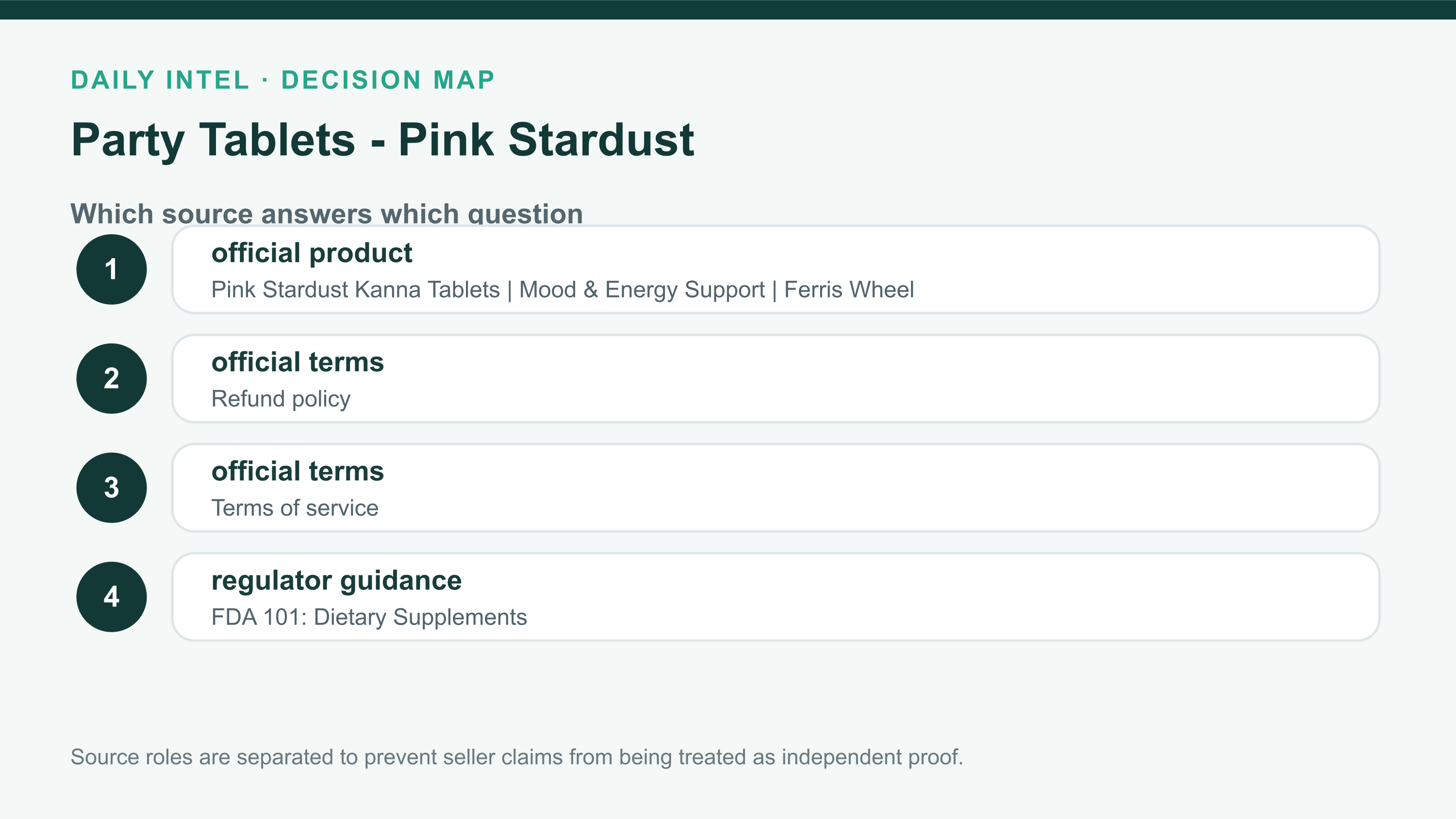
Evidence card: Ferris Wheel's official Pink Stardust product page. This is the primary source for product identity, SKU, flavor, pack size, serving directions, restrictions, seller claims, and captured prices. It establishes what Ferris Wheel says and offers. It does not independently verify efficacy, testing quality, legal status in every jurisdiction, or individual suitability.
Evidence card: Ferris Wheel refund policy. This page supplies the conditions attached to the 60-day return language, including timing, product condition, original packaging, request review, promotional-item treatment, and nonrefundable shipping. It does not guarantee that every opened product or return request will qualify.
Evidence card: Ferris Wheel terms of service. The terms provide age, shipping, delivery-estimate, territory, and return context. They are dated operational terms and should be checked again before purchase. Their broad 50-state shipping language does not resolve the product page's narrower Louisiana exclusion.
Evidence card: FDA 101: Dietary Supplements. This regulator guidance explains the lack of FDA premarket approval for supplement safety and effectiveness. It also discusses medicine interactions, laboratory and surgery concerns, adverse-event reporting, and why natural does not automatically mean safe. It does not evaluate Pink Stardust itself.
Evidence card: Randomized trial of standardized Sceletium tortuosum extract. This study provides a human safety and tolerability data point for a specified extract at 8 and 25 milligrams daily in 37 healthy adults for three months. It did not test Pink Stardust, its caffeinated finished formulation, situational use, or promoted outcomes. No efficacy variables were assessed.
Final Take: What Would Change the Verdict
The packet identifies Pink Stardust more clearly than it verifies the experience being sold. It establishes the product name, brand, SKU, flavor description, two-tablet format, one-tablet serving, adult-only restriction, caffeine warning, driving restriction, repeat-use delay, and daily maximum.
It does not establish mood elevation, social ease, steady energy, or a no-crash experience. The only human study concerns a different standardized extract, different regimen, and narrower safety question. The complete Pink Stardust active formula and caffeine amount remain unavailable, and the official page contains conflicting onset and duration statements.
Five prices are documented, but every quantity and charge type is not. The return policy is conditional, and the affiliate redirect remained unverified as of the evidence date.
Until the identified gaps are resolved, Pink Stardust is an evidence-limited option for adults who knowingly accept those uncertainties. It is not a clinically verified route to the outcomes Ferris Wheel promotes.
This article is for informational and educational purposes only. It is not medical advice. Daily Intel is independent and may earn an affiliate commission. Ferris Wheel did not write, review, or control this article.
Comments(0)
No comments yet. Members, start the conversation below.
Related reads
 reviews
ARMRA Colostrum Review: Evidence, Dose Gaps, Price, and Verdict
ARMRA’s 120-serving colostrum powder comes with notable manufacturer-reported survey percentages. However, the undisclosed amount per serving and a materially different ingredient trial leave the finished product’s highlighted outcomes unproven.
Read reviews
Olly Goodbye Stress Review: Label Claims vs. Evidence
OLLY Goodbye Stress combines GABA, L-theanine, and lemon balm extract in a Berry Verbena gummy aimed at occasional stress, not sleep. Here's what the label discloses, what a real L-theanine trial found, and exactly where the evidence stops.
Read reviews
Kaged Pre-Kaged Sport Review: Does the Citrulline Study Fit?
Kaged Pre-Kaged Sport provides 3.5 grams of fermented L-citrulline in each 13-gram scoop. The supplied trial tested a higher dose of isolated L-citrulline and found no performance benefit, so it cannot prove whether this finished formula works.
Read