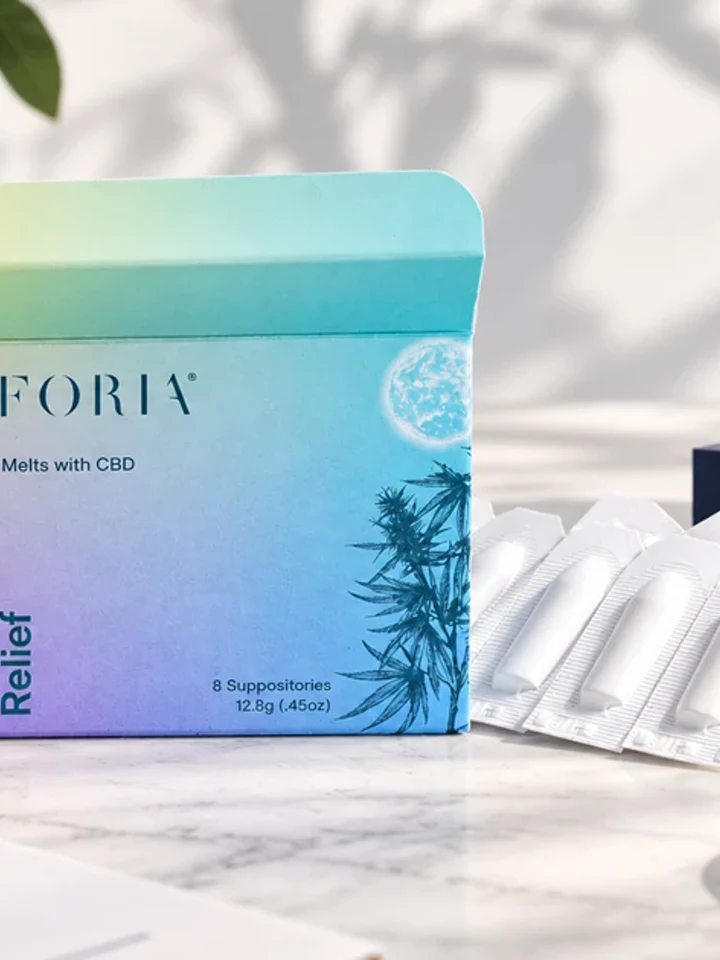
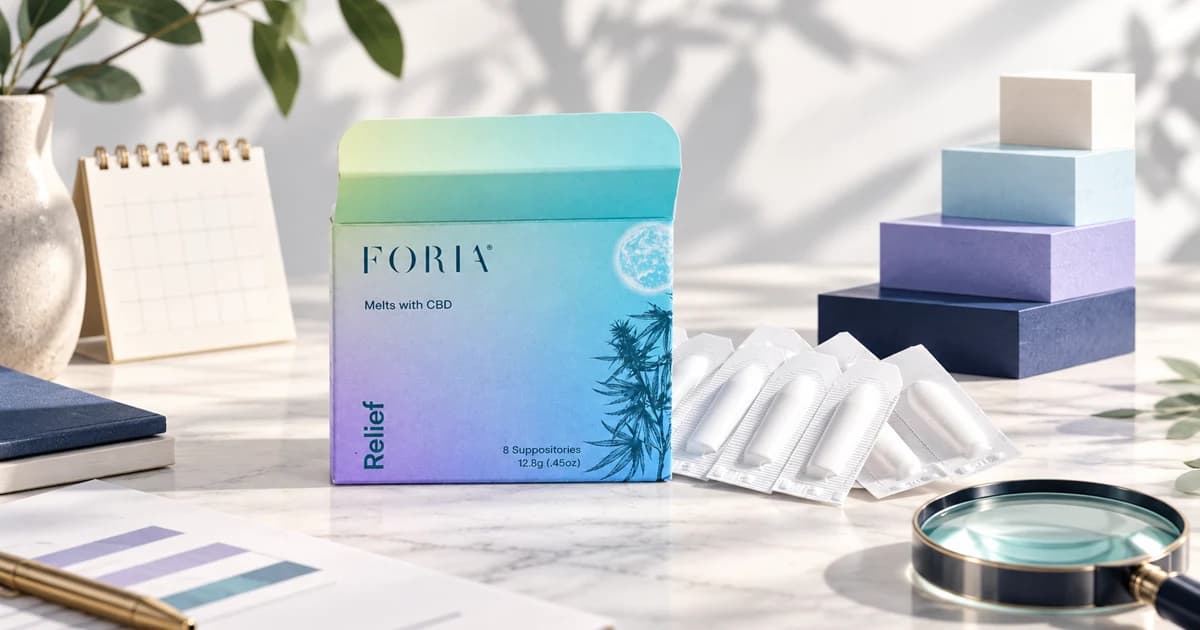
Relief Melts with CBD Review: What the Evidence Can Actually Show
Foria offers an eight-melt, internal-use CBD format for period and pelvic discomfort. The supplied evidence verifies the product and its intended routes, but it does not include a clinical trial of the finished product. This review separates seller claims, batch testing, indirect CBD research, safety guidance, and the October 2026 offer terms.
8,226+
Videos & Ads
+50-100
Fresh Daily
$29.90
Per Month
Full Access
12.5 TB database · 72+ niches · 27 min read
Relief Melts with CBD is an evidence-limited purchase, not a product this review can broadly recommend for pain relief. Foria offers a specific internal-use format for period and pelvic discomfort. Its official page describes eight melts, associates the product with 100 mg of broad-spectrum cannabidiol, or CBD, and directs vaginal use for menstrual cramps or anal use for pelvic tension.
Those records establish the product’s identity, format, ingredients named on the page, and intended uses. They do not establish that the finished product reliably reduces pain or cramping. They also do not show how quickly an effect might begin, how long it might last, or how frequently users experience a meaningful benefit.
The largest uncertainty is the absence of a controlled clinical trial of the current finished product in the supplied evidence. The packet contains one relevant randomized trial, but it tested an oral CBD-enriched oil in women with endometriosis-associated chronic pelvic pain. That study used a different product, formulation, route, dose schedule, population, and treatment period. The oral CBD intervention did not outperform placebo on its main pain outcome and produced more mild adverse events.
That finding does not prove that Foria’s melts cannot help. It does prevent the oral study from being used as favorable proof for the melts. The verdict would change if a well-designed trial tested the current Relief Melts formula through its intended routes in relevant users and reported meaningful pain, function, and safety outcomes.
Until then, this is principally a format, suitability, cost, and evidence-tolerance decision. A prospective buyer must decide whether the internal-use format remains attractive after accounting for the missing finished-product efficacy evidence, FDA safety boundaries, unclear per-melt CBD amount, and offer details that require confirmation.
The Decision Relief Melts with CBD Has to Earn
Foria’s product has a clear practical premise. A person who does not want an oral CBD product may find an insertable melt more compatible with their preferences. Foria also identifies period and pelvic discomfort rather than presenting the product only as a general wellness item.
Those features can establish relevance. They cannot establish relief.
The packet supplies no finished-product results for pain intensity, internal cramping, physical function, onset, duration, absorption, discontinuation, or adverse-event frequency. It also supplies no comparison showing that vaginal and anal use produce similar exposure or effects.
A favorable purchase decision would therefore require several conditions. The buyer would need to want this exact format, be comfortable with the intended route, confirm the current label and matching batch documentation, address relevant medication and health questions, understand the selected package and transaction terms, and accept that product-specific clinical effectiveness remains unproven.
The decision becomes less favorable when a buyer requires predictable results, strong finished-product trials, clear route-specific safety data, or an unambiguous amount of CBD per melt. It also becomes less favorable if checkout does not plainly disclose the selected quantity, final price, shipping charge, return eligibility, and whether the order creates recurring charges.
A larger package does not strengthen the evidence. It only increases the buyer’s financial commitment. Likewise, a return policy may reduce some transaction risk, but it cannot establish that the product works.
The most important update condition is straightforward: a rigorous trial of the current RMS001 product, used through its intended routes, in the populations for whom it is marketed. The study would need a suitable control group, a clearly defined dose, clinically meaningful outcomes, and complete adverse-event reporting. Without that evidence, the product’s case rests on a distinctive format and manufacturer positioning rather than demonstrated therapeutic performance.
What the Foria Page Actually Offers
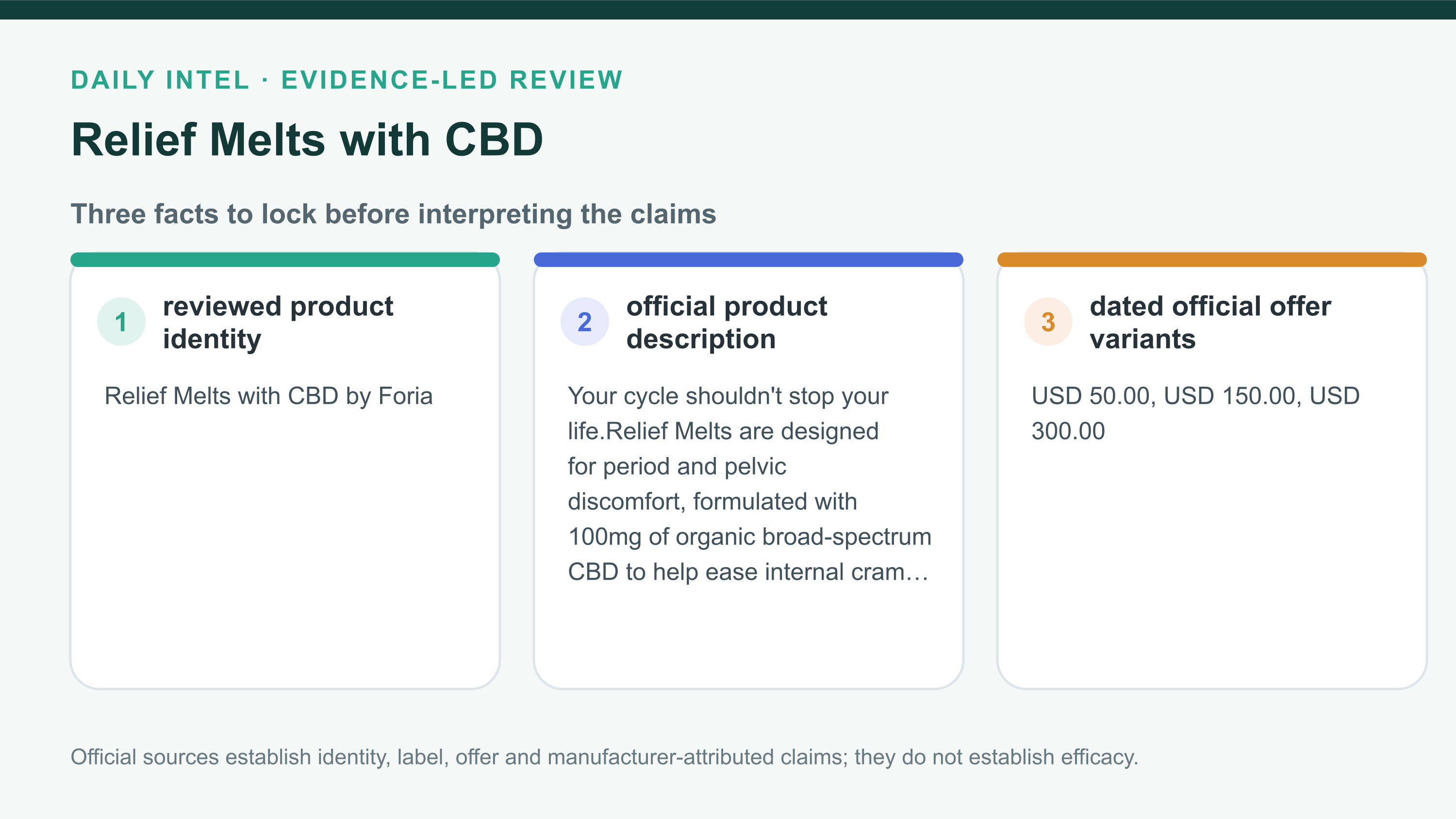
The reviewed item is Relief Melts with CBD by Foria. The structured product record identifies SKU RMS001. The official product page says a pack contains eight small melts and describes the product as formulated with 100 mg of organic broad-spectrum CBD.
The page directs vaginal insertion for menstrual cramps and anal insertion for pelvic tension. These are Foria’s instructions and intended-use claims. The supplied evidence does not establish that either route relieves pain or that one route performs better than the other.
The captured ingredient answer lists organic-certified fair-trade cocoa butter and broad-spectrum extract from USDA organic-certified, regeneratively grown US hemp. The 100 mg figure appears again in that answer. However, the supplied wording does not separately and unambiguously define the quantity in each melt. This review therefore does not divide 100 mg by eight or otherwise calculate a per-melt amount.
Foria says the melts are oil-based and therefore do not have a pH value. It also says the formula does not use glycerin, parabens, or synthetic fragrances. These statements describe the seller’s formulation. They do not independently prove that the product will be compatible with every user or will not affect an individual’s vaginal environment.
The page recommends a patch test on the inner wrist or forearm. It also tells people who are sensitive or predisposed to urinary tract infections, yeast infections, or other imbalances to consult a healthcare provider about whether the product is a good fit. Those are manufacturer cautions, not a complete contraindication or adverse-event assessment.
For storage, Foria says to keep the melts in a cool, dry place and refrigerate them to support firmness. It also says that properly stored products remain effective and usable for two years after opening. The packet contains no independent stability data, so the two-year statement remains attributed to the manufacturer.
The product page mentions Mellö, a separate magnesium product, in promotional copy about stress and relaxation. Mellö is not an ingredient in Relief Melts with CBD and is not part of this review. Its marketing supplies no evidence for the effectiveness or safety of the melts.
The Exact Relief Melts Version Under Review
Product identity needs careful control because the supplied records contain several related names. Foria’s testing directory refers to Relief Melts as formerly being called Relief Suppositories. The current official product page uses Relief Melts with CBD. The packet also refers separately to Intimacy Melts and Intimacy Booty Melts.
This review concerns only the RMS001 Relief Melts with CBD product represented in the October 2026 capture. Facts, amounts, instructions, or certificates for the intimacy products should not be transferred to RMS001.
The stored affiliate-program destination uses a relief-suppositories path. A direct capture of that Foria path on October 20, 2026 resolved to the current relief-melts-cbd page. However, the affiliate tracking URL itself was deliberately not opened, so its redirect remains unverified. A reader using the commercial link should confirm that the resulting page still identifies Relief Melts with CBD and the expected package before paying.
The reviewed record supports the following limited identity description: SKU RMS001, an eight-melt pack description, a 100 mg broad-spectrum CBD statement, cocoa butter, hemp extract, and intended vaginal or anal use. It is not the separate intimacy product. It is also not the oral CBD-enriched oil examined in the clinical trial.
Dose remains a material uncertainty. The packet does not contain an unambiguous per-melt CBD amount or a verified individualized dosing schedule. It also does not contain route-specific systemic-exposure data. A buyer should not treat the prominent 100 mg figure as an individualized dose or assume that vaginal or anal administration prevents CBD from reaching the rest of the body.
Foria also states that its melts use hemp oil rather than THC and that a positive drug test is unlikely. That remains a seller statement. The packet does not contain the buyer’s exact batch certificate, a detection-limit analysis, or a product-specific guarantee about drug-test results. Anyone facing serious employment, legal, athletic, or other consequences from testing would need more specific evidence.
What Foria Claims—and What Each Claim Would Need
Foria says the melts are designed for period and pelvic discomfort and formulated to help ease internal cramping. claim versus evidence boundary: The product records establish the first part as the manufacturer’s intended positioning. The packet does not establish the proposed relief outcome.
Direct substantiation would require research on the current formula, its intended routes, relevant users, a suitable comparison group, and defined pain or function outcomes. The supplied evidence includes no such finished-product trial.
Foria also says the product can be used vaginally for menstrual cramps or anally for pelvic tension. That verifies the seller’s intended routes. It does not show that the routes have equivalent absorption, safety, onset, duration, or effectiveness.
A separate seller claim concerns product testing. Foria says it tests products for purity, potency, and harmful substances and provides batch-specific certificates of analysis. A certificate of analysis, or COA, is a laboratory report for a particular batch and the measurements included in that test. A matching COA could provide useful quality information. It cannot establish pain relief or individual suitability.
The official capture also collected a manufacturer claim candidate referring to an IRB-approved study and a report that eight out of ten women experienced improved period symptoms. IRB means institutional review board, a body that reviews research involving people. The packet does not include the underlying finished-product paper, protocol, complete results, statistical analysis, adverse-event table, or a validated independent source record for that promotional statement. This review therefore does not use the claim as efficacy evidence.
The structured product capture contained a seller-page rating and review count. Those values are not used in this verdict. The packet does not establish the review-collection method, verification controls, representativeness, or typical outcome. Customer-review material would not substitute for a controlled finished-product study in any event.
The supportable conclusion is narrower. The official records establish what Foria sells, how it describes the formula, the number of melts in the pack, the intended routes, storage statements, and the availability of a testing directory. They do not establish the probability, size, timing, or durability of relief.
Dose, Form, and Population: Where the Study Fit Breaks
The most relevant independent study in the packet is a 2026 randomized clinical trial indexed by PubMed. It enrolled 102 women with surgically confirmed endometriosis who had previously received surgical treatment, were receiving hormonal therapy, and reported recurring symptoms.
Participants were assigned equally to an oral CBD-enriched oil or placebo. Random assignment means chance determined the group assignment. The trial was also described as triple-blind, meaning the study used masking intended to keep relevant participants and research personnel unaware of treatment assignments during the trial.
The intervention lasted ten weeks. The oil was given twice daily. The dose escalated from 10 mg per day in week one to 150 mg per day in week nine and was then tapered. The primary outcomes included changes in pain intensity and the proportions of participants reaching at least 30% or 50% pain reduction.
The CBD-enriched oil did not show superiority over placebo on the main pain outcome. Approximately 40% of participants in both groups reached at least 50% pain reduction, while approximately 60% reported at least 30% improvement. Mean pain intensity at the end of treatment was 41.6 mm in the CBD group and 36.8 mm in the placebo group. The differences between groups were not statistically significant.
The trial was stopped after its planned interim analysis because the researchers found no clinically relevant benefit and observed more mild adverse events in the CBD group. Those mild events mainly involved gastrointestinal symptoms and perceived weight changes. No serious adverse events occurred in the trial.
These results matter, but they are not direct results for Relief Melts with CBD. Several evidence-transfer boundaries prevent that conclusion.
First, the trial used an oral oil. The reviewed product is a melt intended for vaginal or anal use. Second, the study did not identify its intervention as RMS001 or the current Foria formula. Third, its dose escalated across a ten-week regimen, while the product packet does not provide a directly comparable per-melt amount or exposure schedule. Fourth, the participants had surgically confirmed endometriosis and a defined treatment history. Foria markets its product more broadly for period and pelvic discomfort. Fifth, the trial duration does not match a verified Relief Melts regimen in the packet.
The study supports two bounded conclusions. It shows that an oral CBD-enriched intervention was not superior to placebo for its primary pain outcome in that defined population. It also undermines any broad assumption that the presence of CBD alone proves pelvic-pain relief.
It does not show that Relief Melts are ineffective. Nor can the product’s internal placement be used to dismiss the trial’s unfavorable result or claim a better outcome. The packet contains no finished-product absorption data, pharmacokinetic comparison, or clinical results supporting such a bridge.
Ingredient- or category-level research is not finished-product proof. Route, formulation, dose, population, duration, and exact product all matter. Here, every one of those elements differs or remains unresolved.
What a Batch Certificate Can and Cannot Answer
Foria’s Certificates of Analysis directory lists Relief Melts, formerly Relief Suppositories, and includes batch RMS001_31R in the captured text. Foria instructs shoppers to match the batch number on their box with the corresponding certificate.
That process could help a buyer examine the reported potency or contaminant findings for a matching batch. The packet does not reproduce or interpret the certificate for the exact package a future buyer will receive.
A batch review would need to confirm the product and batch match, identify the laboratory and test date, inspect which analytes were tested, note reporting or detection limits, and compare the reported cannabinoid measurement with the current label. The evidence packet does not complete those steps for a reader’s package.
Even a matching certificate answers only the laboratory questions covered by its tests. It cannot establish that the product relieves cramps, acts quickly, avoids medication interactions, or suits a particular person. Quality-control evidence and clinical-efficacy evidence are different layers.
Price, Recurring Charges, Refunds, and the Real Commitment
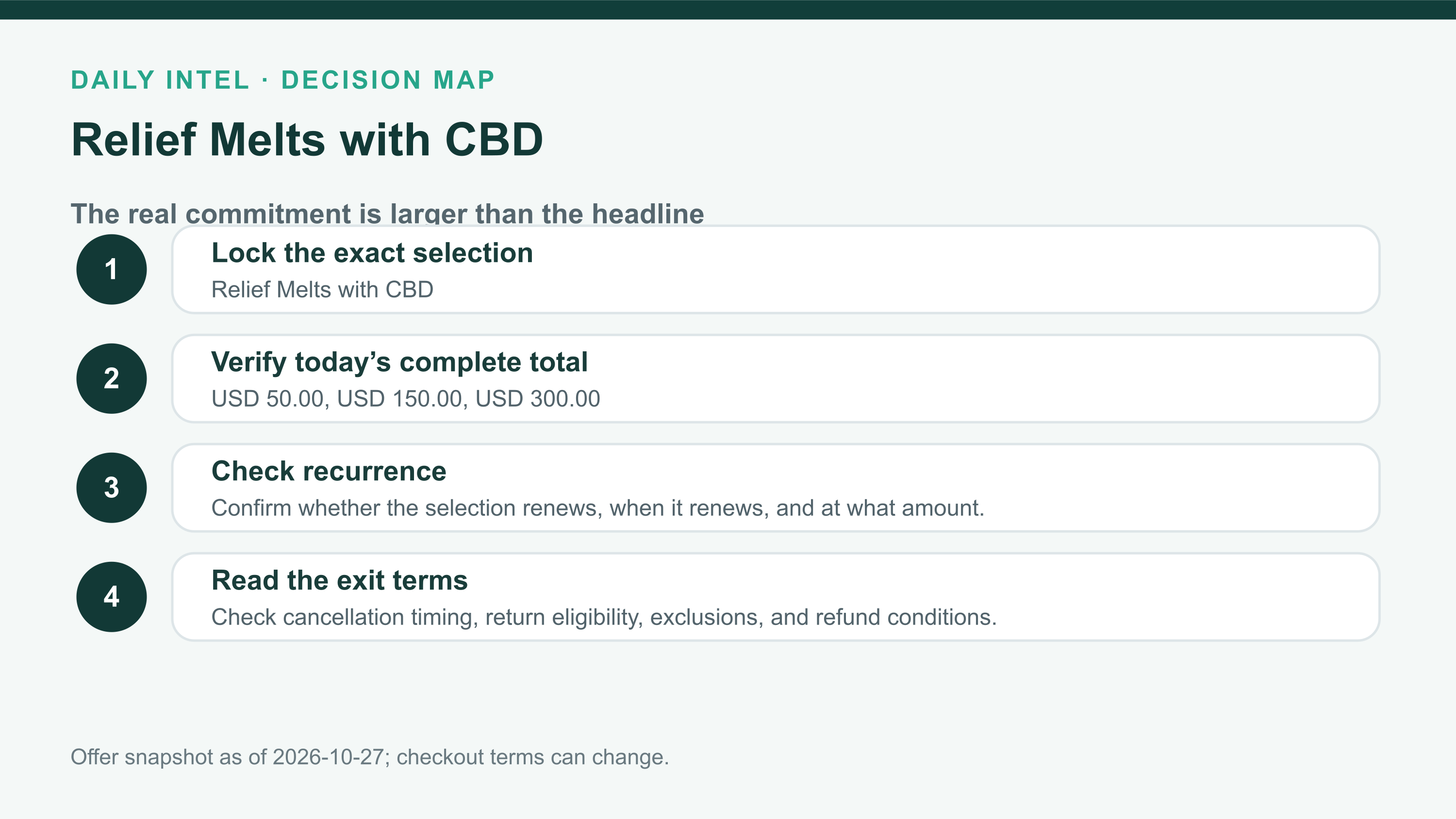
exact offer snapshot: All prices and terms in this review are dated snapshots. Structured product data captured on October 20, 2026 listed three variants at $50, $150, and $300. The product page also displayed one-pack, three-pack, and six-pack selectors. The packet does not provide a sufficiently explicit mapping that allows this review to assign each captured price to a particular selector as a confirmed fact.
The visible page extract contains an additional conflict. It showed $50.00 and $40.00 in the same product area, while an add-to-cart line showed $50. The packet does not explain whether $40 represented a promotion, subscription amount, comparison price, stale interface element, or another condition. This review preserves the conflict rather than selecting the most convenient number.
No product-specific recurring-charge arrangement was verified. The site includes account and subscription navigation, but that does not prove that a Relief Melts selection renews automatically. Before paying, a buyer should confirm whether the order is one-time, whether a displayed price depends on enrollment, the renewal interval, the next charge, and the cancellation procedure.
The Foria terms, refund, and shipping page was retrieved on October 27, 2026. It says a customer who is not completely satisfied should contact Foria within 30 days of receiving the order. Depending on eligibility, Foria says it may offer store credit, an exchange, or a refund. Shipping is nonrefundable, and refunds cannot be processed after the 30-day window.
That policy is not an unconditional promise of a cash refund. Eligibility determines the available remedy. The prominent customer-satisfaction wording on the product page should be read together with those operative limitations.
Claims for products damaged during transit must be made within 72 hours of receipt. The policy directs customers to hello@foriawellness.com. That shorter deadline applies to damage claims and should not be confused with the broader satisfaction period.
For contiguous US orders, standard shipping is free when the order exceeds $85. Orders below $85 incur what Foria calls a small fee, but the supplied extract does not state its amount. Average standard transit is three to six business days and may take up to ten business days before the first delivery attempt. Foria does not guarantee those shipping times.
Expedited shipping is charged according to package weight. Foria gives an average of two to five business days before the first delivery attempt and again does not guarantee the timing.
For Alaska, Hawaii, Puerto Rico, Guam, the US Virgin Islands, and other US territories, Foria states a flat $10 standard-shipping fee and identifies standard shipping as the only option. It does not guarantee delivery timing to those destinations.
Foria says the United Kingdom is its only current international destination outside the United States. International charges depend on destination and package weight. The customer is responsible for customs fees or tariffs, and Foria does not guarantee customs clearance or international delivery time. The affiliate program represented in the packet permits United States traffic, so this article’s commercial placement is limited to US readers.
The stored program destination uses the older relief-suppositories path. A direct capture of that Foria destination resolved to the current product page, but the affiliate tracking redirect itself has not been verified. The next page should therefore be checked for the current product name, package, price, billing frequency, shipping charge, return terms, label, and batch information.
The commercial banner appears immediately after this section. Its commission disclosure must be rendered directly before and near the link. Clicking it is a way to inspect current offer details. It is not evidence that the product works.
Safety Boundaries the Sales Page Cannot Settle
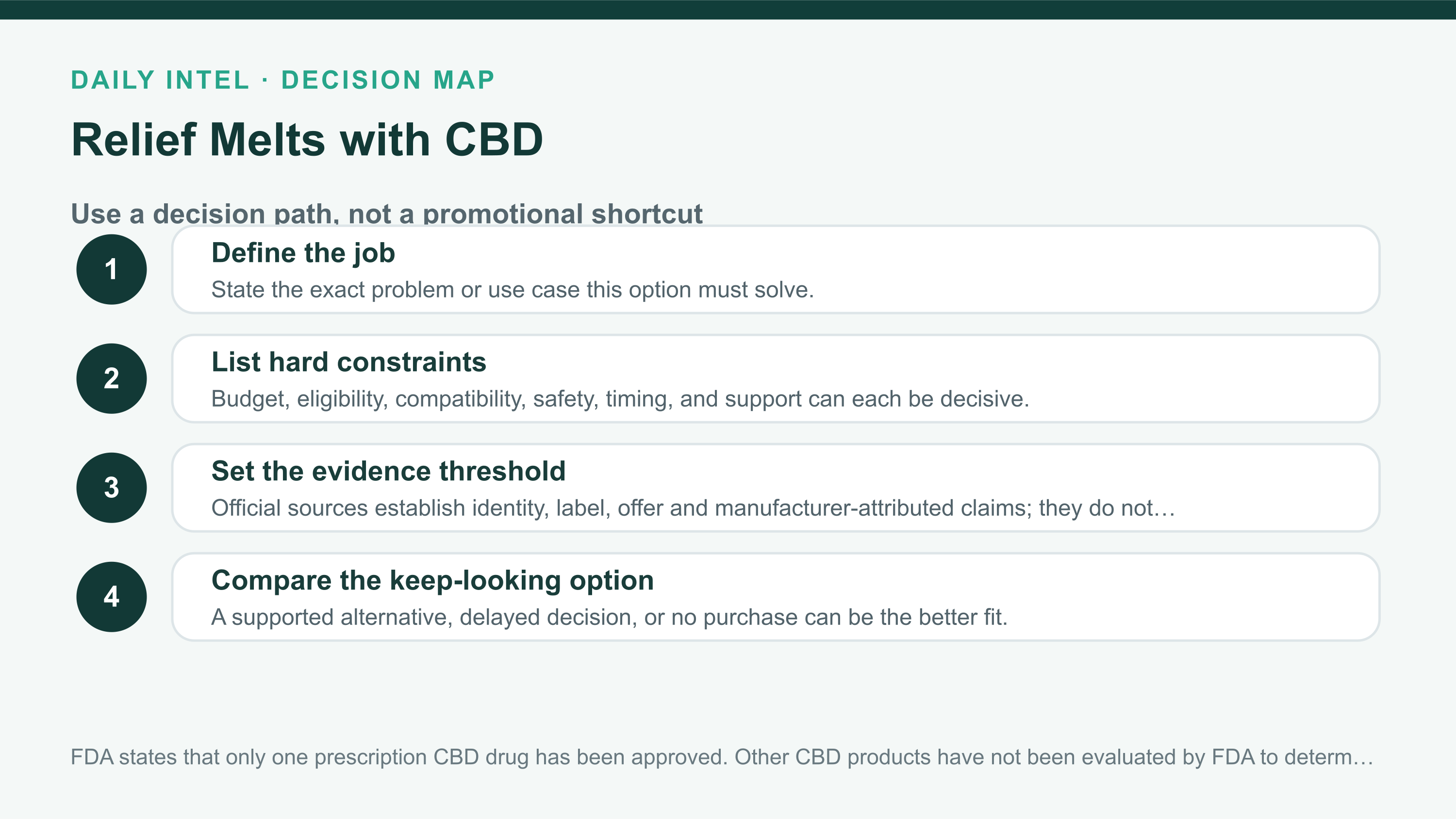
The FDA’s consumer guidance on cannabis and CBD states that only one prescription CBD drug has received FDA approval. Other CBD products have not been evaluated or approved by the agency as drug products for treating disease.
The FDA identifies unresolved questions about effective dosage, interactions with medicines or foods, dangerous side effects, and other safety concerns. The FDA notes potential liver injury, extreme drowsiness, and harmful drug interactions in its consumer guidance.
This is category-level regulator guidance, not a finding that every user of Relief Melts will experience an adverse effect. It also is not a route-specific safety study of the melts. The packet contains no evidence that a product is interaction-free or automatically safe because it is hemp-derived, broad-spectrum, or inserted instead of swallowed.
The FDA strongly advises against CBD use during pregnancy and while breastfeeding. The supplied product evidence does not override that boundary.
The packet does not provide an adverse-event rate for Relief Melts, comparative safety data for vaginal and anal use, or evidence that CBD remains only at the application site. It also does not provide individualized interaction guidance or establish safety for every health condition.
Foria’s page recommends a patch test and advises people prone to urinary tract infections, yeast infections, or other imbalances to consult a healthcare provider. Those seller cautions should be preserved, but they are not a complete risk assessment.
Medication use, health conditions, sensitivity to internally used products, and concern about drug testing all require more individualized information than this packet can provide. New, severe, or unexplained pelvic pain should not be reduced to an online product-selection question. This review cannot diagnose the cause of symptoms or determine whether CBD is appropriate for a particular person.
Who Relief Melts May Fit—and Who Should Keep Looking
Relief Melts may fit a narrow preference profile. The buyer specifically wants an internal-use CBD melt, is comfortable with the manufacturer’s intended route, can verify the current label and matching batch information, has addressed relevant medication and health questions, understands the transaction, and accepts the absence of finished-product efficacy evidence.
That is preference-based fit, not a prediction of relief. The strongest verified differentiator is the format. The packet does not show that the melts are faster, safer, more targeted, or more effective than an oral CBD product or another approach.
Someone who requires a clinically demonstrated treatment, predictable onset, route-specific exposure data, or a clear amount per melt should keep looking or request more information. The same applies if checkout does not clearly explain the selected package, final price, billing frequency, shipping charge, and return eligibility.
Pregnancy and breastfeeding fall outside a reasonable self-directed purchase case because the FDA advises against CBD use in those populations. Medication use, relevant health conditions, sensitivity, or recurrent infections also introduce questions that the sales page cannot settle.
Cost matters because the probability and size of benefit are unknown. The captured amounts range from conflicting $40 and $50 displays to structured variants of $50, $150, and $300. A larger order increases the financial commitment without increasing the quality of the clinical evidence.
The Closest Alternatives Change the Decision, Not the Claim
The packet does not contain enough current evidence to recommend a named competing product. A responsible comparison would require the alternative’s identity, complete current formulation, intended route, price, safety information, offer terms, and product-specific research.
The evidence-supported alternatives are therefore decision paths. A reader can delay the purchase while obtaining more information. They can seek qualified medical guidance about symptoms, medicines, CBD interactions, and the intended route. They can also compare another option after collecting equivalent label, batch, safety, and finished-product evidence.
The oral CBD-enriched oil in the PubMed trial is not a recommended substitute. It was a study intervention in a defined clinical population and did not outperform placebo on the main pain outcome.
Another option becomes more suitable only if it addresses the gaps that matter to the individual. Those might include a clearer dose, stronger finished-product evidence, better interaction guidance, a preferred route, or less financial commitment. Taking no immediate action becomes the better decision when the uncertainty exceeds the buyer’s risk or evidence tolerance.
The VSL Strategy We Would Test for Relief Melts with CBD
This is Daily Intel’s original evidence-led video sales letter strategy. It is not a script created, approved, or run by Foria. The packet supplies no advertising-performance, conversion, profitability, or campaign evidence.
Hook: make the unresolved buying decision the point.
The opening would state the bounded tension immediately. Foria has created a specific internal-use CBD format for period and pelvic discomfort, but the available evidence does not include a clinical trial of the finished product. The viewer’s task is to decide whether the format remains relevant after the proof, safety, and offer gaps are made visible.
The visual would show four separate layers: verified product facts, Foria’s claims, finished-product evidence, and indirect CBD evidence. The narration would explain that these layers answer different questions and should not be blended. Product documentation can verify what is sold. A seller claim can show intended positioning. A COA can report selected batch measurements. A clinical trial can test a defined intervention and outcome. None automatically substitutes for another.
The hook would not promise quick relief, a hidden cure, or a CBD breakthrough. It would promise a transparent decision map.
Lead: lock the product identity before discussing CBD generally.
The lead would identify the reviewed item as Relief Melts with CBD, SKU RMS001. It would present neutral, original graphics rather than unlicensed product photography. The verified description would include eight melts, the page’s 100 mg broad-spectrum CBD wording, cocoa butter, hemp extract, and Foria’s intended vaginal and anal routes.
The lead would flag the first material uncertainty: the packet does not unambiguously establish a CBD amount in each individual melt. Viewers would be told not to calculate or assume one. That point demonstrates the strategy’s central discipline. A prominent number must be used according to the unit and meaning that the source actually establishes.
The lead would then deliver the verdict early. The format is specific and potentially relevant to a preference, but the packet does not demonstrate that the finished product provides clinically meaningful relief.
Utility frame: explain what the format offers without inventing a mechanism.
The defensible utility is practical rather than therapeutic. Foria offers a non-oral melt and directs its use vaginally for menstrual cramps or anally for pelvic tension. Someone seeking that type of administration may consider the format relevant.
The script would not say that the product acts directly at the source of pain, works locally, bypasses systemic exposure, starts faster, or is safer than an oral product. The packet contains no route-specific absorption, onset, duration, or comparative-safety data.
An explanatory diagram could show the intended routes and place unanswered labels around them: exposure, timing, effectiveness, interactions, and adverse events. It would not animate CBD moving to a pain site or depict relief as an established biological result.
This keeps convenience and clinical performance separate. A format can fit a routine without being clinically proven.
Story: use a labeled decision audit instead of an invented testimonial.
The worked example would be explicitly hypothetical. A person with recurring menstrual discomfort notices the internal-use format and considers whether it suits their preferences. The script would not give this person a claimed outcome.
The hypothetical shopper first verifies that the destination identifies Relief Melts with CBD and RMS001 rather than another Foria melt. Next, they check how the current label defines the 100 mg figure. They identify the box’s batch number and look for the matching COA. They consider the FDA pregnancy and breastfeeding boundary, medicines, health conditions, sensitivity, and comfort with internal administration.
The shopper then audits the transaction. They compare the selected package with the final cart amount, investigate the conflicting $40 and $50 displays, determine whether any charge recurs, identify the shipping charge, and read the eligibility conditions for returns.
The story ends at a decision fork. If the missing efficacy evidence, medical questions, or transaction uncertainty exceeds the shopper’s tolerance, they wait or seek qualified guidance. If the product identity and terms are clear, the relevant health questions have been addressed, and they accept the evidence gap, they may still consider the format. No relief outcome is implied.
Proof: move from direct product records to weaker transfer evidence.
The proof sequence would begin with the official product page. That source establishes the product name, format, ingredients named in the captured answer, package count, intended routes, storage instructions, and seller claims. It would be labeled as a manufacturer source rather than independent efficacy evidence.
Next would come the COA directory. The script would explain that a matching certificate may help assess reported potency or contaminants for the batch and analytes tested. It would also explain that the packet does not contain the certificate for the package a viewer would receive. Laboratory quality evidence cannot prove pain relief.
The third layer would be FDA guidance. The agency has approved one prescription CBD drug, while other CBD products have not been evaluated as drug products for effective dosage, interactions, and safety. The narration would preserve the FDA’s warning against CBD during pregnancy or breastfeeding and its cautions about liver injury, extreme drowsiness, and drug interactions.
Only after those boundaries would the script introduce the randomized oral CBD trial. Its design makes it more informative than a testimonial, but its match to Relief Melts is poor. It studied an oral oil in women with surgically confirmed endometriosis and a defined treatment history. It did not study RMS001 or vaginal or anal administration.
The oral CBD intervention failed to outperform placebo on the main pain outcome. More mild adverse events occurred in the CBD group. The script would explain that this weakens broad CBD-equals-relief reasoning without supplying a direct negative verdict on Foria’s finished product.
Objection check: what should stop a careful buyer.
For effectiveness, the answer is that finished-product proof is missing. For speed and duration, the packet provides no reliable measurements. For localized action, intended placement is documented, but localized exposure or benefit is not.
For safety, the internal-use format cannot be assumed to eliminate interactions or systemic effects. The script would direct attention to FDA guidance and personal medical questions without pretending to give individualized advice.
For quality, a matching COA may answer selected laboratory questions. It cannot establish efficacy or universal safety. For drug testing, Foria’s unlikely-positive statement would remain attributed and would not be presented as a guarantee.
For price, the script would preserve every captured amount: structured $50, $150, and $300 variants and the unresolved $40 and $50 displays. It would not declare a sale or subscription price without evidence. The current cart would control the practical purchase decision.
For recurring charges, the answer is that no product-specific renewal terms were verified. The viewer must confirm whether the chosen order is one-time, how often any renewal occurs, the next charge, and how cancellation works.
For returns, the script would explain the 30-day contact window, eligibility-dependent store credit, exchange, or refund, nonrefundable shipping, and the 72-hour deadline for transit-damage claims. Those terms reduce or allocate transaction risk; they do not prove health outcomes.
Offer logic: define what the click must verify.
The offer presentation would use no countdown, inventory warning, invented discount, or guaranteed outcome. It would state that the prices and policies were captured in October 2026 and can change.
The viewer would receive a prepayment checklist: confirm the product name and SKU, selected package, final cart amount, one-time or recurring status, next charge if applicable, shipping cost, return eligibility, current label, batch number, and matching certificate.
The tracking boundary would also be stated. The stored program destination used the older relief-suppositories path, and a direct capture of that Foria path resolved to the current product page. The affiliate tracking redirect itself was not opened. The script would instruct the viewer to verify the landing page rather than assume it remains correct.
CTA: invite verification rather than belief.
The only purchase-oriented CTA would appear after the price, terms, evidence, and safety analysis. Daily Intel’s commission disclosure would be placed directly before and near it. The wording would invite the reader to inspect the current offer and confirm every material detail.
The CTA would not tell readers that the product will work. People who require strong finished-product evidence, fall within the FDA pregnancy or breastfeeding warning, or have unresolved medication or health questions would be directed to wait or seek qualified guidance.
This ending preserves reader agency. It also states the commercial role accurately: the next click is an opportunity to inspect a current offer, not proof of effectiveness or a predetermined recommendation.
Frequently Asked Questions
Q: Is Relief Melts with CBD clinically proven?
A: No clinical trial of the finished Relief Melts with CBD product appears in the supplied evidence. The available randomized trial tested a different oral CBD-enriched oil in women with surgically confirmed endometriosis. It did not establish the effectiveness of Foria’s vaginal or anal melts.
Q: How much CBD is in each Relief Melt?
A: The captured Foria page says the product is formulated with 100 mg of broad-spectrum CBD and that a pack contains eight melts. The supplied wording does not unambiguously say that each melt contains 100 mg or otherwise provide a clear per-melt amount.
Q: Can Relief Melts with CBD be used vaginally or rectally?
A: Foria directs vaginal use for menstrual cramps and anal use for pelvic tension. Those are the manufacturer’s intended-use instructions. The supplied evidence does not establish equivalent absorption, timing, safety, or effectiveness for the two routes.
Q: Are Relief Melts with CBD safe during pregnancy or breastfeeding?
A: The FDA strongly advises against using CBD in any form during pregnancy or while breastfeeding. The packet contains no finished-product evidence that creates an exception for Relief Melts or their intended routes.
Q: What did Relief Melts with CBD cost in the captured offer?
A: Structured data captured on October 20, 2026 listed $50, $150, and $300 variants. The visible product area also contained both $40 and $50 displays. The packet does not conclusively explain or map every amount, so the selected package and final cart price require verification.
Q: What are the evidence-supported alternatives?
A: The packet does not support recommending a competing product. Supported alternatives are to delay the purchase, seek qualified medical guidance, or compare another option after obtaining its current label, intended route, safety information, commercial terms, and finished-product evidence.
Sources and Evidence Notes
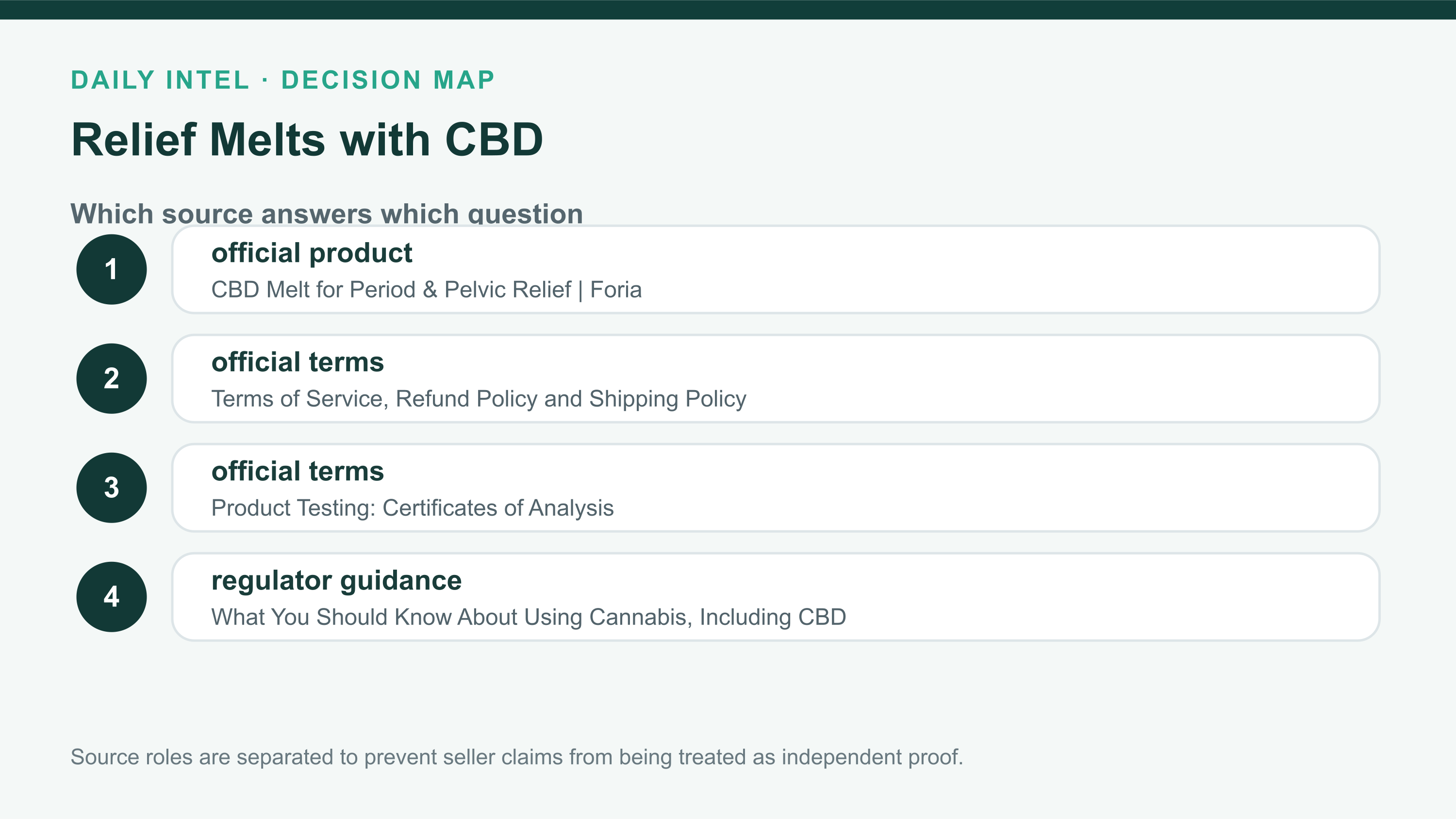
Evidence card: Foria’s official Relief Melts with CBD page. This seller source establishes the current product name, SKU context, eight-melt description, 100 mg CBD wording, ingredients named in the captured answer, intended routes, storage statements, and manufacturer claims. It does not independently establish clinical effectiveness or product-specific safety.
Evidence card: Foria’s terms, refund, and shipping policy. This source supports the 30-day contact window, eligibility-dependent remedies, nonrefundable shipping, 72-hour damage deadline, and captured shipping conditions. Terms may change, and transaction protection is not evidence of efficacy.
Evidence card: Foria’s Certificates of Analysis directory. The captured directory lists Relief Melts, formerly Relief Suppositories, and batch RMS001_31R. The packet does not reproduce the certificate for the exact package a buyer will receive. A COA cannot establish clinical relief.
Evidence card: FDA consumer guidance on cannabis and CBD. This regulator source establishes the CBD approval boundary, unresolved dosage and interaction questions, pregnancy and breastfeeding warning, and potential risks including liver injury, extreme drowsiness, and drug interactions. It is category-level guidance, not a trial of Relief Melts.
Evidence card: The randomized oral CBD trial indexed by PubMed. This primary study tested an oral CBD-enriched oil for endometriosis-associated chronic pelvic pain. The intervention was not superior to placebo on the main pain outcome and caused more mild adverse events. It did not test Relief Melts, their formulation, their routes, or their broader intended population.
What Would Change This Verdict
what would change the verdict: A well-designed finished-product study. The current verdict is cautious. Relief Melts with CBD has a clearly documented format and intended use, but the supplied evidence does not demonstrate clinically meaningful relief from the finished product. The different oral CBD trial provides no favorable efficacy bridge and shows why category-level CBD reasoning cannot be treated as product proof.
The verdict would improve if a well-designed study tested the current RMS001 melts through their intended routes, clearly defined the dose in each melt, enrolled relevant users, used an appropriate control, and fully reported pain, function, discontinuation, and adverse-event outcomes.
The packet lacks route-specific exposure data, clearer interaction information, and an exact-package COA. They still would not replace a clinical efficacy trial.
The commercial assessment would improve if checkout unambiguously mapped each package to its price, explained the conflicting $40 and $50 displays, stated whether any charge recurs, and confirmed the affiliate redirect’s landing page. Until then, every price and term in this review should be treated as an October 2026 snapshot.
For someone who wants this exact format, accepts the evidence gap, addresses the relevant health questions, and verifies the transaction, the product may remain an option to consider. For someone seeking clinically demonstrated relief, predictable timing, or low uncertainty, the evidence supports waiting rather than assuming.
This article is for informational and educational purposes only. It is not medical advice. Daily Intel is independent and may earn an affiliate commission. Foria did not write, review, or control this article.
Comments(0)
No comments yet. Members, start the conversation below.
Related reads
 reviews
ARMRA Colostrum Review: Evidence, Dose Gaps, Price, and Verdict
ARMRA’s 120-serving colostrum powder comes with notable manufacturer-reported survey percentages. However, the undisclosed amount per serving and a materially different ingredient trial leave the finished product’s highlighted outcomes unproven.
Read reviews
Olly Goodbye Stress Review: Label Claims vs. Evidence
OLLY Goodbye Stress combines GABA, L-theanine, and lemon balm extract in a Berry Verbena gummy aimed at occasional stress, not sleep. Here's what the label discloses, what a real L-theanine trial found, and exactly where the evidence stops.
Read reviews
Kaged Pre-Kaged Sport Review: Does the Citrulline Study Fit?
Kaged Pre-Kaged Sport provides 3.5 grams of fermented L-citrulline in each 13-gram scoop. The supplied trial tested a higher dose of isolated L-citrulline and found no performance benefit, so it cannot prove whether this finished formula works.
Read