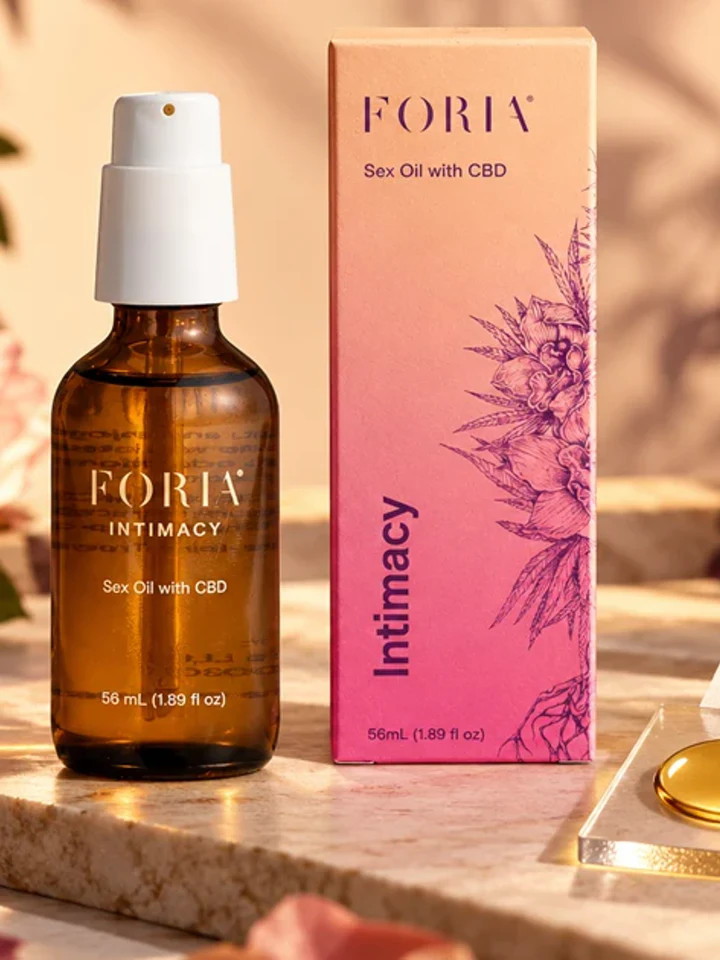
Sex Oil with CBD Review: Clear Lubricant Role, Limited CBD Proof
Foria documents a 56 mL coconut-oil-based intimacy product with a clear intended role, but the supplied evidence contains no clinical trial of the finished oil. Compatibility, safety boundaries, checkout terms, and the buyer’s evidence standard determine the verdict.
8,226+
Videos & Ads
+50-100
Fresh Daily
$29.90
Per Month
Full Access
12.5 TB database · 72+ niches · 25 min read
Foria’s Sex Oil with CBD has a clear personal-care role and several important compatibility limits. It may fit an adult seeking an oil-based source of glide who accepts that the supplied evidence does not clinically establish the finished product’s broader CBD claims.
It is not the stronger choice for someone requiring product-specific clinical proof of increased sensitivity, reduced tension, pain relief, or another health outcome. The packet contains no clinical trial of this exact oil. Its one related human study tested a different CBD-and-myrcene gel in a diagnosed population under different conditions.
The practical decision rests on five questions:
- Do you want an oil-based intimacy product?
- Are coconut oil and the condom restrictions compatible with your intended use?
- Are you comfortable treating glide as the primary documented purpose while treating broader benefits as seller claims?
- Do pregnancy, breastfeeding, medication use, allergy, recurrent irritation, or ongoing discomfort make professional guidance appropriate first?
- Are the current quantity, shipping, and refund terms acceptable after you verify them at checkout?
The bounded verdict is straightforward. The oil’s identity, seller-stated formula, intended use, and principal cautions are documented. Finished-product clinical evidence for its promoted CBD effects was not supplied.
The decision Sex Oil with CBD needs to earn
The most defensible reason to consider this product is its stated role as an intimacy oil. Foria says it supplies glide and reduces friction. That is the direct function the product is designed to perform.
The more demanding question concerns CBD. Foria says CBD works with the body’s natural systems to help ease tension and increase sensitivity. It also associates the oil with comfort and shared pleasure. These are manufacturer claims. The packet contains no independent trial demonstrating those outcomes for the current product.
A plausible ingredient explanation is not finished-product proof. A useful product trial would need to identify the exact formula, amount used, frequency, population, comparison group, duration, outcomes, and adverse events. It would also need to resemble the commercial product and its intended use closely enough for its findings to transfer.
The largest uncertainty is therefore not what Foria sells. It is what outcomes the finished formula has been shown to produce. The packet verifies the product identity, bottle size, seller-stated ingredients, offer snapshot, cautions, and related policies. It does not verify that the CBD in this oil improves sensitivity, tension, comfort, or a medical condition.
That gap is not proof that the product fails. It means the buying case should stay narrow. The product is better assessed as an oil-based lubricant containing seller-reported CBD than as a clinically demonstrated CBD intervention.
A rigorous trial of the current SKU ISO004 formula under its intended-use conditions would materially change this conclusion. Until then, the buyer’s evidence tolerance is part of the decision.
What the Foria page actually offers
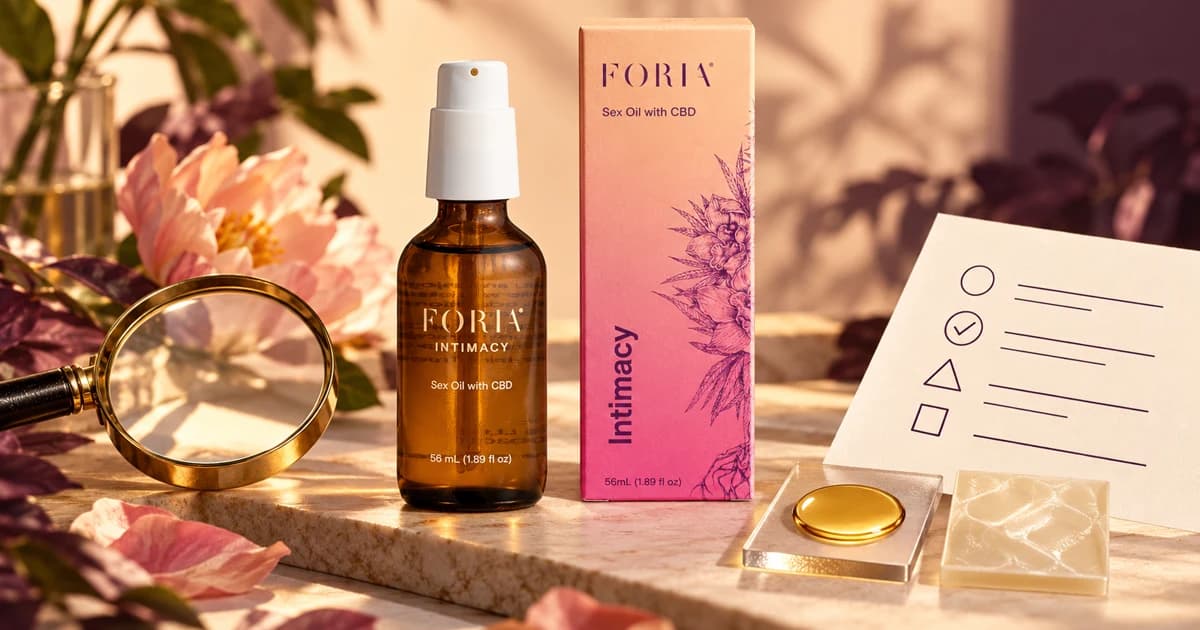
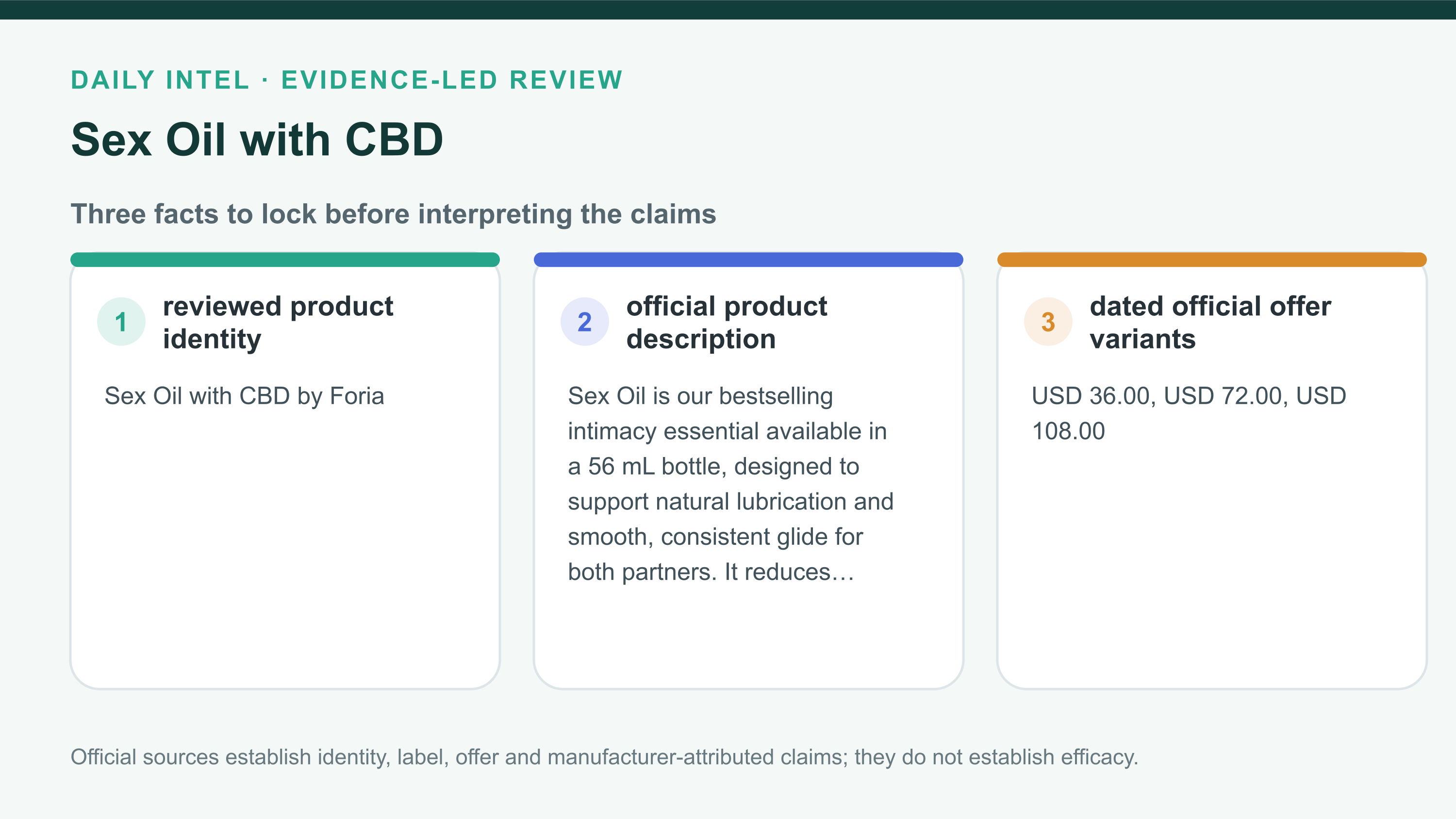
The official product page identifies the item as Sex Oil with CBD by Foria. Its structured product record lists SKU ISO004, and the official description specifies a 56 mL bottle.
Foria describes it as an intimacy oil designed to support lubrication, maintain glide, and reduce friction. The company also describes the texture as silky, slowly absorbed, gently warming, nonsticky, and resistant to drying out during use. Those sensory and performance descriptions are seller-provided. No independent finished-product comparison was supplied.
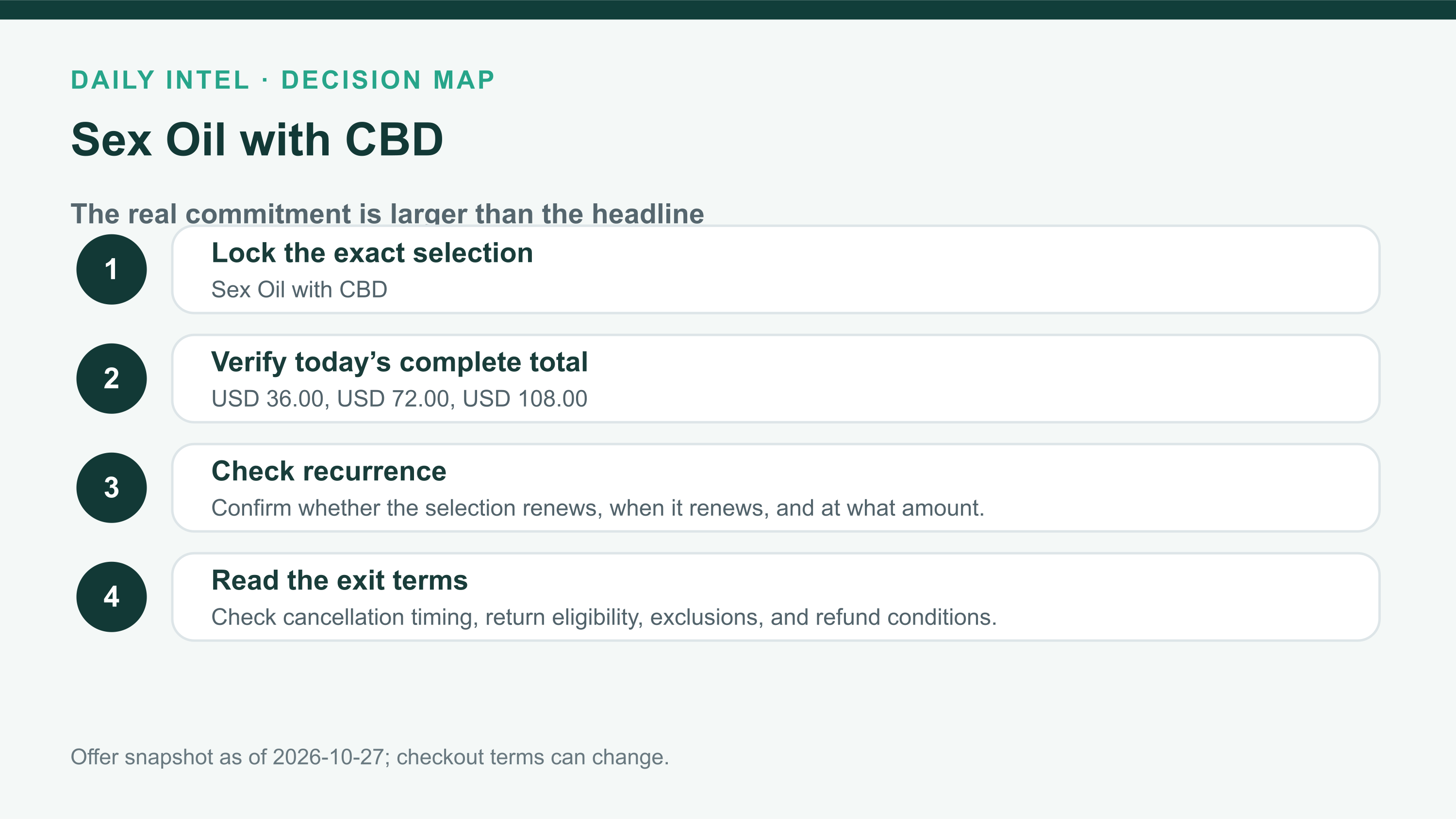
The captured page showed 1-, 2-, and 3-pack selections. The structured offers recorded prices of $36, $72, and $108. Those figures imply $36 per bottle at each level, so the packet does not establish a quantity discount.
The visible page capture also displayed $28.80 near $36. The packet does not explain whether $28.80 was a conditional promotion, a temporary price, or a rendering issue. This review therefore preserves both observations but does not present $28.80 as a generally available price.
The captured affiliate destination contains a path ending in “2oz.” That destination redirected during research to the canonical page describing 56 mL. This review uses the explicit 56 mL specification and does not treat wording inside a URL path as a separate verified size.
Foria says the product uses food-grade ingredients and can be included in oral play. Its FAQ also says it should not be consumed as a daily tonic or supplement. Those are manufacturer instructions about intended use, not independent safety findings or regulatory approval.
The exact formula and version under review
This review concerns Sex Oil with CBD, SKU ISO004. It does not concern Foria’s Awaken Arousal Oil, Massage Oil, Intimacy Melts, Booty Melts, or another product. Evidence cannot transfer merely because two products share a brand or contain CBD.
Foria says Sex Oil with CBD contains only two ingredients:
- Organic MCT coconut oil.
- Broad-spectrum extract from USDA organic-certified, regeneratively grown US hemp.
The company reports 400 mg of active CBD in the 56 mL bottle and describes the extract as free of THC. These are seller-provided product specifications. The packet does not include the results from a laboratory report matched to a bottle a future buyer would receive.
The 400 mg figure describes the bottle total. It does not establish the amount applied during one use, the CBD delivered per application, or the amount absorbed under a particular use condition. The packet supplies no per-use dose.
Foria also says the formula contains no alcohol, petroleum-based ingredients, phthalates, glycerin, parabens, dye, synthetic fragrance, or fillers. Those exclusions may help a reader screen for formulation preferences. They do not establish universal tolerance, medical suitability, or clinical benefit.
The captured page contains conflicting pH language. One passage calls the product’s pH “vagina-friendly.” The FAQ on the same page says the oil-based formula does not have a pH value. It then points to the absence of ingredients Foria says can disturb vaginal pH. Those statements are not equivalent. The packet does not support assigning a measured pH value to the oil.
Foria maintains a certificate-of-analysis page listing Sex Oil batches ISO004_019 and ISO004_018R. A certificate of analysis, or COA, is a laboratory report for a particular batch. The packet confirms that these links exist but does not reproduce their potency or contaminant results.
A buyer would need to match the batch number on the received product to the relevant report. Even a matching COA would have a limited job: it could support reported laboratory findings for that batch. It would not prove comfort, sensitivity, pleasure, lubrication performance, or efficacy for a medical condition.
What Foria claims—and the evidence each claim needs
Foria’s simplest product claim is that the oil adds glide and reduces friction. That describes its intended mechanical role. The packet does not contain an independent test comparing its friction, duration, or irritation rate with another lubricant.
Other claims require different evidence.
Supports lubrication and reduces friction. A finished-product test could examine the current formula under intended-use conditions. It would need a defined amount, comparison product, test period, relevant measurements, participant feedback, and adverse-event reporting.
Long lasting, stable, and resistant to drying out. These are performance-over-time claims. The packet provides no defined duration or comparison standard. The phrase “long lasting” therefore remains a manufacturer description rather than a measured finding in this review.
Foria says the oil helps ease tension and increase sensitivity. The company links these outcomes to CBD. A proposed mechanism cannot establish the outcome. Product-specific human evidence would need to show that the current formula, at the amount actually used, produced a meaningful difference from a suitable control.
Comfortable on sensitive skin and nonirritating. These are broad tolerance claims. The official page also recommends a patch test and tells people prone to urinary tract infections, yeast infections, or other imbalances to check with a healthcare provider. The supplied evidence does not establish tolerance across populations.
Suitable for oral play. Foria limits this claim by advising against consuming the oil as a tonic or supplement. The statement should not be expanded into permission to consume unspecified amounts.
THC-free. This is a manufacturer specification. A report matched to the purchased batch would be the relevant document for checking reported cannabinoid results. Cannabinoid testing would still not prove the promoted experiential effects.
The page also names awards from 2024, 2025, and 2026 and calls the product a bestseller. These are seller-presented recognition and popularity statements. They do not replace clinical evidence, demonstrate typical results, or establish compatibility for an individual.
The official page includes testimonials and a structured rating. This review does not use them as proof. Personal reports cannot isolate the formula’s effects, establish typical outcomes, or substitute for controlled finished-product research.
The evidence layers must remain separate. The official page establishes what Foria sells and says. A matching COA could address laboratory findings for a batch. A clinical trial could evaluate defined outcomes in a defined population. None of those layers silently performs the job of another.
Dose, form, and population: where study fit breaks
The packet contains one related human study: a randomized, double-blind trial of a 5% cannabidiol gel with myrcene for provoked vestibulodynia. Provoked vestibulodynia is vulvar pain triggered by touch or pressure. Myrcene was a separate component of the tested preparation.
According to the PubMed record, the study enrolled 40 women. Twenty received the active preparation and 20 received placebo. Participants applied the preparation to the vulvar vestibule for 60 days. Investigators assessed pain, pain during sex, and cotton-swab-test scores on a 0-to-10 visual analog scale. Symptoms improved in both groups, with greater reductions in some measures in the active group.
This study is relevant background, but it does not establish how Foria Sex Oil with CBD performs.
The formula differs. The study used a 5% CBD gel with myrcene. Foria describes an MCT coconut oil with broad-spectrum hemp extract. The packet does not establish that the commercial oil contains myrcene at the studied level or contains it at all.
The dose cannot be matched. Foria reports 400 mg of CBD per bottle, but the packet provides no amount per application. A total-bottle figure cannot be equated with a 5% study formulation.
The population differs. The trial involved women with provoked vestibulodynia. Foria markets the oil broadly for intimacy, lubrication, and comfort. Results from a diagnosed research population cannot automatically be generalized to all adults seeking a lubricant.
The form and use conditions also differ. A gel applied during a 60-day study is not the same as an oil used before penetration or during sexual play. The application pattern, comparator, formula, and outcomes are not interchangeable.
The study supports a narrower conclusion: the tested CBD-and-myrcene preparation was studied in the reported population. It does not prove that Foria’s oil improves lubrication, sensitivity, pleasure, tension, or symptoms of a diagnosed condition.
For the buyer’s decision, the claim versus evidence boundary is clear: the study supports only the tested preparation and population, not the finished Sex Oil with CBD.
Price, recurring charges, refunds, and the real commitment
As of October 27, 2026, the structured official snapshot showed 1-, 2-, and 3-pack choices at $36, $72, and $108. A separate visible fragment showed $28.80 near $36, but the packet did not establish the conditions attached to that amount. Prices can change, and the conflict should be checked at checkout rather than resolved by assumption.
For the Sex Oil with CBD decision, this exact offer snapshot is a checkout checkpoint, not evidence of a discount or fixed future terms.
No subscription or recurring-payment arrangement was established by the supplied evidence. That does not prove every checkout path is one-time. The order summary, payment frequency, and opt-in language should be reviewed before payment.
The page banner advertised free US shipping on orders of $85 or more. The captured terms, refund, and shipping page says standard shipping is free for orders over $85 in the contiguous United States and carries a fee below that threshold. The wording differs at exactly $85. The documented $108 selection exceeds either threshold, while $36 and $72 do not.
Foria reports an average contiguous-US standard transit time of 3–6 business days, with up to 10 business days until the first delivery attempt. It reports an average of 2–5 business days for customer-paid expedited shipping. The company does not guarantee either time frame.
For Alaska, Hawaii, Puerto Rico, Guam, the US Virgin Islands, and other US territories, the captured policy specifies a $10 standard-shipping fee and says standard shipping is the only option. Foria says international shipping is currently limited to the United Kingdom, with customer-paid shipping and possible customs costs. The affiliate program represented here permits United States traffic.
Foria’s return terms are narrower than the page’s general “100% Customer Satisfaction Guarantee” language. The policy says customers should contact hello@foriawellness.com within 30 days of receiving an order. Depending on eligibility, Foria may provide store credit, an exchange, or a refund. Shipping is nonrefundable, refunds cannot be processed after the 30-day window, and damage claims must be made within 72 hours of receipt.
The extract does not establish that every opened intimacy product receives a cash refund. Buyers should verify the eligibility rules and available remedy for the exact order.
The real commitment therefore includes the final checkout price, any shipping fee, payment frequency, material compatibility, and the possibility that the available remedy is credit or exchange rather than a refund.
Commission disclosure: Daily Intel may earn a commission if you purchase through the offer banner placed immediately after this section. That commercial relationship does not change the evidence assessment, safety boundaries, or price conflicts reported here.
Safety and compatibility boundaries the sales page cannot settle
Foria says to avoid the product if either the user or a partner has a coconut allergy. The packet supplies no basis for overriding that caution.
Foria also says the oil should not be used with latex or polyisoprene condoms. Its FAQ explains that oil can degrade those materials and make them more likely to break or tear. Foria mentions polyurethane condoms as an alternative but instructs buyers to read the packaging for the specific barrier. A general “nonlatex” label should not replace the exact manufacturer’s compatibility instructions.
Foria recommends nonlatex toys and names silicone, glass, elastomer, and stainless steel as examples. That is manufacturer guidance. The instructions for the exact toy and material should still control.
The company recommends a patch test on the inner wrist or forearm before use. The packet does not establish how well that test predicts vaginal or vulvar tolerance. Foria advises people prone to urinary tract infections, yeast infections, or other imbalances to check with a healthcare provider.
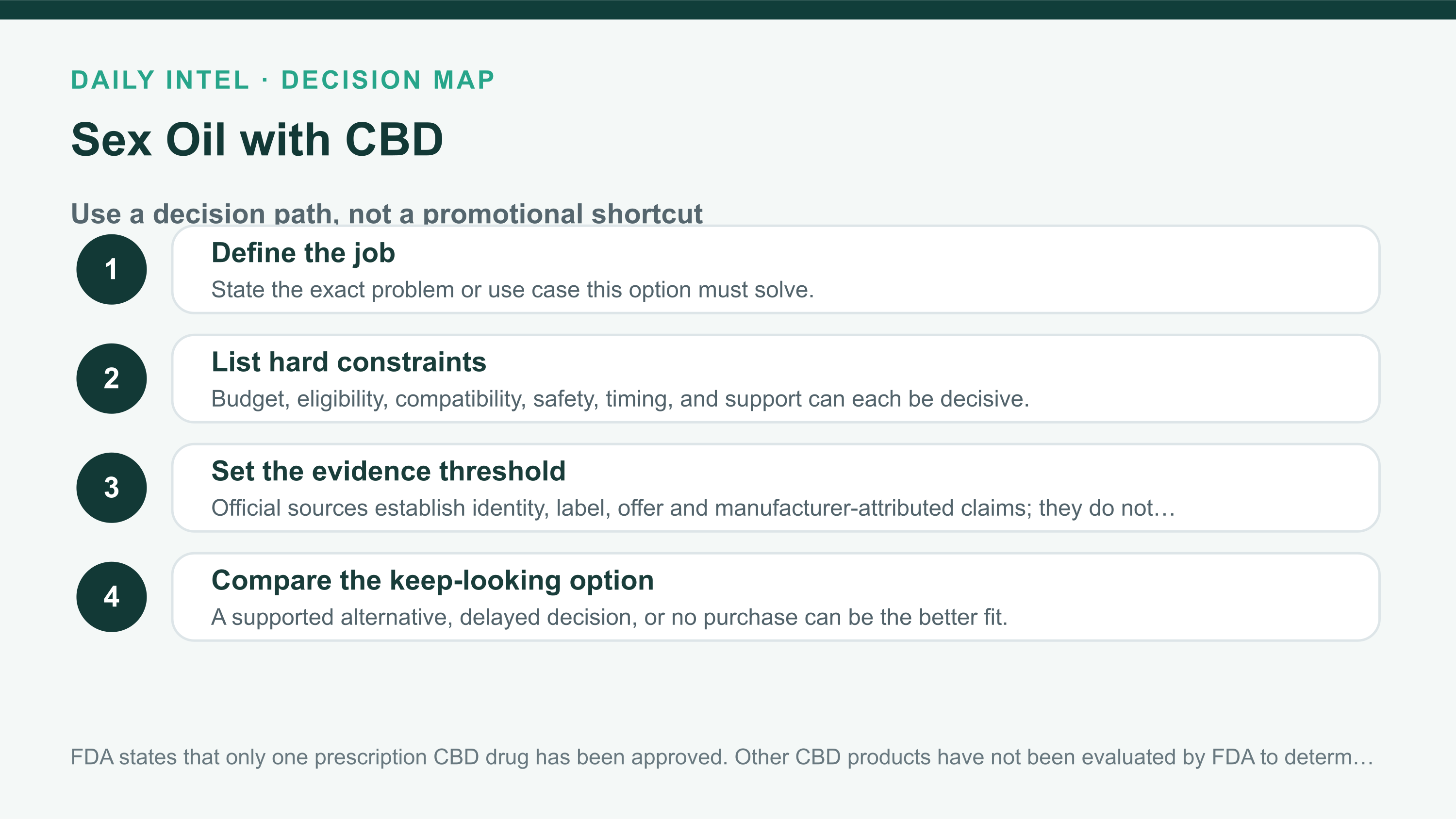
CBD introduces a separate boundary. The US Food and Drug Administration’s CBD guidance says only one prescription CBD drug has been approved. Other CBD products have not been evaluated or approved by FDA as drug products for effective dosage, interactions, safety, or disease treatment.
FDA identifies liver injury, extreme sleepiness, and harmful drug interactions among risks found in the clinical studies supporting the approved prescription CBD medicine. That broader evidence does not calculate the probability of those effects from this topical oil. The formula, route, dose, exposure, and user differ. It does explain why the presence of CBD cannot be converted into a claim of universal safety.
FDA strongly advises avoiding CBD, THC, and marijuana in any form during pregnancy or breastfeeding. The packet provides no basis for an exception for Sex Oil with CBD.
Foria also says people taking pharmaceutical drugs should consult a physician. The packet contains no interaction study for this product, per-use CBD dose, or absorption data under its intended conditions. This review cannot determine compatibility with a particular medication or medical history.
Persistent or unexplained discomfort should not be treated only as a product-selection question. The related study involved a diagnosed pain condition but did not test Foria’s product. The packet does not establish Sex Oil with CBD as treatment for vestibulodynia, infection, or any other disease or condition.
A batch report would not settle these medical questions. A COA may address reported potency and contaminants for a tested batch. It cannot establish individual tolerance, medication compatibility, barrier compatibility, or clinical efficacy.
Who Sex Oil with CBD may fit—and who should keep looking
The product may fit an adult seeking an oil-based source of glide who is comfortable with coconut-derived ingredients, does not require latex or polyisoprene compatibility, and accepts the absence of supplied finished-product clinical evidence for the CBD claims.
The short seller-stated ingredient list and listed exclusions may also fit a buyer’s formulation preferences. Terms such as organic, plant-based, and broad-spectrum should not be treated as proof of superior outcomes or universal tolerance.
Keep looking if latex or polyisoprene barriers are required. A lubricant confirmed as compatible with the exact barrier is the more practical choice.
FDA advises avoiding CBD during pregnancy and breastfeeding. Medication use, coconut allergy, recurrent irritation, common vaginal imbalances, or another health concern also calls for additional scrutiny or professional guidance.
Someone seeking clinically demonstrated relief for pain or a diagnosed condition should not use this packet as treatment evidence. The product is also a weak fit for a buyer requiring a verified per-use CBD dose, a batch report reviewed before purchase, or a guaranteed sensory outcome.
The closest alternatives change the verdict
The packet does not support a brand-by-brand competitor ranking. It contains no current competitor prices, formulas, policies, or comparative performance results. The supported alternatives are decision paths.
A CBD-free lubricant becomes the better category when CBD is not important. This avoids making a purchase decision around CBD effects that the supplied finished-product evidence does not demonstrate. Any alternative still requires its own ingredient and compatibility review.
An oil-compatible-barrier decision is necessary when condoms are involved. If latex or polyisoprene condoms are required, Sex Oil with CBD is ruled out by Foria’s instructions. The exact barrier manufacturer’s guidance should control.
Professional evaluation becomes the better path when the goal is relief from persistent or unexplained discomfort. The supplied study does not make this commercial oil a treatment.
No purchase is reasonable while material details remain unresolved. A buyer can wait to inspect the relevant batch report, verify checkout terms, or obtain guidance about medication or health concerns.
The VSL strategy we would test for Sex Oil with CBD
This is Daily Intel’s original strategy for an evidence-led video sales letter, or VSL. It is not Foria’s VSL. The packet contains no evidence that Foria wrote, approved, ran, or tested this execution. It also contains no campaign, conversion, profitability, or sales-performance evidence for the strategy.
Hook
The opening would treat the purchase as a private decision rather than a problem requiring dramatic promises. It would state the central finding immediately: Foria documents a 56 mL coconut-oil-based intimacy product containing a seller-reported 400 mg of CBD, but the supplied evidence contains no clinical trial of the finished oil.
The hook would promise three answers. First, what is actually in the documented product? Second, which claims are supported only by the seller? Third, which safety or compatibility limits could rule out the purchase before price matters?
It would avoid shame, fear about a relationship, graphic imagery, invented urgency, or suggestions that the viewer has an undisclosed medical problem. The unresolved issue is evidence quality and product fit, not the viewer’s worth.
Lead
The lead would separate two product stories.
The first is mechanical. The official product page presents glide and reduced friction as Foria’s intended uses for the oil. That is its most direct stated utility.
The second is biological. Foria says CBD works with the body’s natural systems to help ease tension and increase sensitivity. Those outcomes require a different level of proof. The supplied packet does not show that this finished formula, at the amount used, produces those effects.
The lead would deliver the conditional verdict early: consider the product for its documented role as an oil-based intimacy aid if the formula and compatibility limits fit. Do not purchase it on the assumption that its CBD has been clinically shown to produce the promoted outcomes.
Utility and mechanism
The explanation would begin with the product’s observable intended function. Foria says the coconut-oil base creates persistent glide. That remains a manufacturer performance claim, but it describes what the product is designed to do.
CBD would be presented as an unresolved evidence question. The company provides a 400 mg bottle-total figure, but the packet provides no amount per use, no matched absorption information, and no finished-product clinical trial. A bottle total is not an effective dose and does not establish a result.
FDA context would then set the boundary. Only one prescription CBD drug has FDA approval. Other CBD products have not been evaluated as drug products for effective dosage, interactions, safety, or disease treatment. This guidance does not prove that Foria’s topical oil will produce a particular systemic effect. It prevents the VSL from turning “contains CBD” into “clinically proven” or “safe for everyone.”
Hypothetical decision path
The story would be explicitly labeled as hypothetical. It would not describe an actual customer or product experience.
Imagine an adult who wants more glide, prefers a short ingredient list, uses latex condoms, and takes a pharmaceutical drug. The product initially appears relevant because Foria lists two ingredients and a clear intended use.
The checklist changes the decision. Foria says the oil is incompatible with latex. Medication use raises a CBD interaction question the packet cannot answer. The 400 mg figure does not reveal how much CBD would be used during one application.
The buyer does not need to declare the brand good or bad. The product is mismatched to current constraints. A lubricant compatible with the intended barrier and appropriate medication guidance become better next steps.
A second hypothetical buyer does not use latex or polyisoprene barriers, has no coconut allergy, is not pregnant or breastfeeding, and wants an oil-based lubricant. That person may reasonably evaluate the product while accepting that the CBD-related outcomes remain unproven for the finished formula.
Neither path reports use, satisfaction, or an outcome. The story demonstrates decision logic rather than efficacy.
Proof sequence
The proof would move through distinct evidence layers.
First, the official page establishes identity, SKU, bottle size, seller-stated ingredients, prices, intended use, cautions, and manufacturer claims. It is evidence of what Foria sells and says. It is not independent outcome evidence.
Second, Foria’s testing page lists batch-specific COA links for ISO004. A certificate matched to the received bottle could support reported potency or contaminant findings for that batch. The supplied packet does not contain those results, and a laboratory report cannot establish comfort, sensitivity, or pleasure.
Third, the PubMed study provides related human research. It tested a 5% CBD-and-myrcene gel in 40 women with provoked vestibulodynia for 60 days. It did not test Foria Sex Oil with CBD. Differences in formula, dose, population, form, use conditions, and claimed outcomes mean this study cannot establish performance of Sex Oil with CBD.
Fourth, FDA guidance provides the approval and safety boundary. It identifies unresolved questions around nonapproved CBD products and advises avoiding CBD during pregnancy and breastfeeding.
The proof conclusion would remain narrow: this is a documented commercial intimacy oil with a clear intended lubricant role, but the packet supplies no finished-product clinical proof for the promoted CBD outcomes.
Objections
If a viewer points to awards, ratings, or testimonials, the response is that recognition and personal reports do not establish typical results or isolate the formula’s effect.
If the viewer asks whether 400 mg is enough, the response is that the figure covers the whole bottle. The packet provides neither a per-use dose nor an effective dose for the promoted purpose.
If the viewer asks whether organic coconut oil guarantees safety, the response is no. Foria itself provides coconut-allergy, barrier, patch-test, and sensitivity cautions.
If the viewer asks about condoms, the answer is direct: Foria says not to use the oil with latex or polyisoprene condoms. Compatibility must be checked against the instructions for the exact barrier.
If the viewer is pregnant, breastfeeding, or taking medication, the VSL would not improvise reassurance. FDA advises avoiding CBD during pregnancy and breastfeeding, and the packet cannot provide an individualized medication answer.
If the viewer expects treatment for pain, the response is that the evidence does not establish this oil as treatment for pain, vestibulodynia, or any disease. Persistent or unexplained discomfort calls for professional evaluation.
Offer logic
The offer segment would use dated facts without scarcity. On October 27, 2026, the structured snapshot showed 1-, 2-, and 3-pack choices at $36, $72, and $108. A visible $28.80 fragment had unexplained conditions and would not be promoted as the current price.
No recurring charge was established. The VSL would instruct viewers to confirm payment frequency at checkout rather than promise a one-time purchase.
The policy explanation would include the 30-day contact window, eligibility-dependent store credit, exchange, or refund, nonrefundable shipping, and 72-hour damage-claim deadline. It would not convert the satisfaction language into an unconditional cash-back promise.
The viewer would also be told to verify the selected quantity, final total, shipping charge, payment frequency, batch information, and exact refund eligibility before ordering.
CTA
The closing would be conditional and low pressure: if an oil-based formula fits the intended use, the condom restriction is acceptable, and the buyer accepts the lack of supplied finished-product clinical proof, the buyer can review the current offer and verify its terms. If pregnancy, breastfeeding, medication, coconut allergy, persistent discomfort, or another health concern is involved, the buyer should pause and obtain appropriate guidance.
The commercial link and disclosure would be supplied by Daily Intel’s renderer. The VSL would not add another link, countdown, unverified discount, testimonial, guaranteed outcome, or claim that buying is the only responsible option.
That is the strategy: discretion in the hook, a product-first lead, mechanical utility before biological speculation, hypothetical decision paths instead of testimonials, a visible evidence ladder, direct objections, a dated offer, and a conditional CTA. Its purpose is to improve the decision, not create certainty the evidence does not support.
Frequently asked questions
Q: Is Sex Oil with CBD clinically proven?
A: No finished-product clinical trial was supplied. The packet includes a randomized study of a different 5% CBD-and-myrcene gel used by women with provoked vestibulodynia. Differences in formula, dose, population, duration, and intended use prevent that study from proving how Foria Sex Oil with CBD performs.
Q: What is in the reviewed bottle?
A: Foria lists two ingredients: organic MCT coconut oil and broad-spectrum extract from USDA organic-certified, regeneratively grown US hemp. The company reports 400 mg of active CBD and describes the extract as THC-free. Those are seller-provided specifications, not independent efficacy findings.
Q: Can Sex Oil with CBD be used with latex condoms?
A: No. Foria says the coconut-oil formula should not be used with latex or polyisoprene condoms because oil can degrade those materials. Foria mentions polyurethane as an alternative, but buyers should follow the compatibility instructions for the exact barrier they intend to use.
Q: Is it suitable during pregnancy, breastfeeding, or medication use?
A: FDA advises avoiding CBD during pregnancy or breastfeeding. FDA also identifies possible drug interactions, liver injury, and extreme sleepiness in its broader CBD guidance. Foria directs people who are pregnant or taking pharmaceutical drugs to consult a physician. The packet cannot provide individualized clearance.
Q: What does Sex Oil with CBD cost, and is it a subscription?
A: The October 27, 2026 structured snapshot showed $36, $72, and $108 alongside 1-, 2-, and 3-pack choices. A visible $28.80 fragment had unexplained conditions. The supplied evidence did not establish a subscription. Confirm the quantity, final price, shipping, and payment frequency at checkout.
Q: What is Foria’s refund policy?
A: Foria’s captured terms say customers should contact the company within 30 days of receiving an order. Depending on eligibility, the remedy may be store credit, an exchange, or a refund. Shipping is nonrefundable, refunds are unavailable after the window, and damage claims must be made within 72 hours of receipt.
Sources and evidence notes
Evidence Card 1: Product identity and seller claims
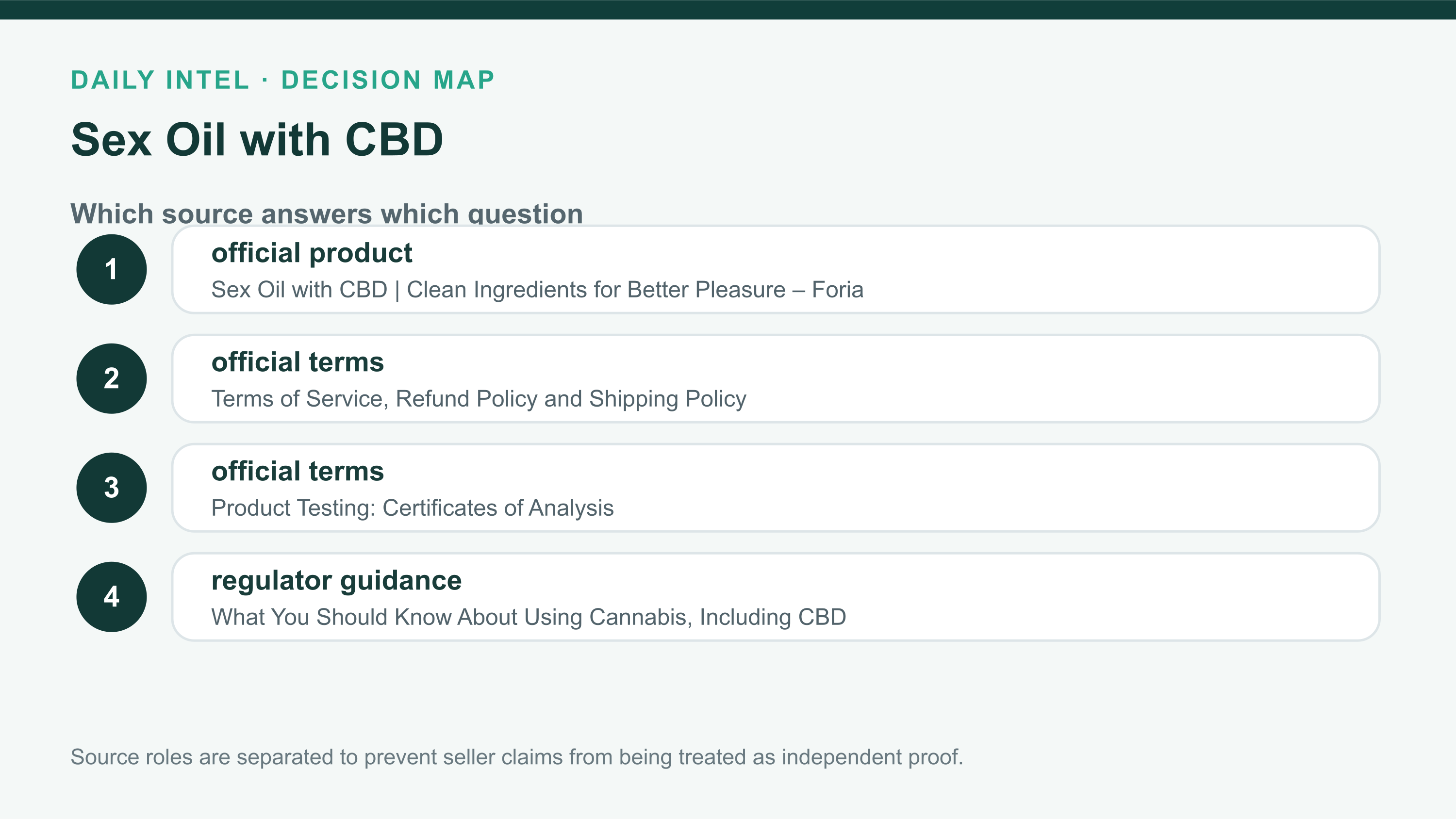
- Foria — Sex Oil with CBD official product page. This source establishes the commercial identity, SKU, 56 mL size, seller-stated ingredients, 400 mg bottle-total specification, pack choices, cautions, compatibility instructions, and manufacturer claims. It does not independently prove efficacy, universal tolerance, or typical results.
Evidence Card 2: Commercial terms
- Foria — Terms of Service, Refund Policy and Shipping Policy. This source supports the 30-day contact window, eligibility-dependent remedies, nonrefundable shipping, damage-claim deadline, shipping conditions, and estimated transit times. Those commercial terms do not demonstrate product safety or effectiveness.
Evidence Card 3: Batch-testing documentation
- Foria — Product Testing: Certificates of Analysis. This page lists ISO004_019 and ISO004_018R for Intimacy Sex Oil with CBD. The packet confirms the links but does not supply the underlying results for the buyer’s bottle. A matching COA could address reported batch potency or contaminants, not clinical outcomes.
Evidence Card 4: Regulator safety boundary
- US Food and Drug Administration — What You Should Know About Using Cannabis, Including CBD. This regulator source establishes the CBD approval boundary and broader concerns involving dosage, interactions, liver injury, extreme sleepiness, pregnancy, and breastfeeding. It does not quantify the risk from this exact topical formula or replace individualized advice.
Evidence Card 5: Related study and transfer limits
- PubMed — Efficacy and Safety of Topical 5% Cannabidiol Plus Myrcene for the Treatment of Vestibulodynia. This primary-study record describes a randomized, double-blind trial involving 40 women over 60 days. Its 5% CBD-and-myrcene gel, diagnosed population, application protocol, and outcomes differ from Foria Sex Oil with CBD, so its findings cannot establish finished-product performance.
Final Take: What Would Change the Verdict
The present verdict is conditional; what would change the verdict is stronger finished-product evidence or clearer offer documentation. Sex Oil with CBD has a coherent role as an oil-based intimacy product, a concise seller-stated formula, and clear compatibility cautions. The packet does not contain finished-product clinical evidence for the broader CBD-related claims involving tension, sensitivity, comfort, or health outcomes.
The product may still fit an adult whose primary goal is added glide, whose barriers and other materials are oil-compatible, who has no coconut allergy, and whose evidence standard does not require a clinical trial of the finished formula. CBD should be treated as a documented formulation feature with unresolved product-specific outcomes, not as proof that the product will work in a particular way.
A controlled trial of the current ISO004 formula would materially improve the evidence. It would need a defined per-use amount, a corresponding CBD dose, an appropriate comparator, outcomes tied to the promoted claims, participant and duration details, and adverse-event reporting. A readable COA matched to the purchased bottle would separately strengthen batch-level potency and contaminant documentation.
Clearer checkout documentation would also help. Each pack should map visibly to its current total price, shipping charge, payment frequency, and refund eligibility. Official wording should resolve the $28.80 versus $36 price display, the $85-or-more versus over-$85 shipping threshold, and the conflict between “vagina-friendly pH” and the FAQ statement that an oil has no pH value.
The verdict would worsen if recurring charges appeared without clear consent, relevant batch documentation disappeared, the formula changed without clear notice, or new evidence identified a material safety or compatibility concern.
Until stronger evidence arrives, the narrow conclusion stands: consider Sex Oil with CBD as a coconut-oil-based lubricant containing seller-reported CBD, not as a clinically demonstrated treatment or a guaranteed route to comfort, sensitivity, or pleasure.
This article is for informational and educational purposes only. It is not medical advice. Daily Intel is independent and may earn an affiliate commission. Foria did not write, review, or control this article.
Comments(0)
No comments yet. Members, start the conversation below.
Related reads
 reviews
ARMRA Colostrum Review: Evidence, Dose Gaps, Price, and Verdict
ARMRA’s 120-serving colostrum powder comes with notable manufacturer-reported survey percentages. However, the undisclosed amount per serving and a materially different ingredient trial leave the finished product’s highlighted outcomes unproven.
Read reviews
Olly Goodbye Stress Review: Label Claims vs. Evidence
OLLY Goodbye Stress combines GABA, L-theanine, and lemon balm extract in a Berry Verbena gummy aimed at occasional stress, not sleep. Here's what the label discloses, what a real L-theanine trial found, and exactly where the evidence stops.
Read reviews
Kaged Pre-Kaged Sport Review: Does the Citrulline Study Fit?
Kaged Pre-Kaged Sport provides 3.5 grams of fermented L-citrulline in each 13-gram scoop. The supplied trial tested a higher dose of isolated L-citrulline and found no performance benefit, so it cannot prove whether this finished formula works.
Read