Sign Up to Drive Review: What the Numbers Cannot Prove
Sign Up to Drive provides an official path to apply to drive with Uber, but the supplied evidence does not establish representative take-home earnings. Eligibility, local requirements, vehicle costs, insurance responsibilities, and time determine whether the opportunity fits.
8,226+
Videos & Ads
+50-100
Fresh Daily
$29.90
Per Month
Full Access
12.5 TB database · 72+ niches · 24 min read
Sign Up to Drive is worth investigating only if you can verify three things before depending on it: local eligibility, the applicable costs of using a vehicle for rideshare work, and a plausible net return for the time you can commit. The supplied evidence confirms an official Uber signup path and documents important parts of the operating model. It does not establish representative take-home earnings, approval odds, local demand, or a guaranteed amount of work.
That makes this a conditional opportunity rather than an evidence-backed income forecast. Scheduling discretion may be useful. It is not proof of financial fit. The decisive figure is net earnings: the amount left after applicable expenses. The packet contains no standardized net figure and no independent outcome evidence showing what a typical applicant should expect.
The verdict becomes more favorable for a particular reader only after that person confirms current local requirements, insurance responsibilities, vehicle compatibility, relevant expenses, and results from a bounded test. Until then, signup should be treated as the beginning of due diligence, not proof that the economics work.
The Decision Sign Up to Drive Has to Earn
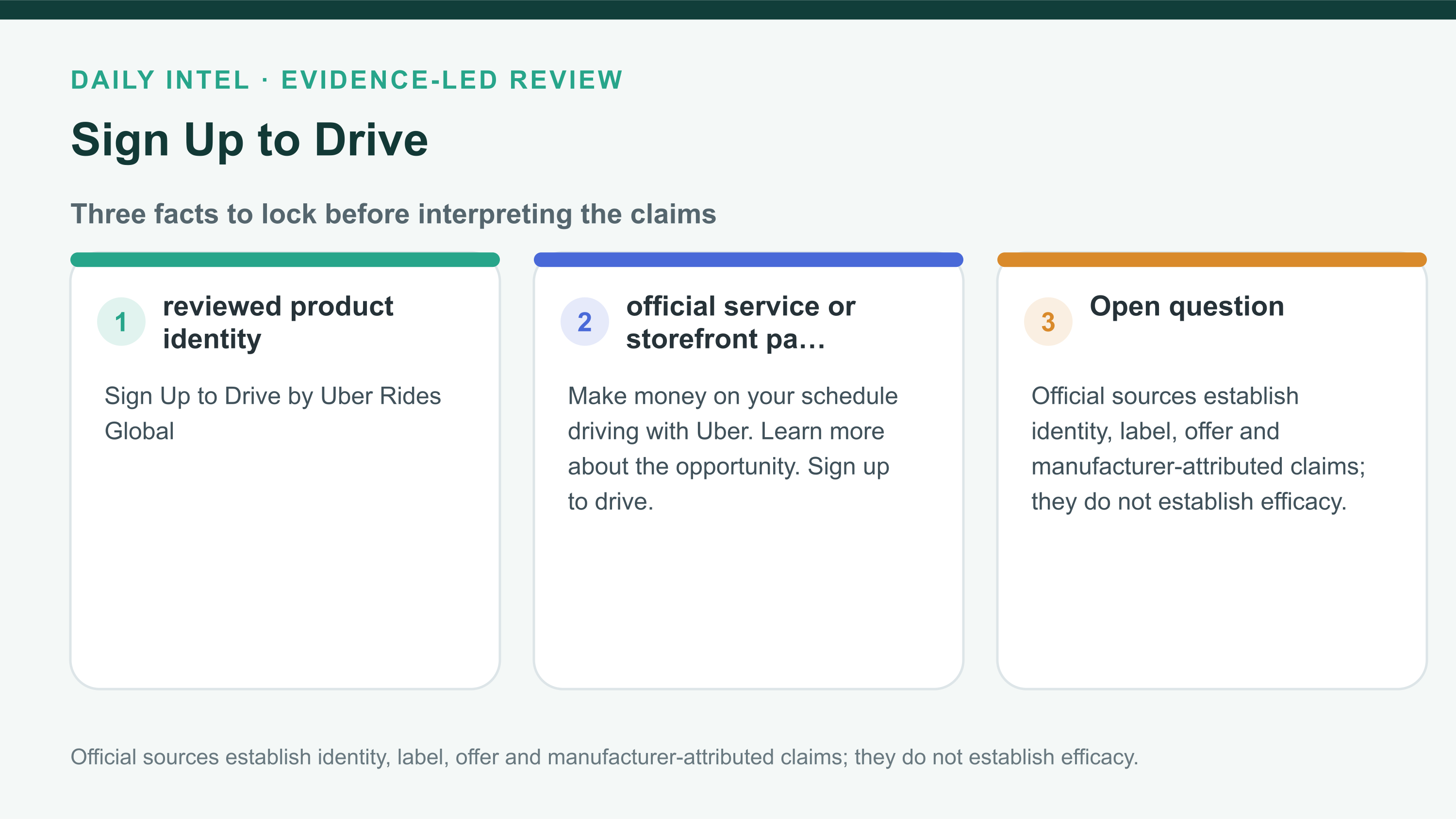
The strongest verified conclusion is narrow. Uber Rides Global operates an official Sign Up to Drive path for people interested in driving through Uber. Uber says drivers decide when and how often they drive. Its supporting materials describe eligibility, documents, screening, app access, fares, promotions, tips, insurance, and support.
Those facts explain what the opportunity is. They do not answer whether it is financially worthwhile for one applicant.
The largest uncertainty is the distance between gross earnings and take-home profit. Gross earnings are recorded before relevant expenses. Take-home profit is what remains after applicable costs. Uber's supplied earnings material says results vary with factors including location, time, trip volume, fares, promotions, and tips. The same evidence recognizes that vehicle and operating costs remain relevant. It provides no representative local calculation that joins those variables.
That gap matters because a driver supplies more than labor. Participation depends on an eligible vehicle, current documentation, insurance, screening, time, and continued maintenance. The packet also refers to expected wait times in the app, but it provides no representative measure of waiting or other time surrounding completed trips. Treating unmeasured time or costs as zero would make a forecast look more certain than the evidence permits.
The supplied Federal Trade Commission policy context supports examining earnings claims alongside material costs and conditions. It does not establish whether driving with Uber is profitable. It explains why an invitation to make money cannot substitute for a complete economic picture.
Our decision is therefore evidence-dependent. Investigate if scheduling discretion has real value to you and you can tolerate uncertain demand and operating costs. Keep looking if you need a fixed earnings amount or a result established before you begin.
What the Uber Rides Global Page Actually Offers
The exact reviewed service is Sign Up to Drive by Uber Rides Global. The official destination presents an opportunity to learn about driving with Uber and begin signup. The supplied evidence does not describe it as a physical product, vehicle purchase, training course, investment, guaranteed job placement, or promise of employment.
The fulfillment path is digital and operational. An interested person begins the signup process, supplies information about themselves and the vehicle, shares required documents, completes screening, obtains the Driver app, and may go online after joining the platform. The evidence does not establish that every application becomes an active account.
The reviewed page says drivers can fit driving around what matters to them. It also says support can be reached online or through the app. Those are Uber's statements. The packet does not contain independent measurements of scheduling freedom, support response times, resolution rates, or suitable-trip availability at a chosen time.
The service path also has meaningful exclusions. No fixed wage appears in the packet. No guaranteed trip volume, approval timeline, minimum number of hours, representative net-income figure, or individual demand forecast is supplied. There is no documented physical shipment, so ordinary shipping and physical-return questions do not apply. Account review, platform access, and continued eligibility are the relevant forms of fulfillment.
The captured landing-page record contains a malformed canonical address ending in /undefined, while the requested and final destination was the normal official offer page. That artifact does not establish a service defect. It does mean the malformed canonical value should not be used as the identified destination.
The affiliate record is a separate evidence layer. It shows an active commercial contract permitting content and using a cost-per-action model. Cost per action means the publisher may be paid after a qualifying action. That commercial arrangement is not evidence about applicant approval, driver earnings, service quality, or suitability.
Requirements and Signup Process: From First Click to an Active Driver Account
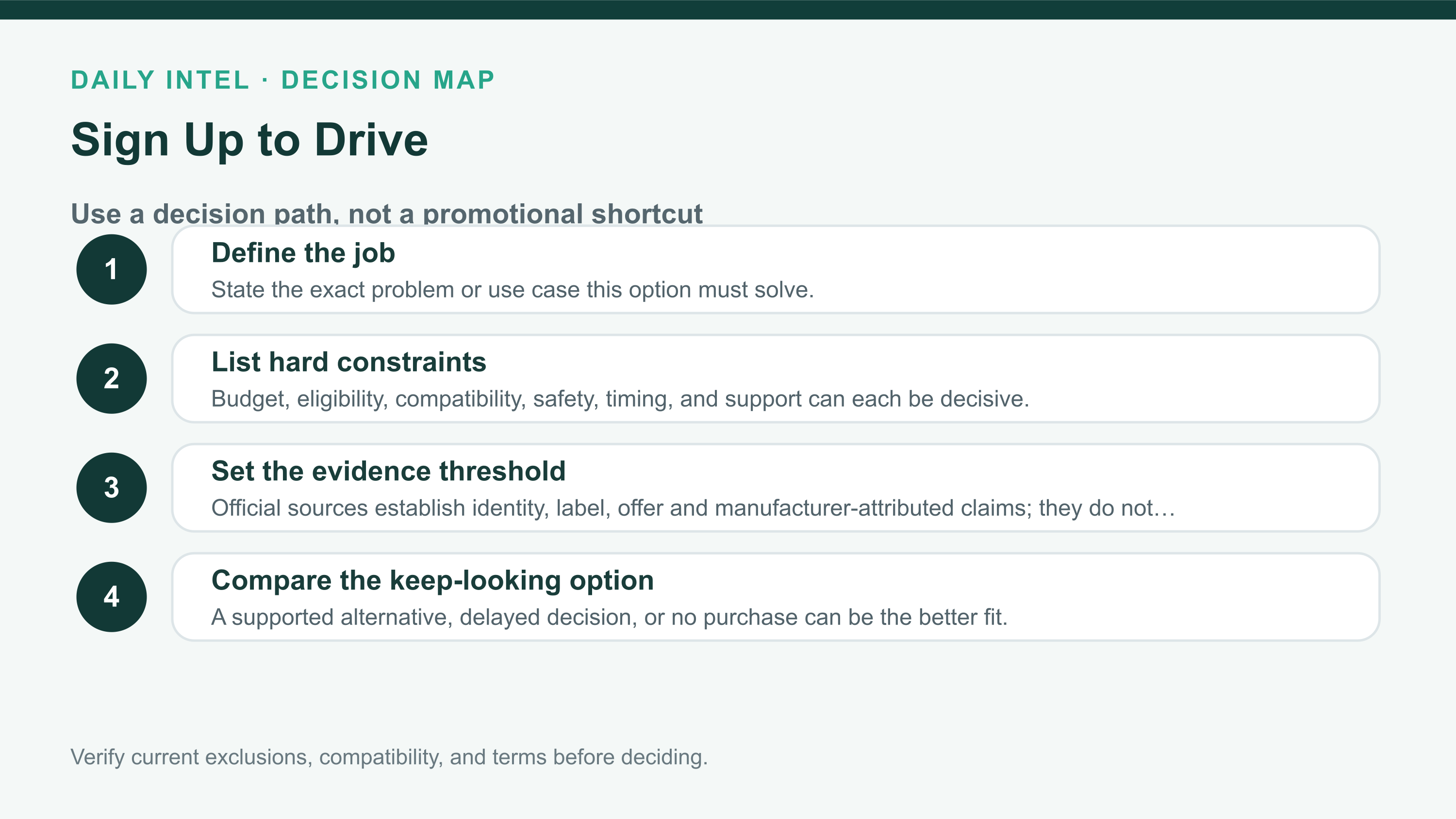
The signup journey has several gates. Passing one does not prove the next.
1. Review the applicable local requirements. Uber's captured requirements page says applicants must meet the minimum driving age in their city and states that new drivers must be at least 23 years old. It also lists at least one year of licensed driving experience in the United States, or three years for someone under 25, plus an eligible four-door vehicle. The page warns that its material may not apply in every country, region, or city and may change without notice. Current local requirements therefore control over a general summary.
2. Check document readiness. The page lists a valid US driver's license, proof of residency in the applicable city, state, or province, proof of vehicle insurance when using one's own car, a passing vehicle-inspection form, and a driver profile photo. Its process summary also refers to vehicle registration. Having the listed materials does not establish approval.
3. Complete screening. Uber says the online screening reviews driving records and criminal history. The packet does not provide the applicable approval standards, processing times, exception procedures, appeal process, or an applicant's probability of passing.
4. Confirm vehicle compatibility. An eligible four-door vehicle is a stated minimum, but Uber also says vehicle requirements vary by region. A car's ordinary road use does not prove platform eligibility. The packet establishes the need to check the applicable vehicle rules, inspection, registration, and insurance documents. It does not provide every local standard.
5. Obtain platform access. Uber describes the next step as getting the app and going online after joining the platform. That confirms an app-mediated workflow. It does not establish that suitable trips will be available whenever a driver logs in.
6. Observe earnings and costs. Uber says a driver can track earnings in the app. Its earnings material discusses fares, tips, promotions, busy-area information, wait-time estimates, and scheduled trips. Those tools can document activity. They cannot establish profit without reconciling relevant expenses and time.
7. Decide whether to continue. The packet does not supply a formal account-cancellation or exit policy. Going offline and ending every related obligation are not proven to be the same event. A personal insurance change, vehicle rental, or other separate arrangement would have its own terms, which must be read rather than inferred.
This sequence matters because signup, document submission, screening, account access, completed trips, gross earnings, and profit are different states. Evidence of one is not proof of all the others.
Earnings Claims Need a Net-Income Stress Test
Uber's offer uses the proposition of making money on one's own schedule. That describes intended utility. It is not a quantified forecast.
The supplied earnings page identifies several components. Fares are attached to trips under applicable rules. Tips may add to earnings. Surge can add earnings to qualifying trips in designated areas while it is available. Quest promotions may reward completion of a specified number of trips within a stated period. Boost+ may add to base fares for trips starting in an eligible area during a specific window. Uber says drivers can check available opportunities in the app and that some offers are occasional.
Each component creates a checkable question rather than a guaranteed value. Are qualifying trips available in the intended area? Is a promotion offered to the particular driver? What conditions apply? How much of the recorded revenue remains after relevant costs? The packet provides no representative answer.
A useful feasibility worksheet should keep four categories separate:
- Recorded revenue from fares, promotions, and tips.
- Verified vehicle and operating expenses applicable to the individual situation.
- Total time devoted to the work, including any relevant waiting and administrative time.
- Responsibilities connected with insurance, documents, inspection, maintenance, and vehicle access.
The evidence confirms that maintenance remains the driver's responsibility and that vehicle and operating costs matter. It does not provide a complete, standardized expense schedule. This review therefore cannot publish a universal cost total. Each applicant must identify the categories and figures that apply to the intended vehicle and location.
The same discipline applies to time. A fare can document revenue from a completed trip, but the packet does not establish how much time surrounds that trip. A responsible test records the full period committed rather than counting only the most visible activity.
The supplied FTC policy statement says gig-work companies must not make deceptive earnings claims or conceal material costs and terms. The supplied FTC policy statement frames earnings claims, material costs, terms, and worker choice as disclosure issues. It does not provide an Uber-specific earnings number or establish typical take-home income.
A completed trip proves that a trip occurred. A gross total proves that amount was recorded for the period. Profit requires reconciliation against verified expenses. Sustainable fit requires observing whether an acceptable result can be repeated under conditions the driver is willing to accept.
The Proof Ladder: What Is Verified and What Remains Inferred
claim versus evidence boundary: The evidence is strongest when it remains close to the retrieved operational facts. Official pages can establish Uber's published terms and claims; they cannot establish applicant outcomes without outcome evidence.
Verified identity and path: The packet retrieved the official Sign Up to Drive page and identifies Uber Rides Global as the reviewed brand. The destination invites people to learn about the opportunity and sign up.
Verified official requirements: Uber's requirements page lists broad minimums, required documents, screening, and an onboarding outline. These are official terms. They are not independent evidence of approval rates or applicant experience.
Verified earnings variables: Uber's earnings material discusses fares, tips, promotions, demand tools, earnings tracking, and expenses. This explains components of the model but does not establish a typical net result.
Verified insurance framework: Uber describes different coverage depending on whether a driver is offline, online and available, en route, or on a trip. This establishes that operating status matters. It does not prove that every loss will be covered or that every personal policy is compatible.
Seller-attributed support claim: Uber says questions can be addressed online or in the app at any time. The packet contains no independent response-time, resolution-rate, or support-quality evidence.
Government context: The FTC source provides a policy framework for examining gig-work earnings claims, material costs, terms, and worker choice. It is not an evaluation of this signup path and does not predict an individual's outcome.
Not verified are representative take-home earnings, local demand, approval probability, support effectiveness, applicant satisfaction, long-term vehicle impact, or the economic result for an individual driver. The packet contains no independent driver cohort, verified case study, testimonial evidence, or customer-rating dataset. None should be implied.
Vehicle, Insurance, and Support Friction
The main ownership friction is not maintenance after buying a product. It is the continuing coordination of a vehicle, insurance, documents, platform status, and time.
real commitment: For this decision, the evidence supports separate checks for sign-up setup, vehicle compatibility, insurance, maintenance, support, and any separate vehicle arrangement. It does not establish a particular driver's setup time, switching cost, support outcome, or long-term vehicle durability.
Vehicle compatibility starts with the official requirement for an eligible four-door vehicle. It does not end there because Uber says vehicle requirements vary by region. A prospective driver should confirm the applicable rules before treating a vehicle as suitable for the platform. Required documentation and a passing inspection are separate checks.
Maintenance remains the driver's responsibility. Uber's insurance page explicitly says the insurance it maintains does not cover regular car maintenance. A vehicle can meet an eligibility rule while still creating upkeep costs that reduce net income.
Insurance also changes with operating status. Uber says personal auto insurance covers the driver while offline. The driver must maintain personal automobile insurance at mandatory minimum limits and provide proof of coverage when driving a vehicle with Uber. Uber describes commercial insurance maintained for qualifying rideshare activity, but applicable coverage depends on factors including fault, app status, the personal policy, state rules, limits, and deductibles.
Uber says coverage to repair the driver's vehicle while en route or on a trip is contingent on the personal policy including comprehensive and collision coverage. In general terms, comprehensive and collision are types of vehicle-damage coverage, but the actual policy language controls.
Uber also says uninsured or underinsured motorist coverage varies by state and is not maintained for rideshare in every state. It points drivers to state-specific Certificates of Insurance. Commercially licensed drivers must have their own commercial auto insurance. Comprehensive and collision coverage on vehicles rented through the Vehicle Marketplace may be subject to a $1,000 deductible.
These facts do not prove what would happen in a particular incident. They show why a general statement that insurance exists is not enough. The applicable state certificate and personal policy must be compared with the intended activity.
Support is an official channel, but channel availability is not verified service performance. The packet does not state response times, escalation procedures, resolution rates, or remedies for delayed screening or an account dispute. Readers should not rely on an unmeasured support outcome to replace review of material terms.
Price, Commitment, Exit Terms, and the Missing Fine Print
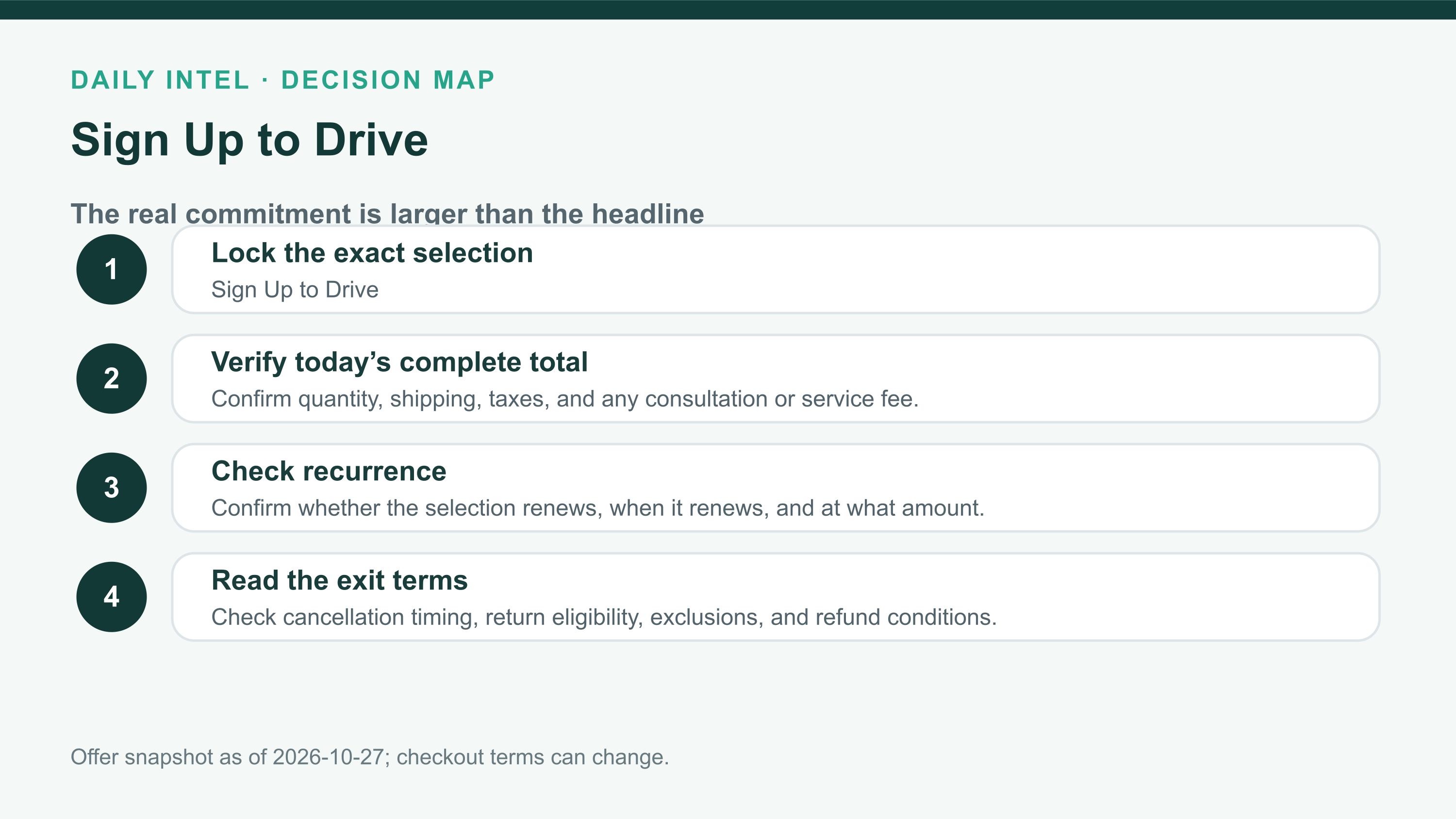
exact offer snapshot: As of October 27, 2026, the supplied consumer evidence does not state a signup price, subscription charge, automatic renewal fee, consultation requirement, satisfaction guarantee, or applicant refund process. It also does not describe a shipped product, so shipping charges and physical-product returns are not part of the documented offer.
Those absences must remain absences. They do not justify advertising the service as free, risk-free, commitment-free, or refundable. The packet may not contain every term presented during a live application. Applicants should inspect the current terms before supplying personal information or entering a vehicle, insurance, or rental arrangement.
The practical commitment can extend beyond a platform charge. It includes the intended use of a vehicle, time spent applying and driving, document and inspection responsibilities, insurance decisions, and maintenance. The packet recognizes operating expenses but does not supply a complete cost schedule. This review therefore cannot calculate a universal startup cost or break-even point.
Exit is underdocumented. The evidence does not provide an account-closure process or explain how ending platform activity interacts with any separate vehicle or insurance arrangement. No answer should be invented. Each separate agreement must be reviewed under its own terms.
Daily Intel's publisher record shows an active affiliate contract with content permission. It uses a cost-per-action arrangement with a captured publisher amount of $80 USD. That is publisher compensation. It is not a signup price, driver bonus, wage, fare, earnings forecast, or evidence of applicant value.
The affiliate link was captured on October 21, 2026, but was deliberately not opened. Its tracking redirect therefore remains unverified. Promotional-image rights are also unverified. These are Daily Intel publication controls. They are not evidence of a defect in Uber's service, but they must be resolved before the commercial placement is treated as fully verified.
Commission disclosure: Daily Intel may earn a commission if a reader takes a qualifying action through the offer panel placed after this section. That relationship does not change our evidence standards or conclusions. Confirm the destination and current terms before submitting information.
Who This Opportunity Fits—and Who Should Keep Looking
Sign Up to Drive may fit a US reader who values scheduling discretion, meets the applicable requirements, has a workable vehicle arrangement, understands the current insurance framework, and can evaluate uncertain results without relying on a promised income figure.
It is better suited to someone willing to run a controlled test than someone who must know the result in advance. A controlled test has a defined period, complete revenue, expense, and time records, a minimum acceptable result, and a stop condition. The packet does not prescribe those values. They must reflect the reader's needs and constraints.
The opportunity is a weaker fit for someone who needs fixed pay, guaranteed hours, predictable local demand, or independently demonstrated take-home income before beginning. It may also be unsuitable when the available vehicle does not qualify, the insurance responsibilities are unacceptable, or vehicle maintenance conflicts with the owner's priorities.
Evidence tolerance matters. Some readers may accept official operational terms and learn through a limited test. Others may require representative local outcomes, clearer exit terms, or independently measured support performance. The mistake would be treating a willingness to proceed with incomplete evidence as proof the packet does not contain.
Investigating, deferring, and declining are all defensible outcomes. Signup is not the only rational response to a flexible-work proposition.
The Closest Supported Alternatives Change the Verdict
The packet supports two adjacent alternatives. It does not support a broad competitor ranking.
The first is delivery through services such as Uber Eats. Uber's requirements page says people 19 years of age and older may qualify for delivery services. That may make delivery the more relevant path for someone who does not meet the captured rideshare age requirement. The packet does not provide delivery vehicle rules, earnings, insurance details, or net economics, so it cannot establish that delivery is more profitable or easier.
The second is a vehicle-rental option available through Uber's partner marketplace. This may be relevant when a person lacks an eligible vehicle. It does not remove the economic question. Uber's insurance evidence says comprehensive and collision coverage on marketplace rental vehicles may carry a $1,000 deductible. The packet does not provide rental rates, availability, contract length, maintenance allocation, or total cost. Renting becomes a defensible option only if current verified terms fit the applicant's needs and economics.
No supplied source supports a fair comparison with another rideshare platform or a fixed-pay employer. Ranking either as superior would require current like-for-like evidence on eligibility, earnings, costs, insurance, control, and exit terms.
The VSL Strategy We Would Test for Sign Up to Drive
This is Daily Intel's original strategy for an evidence-led video sales letter, or VSL. A VSL is a sales presentation delivered in video form. This worked execution is not an Uber Rides Global advertisement. We are not claiming Uber created, approved, or ran it.
Hook
“Make money on your schedule” describes an appealing possibility. It does not say what remains after vehicle costs, insurance responsibilities, maintenance, time, and other applicable expenses are counted.
That is the decision the VSL would put first. The official signup path is verified. The applicant's earnings outcome is not. Before flexible driving becomes an income plan, the top-line proposition must survive a net-income check.
The largest unknown is not whether a completed trip can generate a fare. It is whether the complete local result meets the driver's minimum standard after applicable costs and all committed time. The opening would acknowledge that uncertainty rather than postponing it until after signup.
Lead
Uber describes a recognizable app-based path: review the opportunity, provide information and documents, complete screening, gain platform access if accepted, and go online. That path may appeal to someone who values scheduling discretion.
It is not automatic. The applicant must satisfy applicable requirements, provide the required documents, maintain a workable vehicle situation, understand insurance responsibilities, and decide whether the economics justify continuing.
The lead would establish the verified facts as of October 27, 2026. Uber has an official signup destination. Its requirements page identifies age, driving experience, an eligible four-door vehicle, documents, inspection, and screening. Its earnings page discusses fares, promotions, tips, demand tools, and expenses. Its insurance page explains that coverage changes with operating status and personal-policy conditions.
It would then state the boundary: none of those pages provides a representative take-home result for the individual watching.
Mechanism and Intended Utility
The intended utility is scheduling discretion within a platform-mediated workflow. An accepted driver can choose when to go online and consider trip requests under the platform's current operation. Earnings may include fares, tips, and eligible promotions. The app can display earnings and information about busy areas, wait-time estimates, and available opportunities.
Software organizes parts of the workflow. It does not replace the driver's labor or the physical requirements behind each trip. That operating system includes the person, vehicle, documents, insurance, maintenance, and time. Promotions may be occasional. Demand can differ by location and time. Vehicle expenses remain relevant even when they are not displayed next to a fare.
The mechanism section would therefore show two records. The first tracks platform revenue. The second tracks verified expenses and all relevant time. Only the reconciled result answers the fit question.
Labeled Hypothetical Decision Path
Imagine Casey wants to drive on selected evenings. This is a hypothetical decision path, not a reported Uber driver experience.
Casey first checks the current rules for the intended city. A generally usable four-door car is not assumed to qualify. Casey verifies the applicable vehicle, age, and driving-experience requirements. Casey then gathers the listed license, residency, registration, insurance, inspection, and profile-photo materials and reviews what the screening covers.
Next, Casey creates a worksheet before entering a hoped-for earnings target. Revenue has separate lines for fares, tips, and promotions. Time includes the full period committed to the test. Costs include only categories Casey can verify for the actual vehicle and location. Unknown figures remain unknown rather than becoming zero.
Casey also reviews the relevant state insurance certificate and compares it with the personal policy. The distinctions between offline, available, en route, and on-trip status are recorded. If the coverage responsibilities or deductible exposure are unacceptable, Casey stops before relying on the opportunity.
If accepted onto the platform, Casey runs a limited test. The stop condition is defined in advance. A completed application is not counted as success. An active account is not counted as success. Gross revenue is not the final measure. Casey continues only if the reconciled result clears the chosen standard without relying on an unverified assumption.
The story demonstrates a process. It does not predict an outcome.
Proof
The proof sequence would begin with the official offer because it establishes identity and the signup path. It would then use the requirements page for operational gates, the earnings page for revenue variables, and the insurance page for status-dependent responsibilities. The FTC policy statement would explain why material costs and terms belong next to an earnings proposition.
Each source would retain its boundary. Official pages establish what Uber publishes. They do not independently prove approval odds, support quality, local demand, or typical profit. The FTC source supplies a government policy framework. It does not determine what a specific driver will earn.
No testimonial montage would be used because the packet contains no verified driver cases. No app screen would be presented as proof of repeatable profit. No broad gig-work evidence would be converted into an individual forecast. The absence of those devices is part of the strategy's evidence discipline.
Objections and Fit
This objection-and-fit step tests whether scheduling discretion answers the reader's actual need; it does not add evidence of dependable income.
“If the schedule is flexible, why analyze it this deeply?” Because scheduling discretion and profitability answer different questions. A convenient schedule can still produce an insufficient net result.
“What if I want to drive only a few hours?” A smaller commitment may limit exposure, but the packet supplies no profitable minimum schedule. All time associated with the test still belongs in the evaluation.
“What if my car is already insured?” Personal insurance is required, but Uber says coverage varies with operating status, state rules, fault, personal-policy terms, limits, and deductibles. Existing insurance should be compared with the intended rideshare use.
“Can support resolve the details later?” Uber says support is available online and in the app. The packet does not measure response or resolution quality. Material eligibility, insurance, and cost questions should be investigated before reliance on the platform.
“What if I need dependable weekly income?” This evidence does not establish it. A person who requires a fixed amount should not convert a flexible earnings opportunity into an implied guarantee.
“Is signup the only commitment?” No. The operating decision includes vehicle use, time, documentation, insurance responsibilities, maintenance, and any separate vehicle arrangement. The applicable terms for each component must be checked.
Offer Logic
The offer would be described without false urgency. As of the evidence date, a reader can review an official path to apply to drive with Uber. The supplied consumer evidence does not state a signup charge, subscription, renewal fee, satisfaction guarantee, or applicant refund process. It also does not establish that there are no costs or obligations.
The publisher's cost-per-action compensation would be disclosed because the commercial relationship should be visible. It would be explicitly separated from driver economics. The captured $80 publisher amount is not money promised to an applicant.
The tracking redirect and promotional-image rights would remain publication gates. A commercial placement should not be described as fully verified merely because a link was captured in an authenticated publisher interface.
CTA
The close would invite only potentially suitable readers to inspect the current signup path and terms. It would ask them to proceed only if they can verify local eligibility, understand the insurance and vehicle responsibilities, and measure net results against a predetermined stop condition.
It would preserve the other choices. Investigate further if key facts are missing. Defer if the timing or vehicle situation is unsuitable. Decline if fixed earnings are required or the operating uncertainty is unacceptable.
That is the VSL strategy Daily Intel would test: a concrete decision, a plain-language mechanism, a bounded proof ladder, direct objections, transparent offer logic, and a reversible next step. Its objective would be informed qualification, not an unsupported earnings promise.
Frequently Asked Questions
Q: Is Sign Up to Drive legitimate?
A: The packet verifies an official Uber signup page and official pages addressing driver requirements, earnings, and insurance. That establishes a genuine service path. It does not guarantee approval, available trips, a particular income, or profitability for an individual driver.
Q: How much does Sign Up to Drive cost?
A: The supplied consumer evidence does not state a signup price, subscription charge, or automatic renewal fee. That absence does not prove participation has no costs. Vehicle operation, maintenance, insurance responsibilities, and any separately agreed vehicle arrangement can affect the economics.
Q: What are the requirements to drive with Uber?
A: Uber's captured requirements page lists a valid US driver's license, residency documentation, an eligible four-door vehicle, applicable insurance, an inspection form, a profile photo, and screening. It also gives age and driving-experience thresholds while warning that requirements can vary by location.
Q: Does Uber guarantee driver earnings?
A: No guaranteed earnings amount is established in the evidence packet. Uber discusses fares, promotions, tips, demand indicators, and earnings tracking. Those inputs do not establish representative take-home income after expenses or the result a particular driver will receive.
Q: Does Uber provide insurance for drivers?
A: Uber says it maintains commercial insurance for qualifying rideshare activity, but coverage depends on factors including driver status, location, fault, and the personal policy. Offline driving relies on personal insurance, and certain vehicle-repair coverage can depend on personal comprehensive and collision coverage.
Q: What are the closest supported alternatives?
A: The supplied evidence supports two adjacent paths: qualifying for delivery services such as Uber Eats or exploring vehicle-rental options available to Uber partners. The packet does not provide enough evidence for a fair comparison with competing rideshare platforms or fixed-pay jobs.
Final Take: What Would Change the Verdict
Our final view is conditional. Sign Up to Drive is a verified application path with documented requirement categories and an understandable operating model. This packet does not support calling it a dependable or generally profitable income option.
The conclusion would become more favorable if current evidence supplied representative local net outcomes with a clear method that accounted for complete applicable costs and relevant time. Verified application timelines, approval denominators, support-performance measures, and clearer account-exit terms would also reduce uncertainty. For an individual reader, a reconciled limited test could provide personal decision evidence that a general review cannot.
The conclusion would become less favorable if current local requirements exclude the applicant or vehicle, the insurance responsibilities are unacceptable, applicable costs erase the value of gross earnings, or the available hours do not produce an acceptable net result. Those conditions can be checked.
The standard is not whether the proposition sounds flexible. It is whether current local facts survive a complete eligibility, cost, time, and risk review. Until that happens, the evidence supports investigation, not reliance.
Sources and Evidence Notes
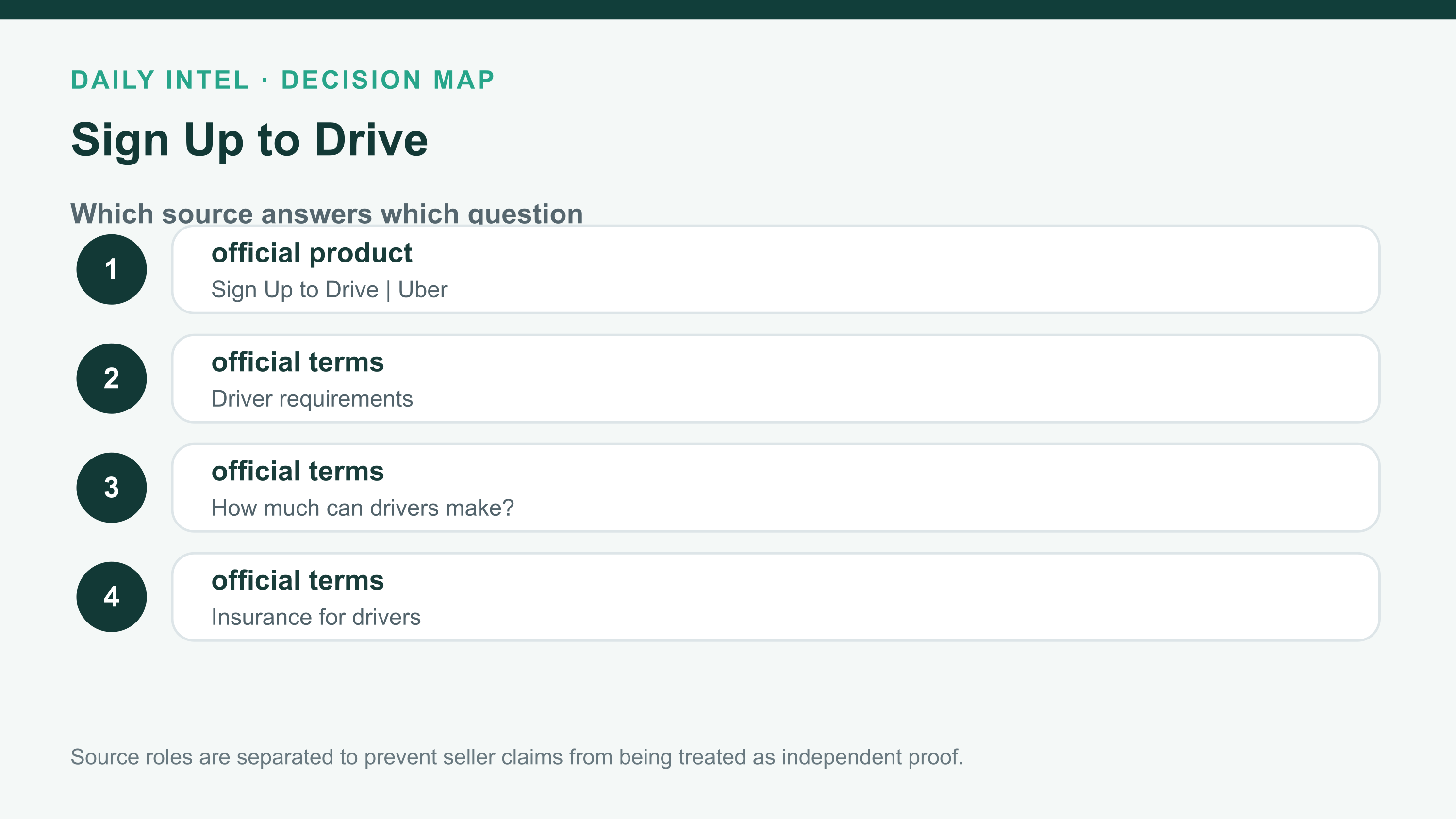
Evidence card: Sign Up to Drive | Uber. This official destination establishes the reviewed service's identity, the invitation to learn about the opportunity, and Uber's statement that support is available online or in the app. It does not establish approval, earnings, profitability, or independently measured support quality. Accessed October 20, 2026, and retrieved again in the supplied packet on October 27, 2026.
Evidence card: Uber driver requirements. This official terms page supplies the captured age, driving-experience, four-door-vehicle, document, inspection, and screening requirements. It also says requirements can vary and may change. It does not predict whether a particular application will be approved. Accessed October 27, 2026.
Evidence card: How much can drivers make?. This official earnings page identifies fares, tips, promotions, demand tools, earnings tracking, and expenses as relevant parts of the model. It helps define a feasibility check. It does not provide a representative take-home result for this review. Accessed October 27, 2026.
Evidence card: Insurance for drivers. This official page explains that insurance changes across offline, available, en-route, and on-trip phases. It also records personal-policy responsibilities, maintenance exclusions, state variation, and possible deductible exposure. It cannot determine coverage for an individual incident without the applicable policies and state-specific certificate. Accessed October 27, 2026.
Evidence card: FTC Policy Statement on Enforcement Related to Gig Work. This government source explains why gig-work earnings claims, material costs, terms, and worker choice require careful disclosure. It supplies policy context, not an Uber-specific outcome assessment or driver earnings estimate. Accessed October 27, 2026.
This article is for informational and educational purposes only. Daily Intel is independent and may earn an affiliate commission. Uber Rides Global did not write, review, or control this article.
Comments(0)
No comments yet. Members, start the conversation below.
Related reads
 reviews
ARMRA Colostrum Review: Evidence, Dose Gaps, Price, and Verdict
ARMRA’s 120-serving colostrum powder comes with notable manufacturer-reported survey percentages. However, the undisclosed amount per serving and a materially different ingredient trial leave the finished product’s highlighted outcomes unproven.
Read reviews
Olly Goodbye Stress Review: Label Claims vs. Evidence
OLLY Goodbye Stress combines GABA, L-theanine, and lemon balm extract in a Berry Verbena gummy aimed at occasional stress, not sleep. Here's what the label discloses, what a real L-theanine trial found, and exactly where the evidence stops.
Read reviews
Kaged Pre-Kaged Sport Review: Does the Citrulline Study Fit?
Kaged Pre-Kaged Sport provides 3.5 grams of fermented L-citrulline in each 13-gram scoop. The supplied trial tested a higher dose of isolated L-citrulline and found no performance benefit, so it cannot prove whether this finished formula works.
Read