Cognitive Dog Chews Review: What Happy Paws Shows, Claims, and Still Hasn't Proved
A source-led review of Happy Paws Cognitive Dog Chews covering price, servings, recurring terms, safety cautions, evidence gaps, and buyer fit.

8,226+
Videos & Ads
+50-100
Fresh Daily
$29.90
Per Month
Full Access
12.5 TB database · 72+ niches · 14 min read
Happy Paws’ captured offer is a 100-soft-chew cognitive supplement for dogs with a displayed $34.99 price and recurring-purchase language. The decisive gap is that the supplied packet contains no controlled study of this exact finished chew. Consider it cautiously only if the live terms, veterinary questions, and this evidence uncertainty fit the purchase standard; otherwise, keep looking.
Affiliate disclosure: Daily Intel may earn a commission if the reader buys through this link.
The decision in one minute
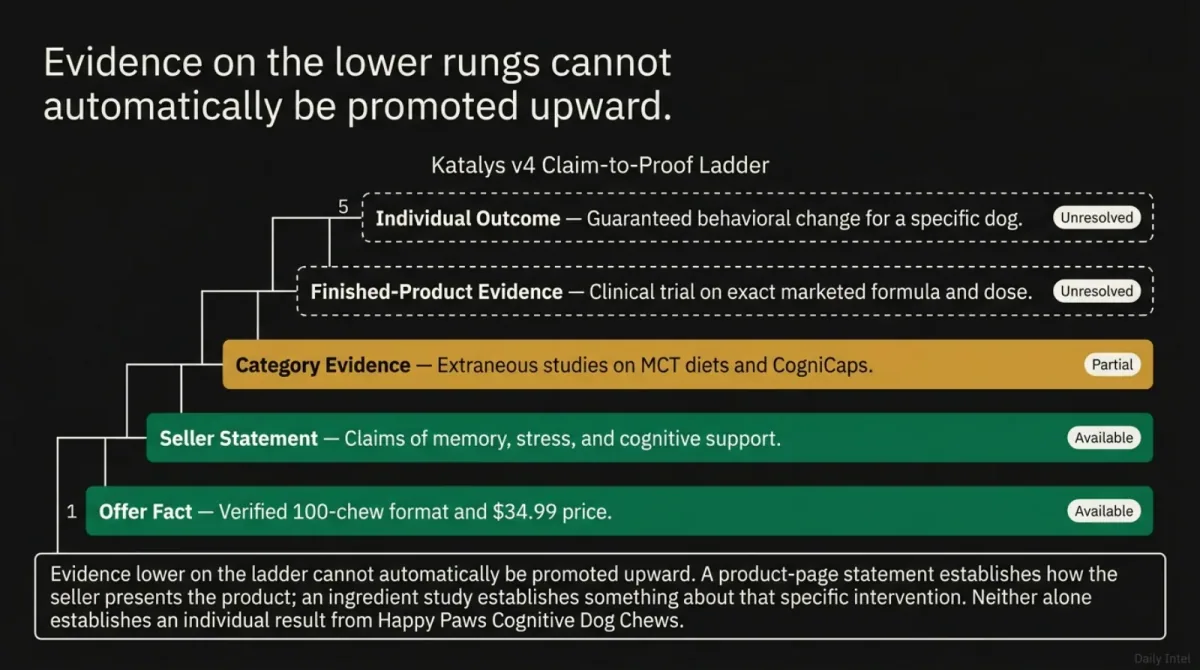
Reviewed Daily Intel teaching slide 1 of 3.
Verdict: the supplied packet identifies a 100-soft-chew Happy Paws offer with a captured $34.99 price and weight-based directions, but it does not establish that the finished product improves cognition, memory, focus, stress, or behavior. Do not treat seller claims, testimonials, or studies of other interventions as proof for this exact chew.
A buyer can only consider the offer cautiously when the soft-chew format and dated cost fit, live checkout terms are acceptable, relevant veterinary questions have been addressed, and the absence of finished-product evidence is acceptable. Keep looking if controlled research on the exact formula, a quantitative formula, or current lot documentation is a purchase requirement.
The largest uncertainty is product-specific proof. The seller describes cognitive, memory, stress, nervous-system, and brain-health support, but the commissioning packet contains no controlled clinical study of this exact Happy Paws formula. Studies of other diets or supplements cannot close that gap.
- Consider cautiously if format and cost fit, the veterinarian-facing questions below have satisfactory answers, and product-specific uncertainty is acceptable.
- Pause and seek veterinary guidance when a dog has concerning or worsening changes, is pregnant or intended for breeding, or takes medication that could create a suitability question.
- Keep looking if the purchase standard requires a quantitative formula, current lot documentation, and controlled research on the exact marketed chew.
This is an evidence audit, not a treatment recommendation. It does not establish that the chews improve memory, focus, stress, behavior, or cognition in an individual dog.
What the Happy Paws page actually offers
The captured official product page identifies the product as Happy Paws Cognitive Supplement for Dogs with Vitamin B and Taurine. The capture was collected on October 29, 2026, so every volatile offer detail needs another check immediately before publication or purchase.
The captured Happy Paws page listed the product at $34.99. The captured Happy Paws page says the pack contains 100 soft chews.
The same page provided weight-based directions:
| Dog's weight | Seller's daily direction | Approximate pack duration | Dated price per day* |
|---|---|---|---|
| Under 10 lb | 1 chew | 100 days | $0.35 |
| 10–30 lb | 2 chews | 50 days | $0.70 |
| 31–60 lb | 3 chews | About 33 days | $1.05 |
| 61–90 lb | 4 chews | 25 days | $1.40 |
| Over 90 lb | 5 chews | 20 days | $1.75 |
*Arithmetic based on the captured $34.99 price and seller directions, before tax or shipping. These calculations are not dosing advice.
The page says to store the product in a cool, dry place after opening. It also displays free shipping for orders of $99 or more. The separate shipping policy lists several delivery methods and describes delivery times as estimates. The return policy, not the shipping policy, says shipping charges are non-refundable.
What the packet does not safely establish is equally important. It does not provide a current checkout total, a complete quantitative active-ingredient panel, a current certificate of analysis, or current product-specific subscription cadence and cancellation steps.
Price, recurring charges, and refund conditions
The captured product page contains recurring-purchase language. That proves recurring billing was contemplated by the page; it does not establish which option is preselected, the renewal interval, the charge presented at a particular checkout, or the exact cancellation workflow a buyer would face today.
Before paying, record four fields from the live checkout:
- Whether the order is one-time or recurring.
- The amount and date of the first charge.
- The renewal amount and frequency.
- The exact cancellation method and deadline.
The supplied return policy describes a 60-day window measured from the order date and says shipping charges are non-refundable. The return policy says only unopened or minimally used items in original packaging may be refunded. Qualification of an opened product may therefore require a customer-service decision; the policy should not be summarized as an unconditional trial.
If those conditions fit your decision standard: view the official Happy Paws Cognitive Dog Chews offer. Recheck the selection, checkout total, renewal terms, shipping, and cancellation conditions before submitting an order.
What Happy Paws claims—and what each claim would need to prove
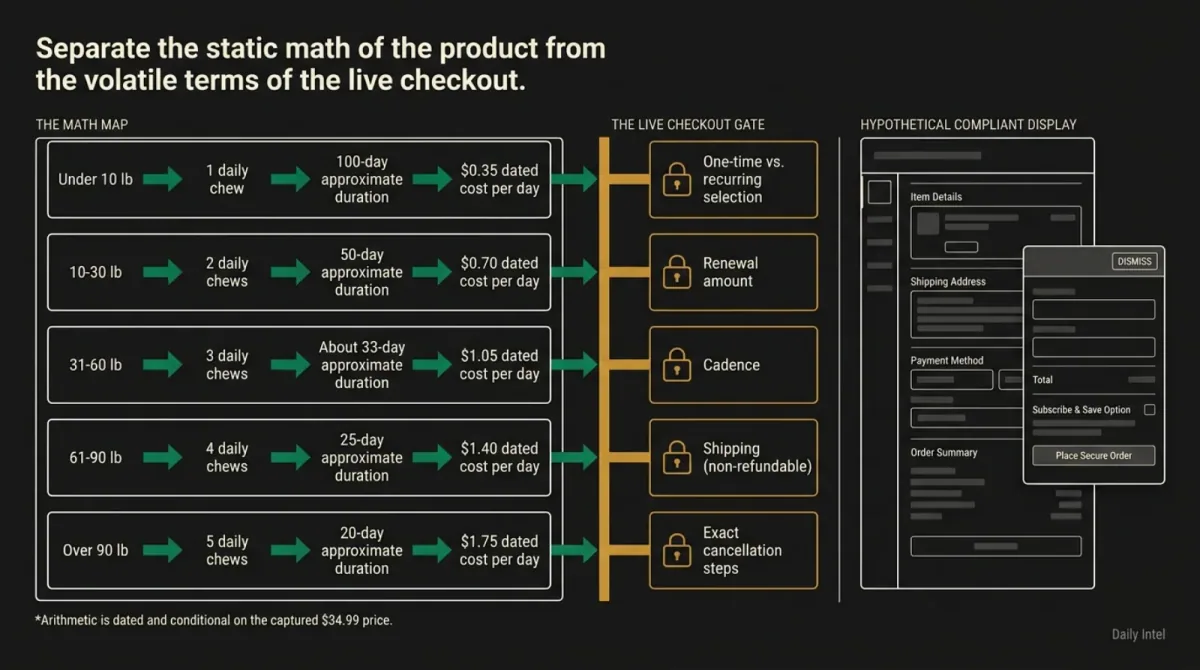
Reviewed Daily Intel teaching slide 2 of 3.
The official page markets the chews for cognitive or brain support and associates the formula with memory, stress, the nervous system, antioxidants, taurine, and several vitamins. It also displays customer-review summaries and makes manufacturing or quality statements.
Those are seller representations. They create research questions; they do not answer them.
| Seller-claim category | Evidence needed for a stronger conclusion | What this packet supplies |
|---|---|---|
| Memory, behavior, focus, or stress outcome | Controlled research on the exact formula, dose, target dogs, outcome measure, and follow-up period | No finished-product trial |
| Ingredient mechanism | Exact ingredient form and quantity, matched canine research, and a justified link to the marketed dose | Ingredient names and general promotional descriptions, but no adequate transfer analysis |
| Product purity or testing | Current report identifying the laboratory, lot, analytes, methods, specifications, and results | Seller statements, not a current lot report |
| Customer outcomes | Independently verifiable, systematically collected evidence with denominators and controls | On-page reviews and summaries, which cannot establish causation |
| Veterinary suitability | Individual history, examination when appropriate, medications, diet, and risk factors | General label cautions only |
A favorable ingredient paper would still leave a formulation question: does this product contain the studied form in a comparable amount, and does the finished chew produce the measured outcome in a comparable population? Without those links, the conclusion remains an inference.
The claim-to-proof ladder
The useful method for this review—and for supplement ad or video sales letter (VSL) research—is a claim-to-proof ladder. It prevents copywriters, researchers, and media buyers from treating every source as if it supported the same conclusion.
- Offer fact: What does the captured page actually sell, at what displayed price, in what format, and under what terms?
- Label or seller statement: What does the manufacturer say about use, ingredients, quality, or expected support?
- Category evidence: Has a related diet, ingredient, or different supplement been studied in dogs?
- Finished-product evidence: Has the exact marketed formula been tested at its marketed dose in the relevant population?
- Individual outcome: Can the evidence predict what will happen for this particular dog?
Evidence lower on the ladder cannot automatically be promoted upward. A product-page statement establishes how the seller presents the product. A study of another formula establishes something about that intervention under that study's conditions. Neither alone establishes an individual result from Happy Paws Cognitive Dog Chews.
Worked example: turning a memory-support claim into research tasks
Suppose an ad researcher receives the proposed line: “Daily cognitive support for senior dogs.” The line sounds restrained, but it still requires definition.
First, lock the exact offer: Happy Paws Cognitive Dog Chews, 100-soft-chew format, and the seller's weight-based directions. Next, translate “cognitive support” into a measurable question: which validated behavior or cognitive score, in what dogs, over what period? Then identify the proof required: a study of the exact formula and dose, not merely a paper about antioxidants, vitamins, taurine, or another commercial supplement.
The packet does not contain that finished-product study. The responsible copy decision is therefore to keep the proposition explicitly attributed to the seller or replace it with verifiable offer language. An evidence-led opening could say:
Happy Paws sells a 100-chew cognitive supplement for dogs. Before choosing it, separate the format and price you can verify from the outcomes the finished product has not yet demonstrated.
That opening gives the viewer a concrete reason to continue without promising a health result.
Counterexample: when a real study is still the wrong proof
The supplied randomized study examined therapeutic diets containing medium-chain triglycerides and a separate nutrient blend in dogs with signs of cognitive dysfunction. The randomized diet study enrolled 87 dogs across three groups of 29. It ran for 90 days, but it did not test Happy Paws Cognitive Dog Chews.
A second supplied study examined a different integrative supplement in an open-label design. The other supplied supplement study recruited ten dogs older than nine. Its small sample, lack of blinding, different formula, and different product identity prevent it from serving as proof for the Happy Paws chew.
Both studies are relevant to the broader research landscape. Neither authorizes an ad to claim that the reviewed product produces the same results.
Claim-to-proof worksheet
Use this worksheet before approving an ad, VSL beat, landing-page claim, or review conclusion:
| Field | Researcher's entry |
|---|---|
| Exact sentence proposed | __________________________________ |
| Is it an offer fact, seller claim, inference, or measured effect? | __________________________________ |
| Exact product and variant | __________________________________ |
| Target dog population | __________________________________ |
| Formula and marketed dose | __________________________________ |
| Outcome and measurement method | __________________________________ |
| Best matching source | __________________________________ |
| Did the source test this finished product? | Yes / No / Unclear |
| Important population or design limits | __________________________________ |
| Safer attributed wording | __________________________________ |
| What evidence would change the decision? | __________________________________ |
The last two rows turn a rejection into an actionable research brief. They tell the copy team what can be said now and what evidence would be needed to say more.
What the independent studies do—and do not—show
The randomized diet study involved client-owned senior dogs with signs of cognitive dysfunction. It compared a control diet with two diets containing specified concentrations of medium-chain triglyceride oil plus a separate nutrient blend. Outcomes were reassessed at 30 and 90 days.
That design is more informative for the tested diets than a testimonial or an ingredient description. It still does not transfer directly to Happy Paws because the intervention was a different therapeutic diet with a different composition.
The ten-dog study used CogniCaps, not Happy Paws Cognitive Dog Chews, and followed participants for two months without a control group. Its authors described it as preliminary. It can generate questions about further canine research, but it cannot validate another finished product.
The evidence audit therefore stops at a precise conclusion: the supplied studies show that canine cognitive interventions can be investigated with defined populations and outcomes. They do not establish the effectiveness—or ineffectiveness—of the Happy Paws chew.
Safety boundaries the sales page cannot settle
The official page directs owners to stop giving the product and consult a veterinarian if an animal's condition worsens or does not improve. It also says safe use in pregnant animals or animals intended for breeding has not been proven.
These cautions do not constitute a complete safety assessment. The packet does not resolve individual medication interactions, underlying conditions, dietary overlap, tolerability, or the suitability of the seller's directions for a particular dog. Nor does it provide independent regulatory analysis or complete dose-matched safety evidence for the exact formula.
A supplement page cannot determine why a dog's behavior or cognition has changed. When changes are new, worsening, or concerning, product shopping should not replace veterinary assessment.
Who may consider it—and who should keep looking
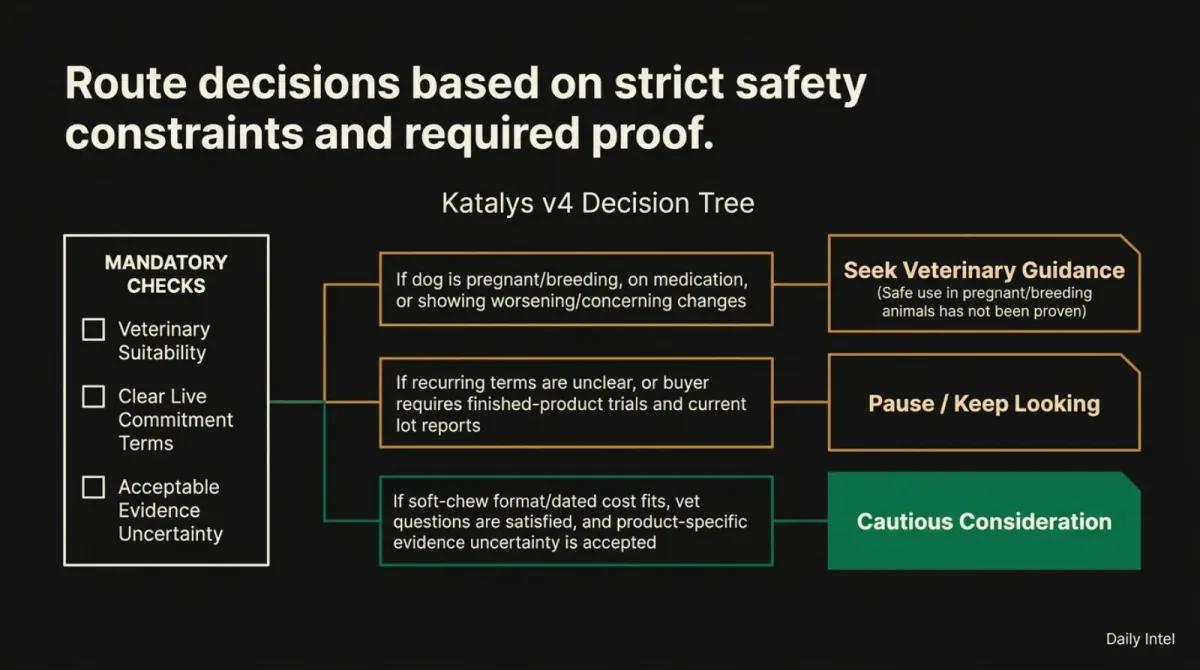
Reviewed Daily Intel teaching slide 3 of 3.
A cautious consideration may be reasonable when:
- The owner specifically wants a soft-chew format.
- The dated per-day arithmetic fits the budget at the dog's weight.
- The live checkout clearly shows an acceptable one-time or recurring commitment.
- A veterinarian has addressed relevant medication, diet, pregnancy, breeding, or health questions.
- The owner accepts that the packet contains no finished-product efficacy trial.
Pause or keep looking when:
- The desired standard is controlled research on the exact marketed chew.
- A complete quantitative formula or current lot report is required before purchase.
- The recurring charge or cancellation process remains unclear.
- The dog is pregnant, intended for breeding, taking medication, or experiencing concerning changes that need professional assessment.
- Testimonials or ingredient-level research are being presented as if they guarantee an individual outcome.
How the closest alternatives change the verdict
The relevant alternatives are decision paths, not unsupported product endorsements.
| Decision path | When it becomes the better choice |
|---|---|
| Veterinary assessment before buying | Symptoms are new, worsening, unexplained, or accompanied by medication and suitability questions |
| Keep looking for a product with finished-product research | Direct evidence on the exact formula is a non-negotiable purchase criterion |
| Compare products with quantitative labels and current lot reports | Formula transparency and batch verification matter more than chew format or seller reviews |
| Discuss a studied therapeutic-diet approach with a veterinarian | The dog's situation resembles the population in the diet study and professional guidance supports considering that category |
| Consider the Happy Paws offer cautiously | Format, dated cost, commitment, and veterinary suitability all fit, and the evidence gap is understood rather than ignored |
The diet study does not make a particular diet appropriate for an individual dog. It simply illustrates what closer evidence can look like: a defined intervention, population, comparison, duration, and outcome.
The original Daily Intel VSL strategy we would test
This is an original strategy for a Daily Intel acquisition or review VSL. It is not an account of advertising Happy Paws has run, and it makes no prediction about sales, conversion rate, or campaign performance.
The structure-only source is an adjacent-condition private transcript for FreedomJointDrops, a different joint-product offer—not Cognitive Dog Chews. It is used only for structural comparison. At 194.78–225.02 seconds, it moves from causal-question framing through criticism of alternatives to an instruction to keep watching. At 1582.56–1600.2 seconds, it connects product components in an offer narrative. These observations describe sequence only; they do not establish the transcript's claims, mechanism, testimonials, pricing, guarantee, or outcomes, and none are transferred to Cognitive Dog Chews.
For Cognitive Dog Chews, the structure should be rebuilt around transparent decisions:
- Hook: Open with the unresolved purchase risk: the page shows a clear format and price, but not finished-product outcome evidence.
- Lead: Identify the exact Happy Paws product and explain that the review will test offer facts, proof, safety boundaries, and commitment separately.
- Mechanism frame: Show the claim-to-proof ladder. Do not invent a hidden cause or imply that vitamins, taurine, or antioxidants validate the complete formula.
- Evidence story: Walk through a labeled hypothetical buyer decision rather than a fabricated customer transformation.
- Proof: Start with the official format, directions, price, terms, and cautions; then show why the two independent studies do not transfer to this product.
- Objections: Address veterinary fit, missing finished-product evidence, price by dog size, recurring billing, and refund restrictions.
- Offer: Present the dated offer without fake urgency, an unverified discount, or a promise that the refund policy removes all risk.
- Call to action (CTA): Invite only readers whose criteria are satisfied to inspect the live offer and verify checkout terms.
Original worked VSL passage
Happy Paws presents Cognitive Dog Chews as a daily soft-chew supplement and gives directions based on a dog's weight. Those details let you estimate how long a pack may last. They do not tell you whether the finished chew will change memory, behavior, focus, or stress for your dog. Before choosing the offer, check three separate questions: whether your veterinarian considers the product suitable, whether the live recurring terms fit your budget, and whether you are comfortable buying without a clinical study of the exact formula.
For a copywriter, this passage establishes a usable tension without manufacturing fear. For an ad researcher, it supplies three concrete proof queues: suitability, commitment, and finished-product evidence. For a media buyer, the legitimate test hypothesis is whether clearer cost-and-terms explanation improves qualified understanding—not whether the product produces a health outcome or whether the copy is a guaranteed performance improvement.
What would change this review
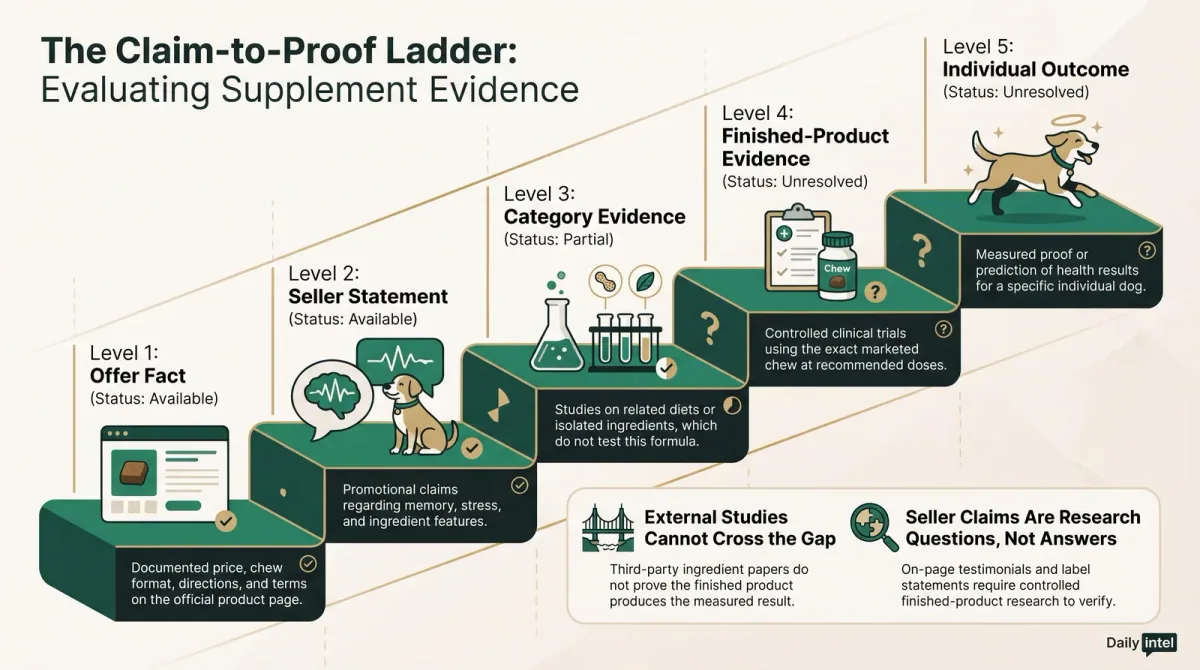
Reviewed Daily Intel infographic separating documented facts, claims, evidence and unresolved questions.
The verdict should be updated if Happy Paws supplies controlled finished-product research matched to the marketed formula, dose, and intended canine population. A current quantitative formula, lot-specific laboratory documentation, fuller adverse-event and interaction information, and unambiguous checkout and cancellation terms would also reduce important uncertainty.
Until then, the evidence supports a narrow conclusion: Happy Paws has documented an identifiable 100-soft-chew offer with weight-based directions, a dated price, commercial terms, and meaningful label cautions. It has not supplied evidence in this packet that proves the exact product improves cognition, memory, focus, stress, or behavior.
Sources and evidence notes
- Happy Paws product page: establishes the captured identity, format, displayed price, directions, promotional claims, recurring-purchase language, and label cautions. It is not independent efficacy evidence.
- Happy Paws return policy: establishes the captured return window, refund conditions, and shipping-charge condition. It should be rechecked because transaction terms can change.
- Happy Paws shipping policy: provides captured processing and delivery information while expressly treating delivery times as estimates.
- Randomized therapeutic-diet study: demonstrates a controlled design in dogs with signs of cognitive dysfunction, but tests different diets rather than the reviewed chew.
- Ten-dog open-label supplement study: examines a different product in a small preliminary design and cannot establish Happy Paws product efficacy.
Related Daily Intel research
- Probiotic Dog Chews: Gastrointestinal Support review: Proof Gaps — A separate named Happy Paws formula review that applies the same evidence-checking method. Its ingredients and conclusions do not transfer to this product.
- Happy Paws Skin & Coat Dog Chews Review: Facts, Terms, Safety Limits, and Proof Gaps — A separate named Happy Paws formula review that applies the same evidence-checking method. Its ingredients and conclusions do not transfer to this product.
- Hip & Joint Dog Chews Review: What the Happy Paws Offer Shows—and What It Does Not Prove — A separate named Happy Paws formula review that applies the same evidence-checking method. Its ingredients and conclusions do not transfer to this product.
Download the teaching materials
Download the reviewed teaching slides (PDF). The file contains 3 pages and searchable English text.
Comments(0)
No comments yet. Members, start the conversation below.
Related reads
 reviews
Probiotic Dog Chews: Gastrointestinal Support review: Proof Gaps
Happy Paws provides a 100-chew count, weight-based directions, commercial terms, and material safety cautions. The unresolved issue is finished-product evidence: the packet contains no complete formula, product-specific clinical trial, batch report, or complete subscription and guarantee terms.
Read reviews
Finasteride 1mg Review: HealthRX’s $67 Plan and the Study Mismatch
HealthRX presents Finasteride 1mg as a once-daily prescription option supplied through an online provider review and pharmacy-fulfillment service. The commercial path is documented more clearly than the medical evidence for the exact dispensed product. The packet does not contain its full label, manufacturer, complete safety information, or a finished-product clinical trial.
Read reviews
Oral Minoxidil Tablets review: Convenience Does Not Close the Gap
Strut Health offers clinician-screened oral minoxidil for hair loss, but the supplied study did not test the exact Strut product. The prescribed dose, customer price, recurring terms, and parts of the safety framework also remain unresolved.
Read